Five Generations
Contents
- Introduction
- Five Generations – Chapter I
- Five Generations – Chapter II
- Five Generations – Chapter III
- Five Generations – Chapter IV
- Five Generations – Chapter V
- Five Generations – Chapter VI
- Five Generations – Conclusion
- Five Generations – Appendix I
- Five Generations – Appendix II
- Five Generations – Appendix III
- Five Generations – Appendix IV
- Five Generations – Appendix V
- Five Generations – Appendix VI
- Five Generations – Appendix VII
- Five Generations – Appendix VIII
- Five Generations – Appendix IX
- Five Generations – Appendix X
- Five Generations – Appendix XI
- Five Generations – Appendix XII
- Five Generations – Appendix XIII
- Five Generations – Appendix XIV
Introduction
This history of our family is the result of many years of searching.
It draws on documents found in archives, parish registers, official and notarial records, school and university papers, letters, photographs, and the memories passed down through generations of our family.
Not everything could be explained. In some places, the documents allow us to say with certainty what happened. In others, we have only clues.
There are also family stories whose truth I cannot prove today, but which I do not wish to dismiss simply because no document has survived to confirm them.
This history spans several centuries and tells the story of two families: the Frischmans and the Baranieckis.
These two families came together in 1867 through the marriage of my great-grandparents, August Frischman and Wanda Salomea Baraniecka.
I shall tell you, then, about the origins of these two families and their lives over nearly two hundred years.
About the Baranieckis and the Frischmans who lived and worked, who knew success and failure, joy and sorrow.
This is a story about us!
About our family!
Five Generations – Chapter I
Frischman or Frischmann?
Even the spelling of the surname can cause some confusion.
In the documents, we find both Frischman and Frischmann, and sometimes de Frischmann as well.
There is nothing unusual about this.
In the eighteenth and nineteenth centuries, the spelling of surnames was not as settled as it is today. The same person could appear in different documents with a slightly different spelling of their name.
I use Frischman as the basic form, because that is how Georg’s surname was written in the document of 1727, where the documented history of our family begins.
This does not mean that the other forms are wrong.
Adolf, the brother of my great-grandfather August, used the spelling de Frischmann.
The double “n” also appears in later family documents.
Throughout this history, therefore, I retain the spelling used in the particular document.
Georg Frischman and the Year 1727
The National Archives of Hungary holds a remarkable collection known as the Libri Regii — the Royal Books.
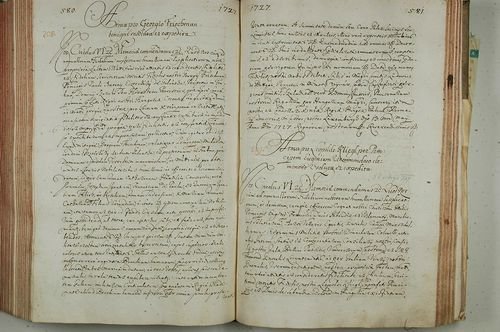
The entry recording the grant of nobility to Georg Frischman in the Libri Regii.
These volumes contain copies of important documents issued in the monarch’s name. The collection includes tens of thousands of entries, among them grants of nobility and coats of arms. According to the National Archives of Hungary, its 73 volumes contain some 38,000 entries and almost three thousand colour illustrations of coats of arms.
And it is there that we find the document concerning Georg Frischman, confirming his ennoblement.
It was issued by Emperor Charles VI at Laxenburg on 3 May 1727.
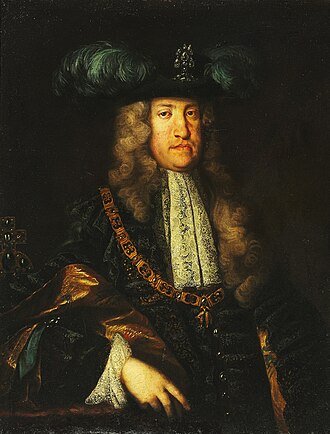
Charles VI of the House of Habsburg.
This is the earliest document known to me from which the story of the Frischmans can begin.
Georg served as estate administrator to Prince Paul Anton Esterházy of Galanta. The document speaks of his faithful service, but, of particular importance to us, it also names members of his family: his wife, Katharina Händlein, and his children.
The original document is reproduced in Appendix XIV.
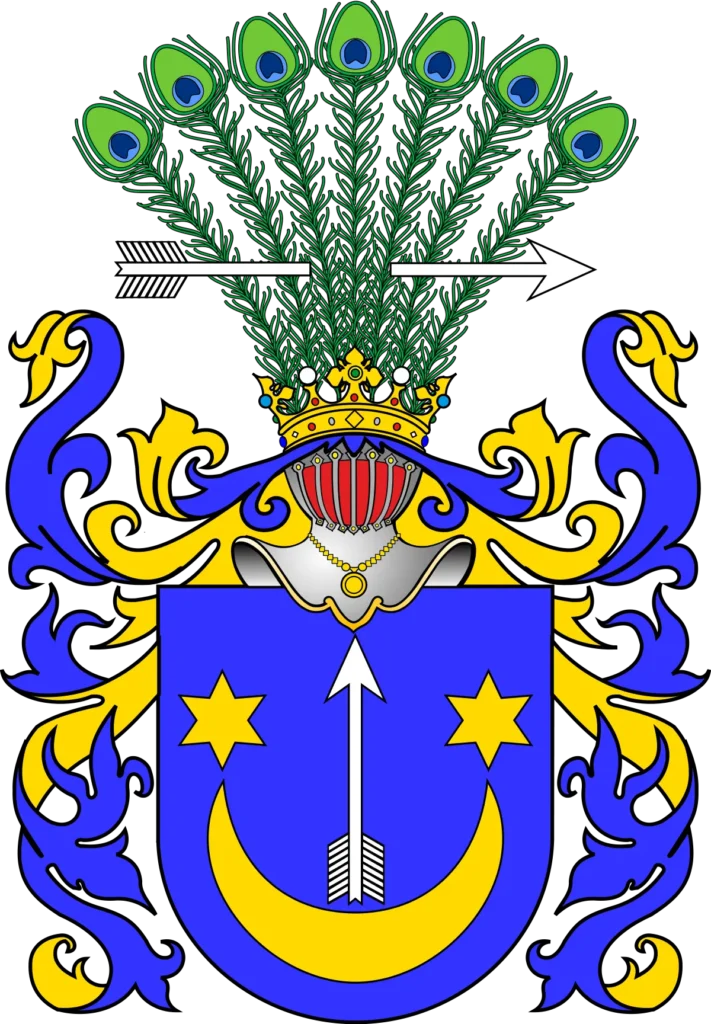
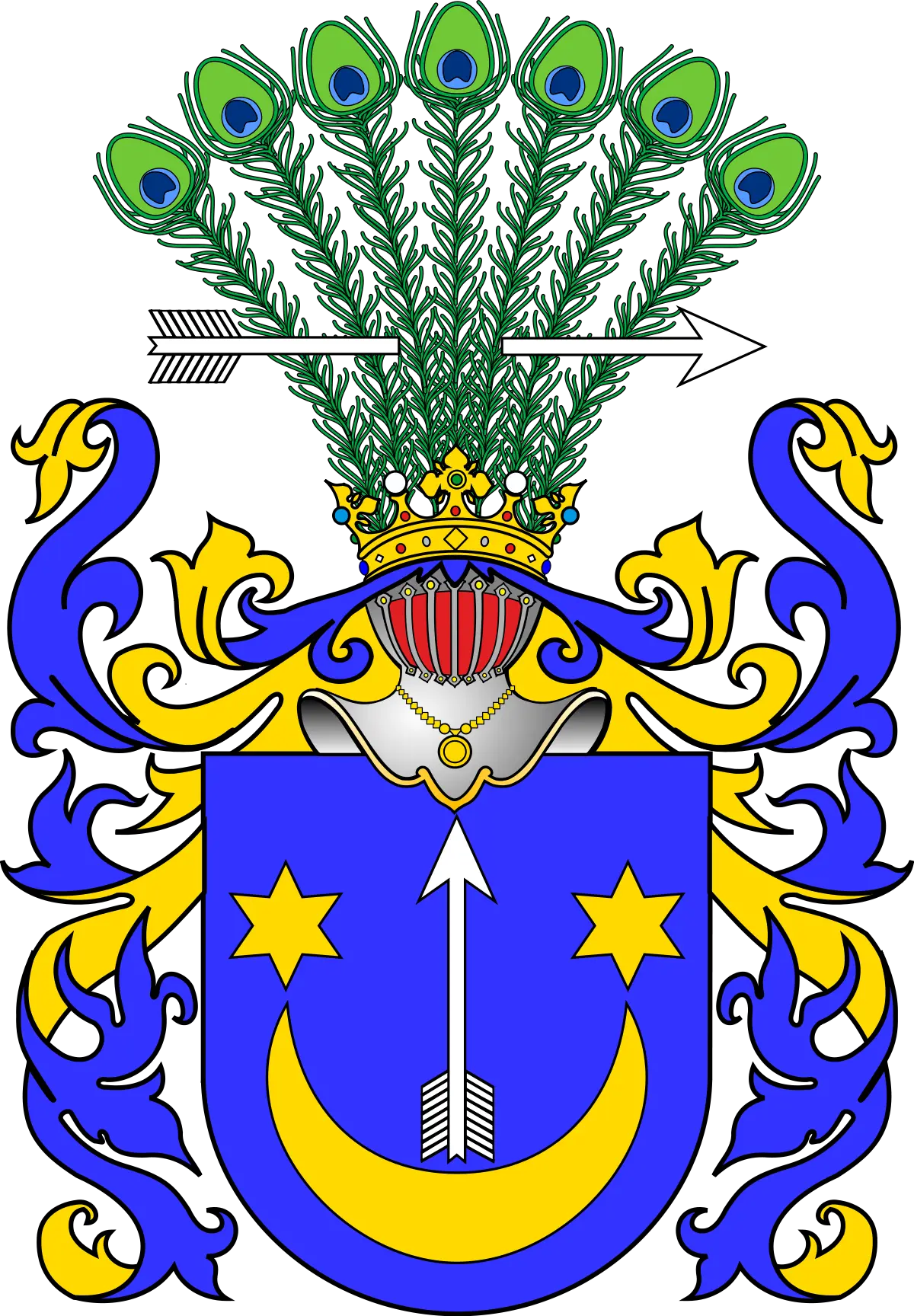
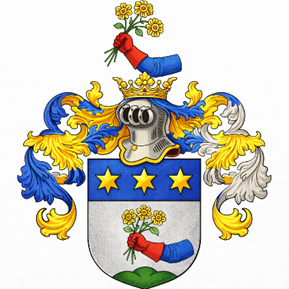
The same coat of arms later appears on the visiting card of Adolf de Frischmann, who lived in Romania in the nineteenth century.
Everything points to this being the same family, although several links in the genealogical chain are still missing.
The First Generation — Johann and Zofia Frischman
Johann Frischman was born around 1755 and died on 5 February 1840 in Stryj.
He belonged to the group of German settlers who established themselves in Bukovina between 1782 and 1787 under the so-called Josephine Patent, issued on 17 September 1781 by Emperor Joseph II of the House of Habsburg.
Among other things, this decree provided for the settlement of underdeveloped areas of the monarchy.
The movement became known as “Josephine colonisation”, and those who took part in it as “Josephine Germans”.
Although neighbouring Galicia was the main destination, the settlement programme also extended to Bukovina, which had recently become part of the Habsburg Empire.
Johann Frischman became a customs controller and auditor at the Imperial and Royal Auxiliary Customs Office in Zurin, near Czerniowce — the k.k. Hilfs-Zollamt zu Zurin.
An official in this position checked and signed the customs ledgers kept by the collector.
He was married to Zofia, whose maiden name I do not know.
By the time of his death, he was already a widower.
His death record states that he was conscious before he died and had received the holy sacraments.
He was buried the very next day, on 6 February. The funeral was conducted by the parish administrator, Father Jan Zawadzki.
Johann died of dropsy, which may have been caused by heart failure.
He was 85 years old. He spent his retirement in Stryj, in Ukraine.
It seems possible that he moved there from Bukovina to live with his daughter Anastazja, who was married to Bazyli Lewicki.
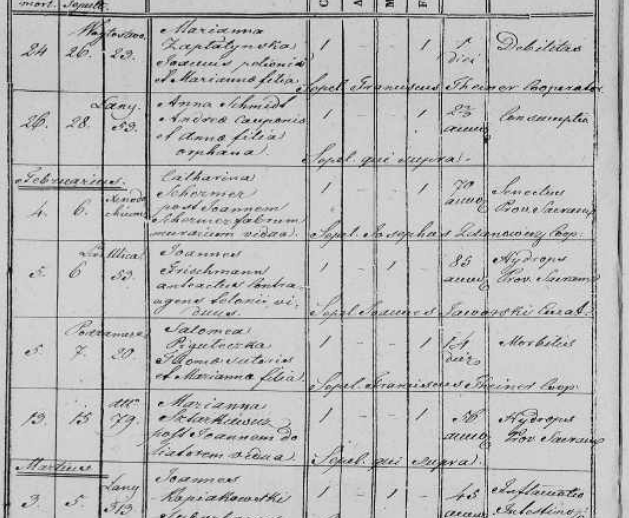
Death record of Johann Frischmann.
The Second Generation — The Children of Johann and Zofia
Johann and Zofia had three children:
- Franz, born in 1797.
- Antoni, born in 1799, died in 1851.
- Anastazja, born in 1798 (?).
1. Franz
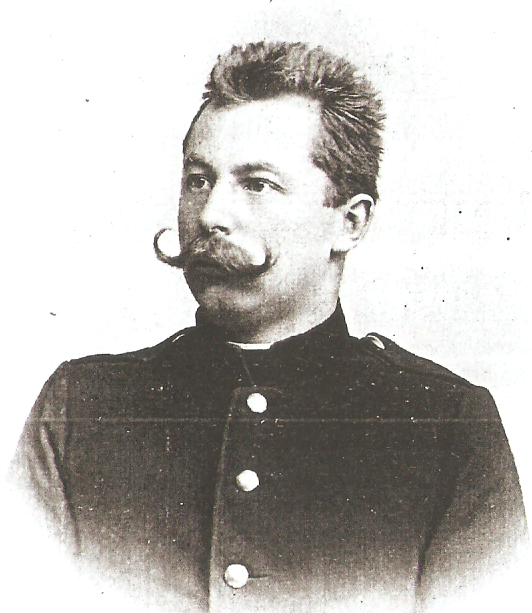
Franz Frischman
Franz was born in 1797 in Zurin, in Bukovina, near Czerniowce. The place where his father worked.
In August 1990, I wrote to the archives in Vienna asking for information about Franz Frischman.
Franz Frischmann.
Here is the reply I received:
Letter from the archives in Vienna concerning Franz Frischman.
In response to your enquiry dated 3 August 1990, the Directorate of the Austrian Court Treasury Archives informs you that, according to Court records Nos. 2512 and 77 of May 1834, your ancestor [Franz Frischman] was born in 1797 in Zurin, Bukovina.
After completing his grammar school education, he began training for a career in public administration. On 23 July 1818, he was employed as a clerical trainee at the district office in Zaleszczyki. On 19 March 1830, he was promoted to the position of subordinate commissioner for taxes on foodstuffs at the Property Inspectorate in Zaleszczyki.
He spoke German, Polish, Ruthenian [Ukrainian?] and Romanian. Reports described him as a very diligent employee whose moral conduct was beyond reproach.
In 1834, he applied for the position of head of the post office in Czerniowce, without success.
In 1840, he was proposed for promotion to the position of deputy inspector, but the higher authorities blocked the appointment. He was alleged to have committed numerous “irregularities” and to have “acted on the criminal suggestions of his wife”, and was therefore considered unsuitable for the post.
The following year, he was removed from his position and legal proceedings were brought against him. As the father of six minor children, he received a state allowance while the matter was being investigated.
The principal accusation was that, in his capacity as a revenue official, he had collected insufficient taxes from distilleries.
His employment was probably terminated during these proceedings. According to the record, he sought reinstatement in May 1842, apparently without success, since the subsequent files contain no further mention of him.
Unfortunately, we have been unable to find any additional information about him in the remaining records.
Directorate of the Treasury and Court Chamber Archives
[Illegible signature]
This document is as fascinating as it is puzzling.
Who was this man who had spent more than twenty years building a career in the imperial administration, spoke four languages, was regarded as diligent and honest, and was then suddenly dismissed from the service?
And what exactly did it mean that he had “acted on the criminal suggestions of his wife”?
For now, these questions remain unanswered.
His wife was Marcjanna Fuchs.
They married in Zaleszczyki on 23 September 1824.
Marcjanna was born on 22 November 1808.
Her father was Bernard Fuchs, a surgeon, born on 14 March 1780. Her mother, Rozalia, was born on 1 November 1786.
The matter needs a little more explanation.
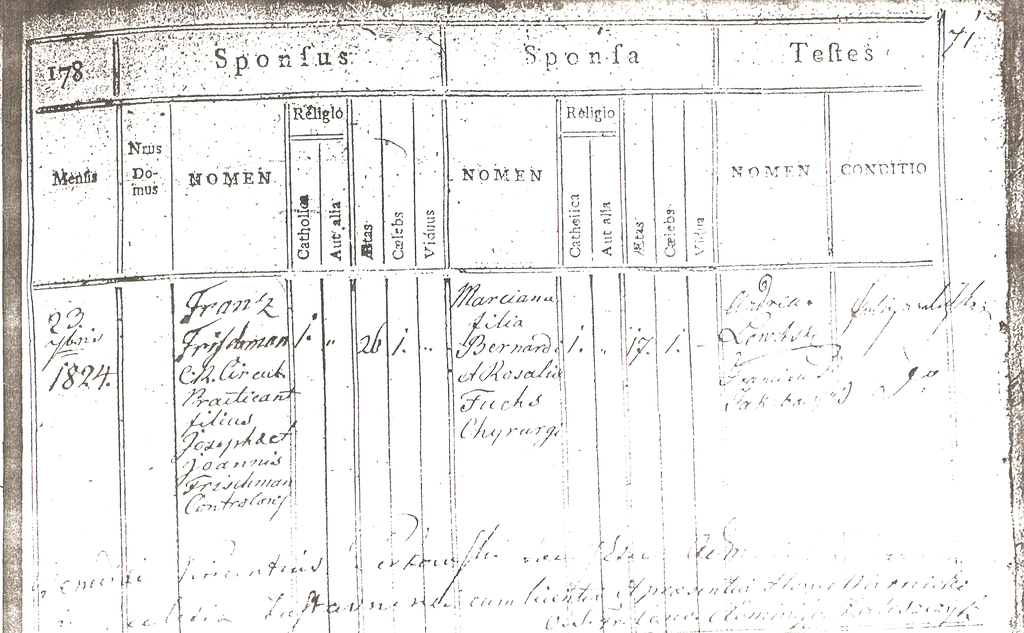
Marriage record of Franz and Marcjanna Fuchs
As I have mentioned, Franz was accused of collecting insufficient taxes from distilleries.
This concerned the right of propination.
Today, the term “right of propination” means little to most people, but in nineteenth-century Galicia it was a matter of considerable importance.
It covered the production and sale of alcohol, and the charges associated with it were a significant source of revenue.
Between 1830 and 1840, there were 4,981 distilleries operating in Galicia, with production exceeding 600,000 hectolitres when measured as pure alcohol.
Franz was therefore responsible for far more than some trivial administrative fee. He oversaw state revenue from an activity of great economic importance.
The accusation that he had collected insufficient taxes from the distilleries was a serious one.
Yet a much more personal question remains:
It seems highly likely that, as a result of these events, Franz and his daughter Leontyna Anna moved to Janów Gródecki.
It was there that Leontyna died in 1852. She was only twenty, and the cause of death was consumption, as was so often the case in those days.
What became of Marcjanna, Franz’s wife, is unknown.
Did she remain in Zaleszczyki? Did she even remain Franz’s wife? I have no answers to these questions.
The date and place of Franz’s death also remain unknown.
It is possible that he died in Janów Gródecki.
2. Antoni
Antoni, Franz’s brother, is not our direct ancestor. Still, I do not wish to leave out his story, for whatever else one may say, it is part of the history of the Frischmans.
All the more so because it involves an almost unbelievable incident, which I describe in Appendix II.
He was born in 1799 and died on 11 November 1851 in Lwów. He was married to Magdalena Scheller, or “Selley” in the Hungarian spelling, the daughter of Józef.
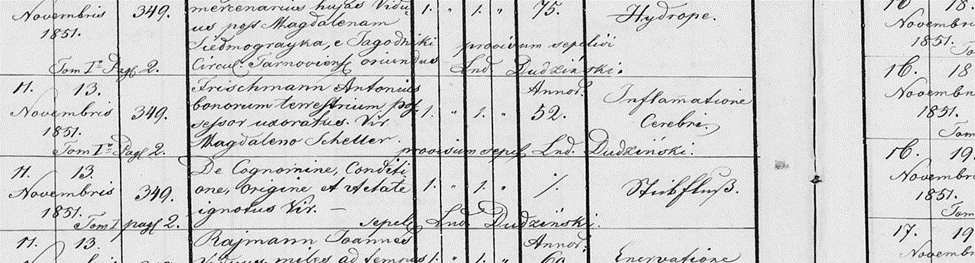
Death record of Antoni Frischmann.
They had two children.
The first was Juliusz de Frischmann, born on 18 August 1818 in Zaleszczyki. Juliusz married Alojza Guznar.
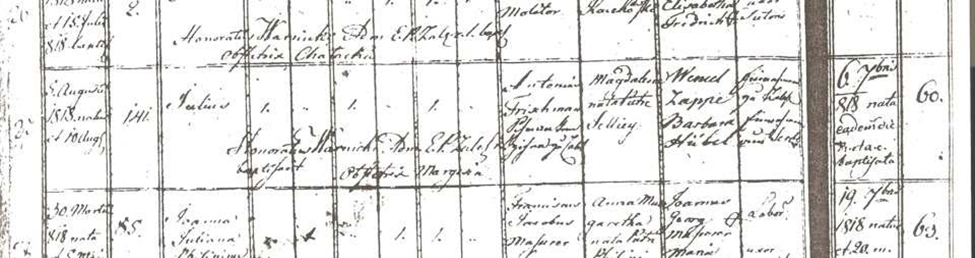
Birth record of Juliusz de Frischmann.
Their children were:
- Juliusz Honoracy Antoni de Frischmann, born on 25 May 1858 in Sibu, Romania;
- Adolf Alexander Karol Frischmann, born on 1 November in Sibu, Romania;
- Maria Alojza de Frischmann, born on 29 December 1866 in Alba Julia, Alba, Romania.
The second child of Antoni and Magdalena was Antonina Emilia Frischmann, born on 30 October 1819 in Zaleszczyki.
Her husband was Maksymilian Nowicki, the son of Józef and Józefa, née Pociechańska. They married on 15 November 1840 in Śniatyn.
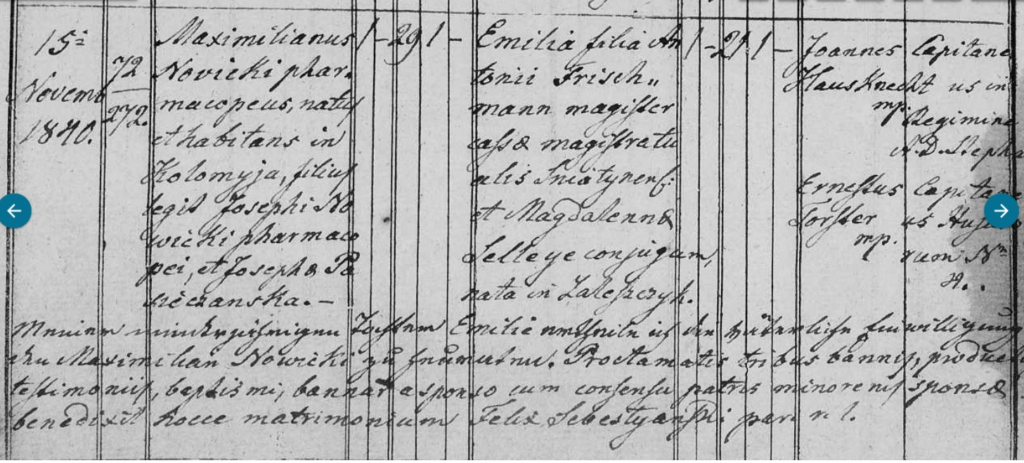
Marriage record of Emilia Frischmann and Maksymilian Nowicki.
Interestingly, both Maksymilian and his father Józef were pharmacists.
This profession keeps appearing throughout the various branches of the Frischmann family.
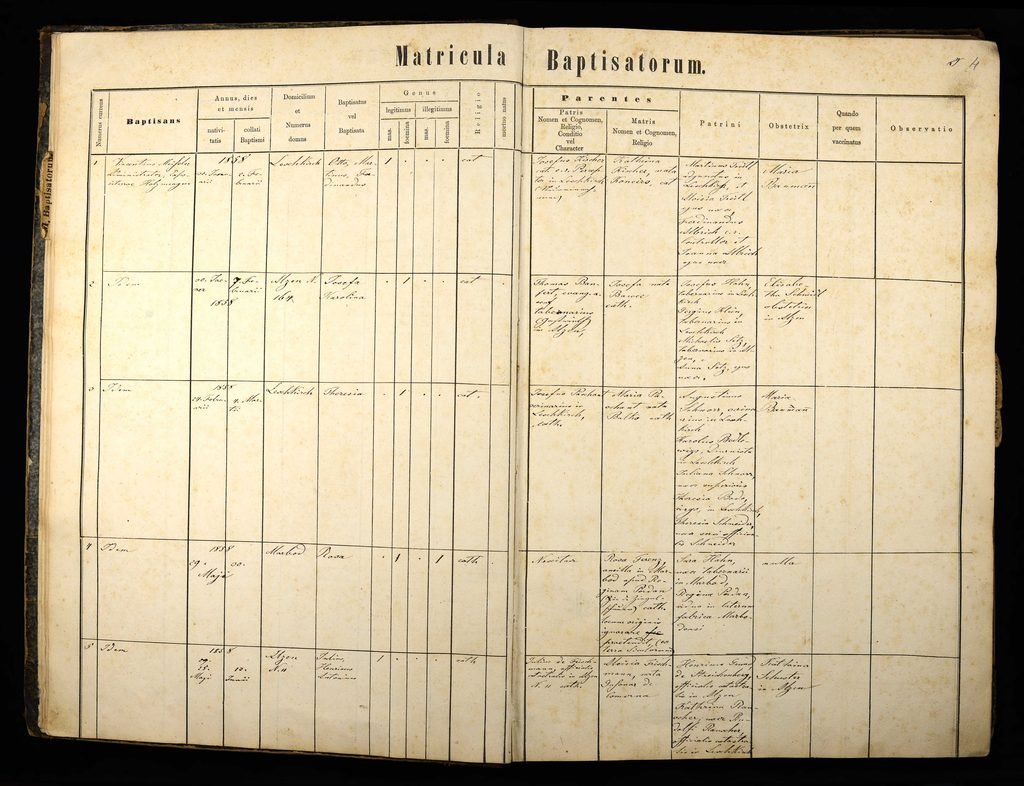
Birth record of Juliusz Honoracy Antoni de Frischmann.
3. Anastazja
The third child of Johann and Zofia was Anastazja Frischman, born around 1798, who later married Bazyli Lewicki.
She was the mother of twins, Herman Leon and Albert Rudolf, born on 7 April 1838 in Stryj. Albert died on 12 September 1839.
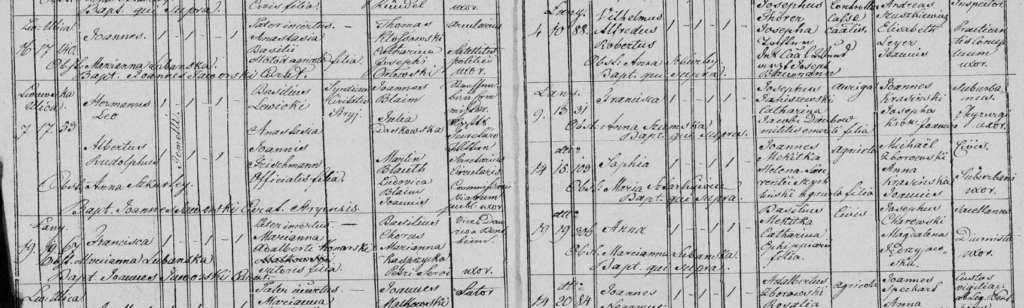
Birth record of twins Herman Leon and Albert Rudolf, sons of Anastazja Frischmann Lewicka.
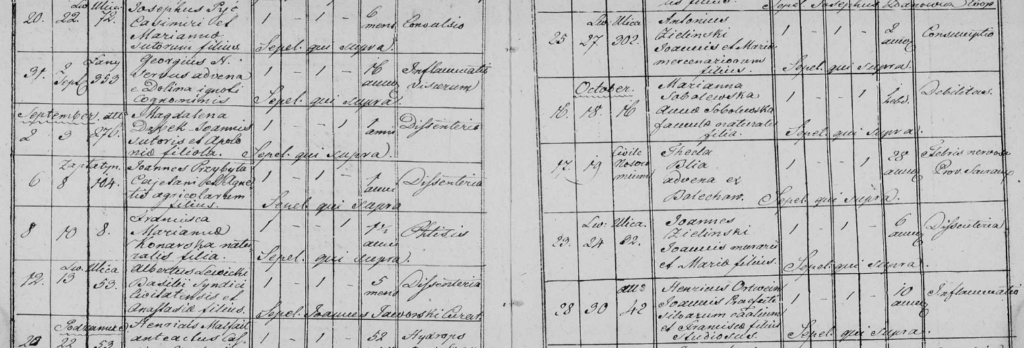
Death record of Albert Lewicki, son of Bazyli and Anastazja.
The Third Generation — The Children of Franz Frischman and Marcjanna Fuchs
Marcjanna — the same woman who later reported to the authorities that her husband was collecting insufficient taxes from distilleries — was not quite sixteen when she married, although the parish priest recorded her age as seventeen.
Marriage record of Franz Frischman and Marcjanna Fuchs.
Franz was twenty-seven, eleven years older than his very young wife.
They had six children:
- Emilia, born on 9 April 1825.
- August Jan, born on 11 November 1826 in Zaleszczyki, died on 2 November 1880 in Dynów.
- Adolf, born on 19 May 1828 in Zaleszczyki.
- Leontyna Anna, born on 29 November 1832, died on 17 February 1852 in Janów Gródecki, in the Lwów district.
- Paulina Antonina Waleriana, born on 27 November 1833 in Zaleszczyki, died on 12 August 1921 in Żywiec, then known as Saybusch, in the parish of the Nativity of the Blessed Virgin Mary.
- Marianna Józefa, born on 1 December 1835 in Gorlice.
A few words about each of Franz and Marcjanna’s children.
1. Emilia
She was born six months after the wedding, which may explain why her mother married so young. As I have mentioned, Marcjanna had not yet turned sixteen.
Beyond that, no information about Emilia has come to light so far.
2. August Jan
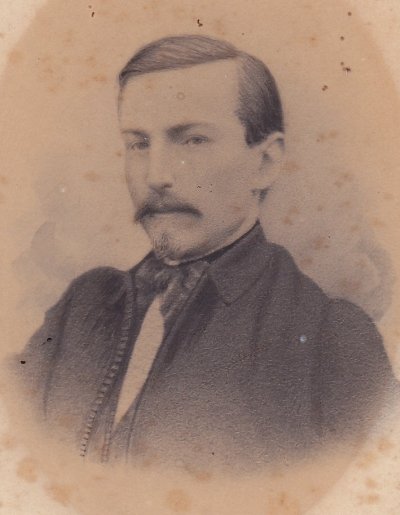
August Frischman
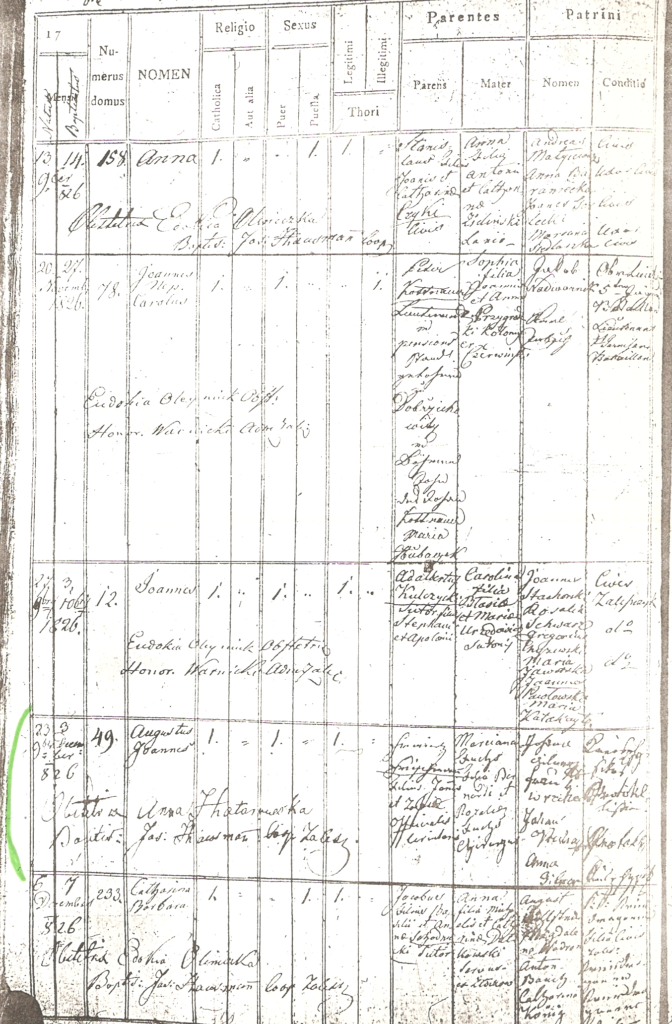
Birth record of August Frischman
Pharmacy studies at the Jagiellonian University in 1853.
An extract from the university’s student register has survived:
August Frischman
Place of birth: Zaleszczyki, Galicia
Religion: Roman Catholic
Nationality: German
Citizenship: Austrian
Father: Franz, a financial commissioner residing in Janów Gródecki, near Lwów.
Previous schooling: grammar school in Buczacz.
At the Jagiellonian University, August studied in the Faculty of Philosophy, which at that time also provided the training of pharmacists.
He attended during the academic years 1853–1854 and 1854–1855, and on 20 March 1858 was awarded the degree of Master of Pharmacy.
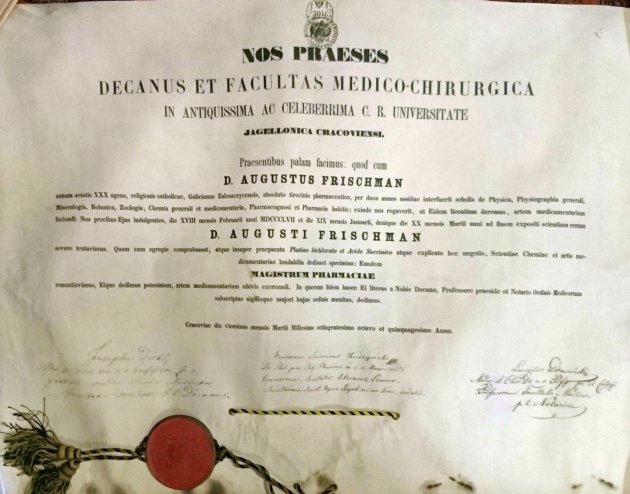
August Frischman’s university diploma.
Very shortly after obtaining his degree, he went to Dubiecko, a dozen or so kilometres from Dynów.
This may have been his first position as a pharmacy manager.
3. Adolf de Frischmann
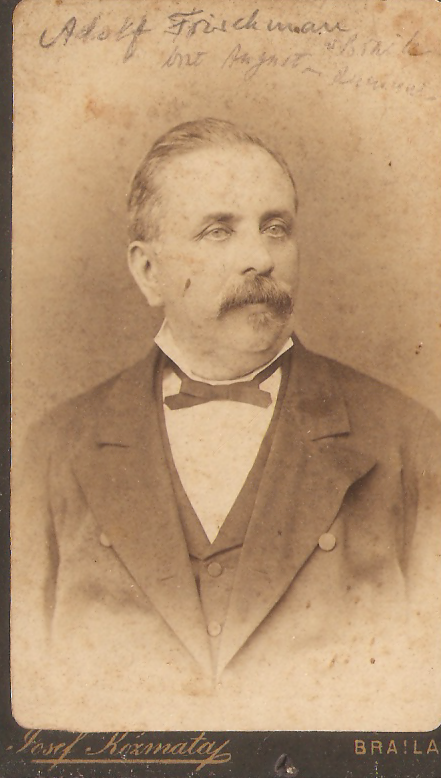
Adolphe de Frischmann.
Adolf was born on 19 May 1828 in Zaleszczyki.
He used the surname with the prefix “de”, the so-called nobiliary particle.
His sister Paulina and some of the Frischmanns from Antoni’s branch of the family signed their names in the same way.
They all bore the Frischman coat of arms, granted to Georg Frischman by Charles VI in 1727, as described earlier.
Like his brother August, Adolf chose the pharmacist’s profession. He studied pharmacy, however, at the University of Munich rather than in Kraków.
After receiving his diploma, he left for Romania and settled in Brăila.
There, he initially leased the “Minerva” pharmacy, which he bought from the Scharmelly family in 1880.
The historic “Minerva” pharmacy occupied the beautiful Bolehover House, on the corner of Strada Regala and Strada Golesti.
Adolf de Frischmann was its second owner, after Rudolf Scharmelly.
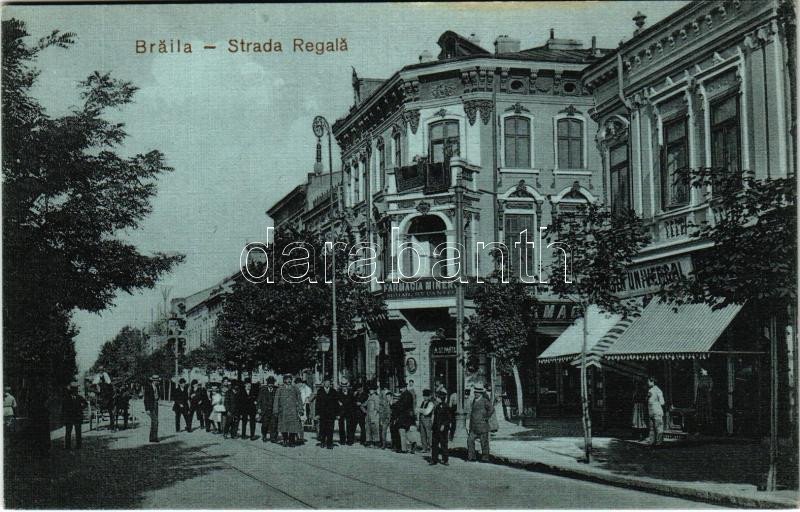
The “Minerva” pharmacy in Brăila.
There is evidence that he took part in various charitable initiatives to help people affected by misfortune.
Interestingly, his visiting card has survived, bearing the original Frischman coat of arms.
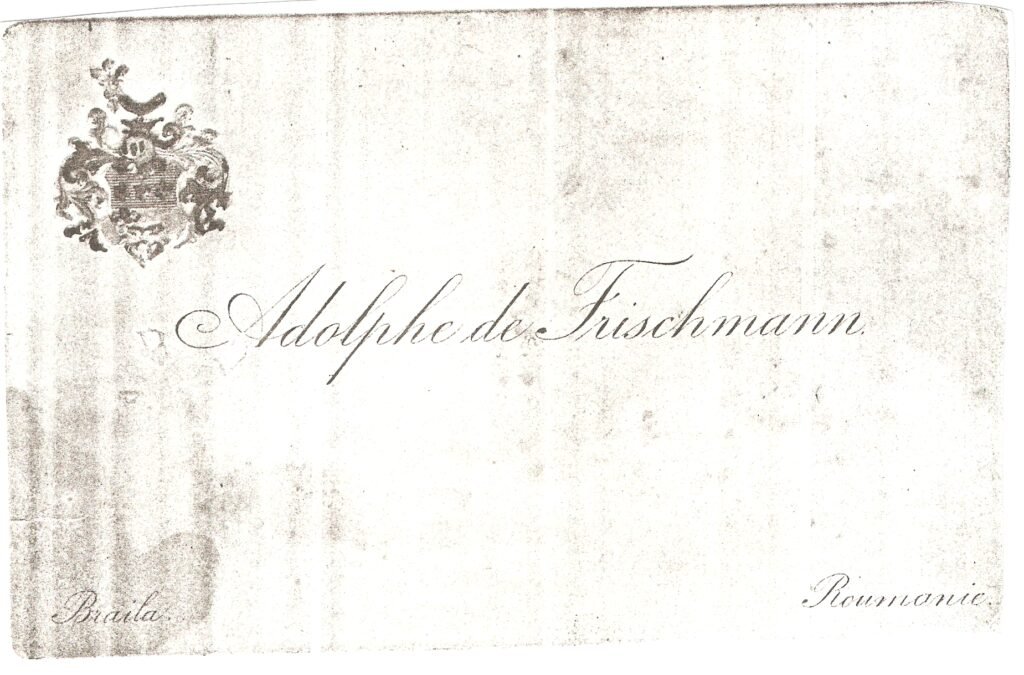
The card is evidence that Adolph knew of his noble ancestry.
4. Leontyna Anna
Born on 29 November 1832, she died of consumption on 17 February 1852 in Janów Gródecki, near Lwów.
She was not quite twenty. It seems possible that she lived there with her father, Franz, although I have no proof of this.
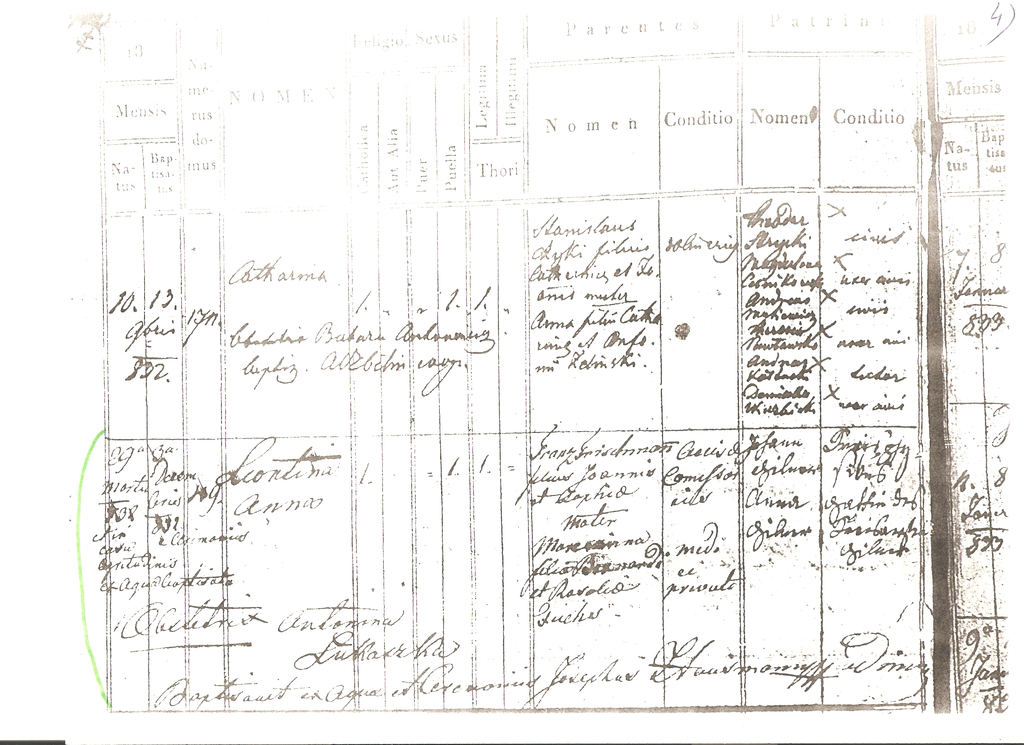
Birth record of Leontyna Anna Frischmann, daughter of Franz and Marcjanna.
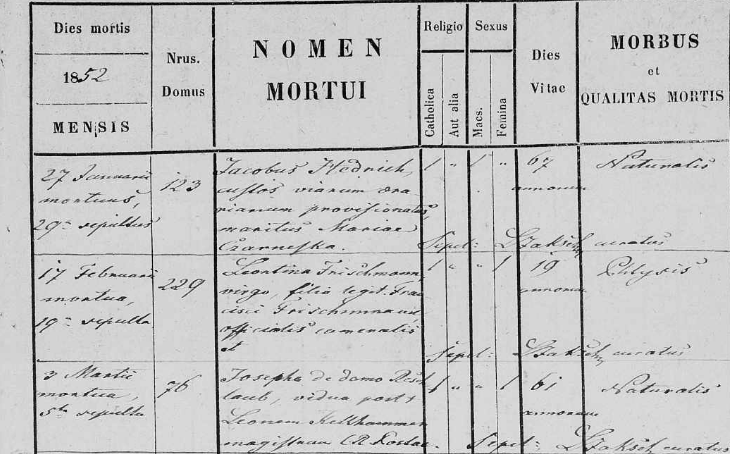
Death record of Leontyna Frischmann.
5. Paulina Antonina Waleriana de Frischmann
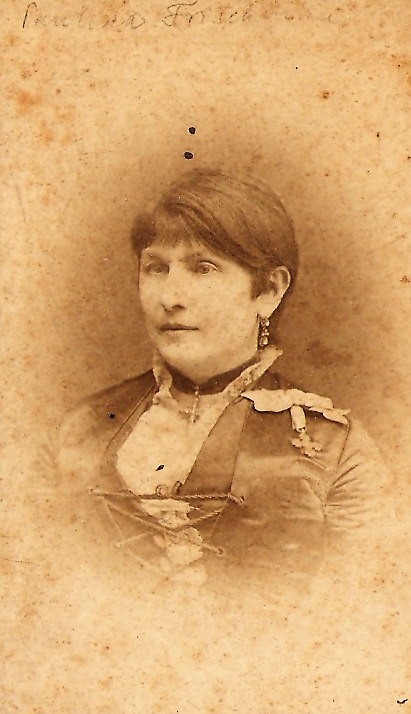
Paulina Antonia Waleriana de Frischmann
She was born on 27 November 1833 in Zaleszczyki.
During the 1860s, she too went to Brăila, as her brother Adolf had done.
In 1877, the Russo-Turkish War broke out. For Romania, it became a war of independence.
Paulina helped care for the wounded as a nurse.
For this work, she was awarded the Elisabeth Cross.
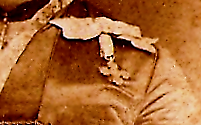
The Elisabeth Cross displayed by Paulina de Frischmann.
A description of the cross and the circumstances of its award can be found in Appendix V.
The historical background is well documented.
Queen Elisabeth was indeed deeply involved in caring for the wounded during the war of 1877–1878, and biographical sources credit her with establishing an award for women who distinguished themselves in this service.
After the war, Paulina de Frischmann became part of Queen Elisabeth’s circle.
Elisabeth, Romania’s first queen, was a remarkable woman.
She devoted herself to literature, music and charitable work. She adopted the pen name Carmen Sylva.
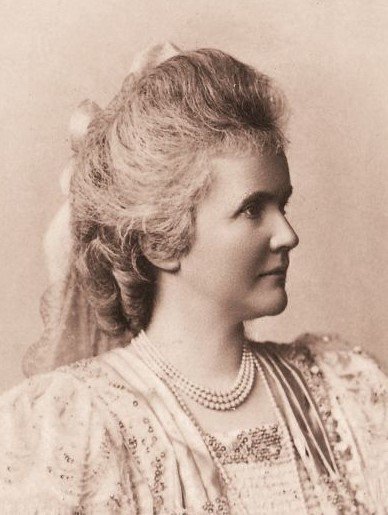
Queen Elisabeth of Romania, known by her pen name Carmen Sylva.
The queen died in 1916, and it was after her death that the final chapter of Paulina’s life began.
Paulina was already over eighty.
She left Romania and came to Żywiec, then known as Saybusch.
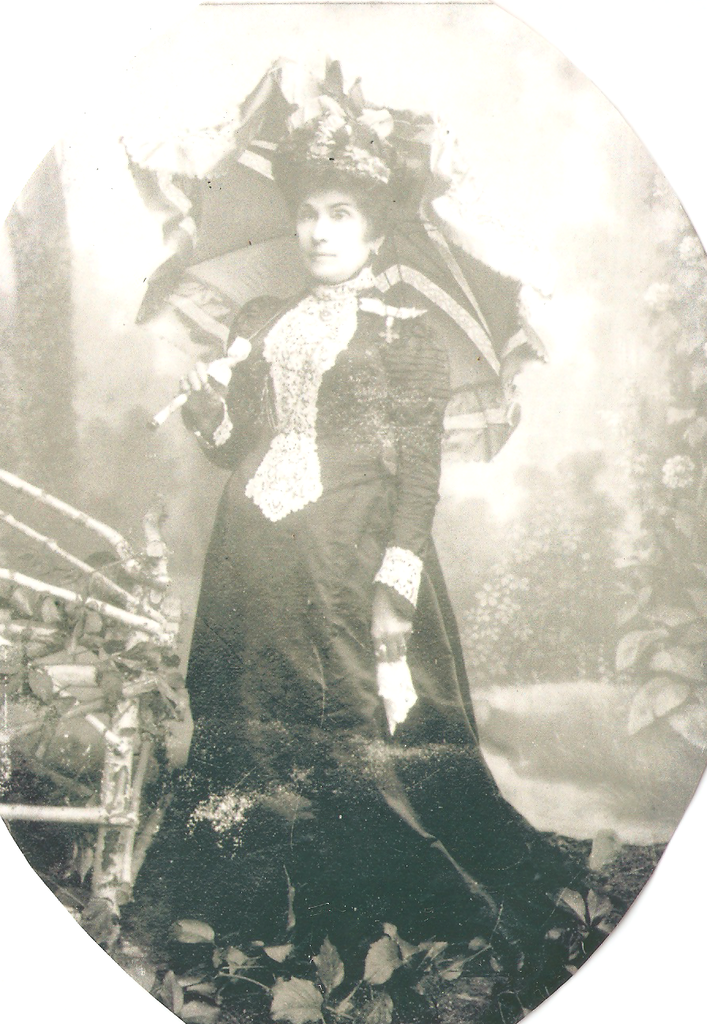
Paulina de Frischmann.
Why there, of all places?
Żywiec was home to the residence of the Żywiec branch of the Habsburg family.
Archduke Charles Stephen Habsburg, the owner of Żywiec, was married to Maria Theresa of Tuscany, a close friend of Carmen Sylva.
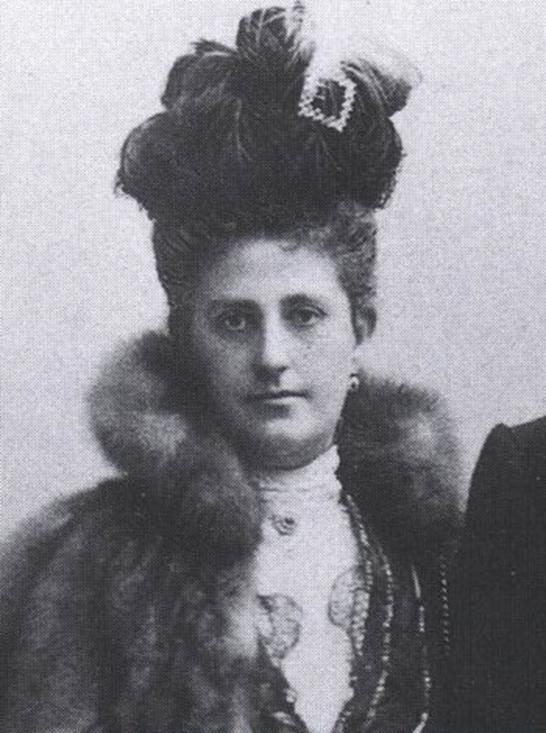
Archduchess Maria Teresa of Austria-Tuscany.
After the Romanian queen’s death, it was she who took the now solitary Paulina under her care.
Paulina died in Żywiec on 12 August 1921, aged eighty-seven, and was buried in the cemetery of the parish of the Nativity of the Blessed Virgin Mary.
I have information — not yet fully verified — that Paulina had a child out of wedlock, born in Lwów on 28 May 1862.
Paulina was twenty-eight at the time.
The child was named Anna. Nothing is known about her.
One more family story has survived.
Before leaving for Żywiec, around 1916, Paulina is said to have expressed a wish to live in Dynów. Wanda Salomea, the widow of Paulina’s brother August, reportedly objected firmly, saying that she had already had “more than enough of the Frischmans”.
There is no doubt that, after thirteen years of marriage to a husband who was far from an easy partner, she bore a grudge against his family.
6. Marianna Józefa
The youngest child of Franz and Marcjanna Frischman, Marianna Józefa, was born on 1 December 1835 in Gorlice, in Lesser Poland. She married twice.
Her first husband was Julian Lewicki of Założce, born in 1838, the son of Stefan Lewicki of Lewiczyn, of the Rogala coat of arms, and Maria Illewicz, of the Zaremba coat of arms. They married on 15 March 1880 in Lwów.
Her second husband was Kajetan Rogalski, whom she married on 11 June 1892. Both husbands were pharmacists, which in a way confirms the tradition of this profession running through the various branches of the Frischmann family.
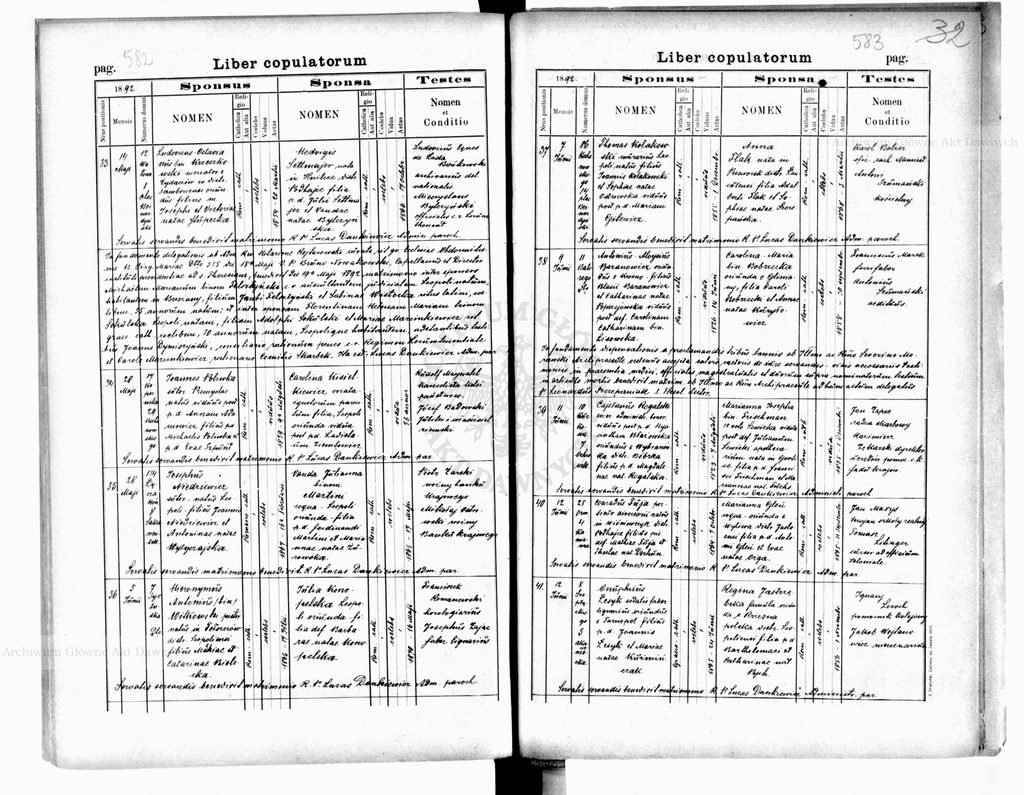
Marriage record of Marianna Józefa Frischmann and Kajetan Rogalski.
1. The Death of Feliks Baraniecki. August and Karolina
At that time, Dynów had a pharmacy called “Pod Opatrznością” — “Under Providence” — owned by Feliks Antoni Baraniecki. Besides being a pharmacist, he also owned the local horse-post station.
We know that he suffered from kidney disease.
In June 1858, he went to Karlsbad for treatment.
After a stay of nearly two months, he set off for Dynów. On the way, he stopped for a short rest in Přerov, Moravia, with his friend from university, Jakubowski, a qualified pharmacist.
There he suddenly fell ill and died unexpectedly on 1 August 1858.
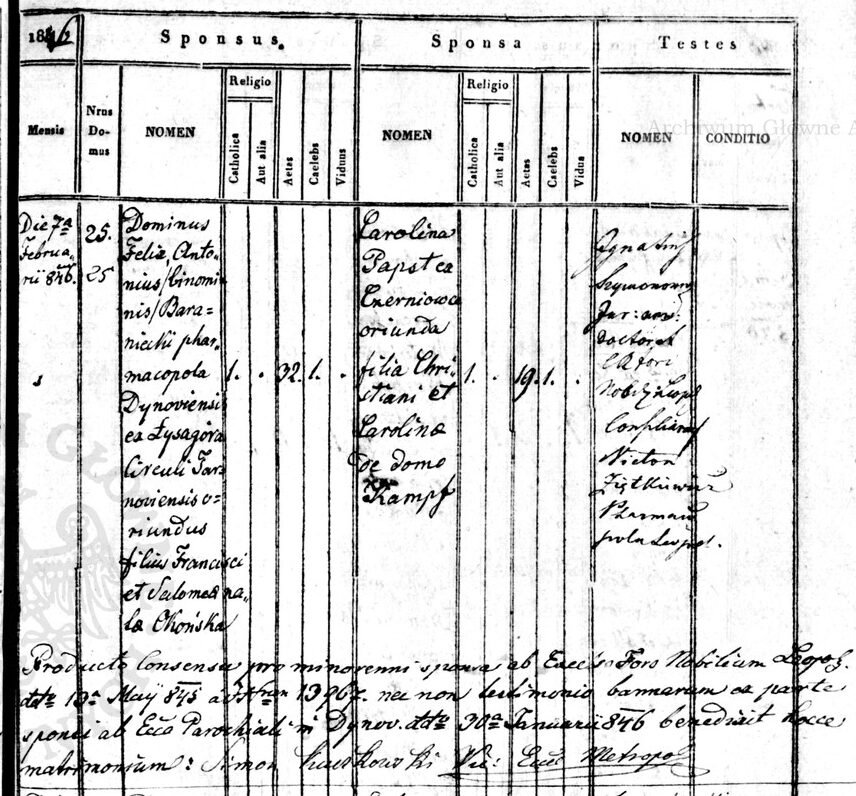
Marriage record of Feliks Baraniecki and Karolina, née Papst.
He left a young wife, Karolina, née Papst, and six children.
Karolina was only thirty-one and found herself in a very difficult position.
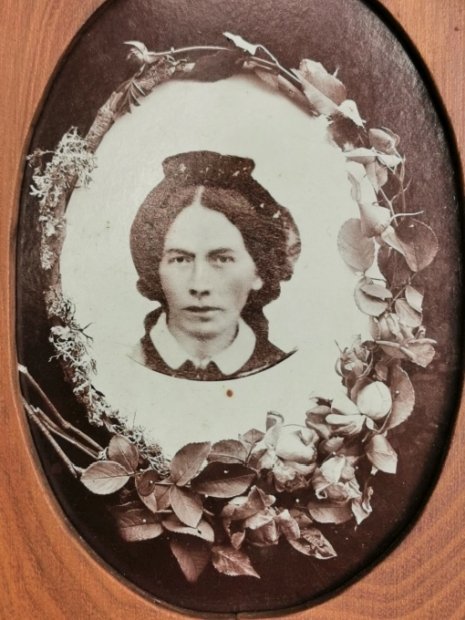
Karolina Baraniecka.
She herself had tuberculosis. Now she was left alone with the children, the house, the pharmacy, the post office, and a multitude of property and financial affairs.
The pharmacy posed a particular problem. Although Karolina, as Feliks’s heir, could hold a share in its ownership, she lacked the professional qualifications required to run it. Under the law then in force, it could not operate without a qualified pharmacist.
To keep the pharmacy going, she therefore had to employ a pharmacy manager.
I explain the training of nineteenth-century pharmacists in Appendix I.
Her search was rather desperate, but that is hardly surprising. A closed pharmacy brought in no income, and Karolina had six children.
We know this from her letters to her friend Marynia Żywicka of Bystra, near Gorlice. To her, she confided her mounting troubles and the expenses she could no longer meet.
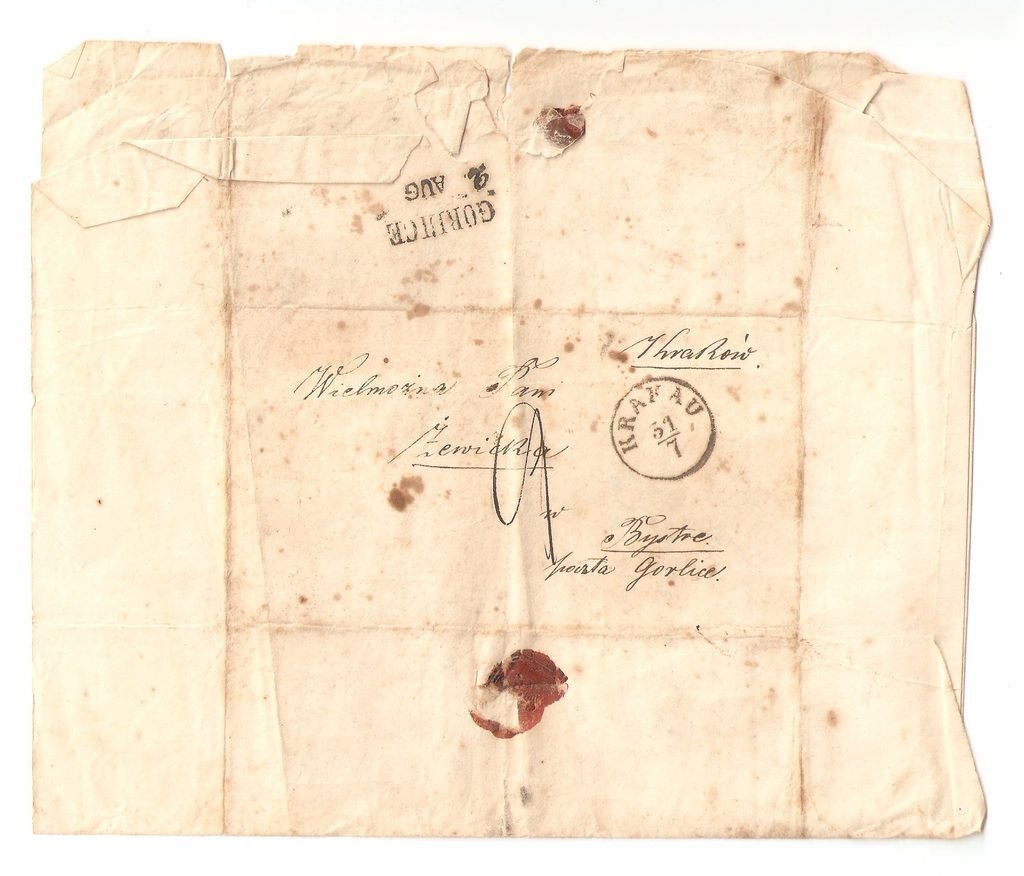
Envelope addressed to Maria Żywicka, 1859.
Karolina’s surviving letters are a remarkable source. These are no dry official records. They show a living woman, frightened by what was happening to her, trying at the same time to keep her family and its property together.
She wrote to her friend Marynia Żywicka asking for help in finding a suitable pharmacy manager to run her establishment, the “Pod Opatrznością” pharmacy in Dynów.
In one letter, Frischman’s name appears, together with a reference to his contract in Dubiecko.
Here is the letter in transcription:
I must warn you, my Dear, that this letter of mine today will probably have neither beginning nor end, but forgive me — I had not even meant to write today, only I am so dreadfully lonely and sad that I cannot settle anywhere. When I write to you, it seems to me, if only for a moment, that I am talking with you — there is not a soul here whom I can ask for advice, and as for pouring out my troubles, there is no question of it. Believe me, my Dear, sometimes I miss you so much that I think I shall leave everything and come to you for a few days — but there is simply no way I can. I am in such a strange state — sometimes, when I begin reasoning with myself, you would think I had grown calm and even cheerful, but when [illegible words — author’s note] comes rushing in, I no longer know what to do with myself. It seems to me that if only I could weep my heart out at Feliks’s grave, that would be the greatest comfort!
Oh God, if it were not for these poor orphans, for whom I wish to live — today my [unclear] said to me — oh, Mama is unhappy without Papa, before Mama never cried, and now she cries every day —
Affairs and troubles without end — they have assessed my taxes at 100 florins. Imagine, since Feliks’s death, besides what has come in, I have already spent 100 florins in cash, and there are still 200 in taxes, and after that I must pay the rechsgebir — now more troubles await me. I am thinking of selling the pharmacy, because a tenant cannot pay as much as I want — indeed, it will be difficult to find a tenant. Frischman is not bound here yet, because they renewed his contract in Dubiecko, and that was three months ago, while my guardian has done nothing to arrange another — and now Frischman says that there are no prospects in Dynów for a leaseholder — certainly none for him, for he needs a great deal, fifteen to twenty florins a month for cigars, and he is forever entertaining guests — he says the boredom here is dreadful, that there is no one for company — if he stays, he will do it only for me. But I can neither ask for nor accept such sacrifices, even though he is so good and honourable a man that his like is hard to find these days — and for that very reason I should not wish to accept such a sacrifice — for I know, I am convinced, that he would be better off and happier in Kraków.
That is how it is, my Marynia! It is bad to have bad people around us — and with good people we are not content either — always something wrong, and for me, at least, things will never be right again.
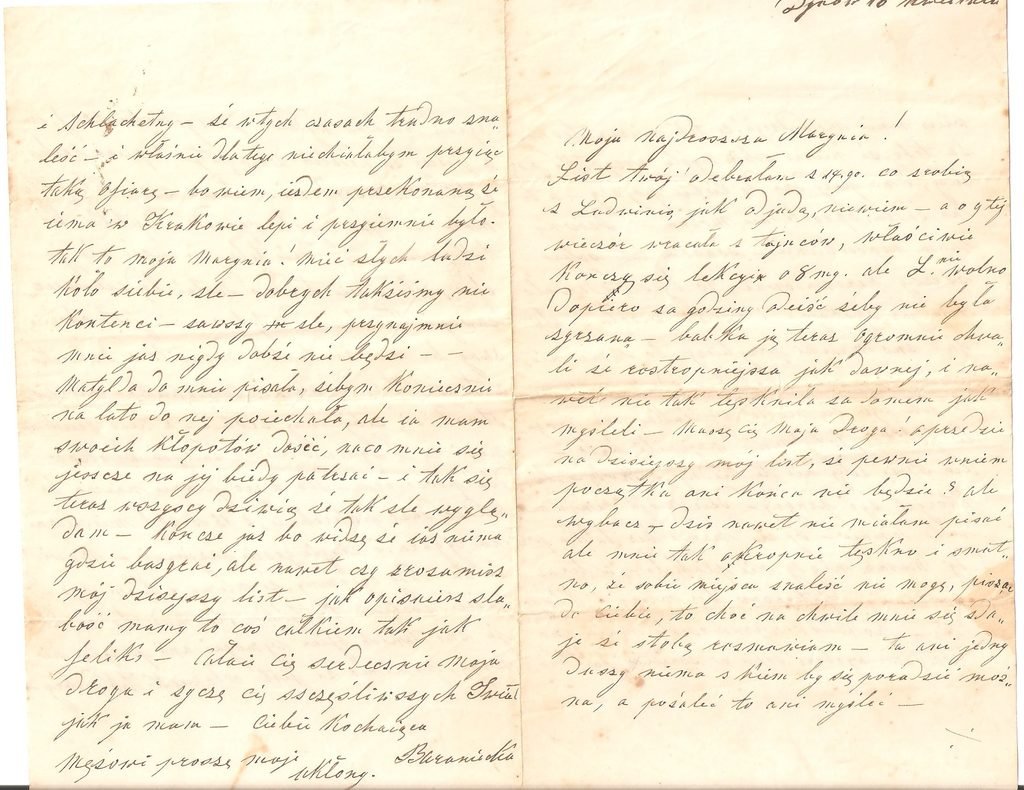
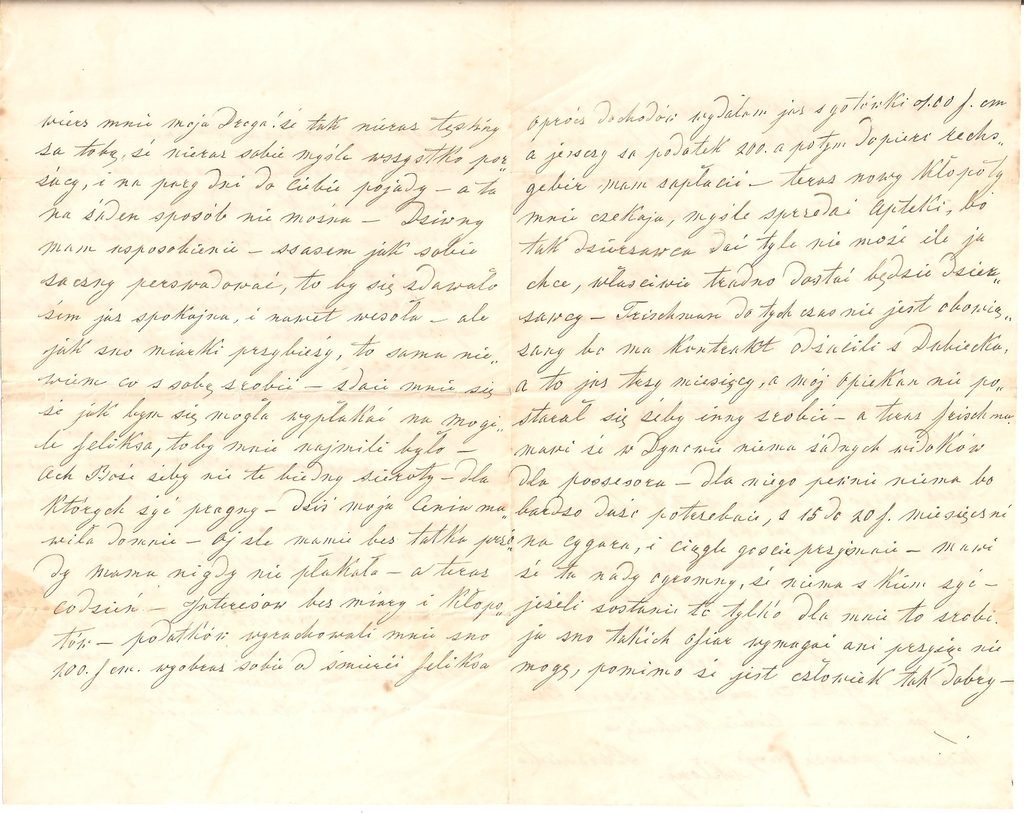
Karolina Baraniecka’s letter – original
These are the first references to August. Although he was already working in Dynów, he was not happy there. He spoke of boredom and the lack of a social life, and said that if he stayed, it would be only for Karolina.
His contract in Dubiecko had been renewed, and everything suggests that he wanted to return there. Mainly because of the boredom in Dynów, which was driving him to distraction.
Incidentally, there is something rather puzzling here.
Advertisements from those years include a notice offering the Dubiecko pharmacy for sale — by Karolina Baraniecka! Most intriguing! Could the Baranieckis have owned that pharmacy as well?
Whatever else one may say, Karolina’s letters make it clear that, although she really needed a pharmacy manager, she had begun to have reservations about August Frischman’s way of life.
August was a sociable man. He liked people, gatherings, guests, cards, outings and amusement. He spent money freely.
Karolina writes that he could spend fifteen to twenty florins a month on cigars and entertaining guests.
Yet she could also say something quite different about him — that he was:
“so good and honourable a man…”
And perhaps those two qualities tell us much about August’s character.
He was extravagant, sociable and probably difficult to keep in check, but he was undoubtedly a good and honourable man.
Incidentally, the expression “a Frischman flourish” survived in our family for many years. It was used of someone who threw money around.
That speaks for itself.
In her letters, Karolina quite often mentions currencies whose names and values few people understand today.
So, a few words of explanation.
Documents from this period use the terms florin, gulden and złoty reński. To a present-day reader, the figures alone mean little.
There is no simple, honest way of saying: “One florin in 1860 was worth exactly this many złotys or dollars today.”
We can, however, try to understand its value by comparing it with prices at the time.
In the middle of the nineteenth century, a morga of farmland in western Galicia cost roughly 200–400 florins.
So when Karolina wrote of August spending fifteen or twenty florins a month on cigars, guests and his social life, she was speaking of very substantial sums.
We shall need such comparisons again, because the family documents mention hundreds, thousands, and later tens of thousands of florins and crowns.
I shall not force these sums into present-day equivalents. It is far more honest to show their value in the circumstances of their own time.
That will do by way of explanation.
Eventually, Karolina overcame her reservations and employed August. And he, surprisingly enough, agreed.
Perhaps he really did do it solely for her, as she suggested in the letter quoted above…
In 1862, when Karolina signed a contract with August to manage the Dynów pharmacy, he was thirty-six and she was thirty-five.
They were almost the same age.
Dynów was a small town. The presence of a handsome, unmarried and very sociable pharmacist in the home of a young widow was bound to provoke comment.
And it did.
Rumours began to spread that Karolina intended to marry August.
And those rumours may have had some basis.
August Frischman and Karolina Baraniecka were almost the same age and came from exactly the same part of the world.
Both had been born in Bukovina, and both came from German families. Karolina’s parents were Krystian Papst and Karolina Kampf.
Nevertheless, the spreading rumours hurt Karolina. She suffered.
In a letter to her friend Marynia Żywicka, she wrote:
“…I imagine that this [the gossip — author’s note] concerns Frischman. Perhaps it has reached your ears too that I am supposedly about to marry, and it seems that many people think that is precisely what I shall do. Those whom I considered my friends have contributed most to all this talk! Surely, if I had meant to marry, I would have done so by now and the gossip would have ended, but I do not wish, for the sake of these reckless people’s chatter, to sacrifice my children’s future and my dear memories of the years spent with my husband. But I explain myself to no one, for time will tell. Nor can I [by a hasty decision to remarry — author’s note] put all my property at risk, where it might fall into untrustworthy hands. I do not deny that there are honest men — but where is one to find them — and besides all that — would it protect me from slander? If there is another man, there will be gossip all over again!
Find me a pharmacy manager who would undertake to run everything, and if you can vouch for his honesty, I give you my word of honour, as truly as I wish happiness for my children, that I shall give Frischman notice at once, and he must leave at the New Year. It seems to me that the pharmacist in Gorlice, your husband’s acquaintance, might know someone, for there are plenty looking for positions, but who knows what they are like? Take Siedlecki, for instance, whom I wanted before — he was considered a good man, and look — while working as a pharmacy manager, he put aside 3,000 florins in just five years. He surely did not save that out of his salary — not even if he went without shoes — so where did it come from?”
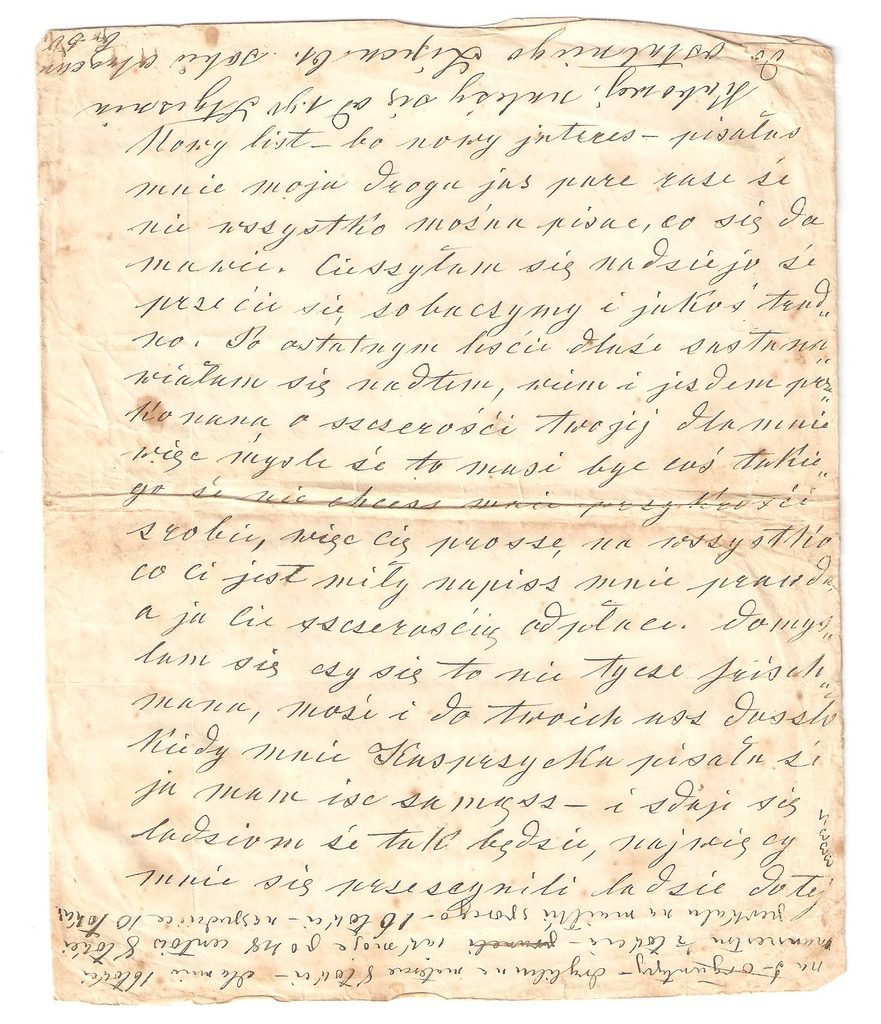
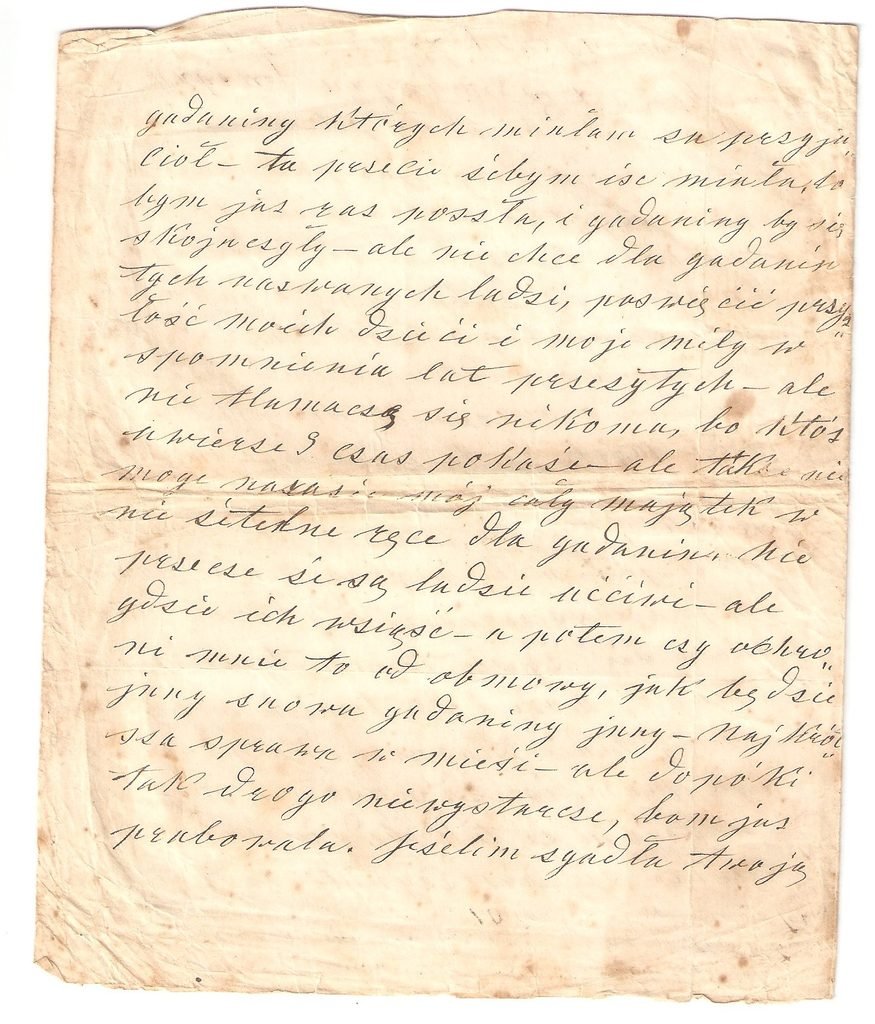
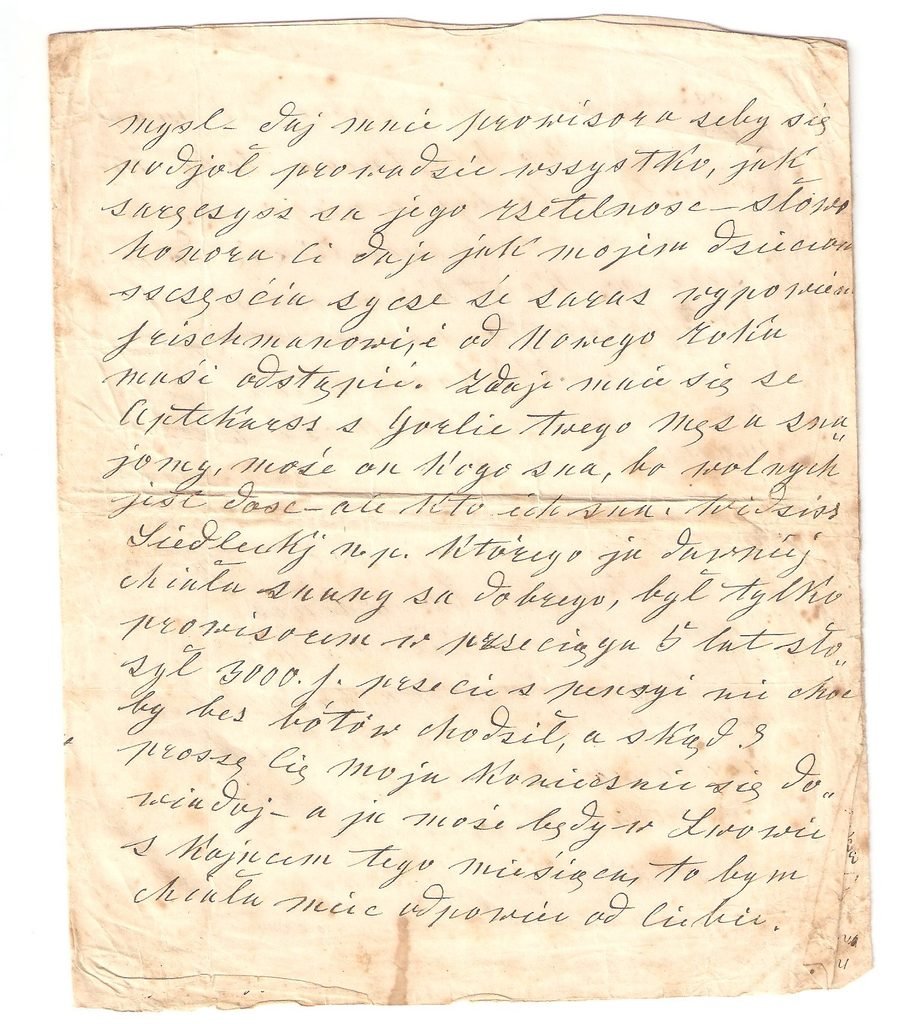
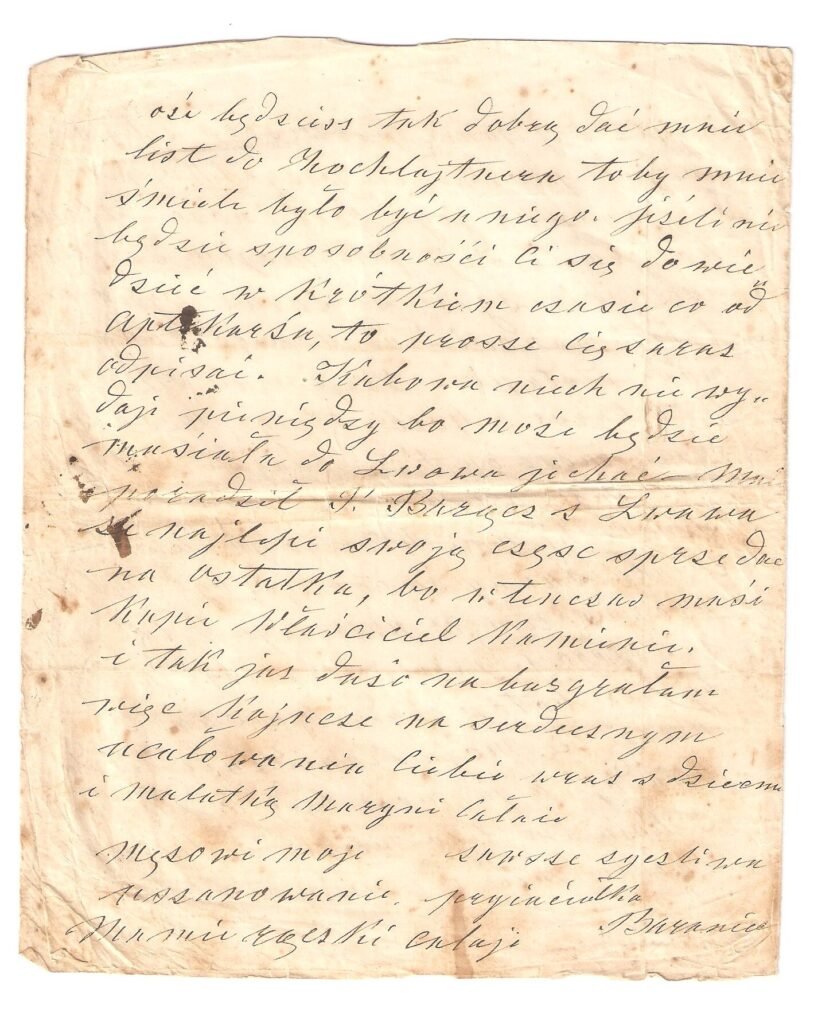
Karolina Baraniecka’s letter – original of the letter quoted above.
Meanwhile, August ran the pharmacy, carried out his duties, and became part of the household in Dynów. The only things spoiling the atmosphere were people’s envy and gossip.
I have no grounds for claiming that their relationship was anything more than professional.
On the contrary, Karolina’s letters show a woman still mourning Feliks and far from contemplating another marriage.
Her husband had died in an unfamiliar town, far from home. She had not been with him when he died. That too disturbed her peace of mind.
And on top of everything else, her strength was failing. Consumption — or tuberculosis, as we would call it today — was destroying her. Karolina was dying.
And August was there all the while.
Ignoring the gossip, he ran the pharmacy, attended to the affairs of the post office, and gradually became part of life in Dynów.
In documents from 1862, he appears as more than a pharmacist.
He was also the Imperial and Royal administrator of the post office in Dynów and an agent of the Kraków Mutual Fire Insurance Society. Later, he also acquired the right of propination.
That is how he is described in materials preserved in the Jagiellonian Library.
And then came the summer of 1863.
Karolina was ill, dying, yet she continued trying to put in order the affairs she would leave to her children.
I give a detailed account of these affairs and Karolina’s letters in Appendix IV.
There are many of them. Some concern the years before she became Feliks’s wife, when her family, the Papsts, already knew him and did business with him.
2. Karolina’s Death. August’s Imprisonment. His Marriage to Wanda Salomea
In 1863, Karolina’s health was deteriorating rapidly.
Two letters written by August during this period have survived.
They are especially precious to me, because for the first time August becomes more than a name in the documents.
The first letter was written on 16 July 1863.
Karolina was still alive.
August knew, however, that the end was approaching.
On behalf of the dying woman, he wrote to her friends asking them to come.
Here is the letter describing the sad days of Karolina’s illness and death.
The letters were written in the summer of 1863.
The first, dated 16 July, was most probably addressed to Mr Żywicki, the husband of Marynia, Karolina’s friend:
My Esteemed Sir,
Poor Mrs Baraniecka is still alive — I have not dared to read your letter to her, for her mind is quite clear, and I could not bear the effect your heartfelt sympathy would have upon her. I know what it means to have a friend, and I can feel what it means to lose one. I imagine what comfort it would bring her to embrace and bid farewell, for the last time, perhaps even in her final hour, to the woman whom she has truly and sincerely loved.
I hope that if your wife sets out without delay, immediately upon receiving this letter, she will find this poor woman still alive.
On behalf of the dying woman, I ask that you keep your promise — I shall be grateful in her stead.
Your servant,
Frischman
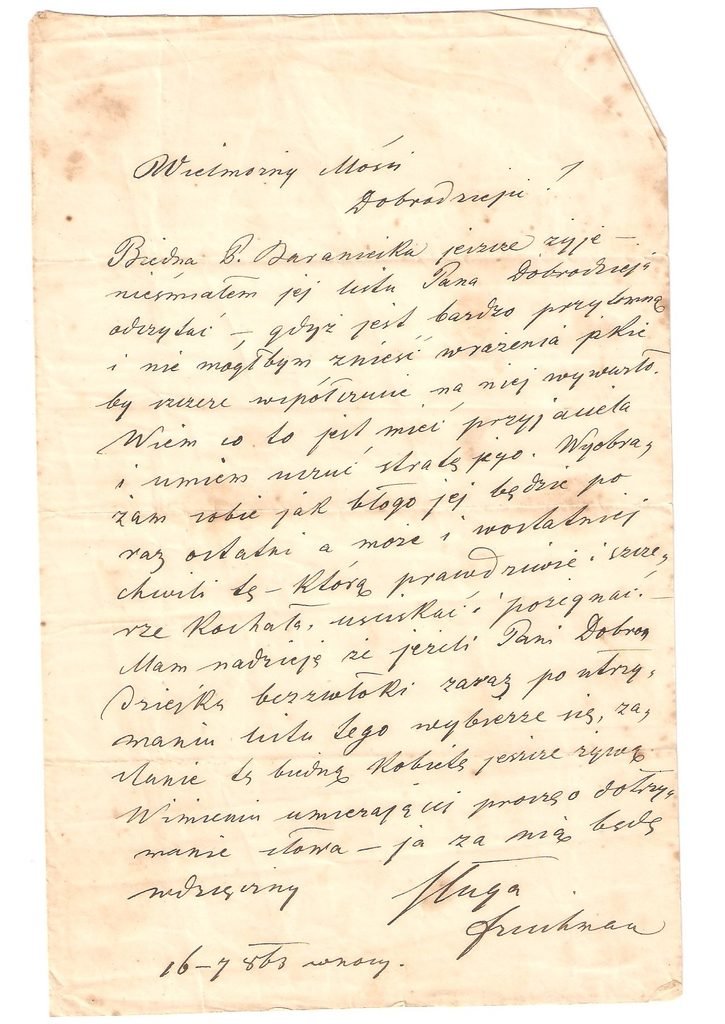
August Frischman’s letter of 18 July 1863
The second letter is even more moving.
August wrote it from Dynów on 9 August 1863.
He describes Karolina’s last moments, her death, the funeral, and what happened afterwards.
Here is the letter:
My Esteemed Madam,
Forgive me for having left your letter unanswered for so long — in my sorrowful circumstances, I forgot everything. Today I have grown accustomed to this new order of things, and so I hasten to fulfil the pleasant duty of [putting your minds entirely at ease].
The children are well. I do not know what is happening in their hearts, but from their faces no one would guess that they are orphans without either father or mother. In the first moment after their mother ceased to live, I think I had the most foolish expression of them all.
At four in the afternoon, she gathered us around her and would not let us leave her side.
At eight in the evening, she began to die. Beside the bed stood myself, Władek, Wanda and Felcia — the little ones behind us.
My head was buzzing, and I would have sworn that they were all weeping and sobbing. At ten in the evening, when she drew her last breath, I turned round and saw only the two older girls; the others were fast asleep. Old Wincenty stood beside the stove.
As though someone had given a command, people began to arrive. Amid the confusion, I noticed only that Felcia and Wanda were dressing their mother’s hair as if for a wedding. They attended to everything so briskly that within an hour she lay on the illuminated bier, all in perfect order, and everyone was kneeling, singing and praying.
What happened at that moment I do not know. I could not bear to look at anyone and sat in my room.
I did not see the funeral, but judging by the money I spent, I gather it was quite a proper one.
I immediately took the children downstairs and ordered some repairs upstairs, for everything there was already in great disorder.
And so, while I was sharing one room with six children, Mrs Stronczakowa came to visit us a week after the death. Wishing to win me over, or for some other purpose, she said: “The deceased was always less than truthful.” … Her eagerness to take everything away from the children made an unpleasant impression on me, and I must have been less than courteous to the lady, since she departed at once, for which I am most grateful to her.
A few days later, the postal official Astleilhner arrived on an inspection. I received him as best I could amid the throng of children. He stayed, lodged and ate with us until today. The Directorate acted most humanely, ordering that … and the whole … be given to the children, while I was to have the office and the administration of everything.
While Mrs Baraniecka was alive, I somehow gave more thought to everything. After her death, I did nothing, visited no one and asked no one for anything. And yet everything turned out for the best.
I promised the official that I would go, and I thanked the Director for the kindness he had shown the children.
There are very many applicants for this post office, and several have sought its administration.
If you would be so kind as to visit my friend’s children in September, I shall gladly and gratefully listen to your advice on what to do with them. Perhaps it would be better to prepare Władek for the postal service, for the road to becoming a pharmacist is a long one — and on this too I should be glad to hear your opinion.
My dear aunt gives no sign of life. I am preparing to write to her, and if this attempt also comes to nothing, then let her stay where she is, and I shall look for someone else.
On this occasion, please accept the expression of my deepest respect for you both.
Your servant,
Frischman
Dynów, 9 August 1863.
I enclose a letter from … — he is not at home.
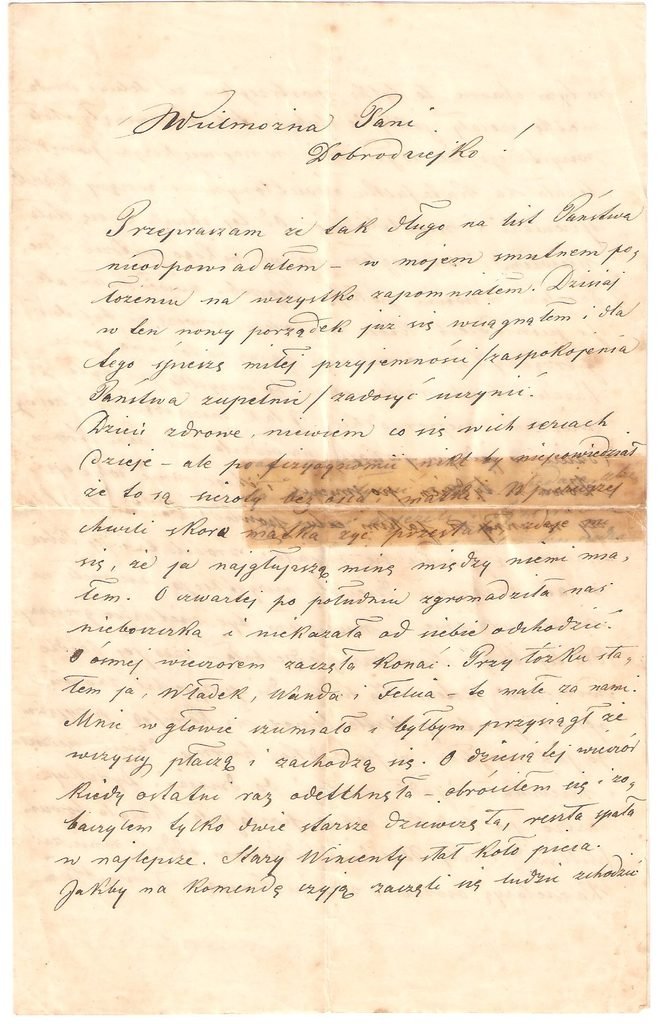
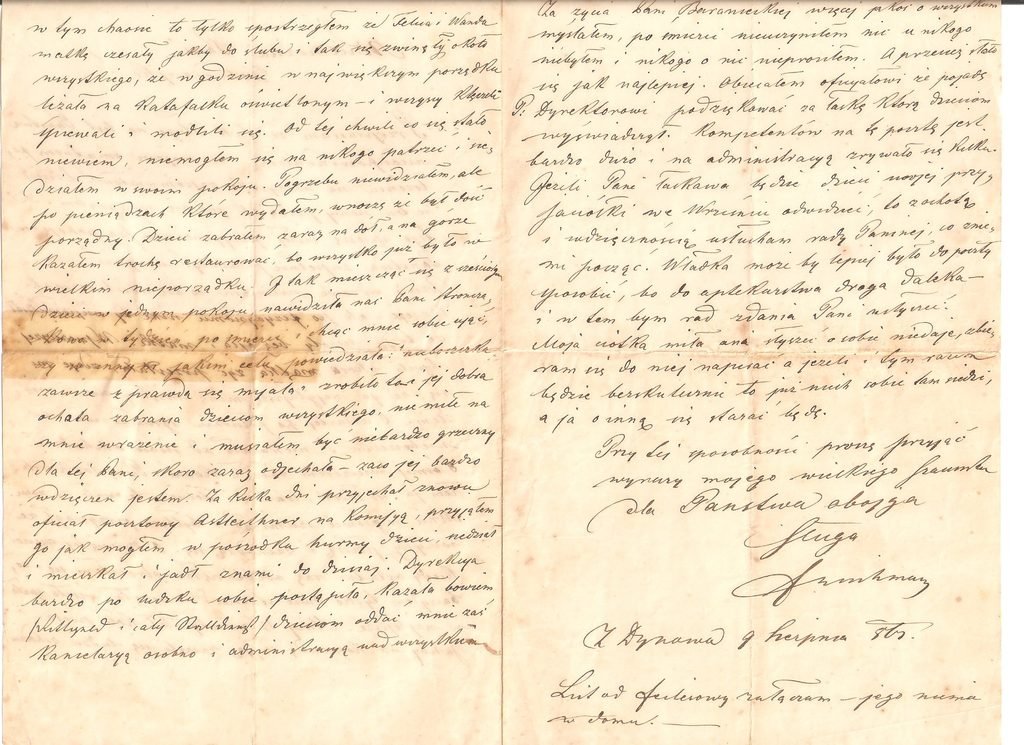
August Frischman’s letter of 9 August 1863.
Karolina Baraniecka’s grave in Dynów.
After Karolina’s death, August took the six children of the late Feliks and Karolina Baraniecki downstairs.
He ordered repairs to the upper floor because, as he wrote, everything there was already in great disorder.
And suddenly this thirty-six-year-old bachelor became the guardian of six children who were not his own. Six orphans.
Mrs Marianna Stronczakowa, née Baraniecka, the late Karolina’s sister-in-law, arrived. She had nothing to offer, only the insulting remark that “the deceased was always less than truthful”!
August practically drove her out of the house.
Later, a postal official appeared. The postal Directorate left August in charge of the office and its administration.
There is another sentence:
“My dear aunt gives no sign of life…”
Perhaps he meant Anastazja Frischman, his father’s sister.
Perhaps August was trying to bring her to Dynów to help him with the children.
It is hard to say!
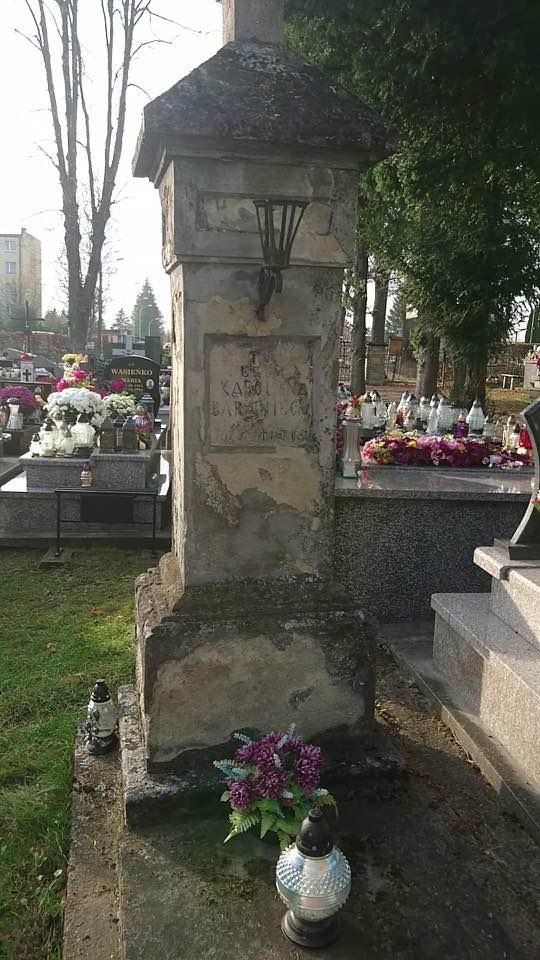
Grave of Karolina Baraniecka, nee Papst, in Dynów
But at that very time, besides Karolina’s death, another event struck the household in Dynów like a bolt from the blue!
The year 1863 was the year of the January Uprising.
After its defeat, many insurgents fleeing the Russian partition crossed the Austrian border. They sought refuge from persecution by the Russian authorities.
At first, the Austrian authorities more or less tolerated them, but this did not last long.
A group of fugitive insurgents reached Dynów. August gave them shelter in the house.
The newcomers, however, behaved in a disorderly manner. Perhaps this was a result of the strain of the defeated uprising? There were disturbances and various troubles — suffice it to say that the Austrian authorities, unwilling to tolerate such behaviour, arrested the newcomers and August along with them.
According to my Father’s account, August was tried and imprisoned in the fortress of Kufstein, in Tyrol.
He spent about a year and a half there, slept on a stone floor, and returned with his health ruined, particularly his kidneys.
What happened during that time to Karolina’s children, the pharmacy, the post office and the house?
Admittedly, the children were no longer all very young. The eldest, Władysław, was sixteen in 1863. His sisters were younger, however, and the youngest, Maria, was only eight.
Who looked after them?
I once suggested that it might have been their aunt, Marianna Baraniecka, born on 2 January 1807 in Zamieście Burek, in the parish of Tarnów Cathedral — the sister of the late Feliks Antoni.
The pharmacy may have been run by Teofil Podsoński, a qualified pharmacy manager, but I am not certain of this.
In any event, the pharmacy certainly continued under qualified managers, while the authorities placed the post office under administration.
August returned from prison to Dynów around 1865.
He returned to the orphaned children, who were, after all, not his children.
He returned to a house that was not really his home, but merely his place of work.
And yet he returned.
Perhaps he had promised the dying Karolina that he would look after her children. Or perhaps he had nowhere else to go — though that hardly seems likely to me, for a man like him could have found work anywhere.
Whatever the reason, he returned and eventually married the eldest daughter of the late Karolina — Wanda Salomea!
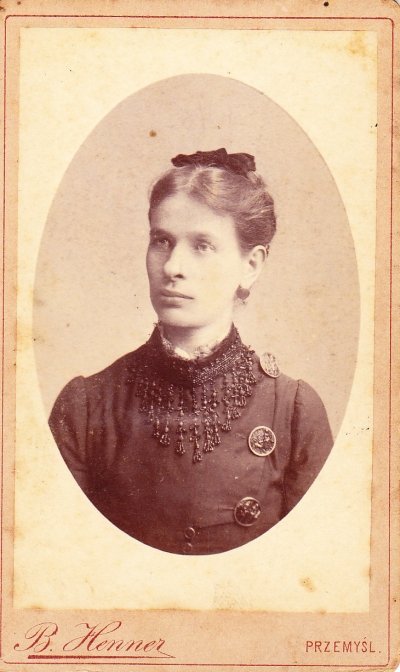
Wanda Salomea Baraniecka.
When August first came to the Baraniecki household, in 1862, Wanda was still a young girl.
A few years later, she became his wife.
They married on 2 February 1867.
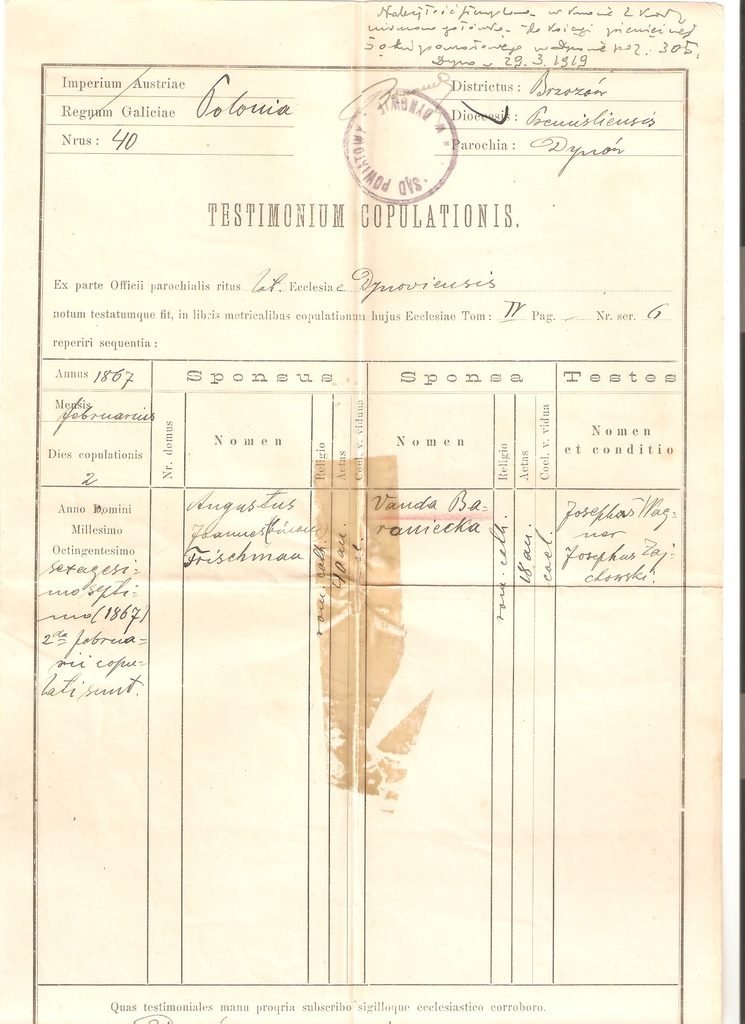
Marriage record of August Frischman and Wanda Salomea Baraniecka.
August was forty, and Wanda Salomea eighteen.
The difference in age was therefore twenty-two years.
August, whose name had been linked with the mother’s, married her daughter!
Apparently, that was what the circumstances called for.
We shall probably never know all the circumstances surrounding this decision, on either Wanda’s side or August’s.
It is hard to say who needed whom more — August needed Wanda, or Wanda needed August.
And so the wedding took place. Although the marriage was unhappy from the beginning, over its thirteen years they nevertheless had seven children!
August Jan Frischman died in Dynów on 2 November 1880.
He was fifty-three.
Within the family, his death was attributed to the kidney disease he was said to have developed during his imprisonment.
He was buried in the family tomb in Dynów.
His grave survives to this day.
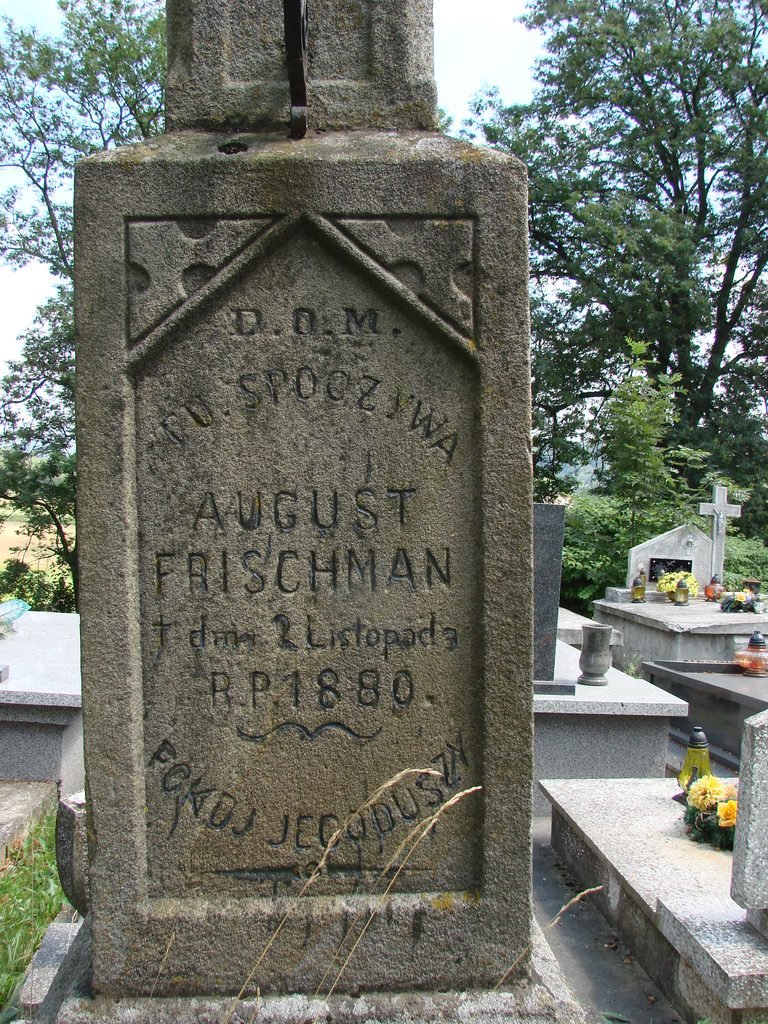
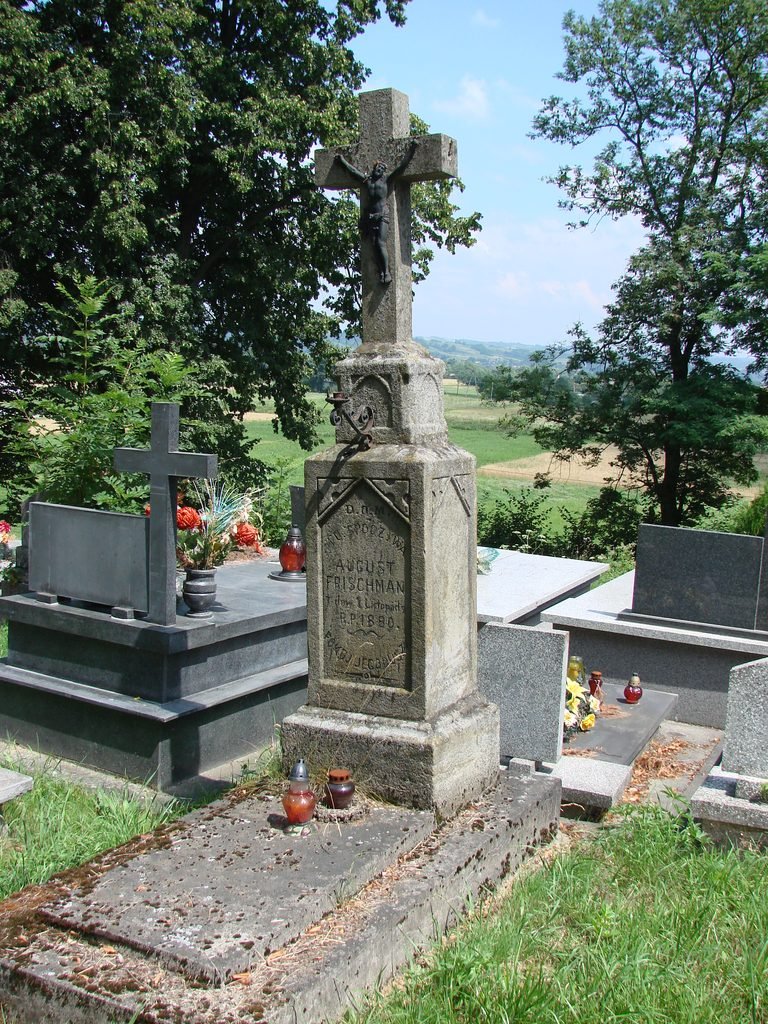
August Frischman’s grave in Dynów.
Wanda Salomea Frischman, née Baraniecka, was thirty-one when she became a widow, and remained one for fifty-nine years.
She was known as “Grandma Frischmann”. Never anything else.
History seemed to be repeating itself.
At the time of August’s death, her circumstances were remarkably similar to those of her mother Karolina twenty-two years earlier.
Karolina was thirty-one when her husband Feliks died.
Wanda was thirty-one when her husband August died.
Karolina was left alone with a brood of children.
Wanda was left alone with a brood of children.
But there the similarities ended, for Wanda was a very different woman from her mother.
After Feliks’s death, Karolina was devastated. She had tuberculosis, could not come to terms with the loss of her husband, and remained in mourning almost until the end of her life.
Wanda Salomea was made of very different stuff.
In fact, after her husband’s death, she came back to life!
One might say she was a woman cast in bronze.
Here is what my Father wrote about her, her husband August, and the circumstances of his imprisonment:
“My grandmother, as I have already written, after a few years of schooling at the convent of the Benedictine nuns in Staniątki, near Kraków, married August Frischman, the son of a district commissioner sent from Vienna to Galicia to Germanise the country. The result was quite the opposite: he himself became Polish in outlook, while his son August, enamoured of the Poles and a man of extraordinary intelligence, was active in secret Polish societies and supported the insurgents in 1863. For this he later suffered two years in an Austrian prison, having been found guilty at his trial.
Grandmother told me that all the young ladies were sewing underclothes for the insurgents, sending boots and such things, while the men sent guns and gunpowder.
She had no fond memories of the insurgents. She maintained that they were no different from ordinary robbers. Fleeing to Galicia after the defeat of the uprising, they behaved as soldiers do, requisitioning and plundering, taking whatever they needed.
From her parents’ stories, my grandmother also knew the history of the peasant uprising, which had taken its toll on Dynów and the surrounding area.
But after the uprising and her husband’s return home, a period of crisis followed. Everyone wanted to forget the defeat in a whirl of amusement. August, invited everywhere, a favourite of the neighbouring manor houses, an almost daily guest of old Count Wojciech Starzeński — August’s father and the grandfather of another Wojciech — in Dąbrówka, and also of Zbigniew Trzecieski in Dynów, amid sleigh parties, festivities and dancing, neglected everything completely (?). He paid neither allowances nor the inheritances due to Grandmother’s sisters. A passionate card player himself, and a gambler at that, he developed kidney disease early and died in his fifty-third year on All Saints’ Day in 1880. A freethinker and a liberal, he waged continual war against the parish priest of the time, Father Zaleski (?) [this surname requires clarification, as the parish priest in Dynów was Father Teofil Witoszyński from 1847 to 1876, and Father Edward Palch from 1876 to 1890], who, hot-tempered and tactless, stopped at nothing in suing him to defend his honour.”
And here is an excellent comment from my sister, Maria Baraniecka Witkowska:
“What fascinated me was the life in Dynów of a liberal — a man whose intellectual horizons were at odds with the values of that provincial backwater; a man who, through his own choices, had also deprived himself of the warmth of family life; a courageous man who stood up to the all-powerful parish priest.
But hardly anyone spoke of this. Indeed, no one was interested.
The world the family held dear was not his world. And that was how he left it, on a bleak November day…”
3. Wanda Salomea — Sole Owner of the “Pod Opatrznością” Pharmacy
In 1880, at the time of August’s death, the pharmacy still did not belong to Wanda alone.
It belonged to all the children of Feliks and Karolina Baraniecki.
They were:
- Władysław (1847–1921).
- Wanda Salomea (1849–1939).
- Felicja Zygmunta (1849–1941).
- Helena (1851–1877).
- Stefania (1853–1932).
- Maria Joanna (1855–1940).
In practice, this meant that for many years — since 1858 — the “Pod Opatrznością” pharmacy had been jointly owned by Feliks Baraniecki’s heirs.
To settle the ownership, while her husband was still alive, Wanda reached an agreement with her siblings: they would all transfer their shares in the inheritance to her, so that the pharmacy would eventually belong to her alone.
And that is what happened!
The harmony among the siblings is remarkable. Quite exemplary!
On 1 July 1874, in Prague, her brother Władysław Baraniecki transferred his entire share in the inheritance to Wanda for 600 Rhenish florins.
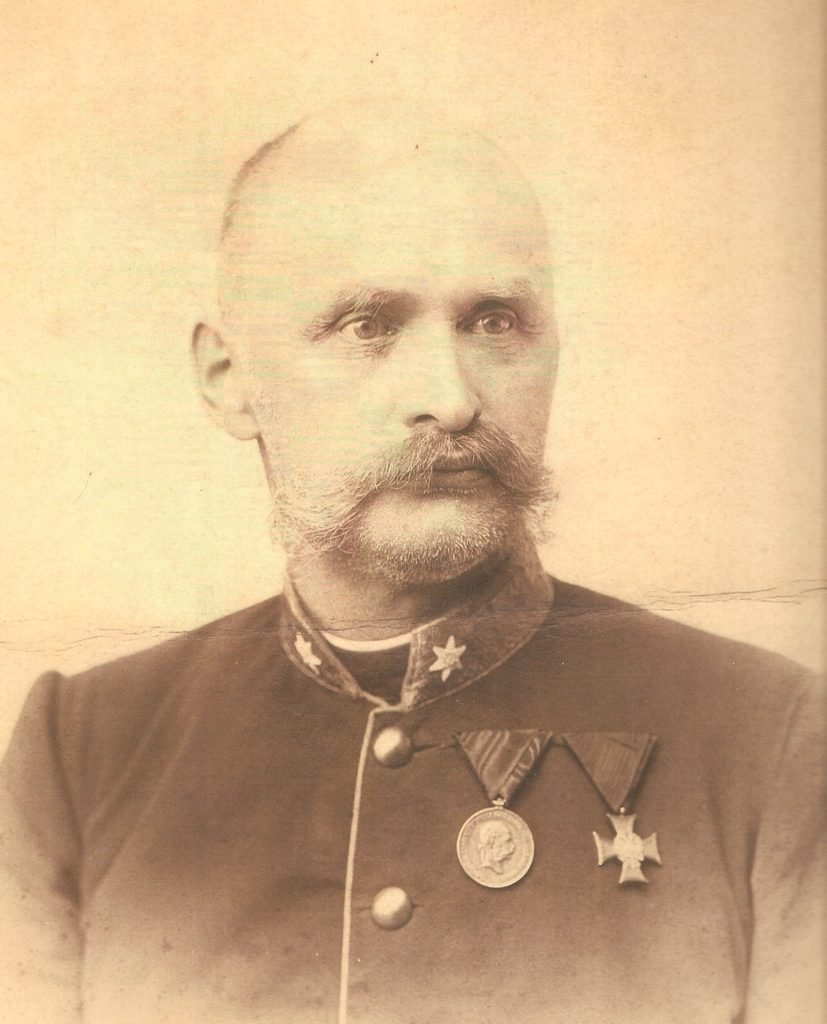
Major Władysław Baraniecki.
The document has survived and specifies exactly what the transfer covered: buildings and other property, land, outstanding debts owed to the estate, movable possessions, and, above all, the pharmacy in Dynów.
Władysław wrote:
“…I transfer my entire share in the inheritance (…) without retaining anything for myself or my heirs, into the sole and unrestricted ownership of my sister, Mrs Wanda Frischman, née Baraniecka…”
Then came the others.
On 20 August 1875, Helena Chodzińska, née Baraniecka, transferred her share for 1,000 florins.
On 3 September 1878, Stefania Niewolkiewicz, née Baraniecka, did the same, also for 1,000 florins.
These three transactions took place during August’s lifetime.
But the matter was not yet settled.
It was not until 23 October 1890 that Felicja transferred her share for 2,000 florins.
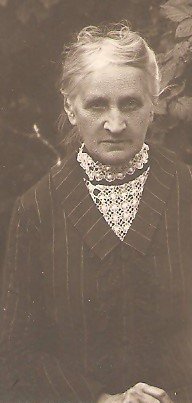
Felicja Baraniecka.
And on 8 January 1891, Maria — who also appears in the documents as Maryanna — sold Wanda her share for another 2,000 florins.
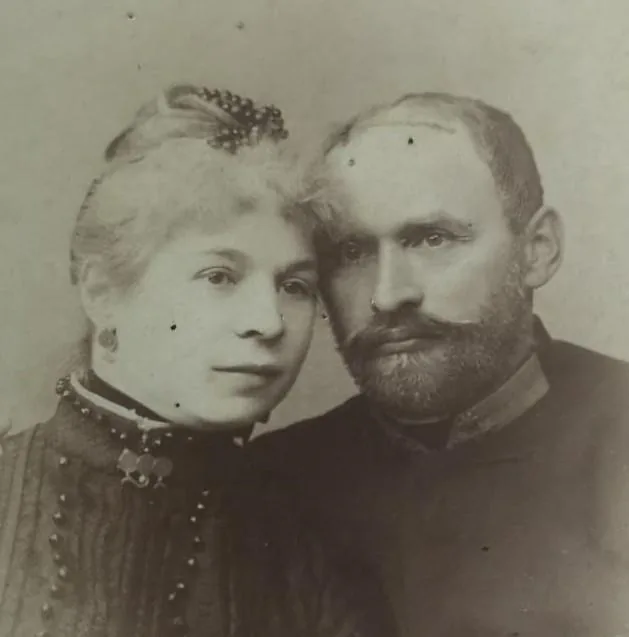
Maria and Władysław Baraniecki.
Only then, more than thirty years after the death of her father Feliks, did Wanda Salomea become the sole owner of the family’s “Pod Opatrznością” pharmacy.
I describe the children of Karolina and Feliks in detail in Appendix VI.
The Fourth Generation — The Children of August and Wanda Salomea
All of August and Wanda Salomea’s children — and there were seven of them — were born in Dynów.
- Adolf was born in the year of their marriage, 1867. He died almost immediately after birth.
- Aleksander was born in 1870. He too died that same year.
- Zofia, born in 1872, died in 1903.
- Franciszek, born in 1874, died in 1955.
- Henryk, born in 1876, died in 1891.
- Stanisław Adolf, born in 1878, died in 1930.
- Filip Kazimierz, born in 1880, died in 1939.
A few words about each of them.
3. Zofia Banach, née Frischmann
She married Adam Banach, who was born on 1 January 1860 and died on 5 October 1928 in Kraków.
Adam was a councillor in the Kraków police administration, but he also found a place in our family history for an entirely different reason.
He is said to have tutored Jan Matejko’s children and knew many painters in Kraków.
He was acquainted with Malczewski, Wyspiański, Mehoffer, Wyczółkowski, Tondos and Fałat.
And he received paintings from them.
Because of his highly unpopular occupation as a legal adviser to the police, he once had acid thrown over him while riding in an open carriage.
Zofia did not live long.
She died on 3 April 1903 in Posada Sanocka, aged only thirty-one.
She died at the railway station, where she was given the last rites. There was a suspicion that she was pregnant, though it seems this was kept quiet.
The death record states that she died of peritonitis and a miscarriage.
The last rites were administered by the parish priest of Sanok, Bronisław Stasicki.
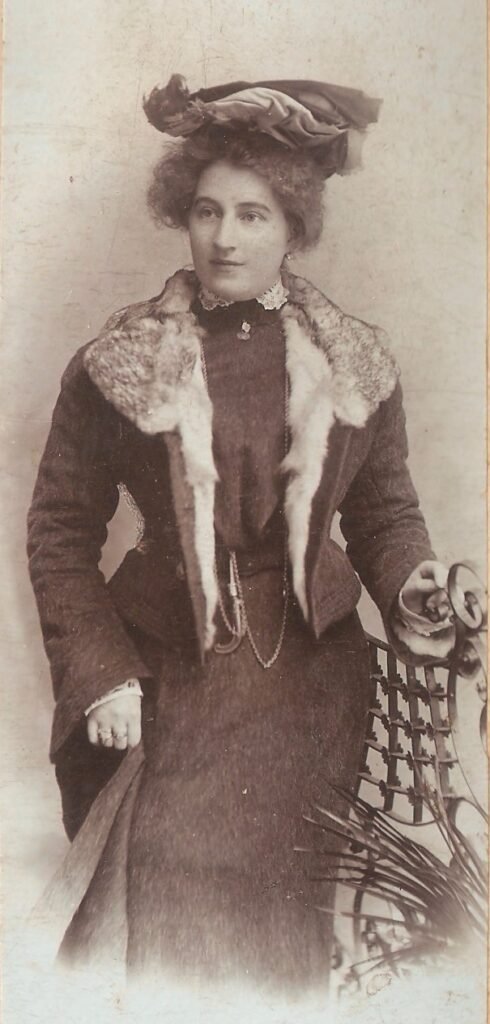
Zofia z Frischmannów Banachowa.
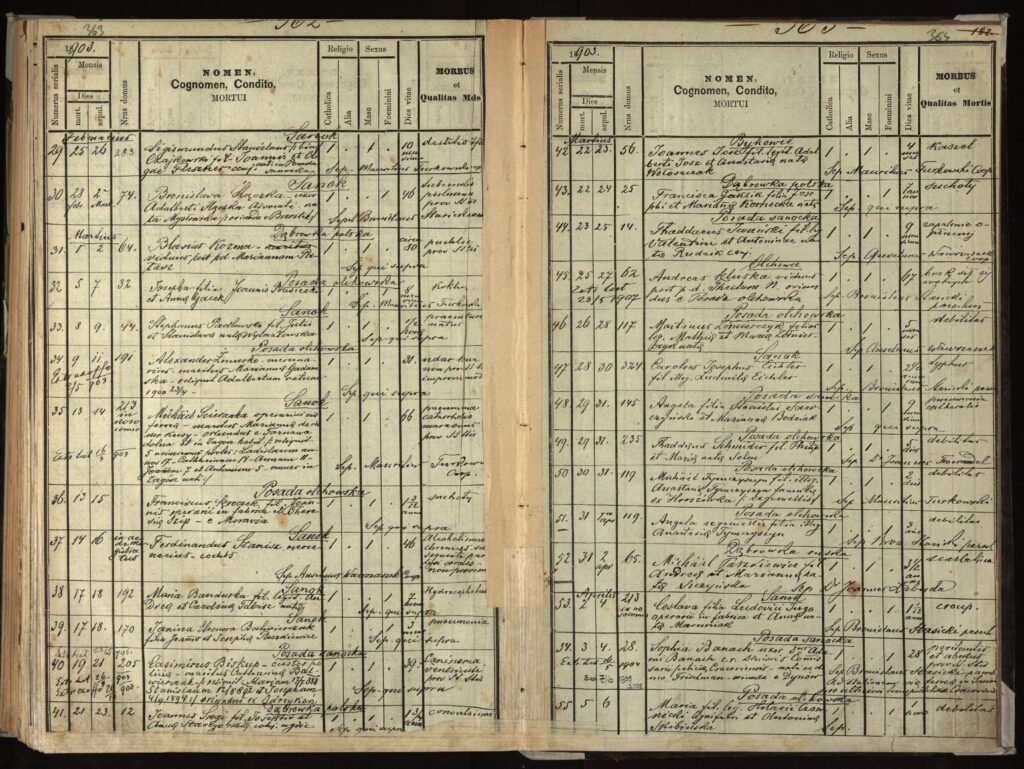
Death record of Zofia Banach, daughter of August Frischman.
She left two daughters, Zofia and Wanda, known in the family as Dusia.
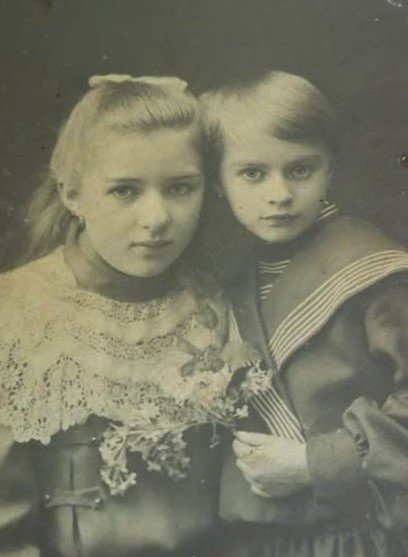
Zofia and Wanda, daughters of Zofia and Adam Banach.
She had also had a son, Henryk, who died almost immediately after birth.
Her daughter Wanda “Dusia” Banach died unmarried on 25 May 1935, aged thirty-six. She suffered from tuberculosis and died on her way from the sanatorium in Fordon, near Bydgoszcz.
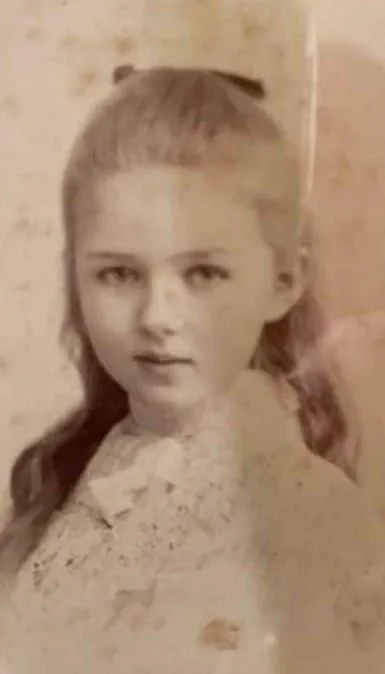
Zofia Banach.
Her elder sister Zofia married Stanisław Nowakowski, an officer and veterinary surgeon.
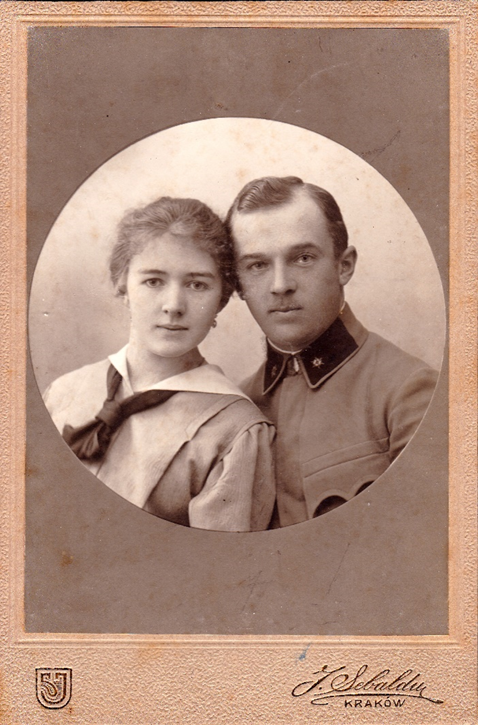
Zofia Nowakowska, née Banach, and Stanisław Nowakowski.
Zofia Banach Nowakowska was born on 6 February 1892 and died on 22 October 1989 in Nowy Tomyśl, aged ninety-seven.
4. Franciszek Frischman
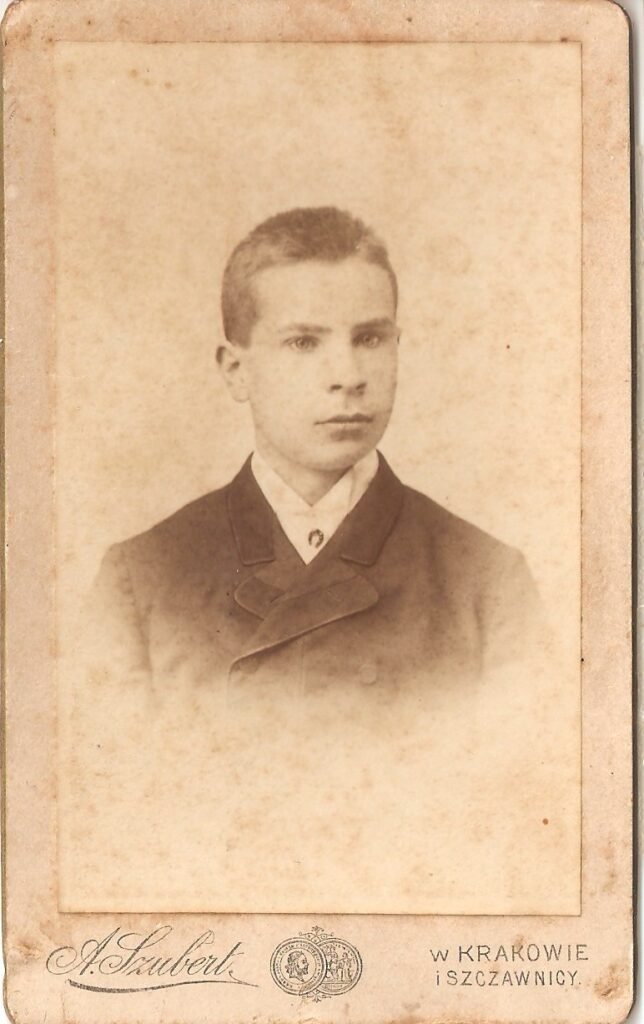
Franciszek Frischman 1890.
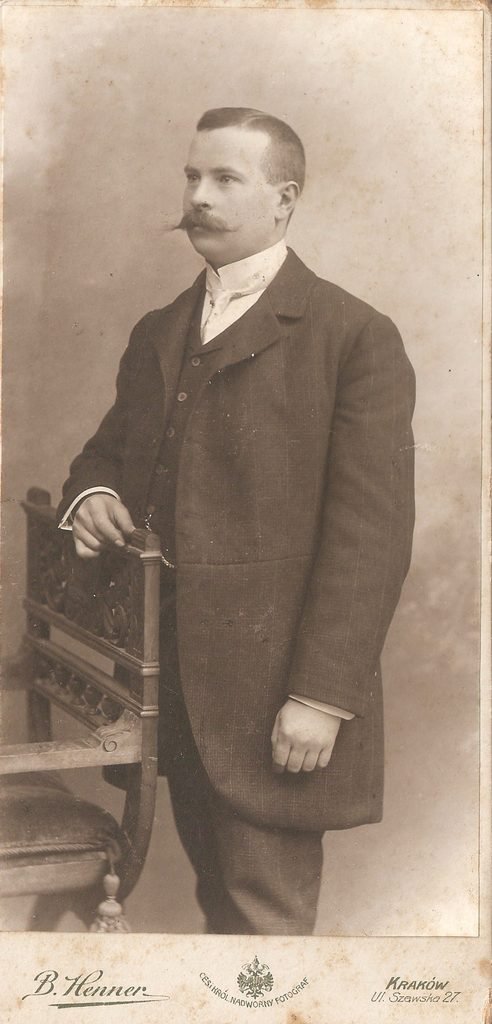
Franciszek Frischman, 1906.
He was born on 22 February 1874 in Dynów.
On 10 October 1892, he entered the pharmacy faculty of the Jagiellonian University.
Before that, however, as a fifteen-year-old boy, Franciszek had already been training in the Dynów pharmacy under Ludwik Giebułtowicz, a qualified pharmacist who was then its manager and also Franciszek’s godfather.
This apprenticeship lasted from 20 July 1889 to 20 July 1890. Franciszek then moved to Kraków, where he continued preparing for his studies as an apprentice at Konstanty Wiszniewski’s “Pod Gwiazdą” — “Under the Star” — pharmacy on Floryańska Street.
He completed his pharmacy studies at the Jagiellonian University in 1895 and received his Master of Pharmacy diploma on 15 July.
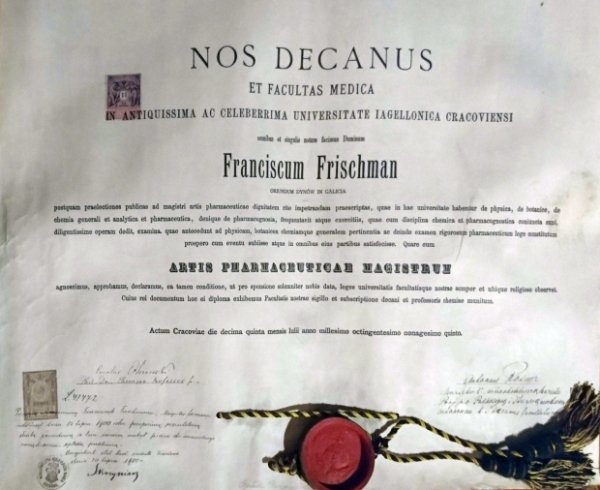
Franciszek Frischman’s university diploma.
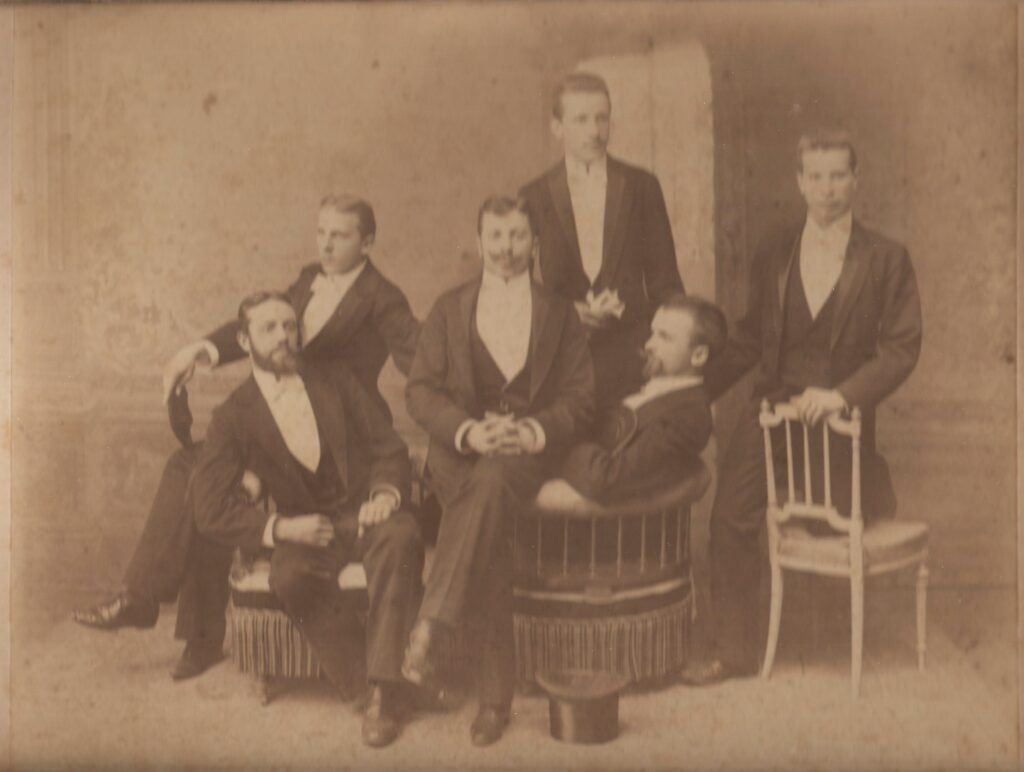
Completion of pharmacy studies. Kraków, 1895. Franciszek is first on the right.
It was customary in those days for a newly qualified pharmacist to work in several, sometimes a dozen or more, pharmacies during his first few years — naturally, to gain experience.
If he was unable to take over a pharmacy of his own afterwards, he would at least be well prepared to apply for a position managing, or even leasing, someone else’s.
Franciszek was fortunate to have his mother’s pharmacy to fall back on. But to take it over and run it, he needed experience.
Over five years, he worked in several pharmacies.
I include a list of these places of employment in Appendix XII.
On 15 July 1900, Franciszek Frischman took over the management of Wanda Frischman’s “Pod Opatrznością” pharmacy in Dynów.
5. Henryk
He was said to have been a very gifted and promising boy.
Sadly, he later died of diabetes at about fifteen years of age. He was buried in the same tomb in the Dynów cemetery where his father August already lay.
6. Stanisław Adolf
Stanisław Adolf was born on 8 May 1878 in Dynów and died on 10 December 1930 in Buffalo, New York, USA.
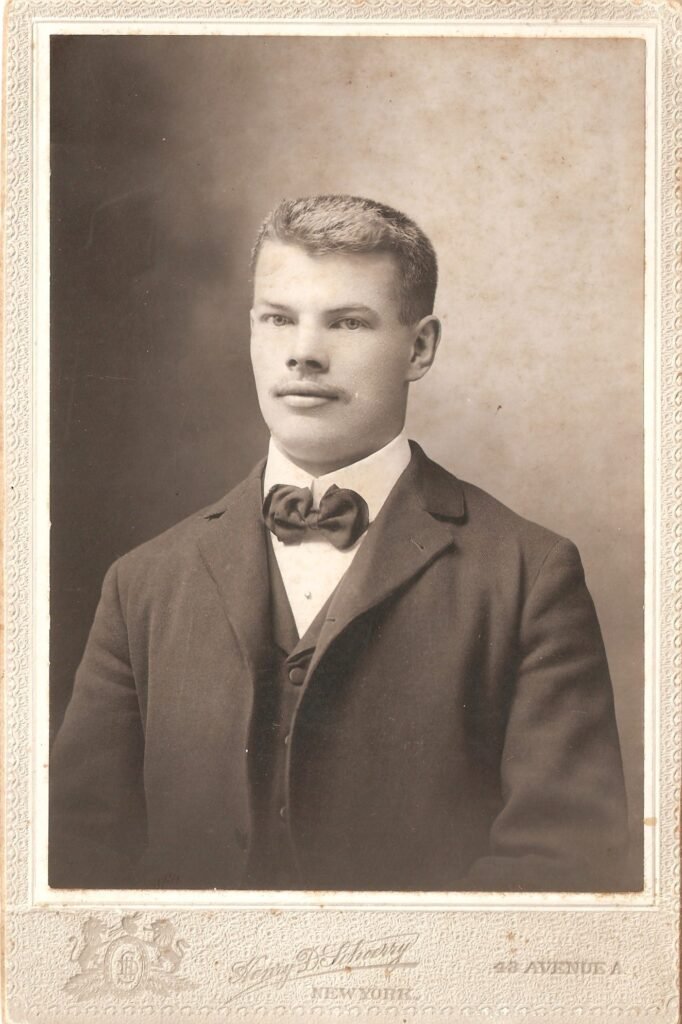
Stanisław Adolf Frischmann.
His letters, my commentary on them, and the documents concerning him are included in Appendix III.
7. Filip Kazimierz
Filip Kazimierz was born on 1 May 1880 in Dynów and died on 29 March 1939 in Przemyśl.
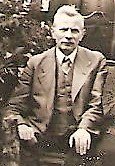
Filip Frischman.
When he was born, his father August had barely six months left to live.
Information about Filip and his family is included in Appendix X.
The Fifth Generation — The Children of Franciszek and Wanda, née Grochowicz
On 22 January 1907, Franciszek Frischman married Wanda Maria Grochowicz, the daughter of Judge Teofil Grochowicz and Aurelia Placyda Lorek.
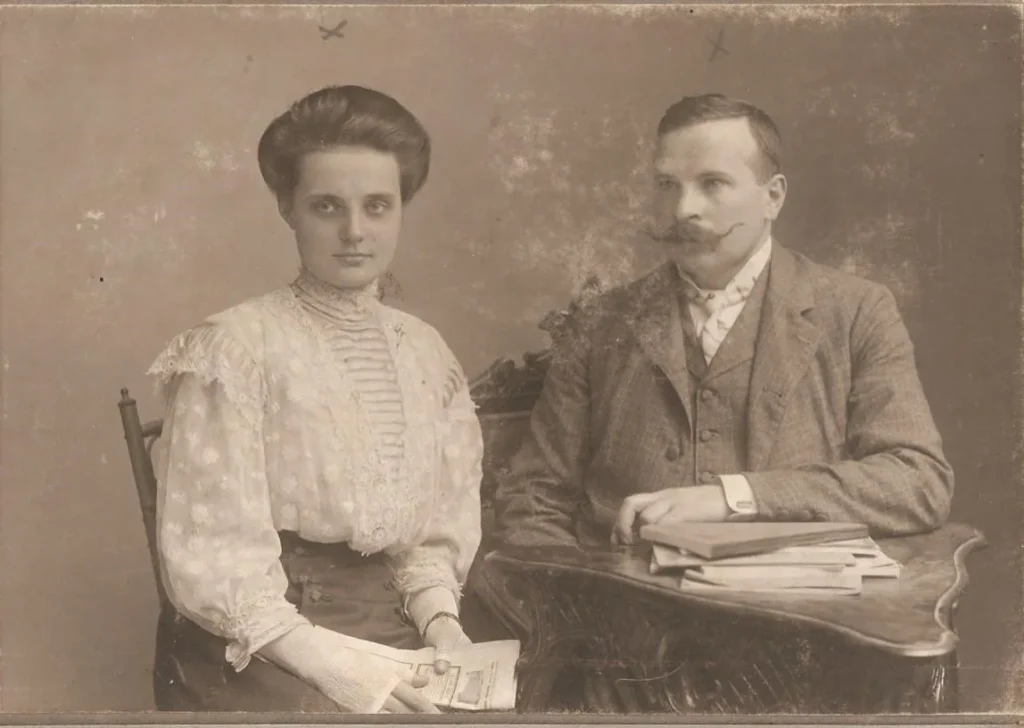
Wanda, née Grochowicz, and Franciszek Frischman.
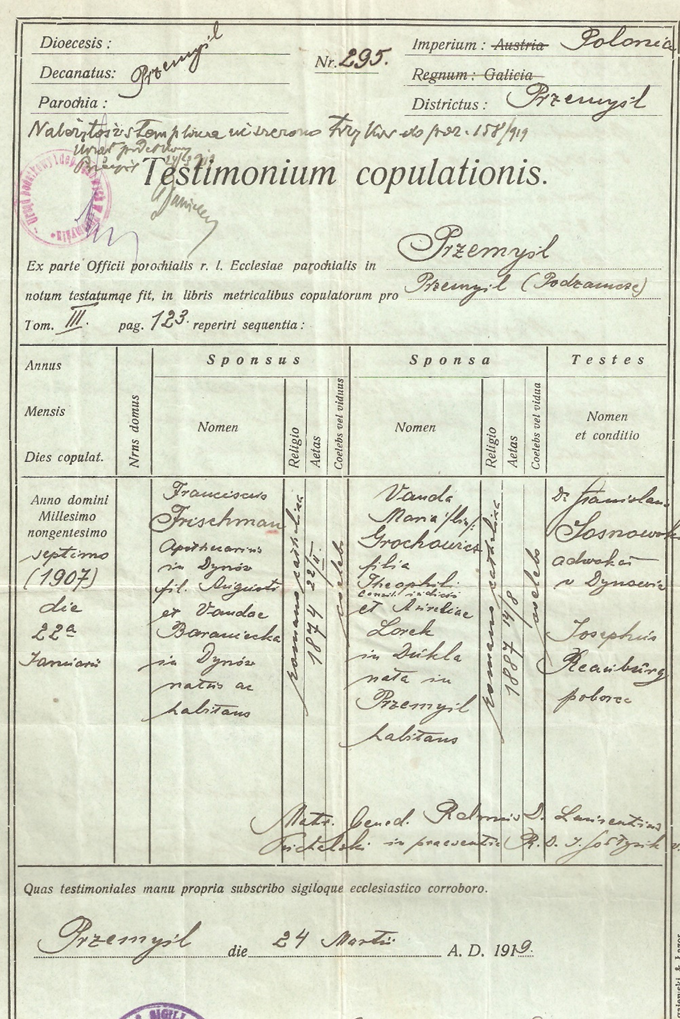
Marriage record of Wanda, nee Grochowicz, and Franciszek Frischman, 1907.
Their marriage brought them four children:
- Zofia, born in 1907 in Dynów, died on 14 January 1908, also in Dynów.
- Kazimierz Stanisław Adolf, born on 27 February 1909 in Dynów, died on 17 July 1995 in Warsaw.
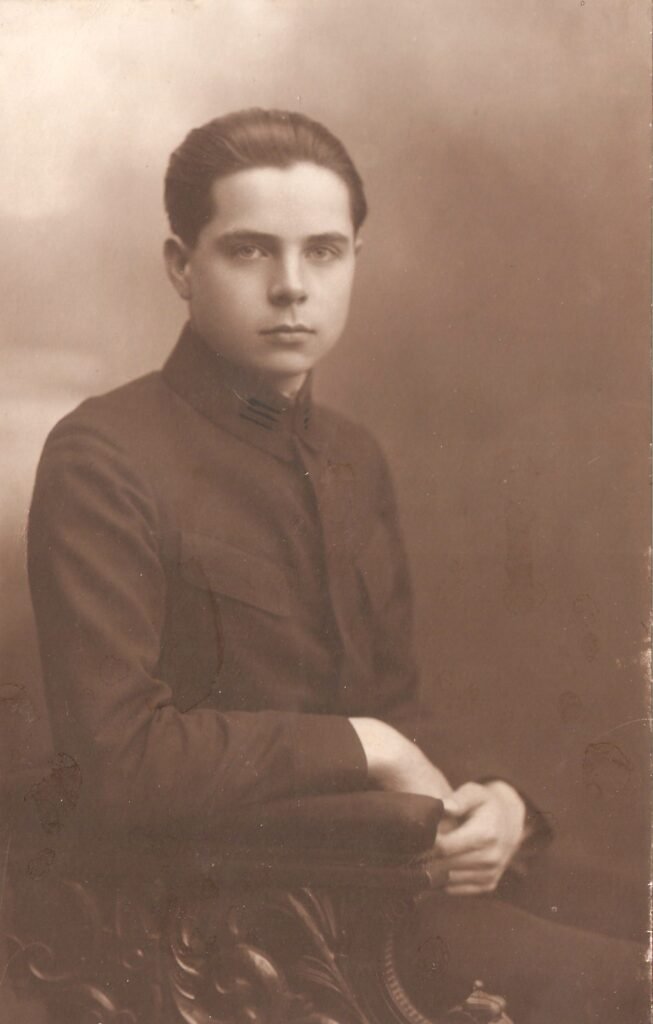
Kazimierz Baraniecki, 1925.
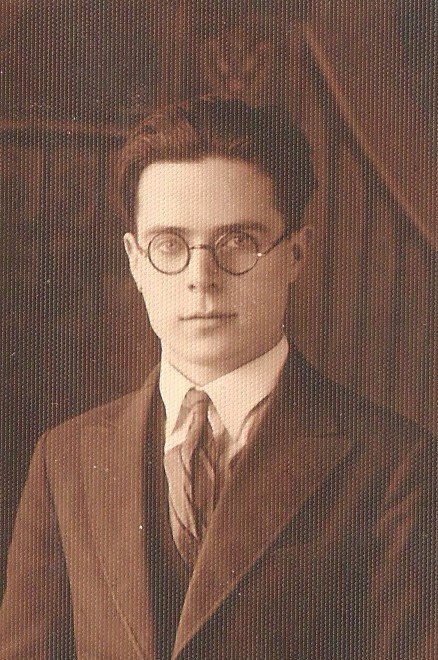
Kazimierz Baraniecki, 1930.
3. Barbara Maria, born on 21 October 1911 in Dynów, died on 16 July 2002 in Łódź.
In 1947, she emigrated with her husband Karol and their two sons.
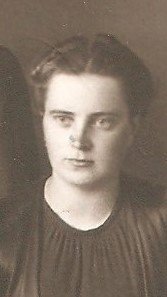
Barbara Kaszycka, née Baraniecka.
- Stanisław, born on 4 March 1922 in Dynów, died on 27 January 1941 in the Auschwitz concentration camp.
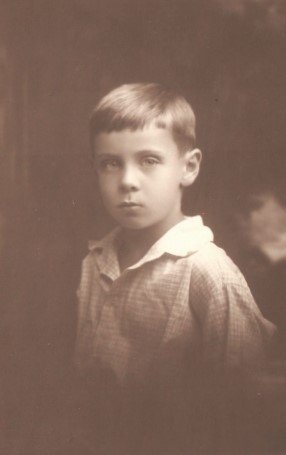
Stanisław (Staszek) Baraniecki
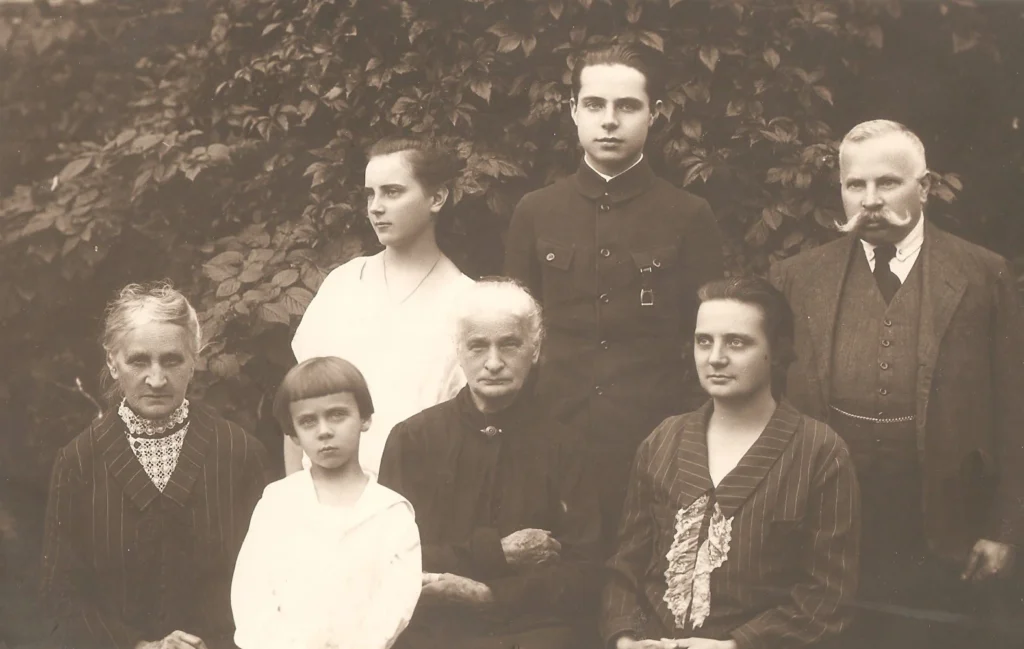
The Baraniecki family in 1926. Front row: Felicja Baraniecka, Staszek Baraniecki, Wanda Salomea Frischman and Wanda Baraniecka.
Back row: Barbara Baraniecka, Kazimierz Baraniecki and Franciszek Baraniecki.
1. Building the House in Dynów
Even before his marriage, Franciszek began building a new house in Dynów.
Around 1890, a long series of business dealings began, culminating in the demolition of the old, two-hundred-year-old house in 1902 and the start of construction of a new one.
The building work was carried out in three stages:
- 1903 — the pharmacy section, with living quarters upstairs.
- 1909 — the addition of a matching section on the southern side.
- 1923 — the addition of a section on the northern side, housing a shop. Nearly fifty years later, this section was bought by a certain Kazimierz Majda.
It was an enormous investment, for which the money was somehow found.
The documents show that Grandpa Franio took out mortgage loans, but not enough to cover the construction. After all, what was a loan of 8,000 crowns from the local savings and loan institution compared with a building valuation of more than 40,000 crowns?
During this period, in 1911, Wanda Salomea also transferred her entire estate — all the Baraniecki family’s real property — to her son Franciszek.
The transfer obliged Franciszek to pay out his siblings’ shares. The sum came to 28,000 crowns.
To meet this obligation, Franciszek borrowed substantial sums from his uncle Władysław, who agreed to accept the same rate of interest as he received at the bank.
A few years later, Franciszek decided to add a matching section to the house.
To do so, he had to purchase the adjoining plot.
This plot had long belonged to the Jewish Kalter family, specifically to Leiba Izaak Kalter, who became its sole owner in 1906 through a series of family agreements.
That same year, under a contract dated 8 August 1906, he sold it to Franciszek Frischman.
The matter was not quite so simple, however, because the legal work of “clearing” the Kalters’ title continued until the very last moment.
I give a detailed account of these transactions in Appendix VII.
By 26 October 1917, Franciszek had paid off all the debts associated with the construction, and the property was free of debt.
One might call that impressive. Besides meeting the cost of building what were effectively two houses, and settling with his mother and siblings — 28,000 crowns for Zofia’s daughters, Wanda and Zofia, as well as Stanisław and Filip — Grandpa also managed to clear the debts secured against the property.
I find Franciszek’s energy quite extraordinary.
Building two houses was not enough for him.
Both then and later, he also lent money to people all around him, registered claims against their properties, and received promissory notes. Eventually, on the plots purchased from Chana Mindla, he decided to build the third section of our house on the Market Square.
This third section housed a shop and was later bought by Kazimierz Majda.
Building the house — or rather, the houses — was the most important of the many investments Grandpa undertook during the first twenty-five years of the century.
Through these activities, the Frischmans grew in strength.
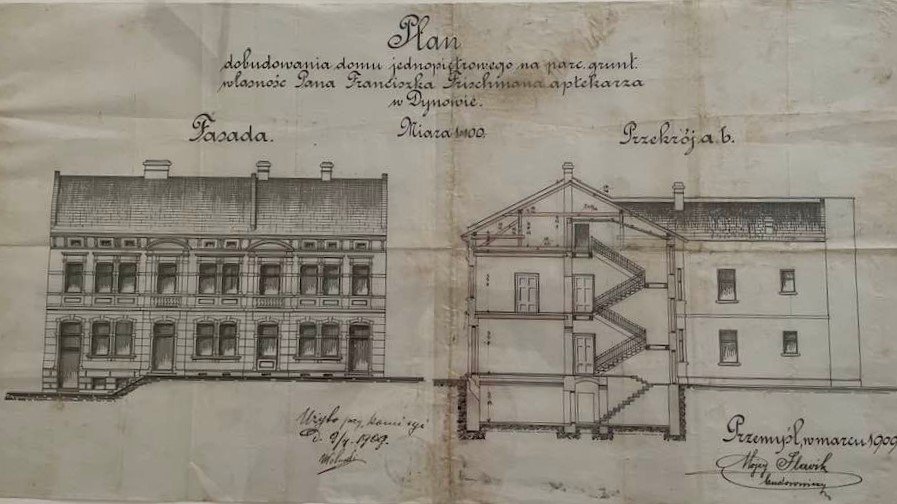
Plan of the house in Dynów, 1909.
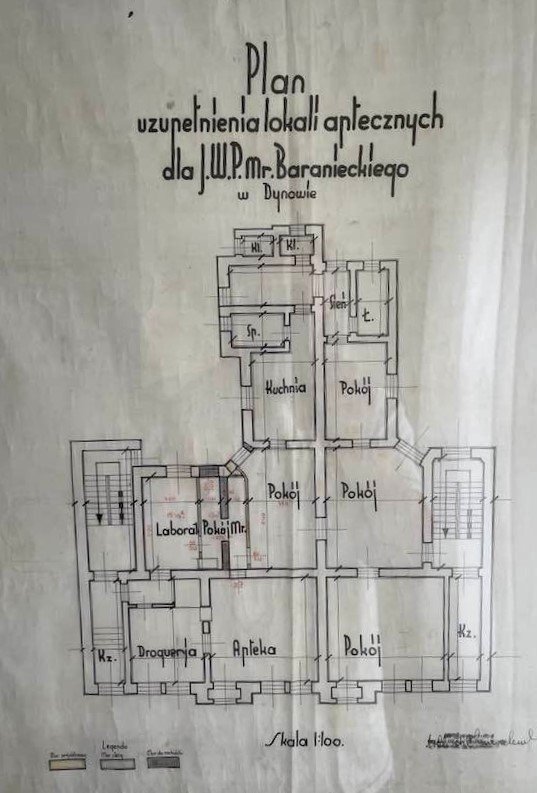
Plan of the house in Dynów, 1923.
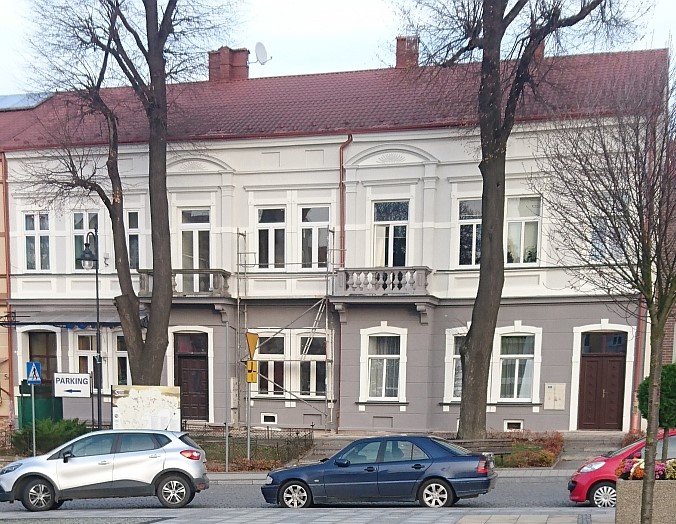
The house in Dynów, 2019.
2. Adoption and a Change of Surname
In 1918, Franciszek, along with millions of others, lived to see an independent Poland!
Enthusiasm, boundless joy, entirely new challenges, a new way of life — everything!
It was a new country!
It was then that he decided to give up his German surname and take his mother’s.
On 4 October 1989, my Father explained the circumstances to me in a letter:
“In one of your letters, you ask about the change of surname. Grandpa Franio was a great Polish patriot. As soon as Poland regained its independence, his German surname no longer suited him.
He wanted to take his mother’s surname.
The name that had been associated with the pharmacy from its beginnings.
In his heart, he considered himself a Baraniecki.
To make everything legal and proper, it was done through adoption.”
In those days, a person without children of their own could adopt.
Franciszek’s uncle Władysław Baraniecki — the brother of his mother, Wanda Salomea — was a childless bachelor, so he was eligible.
At the same time, Franciszek’s brother Filip, encouraged by Franciszek’s actions, decided to do the same.
He was adopted by his aunt, Felicja Baraniecka.
I include all the documents concerning this matter in Appendix VIII.
Franciszek’s grandfather, Feliks Baraniecki, had engaged in various property dealings, lent money, registered claims against properties and increased his holdings. Franciszek, and his mother before him, did all this on an incomparably greater scale!
Between 1895 and 1938, Wanda Salomea and then Franciszek carried out so many property purchases and sales, and so many related financial transactions, that merely listing them would be quite a challenge.
Buying building plots and farmland, lending money against mortgages, and, in addition — though this was really a minor matter — continually buying paintings: it was a never-ending round of activity.
My Father often took a sceptical view of his own father’s actions, but he thought very highly of the adoption and the change of surname:
“Yes, it is true that some of Grandpa’s decisions were misguided and old-fashioned. But in this decision — changing from his father’s surname to his mother’s — he showed just how progressive and far-sighted he could be!
It was an enlightened decision, made with an eye to the future!
The name Frischman was perfectly suitable in Austrian times, but in the new Poland it was becoming unpopular.
And for that we owe Grandpa our gratitude!”
3. Kazimierz’s Years
My Father, Kazimierz, the eldest son of Franciszek and Wanda, followed a path that seemed almost natural in our family.
He became a pharmacist.
He was yet another member of the family to enter this profession. Wojciech Okoński, Feliks Baraniecki, August Frischman, Franciszek Frischman-Baraniecki — and now he.
And, like his father and grandfather, he studied at the Jagiellonian University.
On 29 September 1927, he began his studies in the Pharmacy Division of the university’s Faculty of Philosophy.
Three years later, on 20 October 1930, he completed them, receiving the degree of Master of Pharmacy.
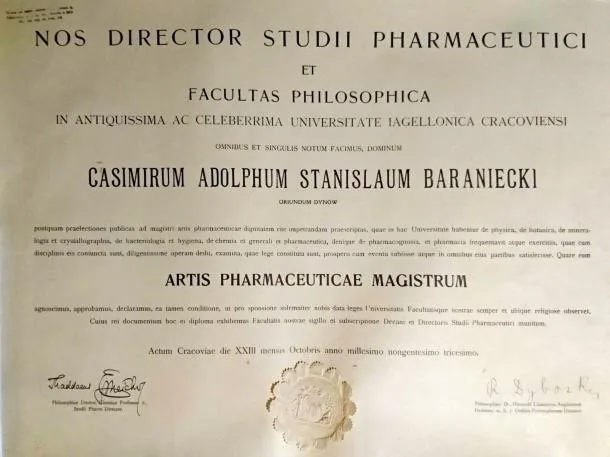
Kazimierz Baraniecki’s university diploma.
After graduating, following the custom of the time, he began a series of practical placements to prepare himself more thoroughly for taking over a pharmacy of his own.
I list these places of employment in Appendix XIII.
On 8 February 1945, Franciszek Baraniecki and Kazimierz Baraniecki applied to the District Administration in Brzozów for permission for Kazimierz to manage the pharmacy in Dynów.
Permission was granted.
Franciszek also transferred to Kazimierz his druggist’s shop at 7 Mickiewicza Street in Dynów.
The shop had been his since 12 September 1913, when the Imperial and Royal District Administration in Brzozów granted him a licence to operate it.
On 3 December 1938, the District Administration in Brzozów also authorised him to sell poisons and products containing poisons in the shop.
This authorisation was granted under a ministerial regulation dated 21 April 1876.
Later, on 9 February 1944, during the German occupation, the district governor in Krosno — Der Kreishauptmann, in the Kraków District of the General Government — confirmed the licence.
Following Franciszek Baraniecki’s transfer of the pharmacy and the druggist’s shop to Kazimierz Baraniecki on 24 January 1945, the licence was transferred to Kazimierz on 22 March 1945.
4. The War
On 6 May 1940, Franciszek Baraniecki’s second son, Stanisław, was arrested by the Germans in Dynów. He was taken to Tarnów and then sent, on the first transport, to the newly established Auschwitz concentration camp, where he was assigned prisoner number 208.
Before the outbreak of war, Stanisław had attended the private Jesuit secondary school in Bąkowice near Chyrów.
He died on 27 January 1941, tortured to death by the Germans, but the news reached Dynów only later.
Here is a recollection of him written by my sister, Maria Baraniecka-Witkowska.
A secondary-school graduate, not quite nineteen, a cheerful “life and soul of the party”, a carefree boy.
He was the youngest son of Wanda and Franciszek Baraniecki, born on 4 March 1922.
After a rather unsuccessful stay at the Jesuit boarding school in Chyrów, now in Ukraine — Staszek disliked its strict discipline — he went to live with his Grochowicz grandparents in Przemyśl. It was there, probably at the Słowacki Secondary School, that he passed his school-leaving examinations in 1939.
We do not know what his plans were.
He spent the summer before the war going on outings, socialising and playing sports. In one of the surviving photographs, he is standing with friends beside the ship Batory.
We know nothing more about Staszek during the first year of the war.
In May 1940, the tragedy began.
Staszek, together with several other boys from educated families in Dynów, was arrested by the Gestapo and taken with the others by lorry to the prison in Tarnów. From there, on 14 June, they were sent to the newly established Auschwitz concentration camp and placed in the “care” of brutal German prisoners. Staszek was given number 208. This was the first transport of prisoners.
Then began the ordeal described by the few who survived…
But the Germans kept up appearances. Staszek sent his parents a few letters, naturally in German, saying that he was healthy, that he had received the parcel (??), and that he lacked nothing. I have included one of these letters.
With virtually no information available — radios had been confiscated at the beginning of the war, and the newspapers were Nazi propaganda sheets (??) — receiving such letters offered a little hope and eased their fears. But no one had any idea what this Auschwitz concentration camp was…
Then came the terrible, freezing winter of 1940–41. Staszek worked in the electricians’ work detail, as Cardinal Adam Kozłowiecki mentions in his book Ucisk i strapienie, on page 146.
What had he “done wrong”? How had he angered the kapo? According to the accounts of Władysław Fuksa and Tadeusz Krupiński, held in the archives of the Auschwitz Museum, he was savagely beaten, doused with water in the freezing cold, and died in agony. It was 27 January 1941. His parents received a telegram two days later. Horror, despair, unanswered questions…
And that was how things remained. No one spoke about Staszek. Only a large photograph on the dining-room wall recalled him. His parents remained in mourning until their deaths in 1955 and 1971. They never knew the full truth, saying only: “He died of cold and hunger.”
Staszek’s older brother, our Father, learned the details from a fellow prisoner, Mr Wyszatycki, who had survived the camp. Thank God he kept them secret until his parents had died.
To us, his nieces and nephews born after the war, Staszek was an unknown figure whose fate, like that of so many others, had been sealed by the war. With the adults remaining silent, we felt we must not ask.
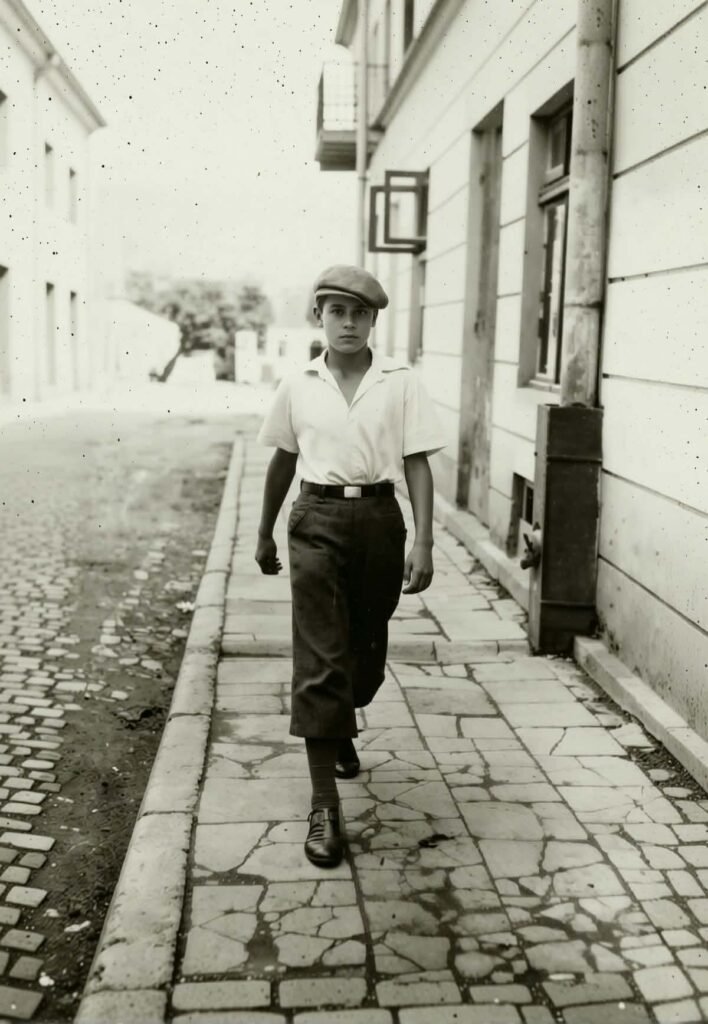
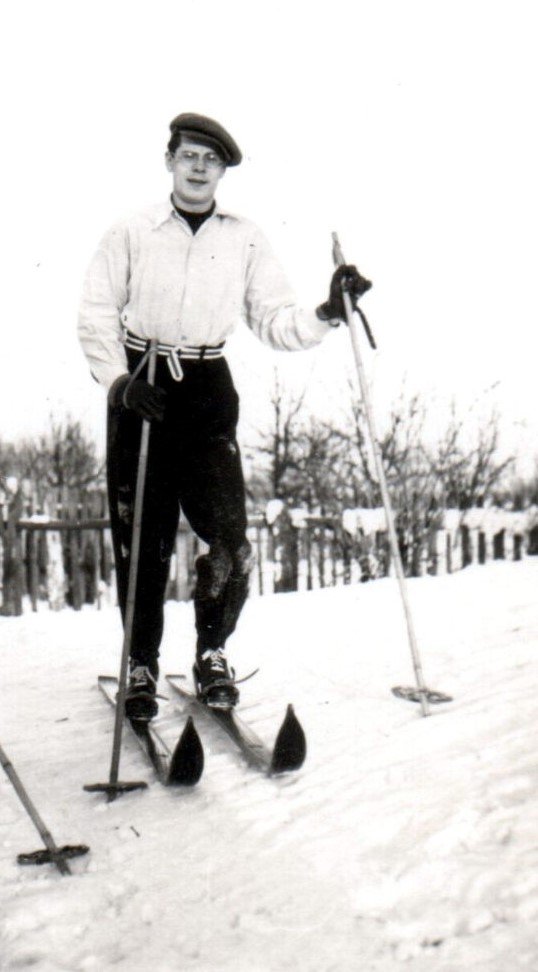
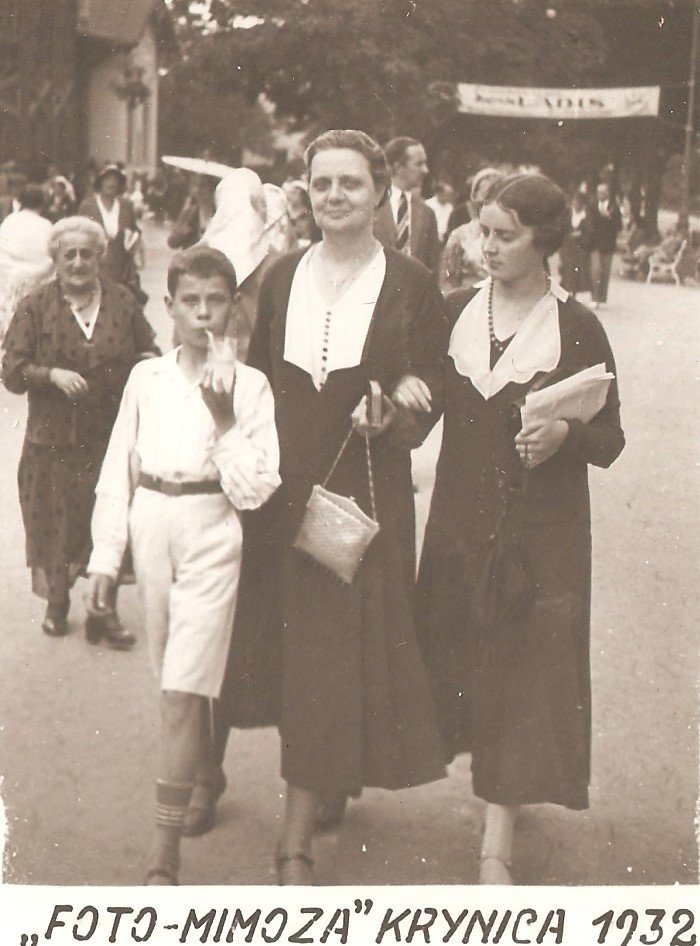
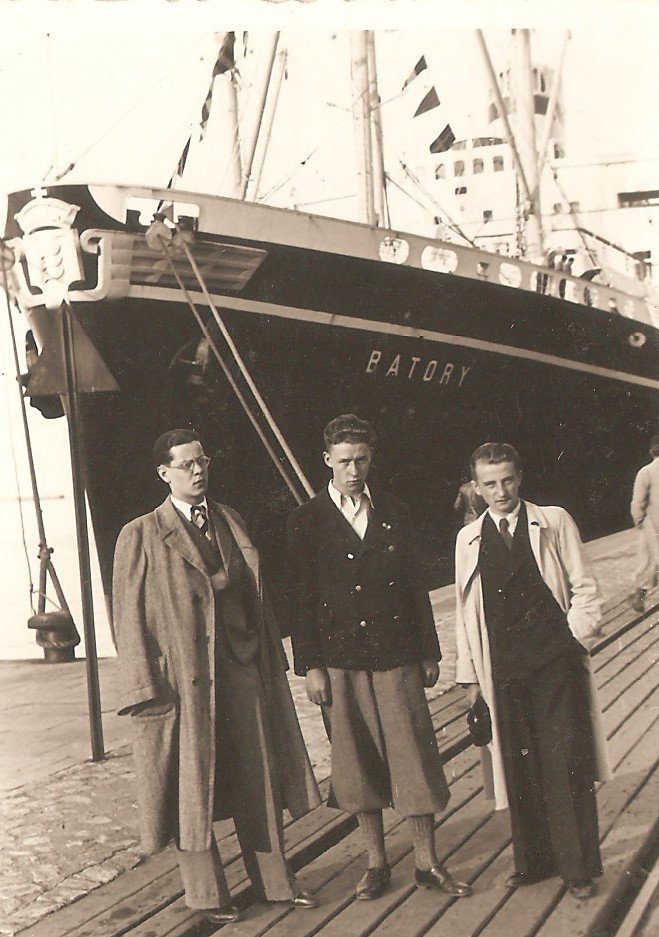
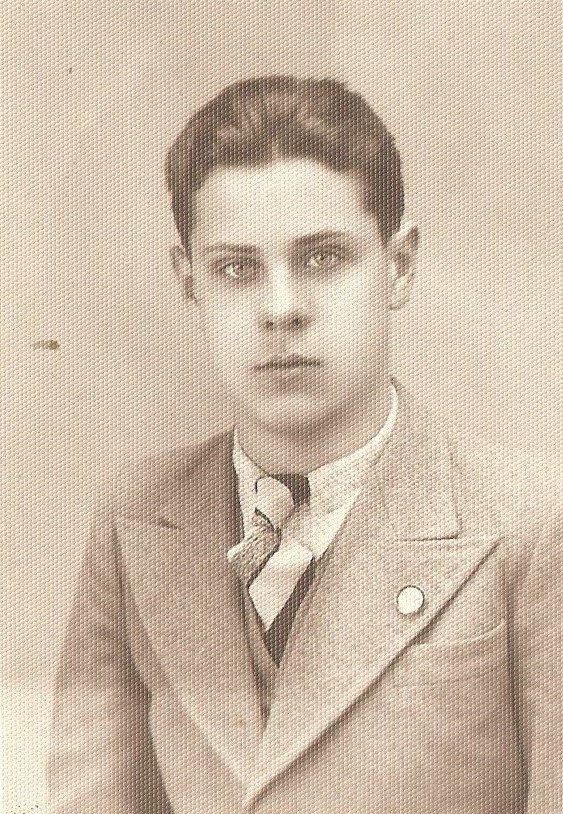
Stanisław (Staszek) Baraniecki – photographs from the family archive.
5. Staszek’s Letters from Auschwitz to His Parents
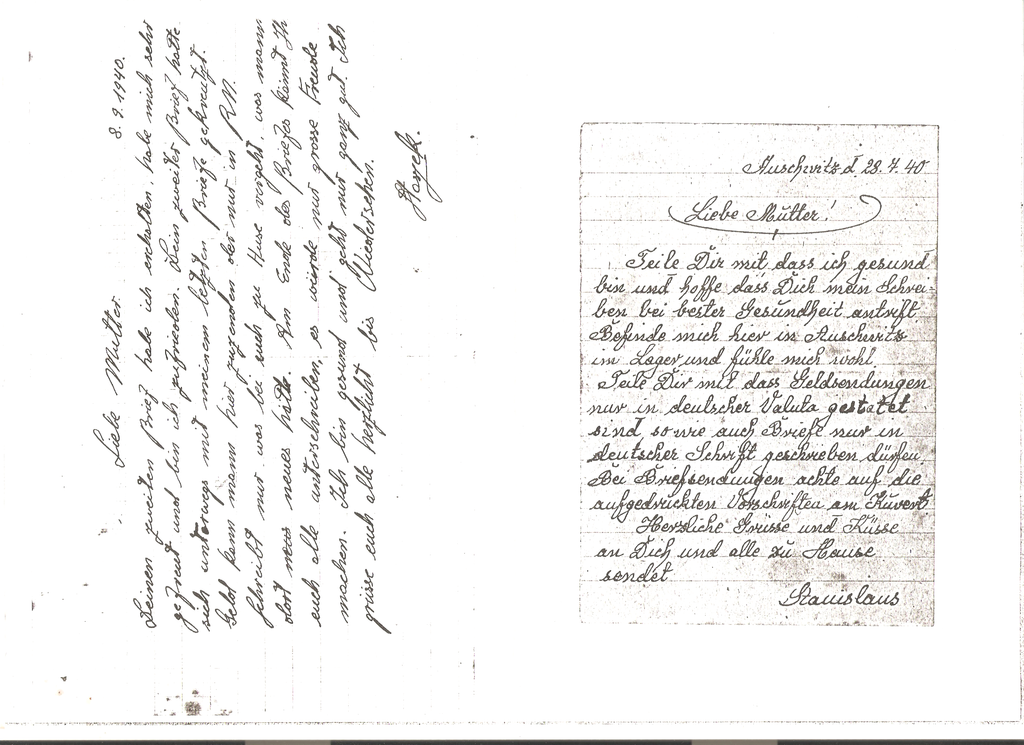
Staszek Baraniecki’s letter from Auschwitz, sated 28 July 1940 – original.
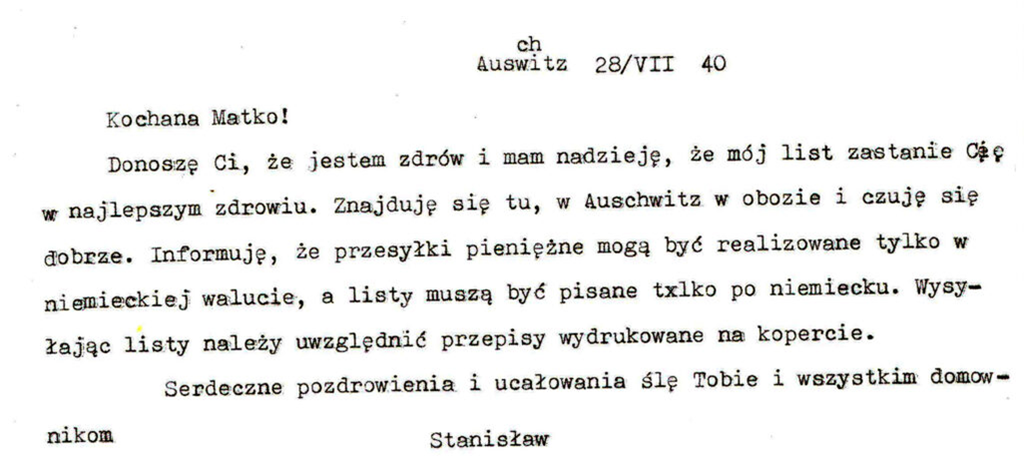
Auschwitz, 28 July 1940
Dear Mother!
I am writing to let you know that I am healthy, and I hope this letter finds you in the best of health. I am here in the camp at Auschwitz and am feeling well. Please note that money can only be sent in German currency, and letters must be written only in German. When sending letters, please follow the regulations printed on the envelope.
I send warm greetings and kisses to you and everyone at home.
Stanisław
8 September 1940
Dear Mother!
I have received your second letter. It made me very happy. I am pleased. Your second letter crossed with my last one. Money can only be sent here in RM. Write only about what is happening at home.
Please have everyone sign at the end of the letter. That gives me great joy. I am healthy and am getting along quite well. Warm greetings to you all. Until we see each other again.
Staszek
Telegram
German Post East
Telegram sent from Auschwitz
31/29 — 29 January — 20:02
Telegram received
30 January 1941 — 08:07
in Reichshof [Rzeszów]
Franciszek Baraniecki
Dynów
Rynek 10
Brzozów district
Your son Stanisław died today in the concentration camp at Auschwitz, as confirmed by the command of the Security Police and Police (?) of the Kraków district (?).
Camp Commandant
The remaining letters Stanisław sent from the camp, together with further information about him, are included in Appendix IX.
6. Attacks on the Family Home and Pharmacy in Dynów
During the German occupation, the Pharmacy continued to operate as usual. But besides the terrible tragedy of the imprisonment and killing of Franciszek and Wanda’s youngest son, Stanisław, three other events shook our Home.
Here they are, as recorded by Franciszek Baraniecki.
The first incident:
30 September 1943. At 7:30 in the evening, while we were sitting at supper, two masked thugs came in with revolvers in their hands. They robbed us of two watches and two rings, and took Basia’s cash. They took everything from the safe. Present at supper were Wandzia, Basia, Mrs Kamińska, Wojtuś, Andzio, Kazio and myself. The robbery lasted forty minutes. I was forced to open the safe. One of these two thugs was — this has been established — Józef Koczyło [or perhaps Koryto — Grandpa’s tiny handwriting is difficult to read] from Pawłokoma, who was shot dead some time later.
The second incident:
16 November 1946. At about half past ten in the evening, Ukrainians burst into the pharmacy. In three successive raids, there were about a hundred thugs each time [this part of the sentence is very difficult to read]. They completely stripped three (?) rooms in the pharmacy of all medicinal preparations, [illegible word], and several dozen pharmacy vessels. Among these robbers were two doctors and one Master of Pharmacy. About ten to fifteen shops were also completely looted, and several people were shot dead. They also took our books, records kept over many years, and ten volumes of the Encyclopaedia. They smashed a window in the pharmacy and destroyed the blinds. There was very heavy rain and mud at the time.
The third incident:
During the night of 23–24 August 1948, robbers broke into seven tombs in the new Cemetery, including ours. They moved my late Mother’s coffin aside. An iron bar above the coffin (?) prevented them from opening it. Aunt Fela’s coffin remained in its place but had been disturbed. The perpetrators were never found.
A detailed account of the UPA attack on Dynów is included in Appendix XI.
7. The Post-war Years
I should add that before the war and into the early 1940s, besides his regular work in the pharmacy, our Father was also a co-owner of a factory producing shoe trees and shoemakers’ lasts, known as the “Kopyciarnia”.
The factory had been established in the 1920s and continued under that name until the 1960s, when it became “Zakład Drzewny”, and later “Respan”.
Father sold his share in the factory in 1942.
In return for the Pharmacy and the druggist’s shop, which had been given to him, my Father undertook to support his parents, Franciszek and Wanda Baraniecki, for the rest of their lives.
On 21 January 1945, Kazimierz married Małgorzata Paygert, born on 10 June 1922, the daughter of Józef Kalasanty Paygert and Józefa, née Trzecieska.
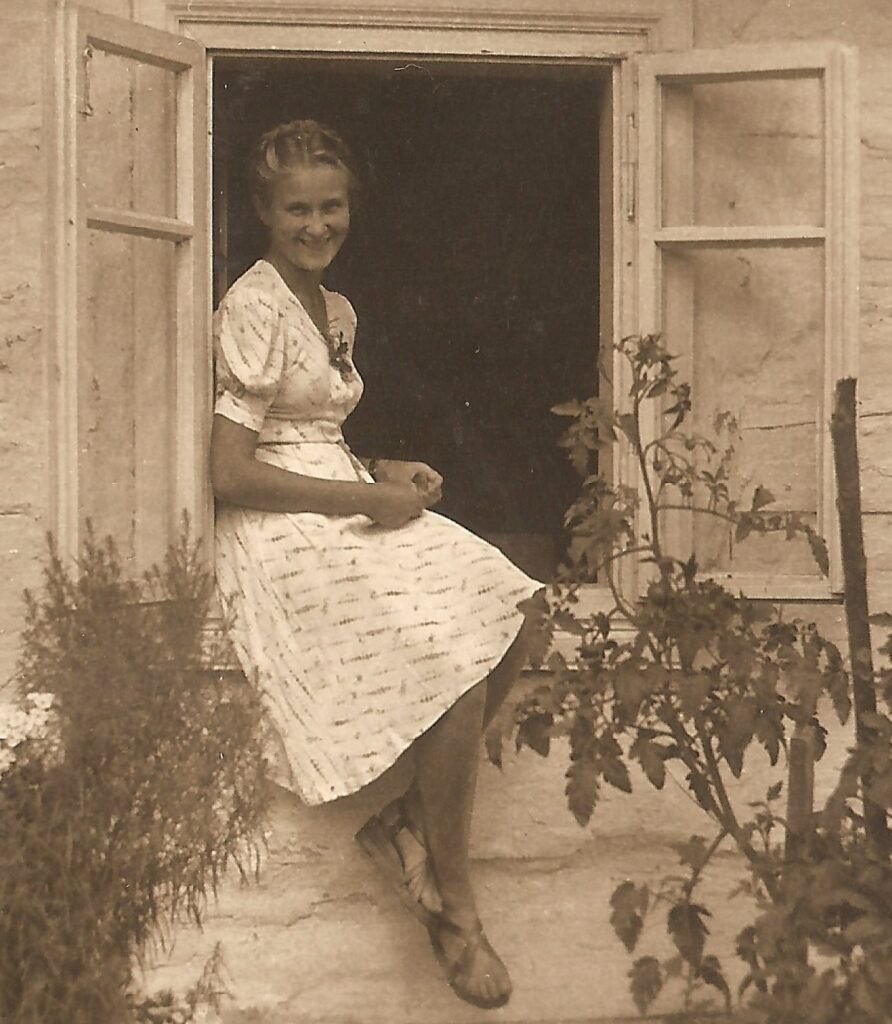
Małgorzata Paygert. Dynów, 1942.
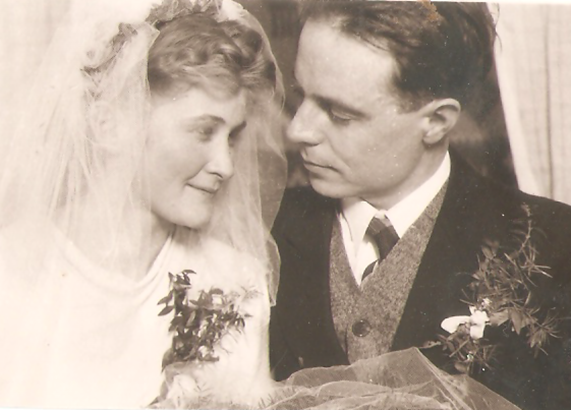
Małgorzata and Kazimierz Baraniecki on their wedding day.
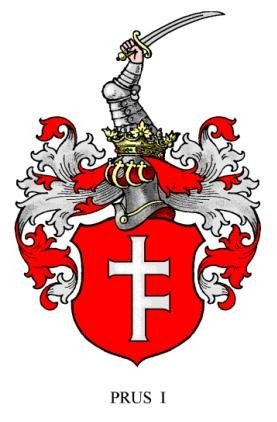
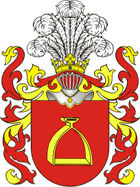
The Prus I coat of arms of the Paygert family. The Strzemię coat of arms of the Trzecieski family.
Kazimierz Baraniecki owned the Pharmacy until 8 January 1951, when it was nationalised. Almost exactly six years.
What happened to the druggist’s shop — I do not know. Whether Father sold it or whether it was seized, like his Pharmacy — I do not know.
Kazimierz’s younger sister, Barbara, who was married to Karol Kaszycki, left Poland in 1947 with her sons, Wojtek and Andrzej. They went first to Germany and then to England. From there, on 18 January 1952, the entire Kaszycki family sailed to the United States to begin a new life.
On 5 September 1948, Father was called up for military service and left for Łódź.
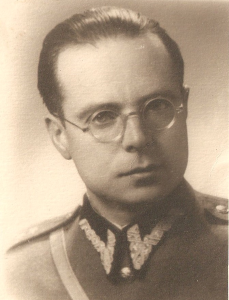
Kazimierz Baraniecki, 1949.
On 14 November, he returned for three days, and on 17 November he left for Lublin.
He served in Lublin from 17 November 1948 to 17 June 1949. From 26 June to 23 December, he served in Oksywie, Gdynia.
On 18 October 1948, my Mother received a notice from the Municipal Administration in Dynów stating that, as the wife of an officer in the Polish Army, she was entitled to a Category I ration card. The children — Maria, born on 10 April 1946, and Marek, born on 31 March 1948 — were entitled to ration cards in Category “I.R.D3”.
During his approximately fifteen months of military service, Father worked for nine months as a pharmacist, three months as an accounting clerk, and three months as a dispatch clerk.
When he received his first officer’s rank, that of second lieutenant — I do not know. In any case, when his military identity card was issued on 1 January 1949, he was already a lieutenant.
My Mother, Małgorzata Baraniecka, née Paygert, had been employed at the pharmacy since 21 January 1945, preparing labels. She also prepared prescriptions.
In October 1951, she was nominated by the Central Administration of Public Pharmacies for a pharmacy assistants’ course. But on 10 April 1953, the Administration decided not to admit her to the correspondence course for prospective pharmacy technicians.
8. The Nationalisation of the Pharmacy
The realities of those days are well illustrated by the notes my grandfather, Franciszek Baraniecki, made at the time.
Here they are:
On 16 November 1950, the pharmacy was robbed once again. Two tax officials came. They carried out a thorough search of the pharmacy. They took all the money Kazio had in his private home. They ordered me to open the Wertheim safe. Fortunately, they found nothing.
And another entry, about the nationalisation of the pharmacy:
9 January 1951. At about eight in the morning, while I was at church, four tax officials from Brzozów descended on the pharmacy with the news that it was being nationalised. After making a detailed inventory of all its stocks and equipment, they left at about three in the afternoon. One can imagine the effect this bolt from the blue had on us. Whether we shall be able to remain in our private living quarters is unknown. As Kazio, until now the owner and manager of the pharmacy, will henceforth receive only a monthly salary, the substantial (?) income I had been receiving has been brought to an end.
My Father remained at the pharmacy as its manager until 4 March 1980 — twenty-nine years.
On 26 March 1955, Grandpa Franio — Franciszek Baraniecki — died.
9. The Forest Dispute
Even before Grandpa Franio’s death, the confiscation of the pharmacy through nationalisation was accompanied by other forms of harassment.
One of these was the state’s seizure of the forest in Bartkówka, which Grandpa had held since before the war.
It is an interesting example of the post-war confusion.
On 6 August 1945, acting on an application by Franciszek Baraniecki, the local court in Dynów ordered the restoration of his possession of the thirteen-hectare forest in Bartkówka, which he had owned since 1933.
Under the decree issued by the Polish Committee of National Liberation on 12 December 1944, all forests covering less than twenty-five hectares — including the forest in Bartkówka — were exempt from takeover by the State Treasury.
Nevertheless, probably after the court had issued its ruling, the authorities discovered that Grandpa owned another forest in Wara. Its area, combined with that of the forest in Bartkówka, exceeded twenty-five hectares, so both forests became state property.
They had failed to read that the decree referred to twenty-five hectares within a single forest tract.
Something must have held the matter up, however, because it was not until 8 February 1949 that the State Forests Directorate in Tarnów sent a decision ordering the return of the forest in Bartkówka. As though the court’s ruling of 1945 had never existed.
The forest was restored to Grandpa, but at the same time it was stipulated that:
Since the forest had been administered by the state from 12 December 1944 to 31 December 1948, Franciszek Baraniecki must reimburse the State Treasury for the costs of that administration (!) in the amount of 24,960 złoty.
Grandpa must have paid the sum, because the forest remained ours. In later years, we harvested timber there and had it sawn into boards — naturally, with the required permits, which were by no means easy to obtain.
10. The Inheritance
Franciszek Baraniecki died, and proceedings to settle his estate began soon afterwards. But the matter was not straightforward, because various plots, ownership shares, farmland and forests remained from before the war.
The Jews of Dynów had perished or had managed to leave. There were no witnesses, and above all there was the constant fear that the family would be accused of possessing “riches” and burdened with an enormous tax bill.
That was also when the much-discussed fear arose that tenants would be assigned to live with us. Under the new regulations, our living quarters — on the ground floor and upstairs — were too large.
Nevertheless, there was an estate, and three people had a claim to it:
Franciszek’s widow, Wanda Baraniecka, and her two surviving children:
Kazimierz Baraniecki
and
Barbara Kaszycka, née Baraniecka.
On 9 July 1957, before a notary in Houston, Texas, USA, Barbara Kaszycka signed a declaration stating that she made no claim to her father’s estate, as he had already provided for her during his lifetime.
The original declaration is in my possession.
On 27 February 1962, she also signed a notarised deed of gift, transferring her shares in Franciszek Baraniecki’s estate — particularly her joint ownership interests in the plots of land — to her mother and brother.
In addition, on 9 April 1962, Barbara Kaszycka signed another notarised document granting Małgorzata Baraniecka, née Paygert, power of attorney to represent her in all matters relating, among other things, to Franciszek Baraniecki’s estate.
This power of attorney was extraordinarily broad. It authorised my Mother to manage all of Barbara’s movable and immovable property in Poland, to make all decisions, and to represent Barbara in all matters concerning her.
There is no doubt whatsoever that Grandpa Franio’s death was a tremendous shock to the whole family, both close and extended. Many friends and acquaintances also sent letters of condolence which seem to have been truly heartfelt. Grandpa was widely liked. He was quiet and unassuming, yet a source of strength and support for everyone.
With him, the spirit of a passing era was also disappearing — the era of the privately owned pharmacy that had been his workplace for fifty years.
Settling his estate involved all sorts of complications. From before the war, besides the house containing the pharmacy, Grandpa owned seven plots of land, two forest tracts, a considerable area of farmland, and many movable possessions, including the paintings already discussed at length.
Then came the taxes to be paid, and all this gradually set off a fever of selling things.
During the 1960s, more and more dealers, swindlers and people hunting for all manner of old objects began to appear.
There was also a certain Mr Aleksander Rybicki, who, unlike the others, was a genuine collector, a curator at the museum in Sanok, and a man of considerable merit.
He began visiting us. Our house, still overflowing with old things at the time, was a tempting prospect for Mr Rybicki.
Whether all these sales made sense is difficult to judge today.
Money was needed — that is certain. But Mother was also eager to get rid of the unnecessary burden that was “all on her shoulders”!
She was simply tired of the great, old-fashioned “machine” that was the house in Dynów, its lack of any modern comforts, and its vast accumulation of old clutter.
It all weighed her down.
She was the only person able to manage the building and “do battle” with the Housing Management Fund, which, on behalf of the Presidium of the National Council, administered the “financing of repairs and the restoration of housing stock”.
These were no small matters!
In those days, dealing with government offices was a challenge!
So we sold whatever we could. And since Mr Rybicki always put cash on the table and bargained only modestly, he was always welcome.
Today, looking back over the years, I regret the loss of many of those objects. They could still delight the eye and remind us of “the days of former glory”. But “this is no time to mourn the roses” — what is past is past…
11. A Ghost from the Past
During the proceedings to settle Grandpa Franio’s estate, quite unexpectedly, like a ghost from the past, out of nowhere, the famous Chana Mindla Fränkel, née Weinberger, surfaced once again!
The matter concerned recognition of ownership acquired through long possession of a plot which had belonged to Chana before the war and against which Grandpa Franio had registered his claim.
That claim arose from the $1,000 Grandpa had lent Chana.
In two instalments.
The first on 3 September 1928, and the second on 3 July 1931.
The agreement concluded before the court on 18 December 1935 clearly stipulated that the plot served as security for the loan, which was due for repayment on 31 December 1935.
The debtor — or, rather, the registered owner of the property — Chana Mindla Fränkel, was unable to repay the debt, which, incidentally, considerably exceeded the value of the property. Consequently, in January 1936, the two parties agreed that Franciszek Baraniecki would take ownership of the plot.
12. The Final Years in Dynów
Ownership through long possession was eventually recognised, but further difficulties kept arising, because the complicated division of the land on which our house stood created additional problems.
On 17 October 1971, Franciszek Baraniecki’s widow, Wanda Baraniecka, née Grochowicz, died, leaving two heirs: Kazimierz and Barbara.
Barbara Kaszycka, represented by Małgorzata Baraniecka, gave her shares in the estate to Kazimierz.
On 18 September 1971, a conditional deed was drawn up for this purpose, described as a conditional agreement of gift.
The question was whether the National Council would exercise its right of pre-emption.
Such was the law: the state had the first right to purchase any property offered for sale.
The gift took effect, and Kazimierz Baraniecki became the sole owner of the property.
By then, his children had moved to Warsaw, and he himself was approaching the end of forty-three years of work at the pharmacy in Dynów and exactly fifty years as a pharmacist.
On 4 March 1980, Kazimierz Baraniecki ended his professional career and retired.
At the same time, the Municipal National Council in Dynów expressed an interest in purchasing the entire property.
In accordance with the valuation report, the price was set at 458,484 złoty.
The actual value of the property was much higher — 2,439,351 złoty — but its deterioration was taken into account, reducing the price to one-fifth of that amount. This was hardly surprising: more than sixty years of only sporadic maintenance had taken their toll on the building.
After the sale, our Parents moved to Warsaw, bringing the Baraniecki family’s 142 years in Dynów to an end.
After completing their studies, Kazimierz and Małgorzata’s children began working in Warsaw.
In 1969, Maria Baraniecka settled with her family in Michalin, near Warsaw.
In 1980, Marek Baraniecki emigrated to Canada with his family.
In 1984, Marcin Baraniecki also left for Canada with his family.
Five Generations – Conclusion
The history I have presented here spans almost three centuries, but our Family lived in Dynów for only a little over 140 years.
In historical terms, that is not a long time. Yet many parts of the story are still immensely difficult to reconstruct.
Although our Family took care to preserve the memory of the past, and I had invaluable help from documents, diaries, recollections and, above all, my Father’s phenomenal memory, there are still many parts I have been unable to explain!
I have not managed to uncover them and bring them to light.
My story of five generations of our Family ends in 1980, but that is certainly not the end!
As I have mentioned, Kazimierz and Małgorzata Baraniecki had three children, and those children are now grandparents themselves.
So, to the five generations described here, we must add three new generations of the Family.
I leave this work to them, sustained by the hope that they will add to it and pass it on to their grandchildren and great-grandchildren!
For we Baranieckis love our past!
Five Generations – Appendix I
The Pharmacy Profession in the Nineteenth Century
In the nineteenth century, the path to becoming a pharmacist was different from what it is today, in the twenty-first century.
It is worth explaining it here, because without this background, the later history of the pharmacy in Dynów is difficult to understand.
Pharmacy was a profession requiring specialist training. Simply inheriting a pharmacy or having enough money to buy one was not sufficient.
An aspiring pharmacist gained practical experience in a pharmacy, then continued his education and undertook studies leading to a master’s degree in pharmacy.
The pharmacy profession in the Austro-Hungarian Empire was fairly strictly regulated. From 1804 onwards, anyone wishing to become a pharmacist was required to complete a one-year course at the Faculty of Medicine of the University of Vienna and pass an examination.
The examination was conducted by the Pharmacy Council established by Emperor Francis II in 1796, rather than by representatives of the University, although the Faculty of Medicine was authorised to assess pharmacists’ professional knowledge.
The examination was followed by at least two years of practical work in a pharmacy. Something akin to a journeyman’s training.
As an aside, I should add that from 1853 onwards, the course of study lasted two years and led to the degree of Master of Pharmacy.
Despite these regulations, pharmacy students were not regarded as fully fledged university students, because they were not required to have passed their secondary-school leaving examinations.
This exemption from the requirement for a secondary-school leaving certificate continued until 1920.
In the mid-nineteenth century, university studies in pharmacy were required only when purchasing a pharmacy or working as a “prowizor”, a qualified pharmacy manager — as was the case with August.
Obtaining the degree was expensive, and many assistants could not afford it.
Those who did not complete their studies remained assistants.
The cost of buying a pharmacy was so high that only a few could afford one.
As a result, two groups of pharmacy assistants emerged: those who had the qualifications but could not afford to buy their own pharmacy, and those who, without meeting the academic requirements, remained assistants for life.
That is enough by way of explaining the situation of pharmacists in mid-nineteenth-century Galicia.
Five Generations – Appendix II
The Criminal Case of Antoni Frischmann
A grim and not entirely clear story is associated with Antoni, Franz’s brother.
I include it here solely for the sake of the historical record.
According to the documents, Antoni Frischmann was the municipal treasurer in Śniatyn and also managed the Kornicz estate near Kołomyja.
In 1848, this same Antoni — to be clear, I repeat: Franz’s brother — applied to the Galician Estates Committee for confirmation of his noble status.
At the time, this was a standard procedure introduced by the Austrians in 1772 to bring the rights and obligations of the social estates into line.
In Galicia, many members of the nobility ignored this requirement for patriotic reasons. Others, however, approached the authorities and submitted their pedigrees, coats of arms and other documents for approval.
Antoni therefore applied for confirmation, but the authorities refused, arguing that he had no records establishing his membership of the Hungarian nobility.
At the same time — although I do not think it was connected with his application for confirmation of noble status — a matter came to light involving Antoni, in his capacity as municipal treasurer, and a certain Franciszek von Eichhorn, a landowner from Wołczkowice in the Kołomyja district.
Here is a certified copy of the judgment, bearing “app. [appellate?] no. [?] 1386”:
Imperial and Royal Galician Court of Appeal
We uphold the judgment of the Imperial and Royal Criminal Court in Stanisławów dated 13 June 848, no. [?] 13670, concerning the proceedings begun on 20 November [of the previous year?] and concluded on 9 June 848 against Antoni Frischmann for the theft [committed by him] against Franciszek von Eichhorn, a landowner from Wałczkowice.
For this offence, the perpetrator was sentenced to eight years’ imprisonment, the loss of his purported Hungarian noble status, payment of compensation to Franciszek Eichhorn in the amount of 5,647 Dutch ducats, and payment of the costs of the criminal proceedings, with Franz Eichhorn reserving his rights should further claims prove necessary. We do, however, reduce the term of imprisonment to five years.
Eder, signed in his own hand. Galician Court of Appeal in Lwów.
17 July 848. Rogalski, signed in his own hand.
This appellate judgment was read to Antoni Frischmann today.
25 July 848. Dobrzański, signed in his own hand.
Certified as a true copy of the original.
[Illegible signature.]
What sort of theft could this have been, considering that Antoni was a public official?
Perhaps it involved some abuse of his official position?
I have no other documents that might shed further light on this grim affair.
Five Generations – Appendix III
Stanisław Adolf’s Letters from America
Stanisław Adolf Frischmann — the son of August and Wanda Salomea.
Born in Dynów in 1878; died in Buffalo, New York, USA, in 1930.
In our Home, little was said about him. When he was mentioned, it was with a hint of sadness or regret…
His portrait hung in the dark entrance hall, and that, too, spoke for itself.
Only fragments of recollections survive about what he did before emigrating.
He is said to have worked as a waiter at the “U Hawełki” restaurant in Kraków, and supposedly served in the Austro-Hungarian Navy in Trieste. But, to tell the truth, there is no evidence of either.
The evidence begins only with his departure for America.
In June 1902, Stanisław Adolf boarded the German steamship S.S. Patricia in Hamburg. The ship belonged to the Hamburg America Line, known as HAPAG.
His third-class ticket cost about $30, equivalent to approximately $1,100 today.
After buying it, Stanisław had $14 left in his pocket. That was the amount he declared to the American immigration authorities.
Following a ten-day voyage, S.S. Patricia reached New York on 12 June 1902.
Conditions in third class aboard the Patricia were, I would say, harsh. Passengers slept in shared quarters, with their bunks very close together.
The ship carried more than two thousand passengers. There were only a few bathrooms, with cold water or lukewarm seawater.
Fortunately, meals were included in the price of the ticket. They were simple enough: stews, cabbage and bread.
In the enormous space below deck, where hundreds of passengers slept, the stuffiness was unbearable!
Fortunately, part of the deck had been set aside for third-class passengers, who could go outside for some fresh air.
On arriving in New York, Stanisław underwent an examination. That was the procedure.
Stanisław Adolph was not tall. He was 168 centimetres in height, with blue eyes and, as the record states, brown hair.
Under distinguishing marks, the entry reads: “First joint of right ring finger missing.” This may have been a congenital condition, or the result of an injury later in life.
As I have mentioned, he declared that he had $14, equivalent to about $500 today. The bare minimum to get started.
He was twenty-four.
He also declared that he would stay with a cousin at 14 Lewis Street on the Lower East Side, but this was only a temporary address.
Later, he changed addresses quite often.
By the time of his letter dated 17 November 1903, he was living in Brooklyn.
After 9 December 1904, the letters to Dynów stopped. Great-grandmother Wanda and Grandpa Franio, together with the whole family, waited and waited. Finally, on 23 July 1905, they decided to write to the Austro-Hungarian Consulate General in New York.
A reply arrived on 8 September 1905, stating that Stanislaus Frischmann lived at 199 East 4th Street in New York.
That was not true. The Consulate had given Grandpa an old address which was no longer current. It had not done so maliciously, but the fact remains that no official had been sent there to check whether Stanisław Adolf actually lived at that address. Instead, the Consulate had supplied an address from its old records of 1902.
Stanisław, who by then was already using the name Adolph or Stanley, was living elsewhere.
He remained in New York until 23 May 1908, when he went to Niagara in Ontario, Canada, for two weeks. There he worked for some Jewish women, presumably as a cook.
He was not happy, however, and returned to America, settling in Buffalo, where things began to go a little better for him.
In 1909, at an exhibition in Buffalo, he won two first prizes and one second prize for his dishes.
Feeling a little more confident, he went to Virginia, where he found work as head chef at a hotel. There, his employer’s wife fell in love with him and urged him to take her to Dynów.
“I’ll take $1,000 out of the bank and we’ll go. You can tell your mother we’re married,” she said.
Nothing came of it. As he wrote to his mother, he could never have lied to her and claimed that the woman he had brought home was his wife.
He must have had some money by then, because he offered to buy tickets for Mother, Wandzia and Kazio to come to Hamburg or Fiume on the Adriatic, simply so that they could see one another. He missed them so much.
Nothing came of that either.
Several times, he was robbed of everything. As he wrote, he was left “without a penny to his name”.
Meanwhile, in accordance with the deed under which he had received the pharmacy, his brother Franciszek was completing the payments due to his siblings.
Stanisław’s share was 7,000 crowns, and Grandpa deposited that sum in a savings account.
Stanisław knew nothing about it, although such a sum would have been an enormous help to him at the time.
Contact with Dynów grew increasingly infrequent.
Then came the Great Depression of 1929, which Americans still recall with horror in their eyes. Those were terrible years! The opportunities for work dwindled to nothing.
Stanisław Adolf Frischmann died suddenly from ruptured aneurysms of the thoracic aorta.
It was 10 December 1930, at 11:30 in the morning, in Buffalo.
News of his death must have reached Dynów quite quickly, because in January 1931 Grandpa’s lawyer, Stanisław Sosnowski, wrote to the Consulate of the Republic of Poland in Buffalo to enquire about any estate the deceased might have left.
The reply arrived on 9 February 1931. I include it here.
And that is probably all. Many matters remain unexplained. Perhaps one day someone will find the determination to investigate them thoroughly. For now, however, we must make do with what we have.
Letters from Stanisław Adolf Frischmann have survived.
They are remarkable precisely because they do not describe great historical events.
They describe the ordinary life of an emigrant.
Around 1930, while the whole world writhed and groaned under the burden of the Great Depression, and bodies falling from New York skyscrapers discouraged anyone from going for a walk, Grandpa Franio’s family was doing exceptionally well.
A little earlier, news had arrived from America about Stanisław Adolf Frischmann.
It came from Jakub Wyszatycki, a former resident of Dynów with whom Grandpa Franio was on good terms. Wyszatycki’s entire family had emigrated to America before the First World War.
After the war, Jakub went to visit them and brought back a great deal of news, including news of Staszek.
The last message came through a German named Schwarz, who passed on Staszek’s request for financial help, as he was destitute. Sadly, before arrangements could be made, Stanisław died. It was December 1930.
Here are the letters he sent to Dynów over more than twenty-five years.
In chronological order.
New York, 12 January 1903
Dear Mother,
Do not worry about my not writing, Mother, because really, what am I to write when I know that you and Franz are well? I am well too, and I can say that I am a hundred times healthier and stronger than I was at home. But what good is that when I have no work?
Since I last wrote to Franio, I have done nothing. I did have a place as a cook, but you know yourself, Mother, what sort of cook I am. My employer soon discovered the same thing and told me to clear off. So I am doing nothing, and my head is spinning with thoughts of what will happen next, because I am sick of sitting about idle. I am not afraid of starving, as I have sixty-two dollars in the bank and a few more on me, so I can manage for a while yet. But I am tired of it, and I spend all day running round offices, shops and restaurants, asking whether there is any work. Always nothing.
These are such times that, without exaggerating, at least 250,000 people are out of work. Anyone is glad to work just for board and lodging, and I am beginning to think of that myself, because what else can I do? I am thinking that if I do not find work this week, I will go and become an apprentice in some bakery or something… Otherwise, I lack nothing, dear Mother. I am healthy, I have an appetite, and I sleep well. The one thing I cannot get out of my head is that until December I had some luck, and now it is nothing and nothing. Today I read an advertisement for waiters on a ship sailing to India. That would not be bad, but if you read the newspapers, Mother, perhaps you have seen how many ships are sinking and being wrecked in the storms just now, so I am not very eager to go. There are terrible storms at sea at present. But who knows whether I shall decide to go aboard, if only to scrape through until April. Afterwards, there is enough to be earned to make up for the whole winter.
I have already decided that I will not touch those sixty-two dollars in the bank, even if I have to sell the boots off my feet. And the worst of it is that no job here is secure. Today I work, and tomorrow I may not, even if I am the most honest man alive. Just imagine, Mother, a country where so many rogues and all sorts of people live, and when you apply for a position, the employer asks for no papers or anything. Think for yourself: if some wanderer came to Dynów without any papers, would you take him on?
But things are different here. They cannot be described, and no one would believe it.
A few days ago, I read that an engineer was wanted. Only someone who knew how to cut meat should apply. Would not an engineer in Galicia laugh at that? [The word order in the original seems confused — my note.] Or an intelligent man is wanted to keep an old gentleman company: forty dollars a month, with board and lodging. People rush there, and the man doing the hiring says the position costs ten dollars. You pay the ten dollars and get the job, but the old gentleman throws you out after two days. Then he and the man who hired you share the ten dollars. Such thieving goes on here, and this whole America is nothing but humbug. Everyone cheats and steals as best he can.
And you keep thinking, Mother, that gold lies in the streets here. If I had a trade, that would be something. But since I am nothing here, I too cheat as best I can, because what am I to do?
I would give you my address, Mother, but I do not know where I shall be tomorrow. As soon as I find some work, I shall write to you at once and send you the address.
I kiss your hands, Mother, and send Franio a warm kiss.
My respects to everyone.
Your loving and grateful son,
Stanisław
Here are two more letters from Stanisław Frischmann to his mother, Wanda Salomea Frischmann, née Baraniecka, the widow of August.
Brooklyn, 17 November 1903
Dearest Mother!
On your name day, I wish you all the very best, and above all good health.
I wrote to you at the end of August, dearest Mother, and so far I have had no reply. I left the place where I was working in the summer, as it was only a summer job. For the past three weeks, I have been working somewhere else. I am doing well enough in the sense that at least I am healthy, but I work like a horse, from five in the morning sometimes until eleven at night. I even work on Sundays.
Is the house finished yet? Is Franio well? Please write soon, dearest Mother, and tell me what is happening at home, whether you are well, and what is happening with my brother-in-law. Are Dusia and Zosia well, and what is Zosia’s address in Przemyśl? What is happening with Filip? He has not written to me yet. He seems to be angry with me.
I have nothing to write to you about, dearest Mother, because I know nothing of what is happening at home. I cannot even remember when I last received a letter from you. Once again, I wish you all the very best, and may God grant you many more years of health and happiness.
I kiss your hands, dearest Mother, and send warm kisses to Franio and Dusia.
Your grateful and loving son,
Stanislaus Frischmann
c/o Mr Ch. Lutz
Harrison Ave No. 185
Brooklyn N.J.
America
My respects to all our friends.
The next letter is dated 14 March 1910 and comes from Buffalo. I retain the original spelling, although in places I correct obvious errors.
Buffalo, 14 March 1910
Dearest Mother!
I wish you all the very best for the approaching Easter holidays, and above all good health. I have not written for a long time, but what am I to write when things are always the same with me? I had been thinking of coming home, but I put the idea out of my head. Such thoughts always come to me when I grow tired of this chasing after luck, but it is always the same story.
Since New Year, I have worked only a few weeks in all. Now I am supposed to get another position in a few days, but not in Buffalo. Once again, I am waiting, and so it always goes.
When I start working this time, I shall stay in one place for a few months, then go to California. At least I shall see a little of the world and have a few different adventures along the way.
On 12 March, I came back from Niagara Falls. I had been there for a whole week, working for Jewish women from Hungary. But I grew tired of being under their rule, packed my things, and now I am back in Buffalo.
Dearest Mother, if I were a novelist, I could write several volumes about my time in America. Even so, I never lose hope that I shall come home, though only for a visit, and then set off wandering again. I shall never make a fortune — or perhaps I shall one day; I do not know yet. But I manage somehow, even though things often go badly. I never complain, because complaining would do me no good.
What is happening at home? Write and tell me something about Dynów, dearest Mother. I kiss your hands countless times.
Your grateful and loving son,
Stanisław
On the reverse is a short letter to Grandpa Franio and Grandma Wandzia:
Dear Franio and Wandzia!
I wish you a happy Easter and everything you wish for yourselves. I am not thinking about Easter, because I do not know where I shall be.
What is happening, and how are you getting on? Write and tell me something. I was ill for a few weeks, but somehow I pulled through. Otherwise, there is nothing new with me. What is happening with Filip? I have not written to him, but if he writes to me, I shall reply. How are things with Banach? Do you write to one another? How is your family? Is it growing? In truth, I do not even know how many children you have. Tell me something about yourself. Write back soon.
Kisses to you, Wandzia and the children.
Your truly loving brother,
St.
Address:
Adolph Frischmann
c/o Sam Kirchmann
130 Broadway
Buffalo, N.Y.
The next letter from Stanisław Adolf Frischman in America is undated. I think it was written after the Pharmacy was transferred to Franciszek, which took place in 1911. This letter, like all the others, is poignant. Stanisław writes that he would like at least to “have a few proper meals”… I leave it without comment, because the letters speak for themselves.
Dear Francio and Wandzia!
My dear Franeczek, I hardly know how to answer your last letter. In any case, thank you for remembering me. But, dear Franeczek, when I think about it — for surely it is high time I had a little sense — the honest truth is that I would cry if I came home and tried to make something of myself with money that you and Mother had worked so hard for. I too had the chance to put something aside. Since I have done nothing for myself, it is not my habit to blame anyone else. I only think: Staszek, this is your maxima culpa.
Somehow, dear Franeczek, I am ashamed to accept your offer. I would be ashamed before Wandzia and little Kazio of having been so foolish, because I had the chance to get somewhere and did not. What is done is done. Besides, I do not complain that I have had no luck, or have none now. Somehow, I always…
[The next sheet is missing.]
…Black people. I remembered those little monthly booklets, with pictures of Black people on their covers, and myself as a little boy at home. That was so many years ago, and how quickly they have passed. Dearest Mother, what did Henryk Niewolkiewicz do? Write and tell me what happened to him. Tell me how Zosia and Dusia are. They must be quite grown up by now. Give me their addresses, so that I can at least send them a card.
Tell me something about Dynów, so that I know something, because here I know nothing, except that I have seen a good part of the world.
How is Grandma Przychodzka?
I am glad, dearest Mother, that everyone at home is well. I lack nothing either, but sometimes I think how good it would be to spend even a week at home and have a few proper meals.
Write to me soon, dearest Mother. I kiss your hands countless times.
Your always grateful and loving son,
Stanisław
Here are further letters from Stanisław:
Pittsburg, 15 December 1910
Dearest Mother,
For Christmas and the New Year, please accept my sincerest wishes for every happiness. I am still in Pittsburg and shall not leave until after New Year. I do not know where I shall go, but there is such poverty here that no one would believe it. I do not even write to tell you what I am doing, because it makes my insides turn over. I have no luck, or whatever it is — I do not know. Since leaving New York, I have been chasing about the world, but I am tired of that too. On 30 June, I left Detroit for Buffalo, and that very day I got a position paying twenty dollars a week. I was to leave the next day. I packed my things and went to bed. When I woke up, everything had been stolen. I had nothing but what I was wearing in bed. Photographs, papers, belongings — everything stolen. I informed the police and brought in a detective. It was as though it had all vanished into thin air.
I could not take any position, because how could I go anywhere when I had been left with nothing?
I borrowed some clothes and got a position on the fastest train in the world, running from Chicago to New York. In New York, I had left a trunk when I went away, with a gold watch, a diamond pin and another with an opal. I thought I would pawn those things and get myself straightened out somehow. I went there, and what did I find? Two years earlier, the trunk had been broken into and the things stolen. I had not written to anyone there and knew nothing about it.
Now, once again, in Pittsburg, I had a fair amount of money, and on 8 November my work ended. I was paid, and I thought I would leave on the ninth, which was a Wednesday, for New York or Chicago. In the best of spirits, I went to bed. When I woke in the morning, I had not a penny to my name. Everything had been stolen. And whom was I to look for? Enough to say that…
The letter breaks off here.
Clarksburg, W.Va., 27 February 1911
Dearest Mother!
I received your last letter, and to tell you the truth, dearest Mother, it brought tears to my eyes. I seem to have a soft heart, and not a day goes by without my thinking of home. But I do not know what to make of it all. I had every intention of going to New York, and once there, getting home would have been the least of my worries. I had arranged everything properly, but things turned out differently. I am in Virginia, a long way from Pittsburg. I boarded the train at eight in the morning and did not arrive until half past eleven at night. I am the chef at a hotel. All the kitchen workers are Black, and I have the title of chef. I have never written to tell you how I came by it. Two years ago, at an exhibition in Buffalo, I entered three pieces and won two first prizes and one second prize. Sometimes I laugh to myself at how I came to be a cook.
Dearest Mother, now I shall turn to something else: your last letter, in which you ask whether I have gone astray. I do not know what to write about that. But I do know that I love you terribly, and I would come home, only somehow I am afraid of you. The best proof is that when my employer’s wife wanted to take a thousand dollars out of the bank and run away with me to Dynów, asking me to lie to you and say she was my wife, I felt quite foolish. I thought: how could I lie to you? I was afraid of you, dearest Mother. But this autumn I must see you. I shall come to Hamburg or Fiume (?) — I do not mind where — and send you the money for the journey, and you will come with Wandzia and Kazio. You know, dearest Mother, however well a person may be doing abroad, something still draws him home.
You would never believe, dearest Mother, what came into my mind when I arrived here, where I am now, and saw in the kitchen…
This interesting letter ends there. The next, and the last one I have — the last that has survived — seems to have been written to Aunt Fela.
Buffalo, 16 January 1927
Dear Aunt!
I received your letter and the photograph of Filip. In your last letter, you ask how I celebrate Christmas. Since I received that letter on 22 December, Christmas had not yet begun. Now that Christmas and New Year are over, I have a good subject to write about. On Wednesday, I very nearly had no work, and on Thursday it was the same. Friday was Christmas Eve. Since I had not celebrated Christmas for so many years, I ate nothing all day, and I do not remember ever eating meat on that day. After all, even in America one can be a decent person and fast twice a year, on Christmas Eve and Good Friday.
Saturday, 25 December, was the great feast day. I looked at the photographs of Franio, Filip and the whole Family, kissed you all, and said a prayer for everyone. That was in the morning. In the evening, I found work, and by the time I came home it was Sunday morning. At four, I went to bed and thought about your last letter, asking how I celebrate Christmas.
On Sunday evening, I went out and met an old German friend. After we talked, he gave me six days’ work. I received seven dollars for each day, making forty-two. After paying my various expenses and the rent, I had twelve dollars left. What I did over those six days is difficult to describe. Enough to say that on New Year’s Eve we had three hundred people for dinner, and on New Year’s Day there was a cold buffet for 997 people. Everything that had taken the three of us six days to prepare was gone in two and a half hours.
Since New Year until today, 16 January, I have had no work.
Dear Aunt, you want to know whether I have travelled around America. Yes, I have travelled quite a lot and seen all sorts of things, but the most beautiful are the Falls…
At this point, the letter breaks off again.
These are all the letters I have from Stanisław Frischman.
Stanisław never married.
He had no children.
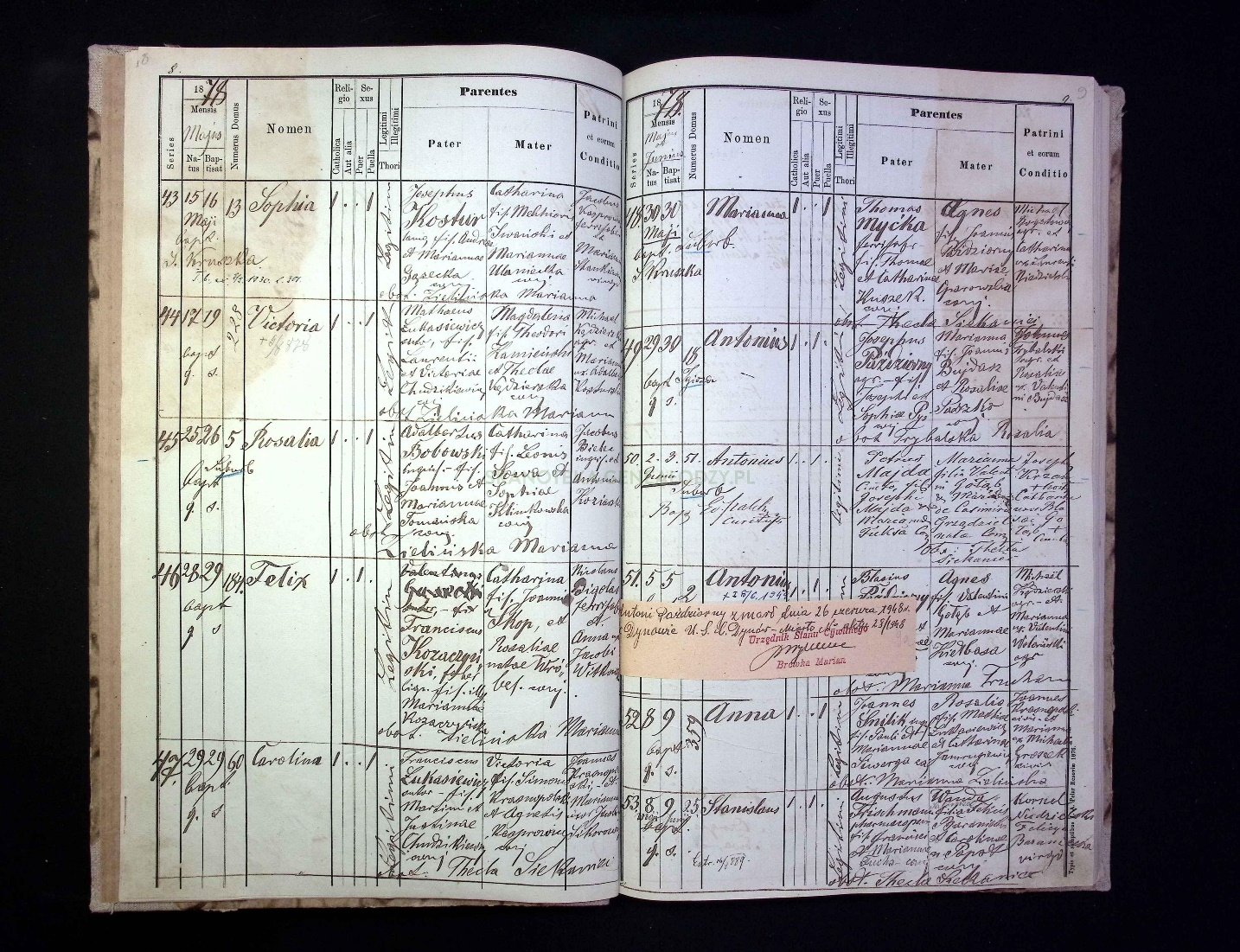
Birth record of Stanisław Adolf Frischmann.
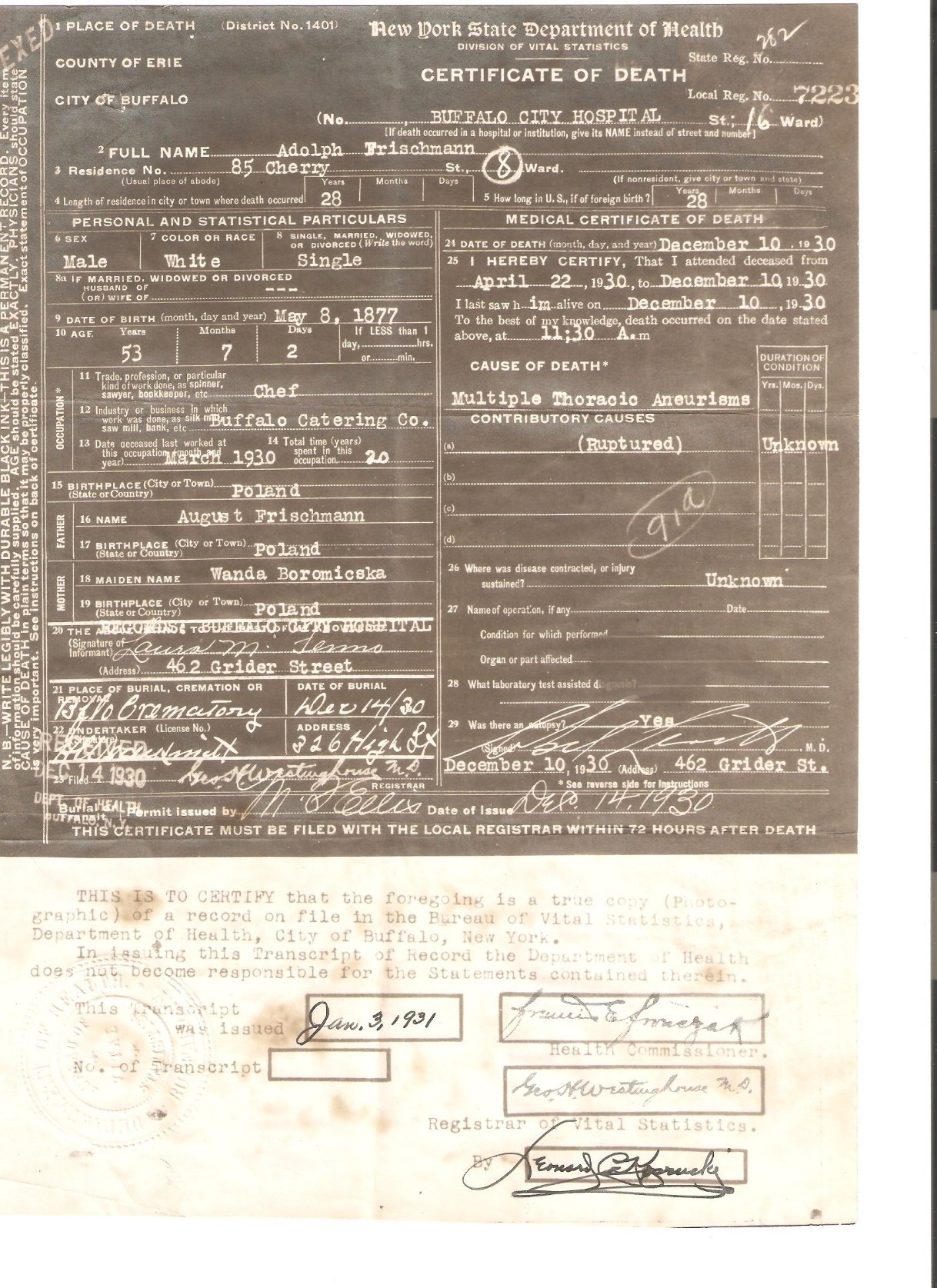
Death certificate of Stanisław Adolf Frischmann.
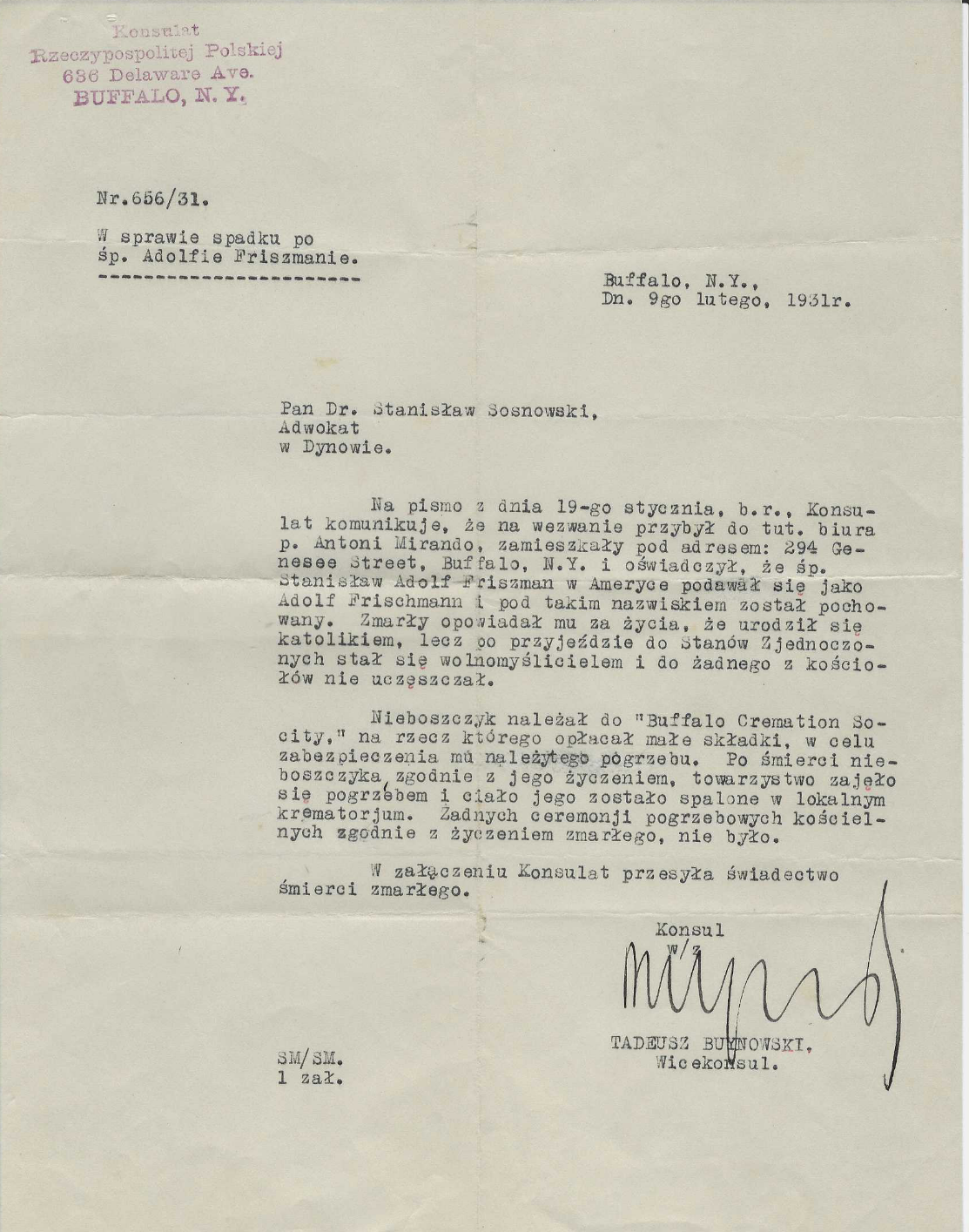
Letter from the Consulate in Buffalo concerning Stanisław Adolf Frischmann.
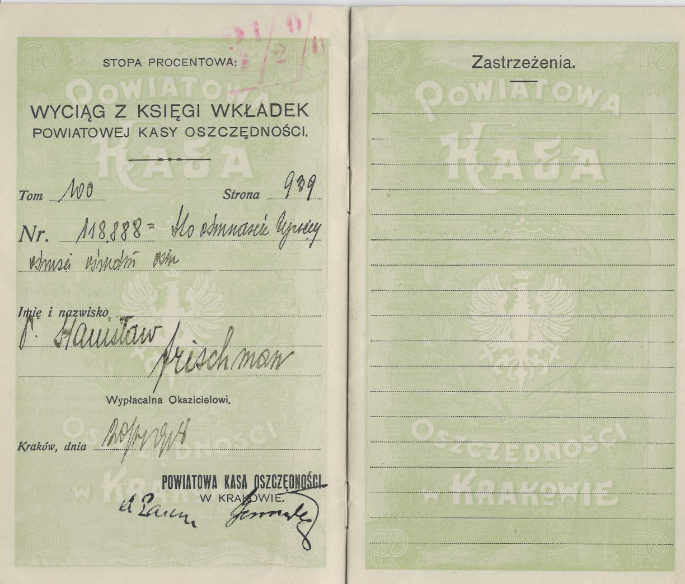
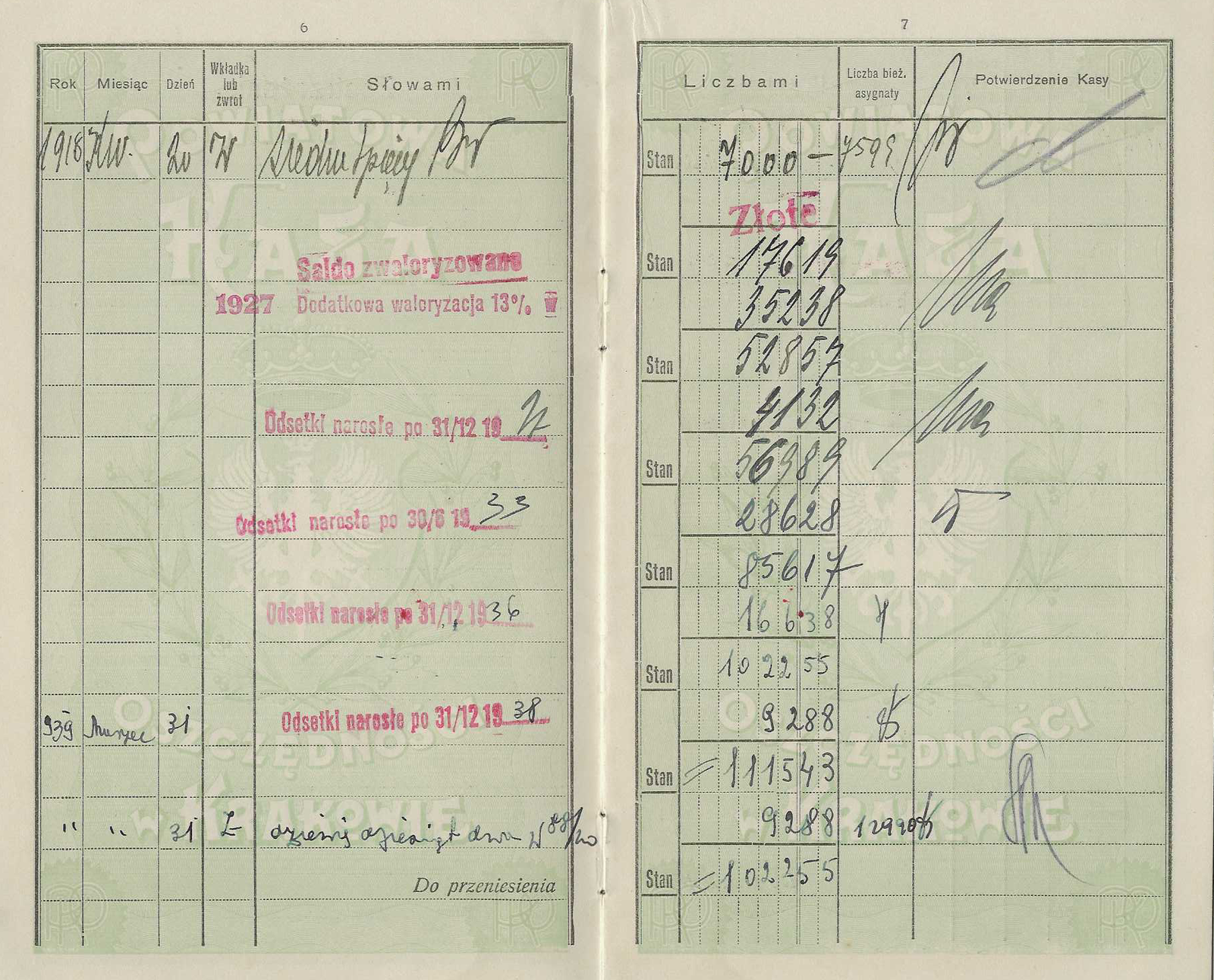
Savings passbook recording a deposit of 7,000 złoty. This was the sum allocated to Stanisław Adolf as part of the payments Franciszek Frischman made to his siblings after receiving the Pharmacy.
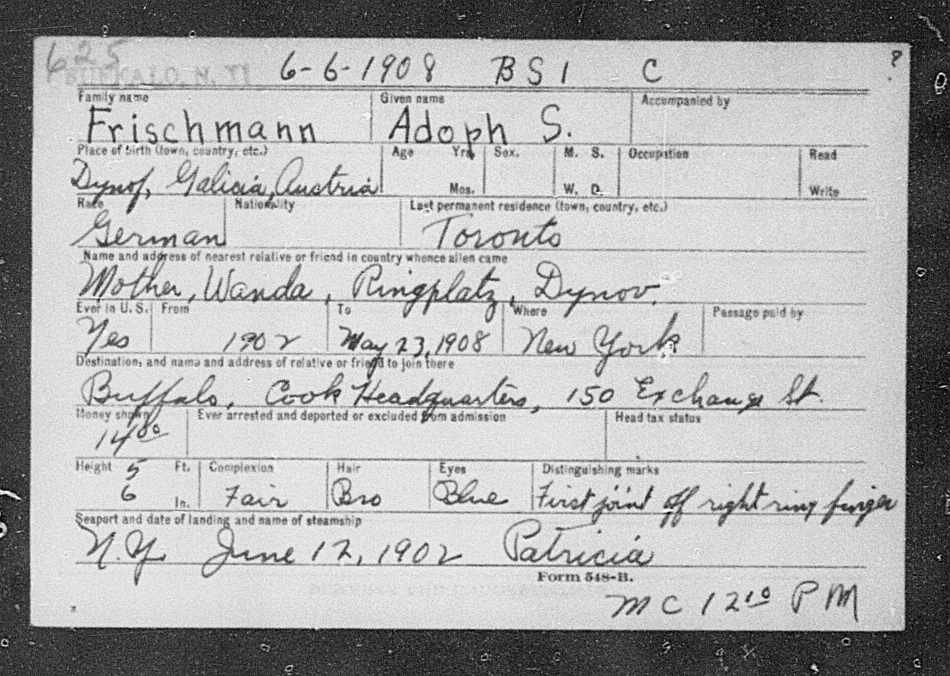
Immigration record of Stanisław Adolf Frischmann.
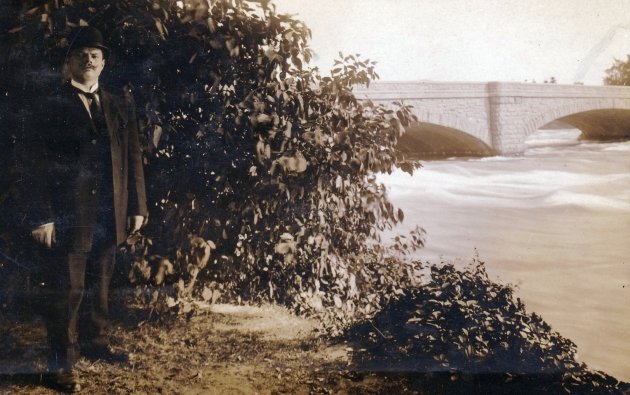
Stanisław Adolf Frischmann at Niagara Falls.
Five Generations – Appendix IV
Karolina Baraniecka’s Letters and the Family’s Financial Affairs
Karolina died on 23 July 1863.
Before her death, she corresponded with her friend Marynia Żywicka.
The letters were written between 1855 and 1863.
Two are addressed to her sister Emilia, known as Milcia, and nine to her friend Marynia Żywicka or Żewicka.
Let us begin with the two letters to her sister Emilia.
First, just a few words of explanation.
Many years ago, my Father wrote the following about Karolina’s sisters:
“Karolina Papst’s sisters were Matylda, who married Józef Ortyński and lived to the age of 107, and Emilia, who married a man named Kube and died aged 102.
They lived in Dąbniki in Kraków.
The daughter of one of them was extraordinarily beautiful but blind. Nevertheless, one of the Wańkowicz family, a wealthy landowner from Belarus, fell in love with her and married her.
Neither sister was remembered fondly by Wanda Salomea, because after Karolina’s death they took no interest in the children she left behind. On the contrary, they even took away some of her belongings.”
And a few more details:
The beautiful daughter of Józef Ortyński and Matylda Papst was Karolina, born on 22 March 1860 and deceased on 11 August 1945. The wealthy landowner from Belarus was Kazimierz Wańkowicz, of the Lis Odmieniony coat of arms, born on 29 December 1831 and deceased in 1891.
He married Karolina Ortyńska, the daughter of Józef Ortyński and Matylda Papst, around 1880.
They had a daughter, Kazimiera, who later married Włodzimierz Sokołowski.
Here, then, is Karolina’s first letter to Emilia. In the Polish transcription, the original spelling, grammar and punctuation have been retained. The letter is undated.
Letter No. 1
Dear Milcia!
I received your letter and was just about to answer when another letter arrived from Żywicka, so I am answering both together. I would like to reply to your questions. You want to know why I do not wish to draw any more money from Pietsch. It is not your fault, but Matylda was always reproaching me, as though I had her money, rather than she mine: that because of me her property was under sequestration, that because of me she was pawning spoons, that I was not sending her money. And I had no means of giving as I used to.
That is why, to this day, I still have a hundred florins with each of you, which I did not collect from Lwów. I shall collect them only when the house is sold… So I thought to myself: if you do not draw any more, you will wish there to be something for you too, because you trust them. And apparently I am robbing you of this property you have on the Moon, for apart from what is in Złoczów and what remains in the house, I know of nothing else and have nothing.
As for the power of attorney to collect money from P., you demand one from me, yet you never gave me one, because you had not yet been… when I was collecting money for you, and afterwards Piet. paid it out to me on trust. You gave me authority to collect from Smutny, which I cannot do without a lawsuit; to collect… instructions to Pietsch, he only really in the following year… in April; and to collect in Złoczów, where the money has already been collected. That is why I have not settled accounts with you, because I did not want to keep the accounts myself. If I had accounted for the expenses to my own disadvantage, you would still have been dissatisfied. And since I was certain that our Mr Żywicki would reckon everything honestly, that was what I wanted. That I have not yet been able to go is not my fault, but the circumstances — the bank.
Now you ask why I am hurt by you. You write that I should be careful, because Frischman will speak ill of me if he speaks ill of his guests. I know nothing of that, for he said Żywicka was a very sensible person. But what can we expect of strangers when you, my own sister, complained to M. that when you were with me, I proposed that you stay under certain conditions, and you refused? Remember that this is not true. I avoided speaking about your staying in Dynów, and we said nothing — not a word. Not because I did not want you, but because I know you would not be as comfortable with me as with Marynia. You complain, but do not offend God. True, you have little to live on, but with the help of good people it is enough. There are good meals, which M. and I very much lack. You have no one else to worry about, whereas I have six children.
Perhaps you have rather little for clothes, but can those rags make us happy?
Now there is another grievance over those two hundred florins, and a demand that I send them to you in Lwów, when I sent Matylda a letter… she wanted eighteen florins from me for a lawyer, but naturally I did not give them.
It is very late already, so I shall write more through P.B. and send the rest of the money.
Kisses from your sister.
As we can see, the three Papst sisters owned a house in Lwów even before Karolina’s marriage to Feliks, and borrowed money against it. Ordinary family disagreements over money. However one looks at it, Karolina seems to have had the most sense and tried to take a reasonable approach to drawing money from the bank against the property.
The letter was clearly written in a moment of agitation. The others are incomparably easier to understand and more carefully written.
How these three young women came to own a house in Lwów is unknown. They probably inherited it from their parents.
The letter mentions August Frischman, whom Karolina defends, so it was written after Feliks’s death.
This letter is almost 160 years old.
Letter No. 2
A letter from Karolina Baraniecka to Marynia Żywicka, dated 25 August. The year was 1857 or earlier — in any case, Feliks was still alive, as he added a note to the letter.
My Dear Marynia!
What will you think of my not writing for so long? Probably that I am still the same when it comes to writing letters! But I found so much disorder that until today I have not had a moment. At the same time, I must praise my husband, because I also found many things in good order that were his responsibility. He made more preserves for me than I usually make myself. Only Mrs Kamniecka saw the rose preserve in the Pharmacy, and he had to let her have one jar. I shall share the other with you. I am not sending it now, because I may bring something back from Lwów and send everything together. I already have a pair of turkeys for you, but I am waiting for Mr Roman.
Feliks says that although Miss Olawia is good and kind, she is too old for Mr Roman. He has other young ladies here in mind for him. One is perhaps twenty-eight, attractive and quite well off. Her parents have died, and there are only two of them. They now wish to sell the village for which her father once paid twelve thousand.
Mr Roman could go there as a prospective buyer and thus most easily see for himself what the property is worth. If he does not like her, Olawia is still available. On Saturday, I am going to Lwów. If you need anything, just write, and Feliks will forward the letter. I shall have to spend a few days in Złoczów, so when I return, your letter will be waiting for me in Lwów.
I do not yet know what will happen with Miss Cecylia. When I arrived, I spoke to her and said she could stay if she wished, but on condition that she did not beat my children. She told me she would stay, and for a while things were fairly quiet with the nursemaid there. But now she tells Paulina that she cannot manage without beating the children. So I shall not know how things stand until I return, although the children have learned a great deal in this short time.
As for the mineral water… Feliks says it is not suitable for transporting. When Szczuciniecki and another tried the water, it no longer… as it did at the spring. The iron, which is the most beneficial part, settles at the bottom. [This probably concerns a remedy for Karolina. Feliks mentions it in his note — my comment.]
We have received neither a receipt for that money nor a letter from Matylda.
Mrs Kube [Emilia, Karolina’s other sister] told me only on the road to Gorlice that she was going to M. for good. Even if things were bad there, she would stay. Once she has a quarrel with Józef there, she will speak differently.
Thank you once again, my dear Marynia, and forgive me for causing so much trouble. Kisses to Sewerynka and Ludwinia. Leoncia must be well by now, perhaps already at home. Kiss her for me, and I kiss you warmly.
Yours affectionately,
Carolina B.
25 August
On the reverse of this letter is a note from her husband, Feliks Baraniecki:
My Gracious Madam!
Karolcia is certainly Mrs Kube’s own sister, at least where writing letters is concerned. I could scarcely persuade her to sit down and write, although it weighed heavily on my heart to thank you both most sincerely for so many proofs of friendship and kindness. At least in this way, I wished to acknowledge the debt of gratitude I owe you for your friendly concern for her comfort and your gracious hospitality.
Indeed, Karolcia looks very well, and the baths have plainly done her good. Already I am wondering whether we shall… follow Józef’s advice and refrain from what he jokingly called “a cavalryman’s little love affairs”. The Wysocka (?) water, effective as it is at the spring, is worthless when brought here. Even as a drink, if not repulsive, it is unpleasant.
We are thinking seriously about the matchmaking. It is only a pity that Karolcia will not be here during the fair, because we would have tried to arrange for Miss Emilia Słowikowa from Hucisko to arrive at the same time as Mr Roman, her brother, as though by chance.
With warm kisses to your hands, I ask you also to kiss Józef and the children for me.
Felix
It is clear that Karolina was already ill and was trying treatment with mineral waters. Hence her stay with the Żywicki family, probably in Gorlice.
In 1858, probably in July, Karolina wrote to Marynia Żywicka as follows:
Letter No. 3
Dear Marynia!
I have been in Kraków since Tuesday. Feliks wrote to me from Karlsbad [where he had gone for treatment — my note] that, after a consultation with four of the best doctors, they had told him to go home. He was to wait for me here on Tuesday. Now it is Saturday. Every day I wait for him at the railway station, but he does not come. I have a terrible foreboding. I am close to despair and often forget my duties, that I have six children. I run to church, but I cannot find peace. Today I am going home, because I have no money here. For the first time in my life, I long for it so desperately. Then I shall return to look for Feliks, even as far as Karlsbad. My poor children! Here in Kraków, I feel as though I am alone in the world, as though I want nothing more than not to live. Kisses to you all.
Baraniecka
And what she had feared came to pass! Here is her letter from Prerau in Moravia, written just after Feliks’s death, in the first week of August 1858:
Letter No. 4
Oh, My Dear Marynia!
I do not know how to begin this letter, or whether I shall finish it! I am in terrible despair. I have been left a widow, without my best and dearest husband! God has punished me terribly! It has happened — such is God’s will — but I, ungrateful as I am, shall never forgive myself for the rest of my life, if I live, that after such devotion to me and twelve years of toil, I could not be beside him. He died in strangers’ care, reaching out his hands for me! God, I shall not survive this. It is dreadful torment. He loved his own land so much, yet he must lie in Prerau in Moravia. I wanted to give my last… [probably her remaining money — my note] to have him taken at least to Kraków, but the authorities would not allow it.
I feel as though I am alone in the world. I even forget my poor fatherless children. My dear Marynia, pray for me, because I can no longer even pray.
Today I shall arrange for a gravestone to be put up here, and then return home to my children! Oh, why can I not see you? Farewell to you all.
Your unhappy friend,
Baraniecka
Feliks died at the home of his friend from his student days, Jakubowski, who ran a pharmacy in Prerau [Przeszów] in Moravia. He was buried there.
The next letter was also written to Marynia, but with a note for Milcia, or Emilia, Karolina’s sister. She, too, seems to have been living in Gorlice, or rather in Bystra near Gorlice, since that is the address on the letters.
Letter No. 5
My Dear Marynia!
I wrote to you from Prerau, where my dear Feliks lies, but I do not know why I have had no reply. Oh, my dear, it seems that you alone can understand my terrible misfortune. That is why, when I had partly recovered my senses [probably meaning “when I came to myself” — my note], my first concern was to put up his gravestone and then write to you. It seemed impossible that I should return home alone. Yet here I am, my dear, at home, and I must live without the man I loved more than life itself. You can imagine what a dreadful moment it was when I returned and the children learned what had happened. They could not even soothe Stefcia.
Now I am somehow calm, much more so than you could imagine. I have resolved to live for his children, whom he loved so much. Only when I remember that my poor little ones will be orphans as I was, my heart almost breaks.
Jakubowski is so kind that he tries to ease my burden where he can, and I now have a very good man for the pharmacy.
I must finish, my dear, because it is already midnight and I am writing almost without being able to see. Kisses to you and the children, and my respects to your husband.
There is a note in this letter for her sister Emilia, or Milcia:
Dear Milcia!
M. [probably her sister Matylda] wrote that she was preparing to visit me and would call for you on the way. But I replied that I would not be home until about the thirtieth, because I am going to Lwów. I also ask Marynia to be so kind as to write to Mr Tomaszewski, asking him to advise me what to do about the Post Office and how to arrange for it to remain in my hands. I shall personally ask Councillor Jakubowicz to be kind enough to intercede with the Director. I shall write no more, as you will learn everything from Marynia’s letter. 23… (?)
Warm kisses. Until we meet again.
Your loving Carolina
18 August
Letter No. 6
18 April 1859
My Dearest Marynia!
I received your letter on the fourteenth. What they will do with Ludwinia (?) when they arrive, I do not know. She returned from dancing at nine in the evening. The lesson actually ends at eight, but L. is not allowed to leave for another hour, so that she is no longer overheated. Grandmother (?) now praises her greatly, saying that she is more sensible than before and does not even miss home as much as they expected.
I must warn you, my dear, that today’s letter will probably have neither beginning nor end, but forgive me. I had not even intended to write today, but I am so terribly lonely and sad that I cannot settle anywhere. Writing to you makes me feel, if only for a moment, that I am talking to you. There is not a soul here whom I can ask for advice, and as for sharing my sorrow, that is out of the question. Believe me, my dear, I sometimes miss you so much that I think I shall leave everything and come to you for a few days. Yet there is simply no way. I am in a strange state of mind. Sometimes, when I reason with myself, it seems that I am calm already, even cheerful. But when [illegible words — my note] comes over me, I do not know what to do with myself. I feel that if I could weep at Feliks’s grave, it would give me the greatest comfort.
Oh God, if it were not for these poor children, for whom I wish to live! Today my… (?) said to me: “Oh, Mama is unhappy without Papa. Before, Mama never cried, and now she cries every day.”
Endless business and troubles! They have assessed my taxes at a hundred florins. Imagine: since Feliks’s death, besides spending the income, I have already spent a hundred florins from my cash. There are still two hundred in taxes, and after that I must pay the rechsgebir. Now new difficulties await me. I am thinking of selling the pharmacy, because a leaseholder cannot pay as much as I want. In fact, it will be difficult to find one. Frischman is not yet bound by a contract here, because his contract in Dubiecko was renewed three months ago, and my guardian has not arranged for another to be drawn up. Now Frischman says that there are no prospects in Dynów for a leaseholder. There probably are none for him, because he needs a great deal: fifteen to twenty florins a month for cigars, and he is constantly entertaining guests. He says it is terribly dull here and there is no one to associate with. If he stays, he will do so only for me. But I can neither demand nor accept such a sacrifice, although he is so good and honourable a man that it is difficult to find his like these days. Precisely for that reason, I would not wish to accept such a sacrifice, because I know, I am convinced, that he was better off and happier in Kraków.
That is how it is, my Marynia! It is bad to have bad people around us, yet we are dissatisfied with good ones too. Always something wrong. At least for me, things will never be good again.
Matylda wrote that I must come to her for the summer. But I have enough troubles of my own. Why should I have to look at her misfortunes too? Everyone is already surprised at how poorly I look. I must finish, because I see I have no space left to scribble. But will you even understand today’s letter? When you describe your mother’s illness, it sounds just like Feliks’s. I kiss you warmly, my dear, and wish you a happier Easter than mine.
Your loving,
Baraniecka
Was the guardian mentioned by my great-great-grandmother Karolina the pharmacist Jakubowski from Prerau? It is difficult to say. One thing is certain, however: a new figure had appeared on the horizon, the pharmacist Frischman, who was being considered as a possible leaseholder of the Pharmacy in Dynów.
The year was 1859.
Letter No. 7
On 23 May of that year, Karolina wrote another letter:
My Dear Marynia!
Mrs Kube’s letter, telling me of your troubles, saddened me greatly. But I am certain this letter will find the poor child (?) almost well — that is what I pray to God for. I often think of you, unhappy with your present condition. Yet I have a feeling that this child will be the support of your old age. May God comfort you and grant you a safe delivery. If I knew when, and could bring you any relief, I would gladly come. Only write openly, because we do not all feel alike in such circumstances. The presence of others comforts some and distresses others.
What is happening with Ludwinia? My girls are well and are a great help to me in the household. Their studies are going badly, because they only revise what they have already learned. I shall not engage a governess until the holidays, because at present I have no money for one. Mr Marcin has been the guardian for several months, but he has no time, so he too does nothing to make it possible to obtain money. My living is not bad, as such, but you have no idea what six children cost. I must struggle like this for another two years while Władzio [Feliks and Karolina’s eldest child and only son — my note] is at school. Then, if it is not too late for things to be good for me, I shall be better off. The doctors tell me to drink the water from Krynica, and I am constantly taking iron powders. They say I look better in Dynów.
Milcia writes that you know nothing about the fur coat. A few days ago, they sent me the outer covering… [wording unclear]. I am sending the bill and the letter. Do not take offence at their rudeness. They do not know you, so they may think what they please. I no longer know who is to blame for all this trouble over the fur coat. If I had the money, I would keep it myself, and that would be the end of it, but I have none. Please write as soon as you receive this letter. Mrs Kube now wishes to go to M. Poor woman, but we cannot help it, and K. could stay where she is. Józef wrote that Milcia had asked him to come for her, but when he arrived, she kept him waiting for three hours and then did not go. He says he will not be such a fool as to send for her again. But now she must be feeling… bad.
You also wrote that he had corrected something in the accounts concerning the bag. But this is how it was: when he was in Kraków, he told me that you had spoken to him about my taking responsibility for paying K.’s debt. Then she would be paid off, and I would have no more dealings with her, since she speaks ill of me anyway. I would owe only you. I said I no longer knew what to answer. I could not specify exactly when I would pay. But he always lies. I only wonder what he meant to gain by lying to both of us.
Tell me whether Ludwinia is coming for the holidays. Perhaps I could somehow make her journey easier. I have nothing more to report, so I kiss you warmly, together with Sewerek.
Your devoted friend,
Baraniecka
Warm greetings to Mr Żywicki.
I kiss the children’s little hands.
Every day I sigh for the former Director, because now they harass me terribly. They demand things that are unjust and impossible, and there is no one to turn to. Going to Lwów would be pointless, and I have no money for it. This D. Kasdema promises things but does nothing.
Dynów, 23 May
Letter No. 8
A new letter, because there is a new matter. You have written several times, my dear, that not everything one can say can be put in writing.
I had comforted myself with the hope that we would see one another, yet somehow it remains difficult. After your last letter, I thought about it for a long time. I know, and am convinced, that you are sincere with me. So I think it must be something you perhaps do not wish to cause yourself the pain of writing. I beg you, by everything dear to you, write to me soon, and I shall repay your frankness with my own.
I wonder whether it concerns Frischmann. Perhaps the talk has reached your ears too. Kasprzycka wrote that I was going to marry, and people seem to think it will happen. Those I considered friends have done the most to encourage this gossip. Surely, if I meant to marry, I would have done so by now, and the talk would have ended. But I do not wish to sacrifice my children’s future and the dear memories of the years I have lived for the chatter of these foolish people. I explain myself to no one, because who will believe me? Time will tell. But I cannot put all my property into dishonest hands merely because people gossip. I do not deny that there are honest people, but where am I to find them? And would that protect me from slander, when there would simply be other talk? The simplest thing is to endure it, but so far that course has not been enough, for I have already tried.
If I have guessed your meaning, find me a pharmacy manager who will undertake to run everything. If you will vouch for his honesty, I give you my word of honour, as I wish happiness for my children, that I shall immediately give Frischmann notice, and he will have to leave from New Year. I believe the pharmacist in Gorlice knows your husband. Perhaps he knows someone, because there are plenty of men available — but who knows them?
Take Siedlecki, for instance, whom I had wanted earlier and who was known as a good man. He was only a pharmacy manager, yet in five years he put aside three thousand florins [that is, saved them — my note]. Surely not from his salary, even if he went without boots. Where, then, did it come from?
Please, my dear, do make enquiries. I may be in Lwów at the end of this month and would like to have your answer. Perhaps you would be so kind as to give me a letter of introduction to Hochlajtner, so that I would feel less hesitant about going to him. If you cannot find out anything about a pharmacist soon, please reply at once. Mrs Kube should not spend her money, because she may have to go to Lwów. Mr Brzęcz from Lwów advised me that it would be best to sell my share last, because then the owner would have to buy the house. I have scribbled quite enough, so I finish with warm kisses to you, the children and little Marynia.
Your ever-devoted friend,
Baraniecka
My respects to your husband. I kiss your mother’s hands.
Postscript: Mrs Kube is owed, from 1 January to the last day of July ’61, such…
Letter No. 9
Dear Marynia!
Today is the fourth day since I returned to Kraków. I shall not write at length about how sorry I am that I could not visit you. The reason was that, after arriving in Dynów, I was unwell for several days. Such was the effect Dynów had on me.
On the way there, I was as happy as a child going to visit its parents. But having arrived at night, I rose very early and walked all round the place. Such sadness and longing came over me, as though something itself were whispering: “What are you looking for here? There is nothing here for you now.” I spent the rest of the day upstairs, saying that I had a headache, because telling the truth would have made them laugh. It is not fashionable to mourn a husband in the third year. They say sensible people do not do such things.
Only after ten days did I go to Lwów. I stayed there several days, because Pietsch had no money. I visited the Jakubowicz family twice, as I wished to see the father, but he was in the country with Mr Józef. I asked what message she wished me to give you. She said there was nothing, only to embrace you all. Then I began asking what would happen with Ludwinia. I said that when… she would ask me when she was going to Grandmother, and what Uncle had said. He replied that his wife had sent him a letter to forward to you. He had not read it, but believed she had already stated firmly what would happen with L. I asked Helena what they were saying about it. She said nothing, unless she herself began the conversation. All she had learned was that Mrs Józefowa would pay half at Mr Wasylewski’s, and the father the other half.
As I was leaving, I met Mrs Bożajnowska, or some similar name, on the porch — a cousin of ours. I spoke to her, and she said: “Tell Mrs Marynia that our advice is not to be too… delicate about it. It has already been discussed. Let her consider the matter settled and bring Ludwinia, because some preparations still have to be made for her.”
I visited Tomaszewski. I did not see Jaś. You ask about the Jarontowski family. I wrote to you that Milcia had died. Her little daughters were taken in by her sister Jarontowska, and their mother went there. Bajewska is just as poor as before, but she is alive. Manio was on leave at Mrs Wajsenwolf’s. He extended it himself and is now under arrest. Teresa is in Kraków. Instead of getting better, things are growing worse for me, because everything is so expensive. When I arrived, a quart of barley groats cost five cents; now it is nine. A measure of potatoes, the sort used here, was twelve cents and is now twenty-five. More than twice as much. And the income is the same. I have just spent nine florins on books for Władek, and… eight florins and ten cents. Books for the girls cost seven florins, and now there is paper and so on. I keep calculating how much a journey to you would cost. I could not come from Dynów, because it was already too late with the children needing to go to school.
Write a great deal, my dear, about what you are all doing, especially whether Sewerek has begun his lessons. My Stefcia now also has a tutor (?).
I am sending a receipt for Mrs Kube. Let her sign it and return it, and I shall send her the money at once. Also, please make sure she gives me a receipt for two florins in interest, which I shall likewise send without a detailed account until we meet. I very much regret that Ortyński did not bring a lawsuit against me over those properties, because by now I could have had him put under arrest for his false accusation. I made enquiries in Lwów about Tekla Turobińska and have it in writing that it was taken in 1820. Where was I then?
There is no space left, and it is growing dark, so I kiss you and embrace you in my thoughts, together with your family.
Your loving,
Karolina
I have become so strange that, apart from my children, you are the only person in the world I still love. I do not even acknowledge my sisters, although it pains me. But what can I do?
Letter No. 10
My Dear Marynia!
I wrote my last letter as soon as I recovered, but I do not know why I have had no answer to this day. When leaving home, I instructed them to forward any letter from you, so I kept waiting. Besides, I am so occupied with my treatment that somehow one day has followed another. But now the wait has grown too long. It is so long since I heard anything of what is happening with you. Is Sewerek well? He must have come home with good marks. If you cannot take Ludwinia to Lwów yourself, I think I shall go there in the first days of September. I shall stay here until mid-August, because it is doing me a great deal of good. I am quite well and hope that for a few years… if God allows me to live.
Krynica is sad today, because everyone has gone to Bardejów for a ball. I remembered the lovely time spent with you a few years ago, and… that day in Bar. I was never a cheerful person, yet it seems to me that I have aged thirty years since then. Then I felt happy and content, even in such a little place. Here I am sad, although I deny myself nothing that I need for pleasure or health.
I went to Częstochowa. You must envy me that, and with good reason. I was there for three days and did not want to leave. People warned me not to go just now, because there was unrest across the border and I might encounter difficulties. My passport was in order, and such small inconveniences mean nothing compared with the joy of being in so wonderful a place.
Krynica is so full this year that no one remembers a year like it. Many people are staying in the village, but that is said to be half a mile from here. I have a little room, a bed, a table, a chair and… for one florin a day. Better rooms cost two florins a day. I rise at five, drink… and then the mineral waters. At nine, I go for a warm shower of iron-rich water, which costs fifteen cents. Then… dinner at twelve. Four dishes cost seventy cents, but there is enough to have supper as well. Between five and six, I take a bath, which costs thirty cents. Service here costs two florins and fifty cents a week, with a similar expense for the music. Everyone must pay two florins… the bathing tax is two florins. But at least everyone is pleased to be healthier. Yesterday and today, the heat has been unbearable, whereas on the preceding days it was so cold that everyone wore hooded cloaks.
All my children are well. Every few days… writes to me, and in fact Wandzia is running the household. Władzio has quite good marks. Tell me, my dear, how far it is from here to you. Stronczakowa also wrote asking me to call for her on my way home, so that she could stay with me for a few weeks. But I no longer know how it will work out, because this is how I came here: by railway to Bochnia, then by express coach through Limanowa and Sącz to Krynica.
Please be so kind as to write soon. Every day I shall look out for your letter.
Warm kisses to you and the children. Tell me something about Helenka.
My respects to your husband, and I kiss your mother’s hands.
Baraniecka
My address:
At… near the baths
No. 20
Krynica
29 July 1862
I cannot discover how all these letters came into our possession. Logically, they should have remained with their recipients, Marynia Żywicka and Emilia Ortyńska, née Papst. How they returned to the Baraniecki family, I do not know!
Here is the last letter, written — who knows — perhaps in the spring of 1863.
Letter No. 11
My Dear Sister,
Having settled the debt arising from the promissory note issued by my late husband, Felix Baraniecki, on 30 December 1845, secured against his properties in the amount of two thousand Rhenish florins in Convention currency, of which one-third was due to you, I paid you that third on behalf of my children. On 29 October 1862, I received a declaration permitting this debt to be removed from the register of the properties inherited by my children. However, the declaration is unstamped and would require stamping. Furthermore, it permits the removal of this sum from the Pharmacy, rather than from the encumbered properties… and is therefore of no use to me.
Being very weak, I turn to you, dear Sister, with the request that you kindly sign and return as quickly as possible the formal declaration authorising the removal of the registered charge, which I enclose here. I feel very weak and would like to settle my children’s affairs as soon as possible.
I am very ill, so please do not be surprised that I am not writing in my own hand. I trust, however, that in consideration of this illness, you will not refuse my request and will sign and return the enclosed declaration as soon as possible.
I kiss you warmly and remain your sincerely loving sister.
The Family’s Property and Financial Affairs
The letters of Karolina Baraniecka, née Papst, Feliks’s wife, are legible. Their context, however, needs some explanation, because they touch on various business matters and the Family’s property.
Here is a brief account of these affairs.
On 20 February 1817, Wojciech Okoński bought the pharmacy from Józef Szczerbicki. On 22 May 1817, his ownership of both the property and the pharmacy was entered in the land register.
Property No. 25 in Dynów and the pharmacy within it were separate properties for registration purposes, with separate mortgage entries. Okoński bought the property from Jan Wyszatycki.
On 6 August 1825, Wojciech Okoński and his wife, Salomea, née Jamroziewicz, bought the meadow called “Moczary” from Fortunat Łobarzewski and Joanna Łobarzewska, née Wiśniowiecka.
On 27 March 1829, the Okoński couple bought the garden called “Pezolnik” from Perla, née Kercyk, and Malka Dyller, née Zuckerman.
On 6 June 1833, they bought farmland in Błonie near Dynów from Szymon Kawiński.
These were the Okoński family’s properties in Dynów. On 28 November 1853, they appointed Maryanna, née Baraniecka, formerly Skibińska and subsequently Stronczakowa, as their universal heir. Almost immediately, she transferred her rights to Feliks Baraniecki. Why it was done in this way is difficult to say.
I include here an extract from the land register for properties Nos. 25, 26 and 244 and the pharmacy situated there. As we can see, Felix encumbered the property with debts arising from loans taken from girls who were minors: Ludwika Łukasiewicz and the three sisters Karolina, Emilia and Matylda Papst. These loans were secured against the property and carried five per cent interest. Taking loans was nothing remarkable, but taking them from underage girls — I hardly know what to think. Where were the Papst sisters’ parents? As we shall later see, the girls owned a house, or houses, in Lwów, but that comes a little later. For now, I present the situation as it stood in 1853. I realise this document will be difficult to read, but do try.
Extract from the Land Register
Concerning the ownership and encumbrances of the properties in the town of Dynów numbered 25, 26 and 244, and the Pharmacy situated at No. 25, formerly belonging to Mr Wojciech Okoński and now owned by Mr Felix Baraniecki.
Ownership Entries
22 May 1817, No. 77. By the ruling of the judicial authority dated 22 May 1817, and pursuant to the purchase agreement concluded with Jan Wyszatycki on 22 May 1817, Adalbert Okoński is registered as the owner of property No. 25.
14 May 1838, No. 7. Pursuant to the purchase agreement concluded on 20 January 1838 with Józef Wyszatycki and Agnieszka Wyszatycka, née Łukasiewicz, Adalbert and Salomea Okoński are registered as joint owners of property No. 26… belonging to No. 25.
14 May 1839, No. 26. Pursuant to the purchase agreement concluded on 13 May 1839 with Maycher and Marjanna Stankiewicz, Mr Adalbert Okoński is registered as the owner of property No. 244, adjoining properties Nos. 25 and 26.
4 April 1845, No. 25. Pursuant to the purchase agreement concluded on 2 April 1845 with Mr Adalbert Okoński, pharmacist in Dynów, Mr Felix Baraniecki is registered as the owner of the masonry house at No. 25 and the pharmacy situated within it, with all rights, etc., together with properties Nos. 26 and 244.
4 August 1853. Pursuant to a purchase agreement, Mr Felix Baraniecki sells the whole of property No. 25, half of property No. 26 and the whole of property No. 244 to Mr Franciszek Xawery Janicki.
1 December 1853. Wojciech Okoński is registered as the owner of half of property No. 26.
2 December 1853. Maryanna, née Baraniecka, formerly Skibińska and subsequently Stronczakowa, takes the place of Wojciech Okoński and is registered as the owner of half of property No. 26.
Encumbrances
2 October 1845. Pursuant to a promissory note issued by Felix Baraniecki, the sum of two hundred Rhenish florins, together with interest at five per cent, is registered as a charge against his properties Nos. 25 and 244 in favour of the minor Ludwika Łukasiewicz.
3 January 1846. Pursuant to a promissory note issued by Mr Felix Baraniecki on 30 December 1845, the sum of two thousand Rhenish florins, together with interest at five per cent, is registered in favour of the minors Karolina, Emilia and Matylda Papst as a charge against properties Nos. 25, 26 and 244, together with plots Nos. 430, 417, 418 and 2028 near Dynów, owned by Mr Felix Baraniecki.
7 March 1846. Pursuant to a promissory note dated 9 February 1846, Mr Jan Fedaczyński registers a claim of one thousand florins, with half-yearly interest at five per cent, against properties Nos. 25, 26 and 244, owned by Mr Felix Baraniecki.
23 December 1846. Pursuant to a promissory note dated 10 May 1846, a loan of two hundred florins, with interest at five per cent, is registered in favour of the minor Ludwika Łukasiewicz as a charge against properties Nos. 25, 26 and 244.
To conclude these reflections on the Baraniecki family’s financial affairs, I shall quote a note I wrote some twenty-five years ago. It concerns the rather puzzling matter of the debt Karolina mentions in her letters to her sisters.
Here is that note:
The mother of the three Papst sisters, Karolina Papst, née Kampf, the wife of Krystian Papst, owned two properties in Lwów.
After her death, her heirs — her three daughters — lent Feliks two thousand Rhenish florins.
As evidence of the loan, Feliks issued a promissory note, which was deposited with the Court.
When the loan was made, the Court ordered the sum to be registered as a charge against the property in Dynów and, additionally, against the properties in Lwów.
Although the sum was registered against the property in Dynów, it was not registered against the properties in Lwów, despite the Court’s order!
Why???
Furthermore, as we read in the Court’s reply to the application submitted by Great-grandmother:
The promissory note was released from the Court’s custody not because Feliks had returned the money — in other words, repaid the debt — but because he held power of attorney for the three Papst sisters, one of whom, Karolina, became his wife.
Feliks died without a will. His widow paid off her two sisters, giving each one-third of the two thousand Rhenish florins.
The fact that the loan had not been registered against the properties in Lwów came to light forty-seven years later, only because, for reasons unclear to me, Great-grandmother Wanda Salomea initiated an enquiry into the matter.
That enquiry revealed a curious situation: in 1845, the Court’s instruction had been disregarded!
From my point of view, that was the right thing to do, because, as I have mentioned, what sense did the requested registration make in the first place? Even so, why was the Court’s order ignored?
And above all, why did Great-grandmother bring the matter to light after so many years?
Was she preparing to sell the properties in Lwów?
And whose hands were they in at that time?
Was Great-grandmother laying some claim to them?
In my view, these questions are connected with a whole series of property transactions conducted by Wanda Salomea and, after her, by her son, Grandpa Franio.
There were so many such transactions that they deserve a separate study.
That is all for now.
Perhaps this is not a particularly spectacular story, but it may be the beginning of something larger.
For example: do those houses in Lwów still exist? What interest did Great-grandmother have in reviving the matter after so many years? How did the Papst family come to own those properties in Lwów at all? After Karolina’s death, did her sisters Matylda and Emilia remain their owners? And so on…
Five Generations – Appendix V
The Elisabeth Commemorative Cross

The Elisabeth Commemorative Cross, also known as the Elisabeth Commemorative Medal (Romanian: Crucea Comemorativă Elisabeta, Medalia Comemorativă Elisabeta), was a Romanian decoration awarded to women for their services in caring for the wounded and sick during the Russo-Turkish War of 1877–1878.
History and Insignia
The decoration was established in 1877 by Prince Carol I of Romania, later King, and named after his wife, Princess Elisabeth. In 1877–1878, Romania sided with Russia in the war against Turkey. Turkey was defeated, and the Congress of Berlin, convened after the fighting in 1878, secured full independence for Romania. Three years later, Carol I proclaimed himself King of Romania.
The decoration had a single class. Its badge was a gold double heraldic cross, with an intertwined, crowned “E” monogram in the central medallion on the obverse.
The reverse bore the dates 1877/78 in its medallion, surrounded by the inscription “ALINARE SI MANGAERE”. Variants exist with white-enamelled medallions on both the obverse and reverse.
The decoration was worn on a blue ribbon bow with gold borders along both edges, on the left breast below the collarbone.
It is not known how long the decoration continued to be awarded.
Five Generations – Appendix VI
Karolina Baraniecka’s Children
Karolina and Feliks’s only son was Władysław, born in Dynów on 16 January 1847.
He was a career officer in the Imperial and Royal Army.
As a lieutenant, he took part in the famous Battle of Sadowa during the war between Prussia and Austria in July 1866.
In 1878, he was posted to Bosnia, then occupied by Austria-Hungary, and subsequently to Stryj, where he remained until his retirement.
By then, he was a major.
In old age, he moved to Brzozów to live with his nephew, Wiktor Niewolkiewicz, the son of Stefania Baraniecka and Jan Niewolkiewicz.
He died there on 6 February 1921.
He never married and had no children.
Wanda Salomea and Felicja were twins.
They were born on 17 November 1849.
Wanda Salomea died on 3 January 1939, aged eighty-nine. Felicja died three years later, on 29 November 1941, aged ninety-two.
Wanda Salomea married August Frischman, but her sister Felicja remained unmarried.
Here is a short recollection of Felicja Baraniecka written by my Father:
“Felicja was the best-looking of the siblings and the only one who resembled her father. An exceptional woman for her time, her mind reached far ahead of those around her. She stood well above her surroundings intellectually and was already an advocate of women’s emancipation. She took an interest in philosophical questions and, despite her deep piety, was something of a free thinker, seeking truth beyond revealed religion. She knew literature, although in old age, because she lacked a more advanced education and was an unmarried woman, she became something of a scapegoat, mocked and treated lightly — unjustly!
She gave up her own happiness and did not wish to marry. Instead, she worked independently to support herself, which was a true curiosity in those days. She was a postmistress on the eastern fringes of Galicia, in Podolia and Pokucie, including Kozowa.
In old age, she settled in Przemyśl. Later, she became a companion to her blind friend, Mrs Elżbieta Trzcińska, in Gdyczyna. After her friend’s death, my father took her into his home as a ‘resident’. She died there in 1941, aged ninety-two. She continued to receive her pension and always gave each of us a hundred złoty on our name days, the equivalent of twenty dollars.”
From the documents, I know that she also worked for a time as postmistress in Majdan Sieniawski.
Helena, born in 1851, married Bolesław Chodziński, the headmaster of the elementary school in Sokołów. He was the brother of the well-known sculptor Kazimierz Chodziński, whose magnificent works still adorn Chicago and Washington.
I mean his designs for the monuments to Tadeusz Kościuszko in Humboldt Park, Chicago, and Kazimierz Pułaski in Washington. Many of his works can also be found in Poland, particularly in churches, though not exclusively. But it is Bolesław, rather than Kazimierz, who concerns us here. His father was the painter Karol Chodziński (1815–1904), and his mother was Zofia, née Dubielowska.
Helena and Bolesław Chodziński had two daughters, Stanisława Zofia and Kamilla. Helena died in 1877 while giving birth to the younger daughter, Kamilla. She was only twenty-six.
Their first daughter, Stanisława Zofia (1872–1906), married Stanisław Konstanty Andrzej Dańczak, a pharmacist in Sokołów, in 1895. They had ten children! She died aged thirty-four.
During the 1990s, I corresponded for quite some time with members of the Dańczak family, particularly Zofia Ginalska, born in 1926, a granddaughter of Stanisława Zofia Dańczak, née Chodzińska. She was a distinguished professor of oncology and died without children in 2001.
I have no information about the second daughter, Kamilla.
Two years after Stanisława Zofia’s death, her husband, Stanisław Konstanty, married again — once more within our family. His second wife was Zofia Niewolkiewicz, the daughter of Stefania Baraniecka and Jan Niewolkiewicz. They had five children. Thus, he had fifteen children by his two wives!
Stefania, another daughter of Feliks and Karolina Baraniecki, married Jan Niewolkiewicz, an elementary-school teacher in Kamień. They had six children, including Wiktor, with whom his uncle, Władysław Baraniecki, a major in the Austrian Army, lived after retiring.
Wiktor married Filomena Fiedler. Among their children was a son, Julek, who was a hunter and visited us in Dynów.
He was exactly the same age as my Father: both were born in 1909.
I mention this because I want to quote what my Father said about Julek:
“Julek Niewolkiewicz held general power of attorney for the Czartoryski princes’ entailed estate at Sieniawa. The Prince appointed him when everyone was fleeing from the Germans. As it happened, the Prince himself fled foolishly, unaware that the Spanish aristocrats to whom he was related were making representations on his behalf through the Spanish Embassy in Berlin.
As a result of their efforts, the Germans kept asking about the Prince and looking for him. But they were not trying to imprison him. Quite the opposite: they wanted to protect and help him. The Prince, unaware of their intentions and interpreting them wrongly, fled as fast as his legs would carry him. He gave Julek Niewolkiewicz such extensive powers that Julek could even have sold the entire estate.
I saw his power of attorney and read it most carefully. It had been drawn up by a notary.
Julek later moved — I do not know why — to the Zamoyski entailed estate. There were strong groups of the Peasant Battalions there. They treated Julek as an employee of a bloodsucker exploiting the working people and robbed him mercilessly of everything. As a result, after the Bolsheviks arrived, Julek fled to East Prussia with little more than the trousers he stood up in.”
The youngest child of Feliks and Karolina Baraniecki was Maria Joanna, born in 1855.
On 30 June 1896, in Racławice, she married Józef Jan Długosz from Korczyna, who administered the estates of Bishop Józef Sebastian Pelczar under power of attorney.
They had a son, Stanisław, born in 1897 in Nisko, in the parish of Racławice. He died on 9 October 1976.
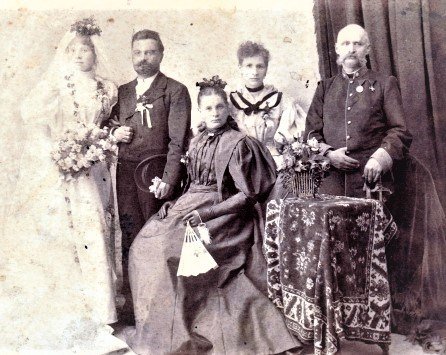
The wedding of Maria Baraniecka and Józef Długosz, 30 June 1896. From left: Maria Baraniecka, Józef Długosz, Wanda Salomea Frischman, Felicja Baraniecka and Władysław Baraniecki.
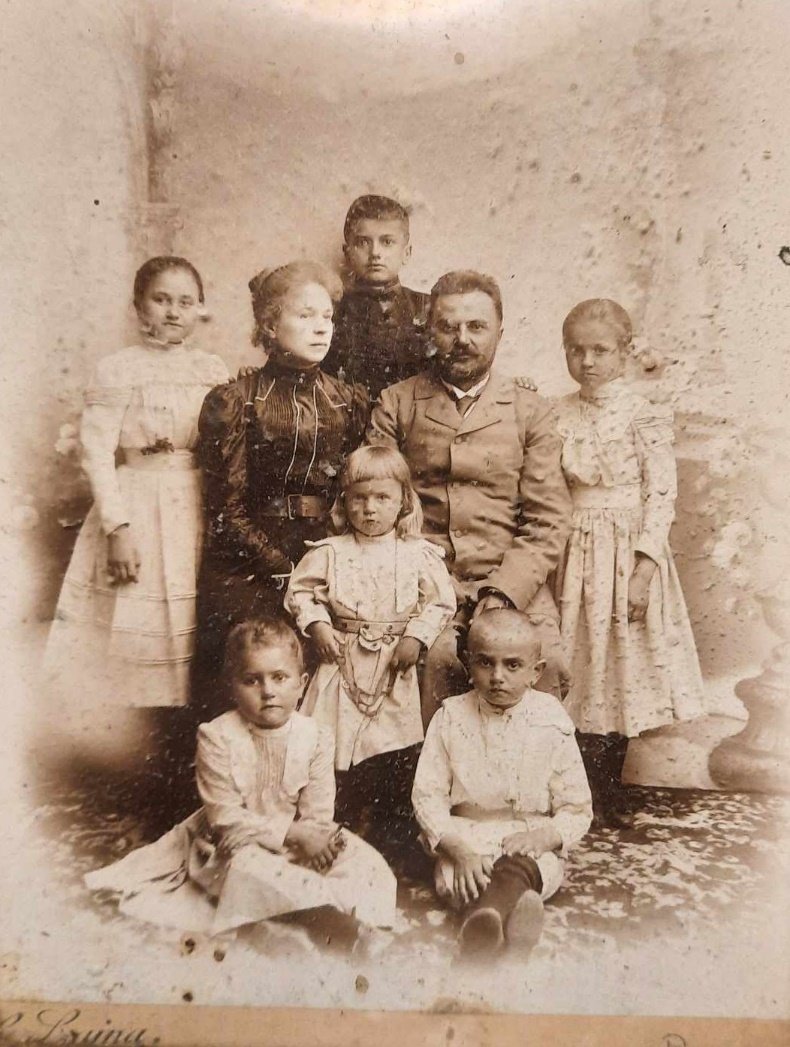
Maria and Józef Długosz with the children. Five were Józef Długosz’s children from his first marriage, to Izabella Horwath. One was Maria and Józef’s son, Stanisław.
Stanisław held a doctorate in law and worked at the Treasury Prosecutor’s Office in Warsaw. Perhaps, however, it was the economic crime department of the National or Regional Prosecutor’s Office.
He married a woman named Ada Reicher. They had two children, Zofia and Stanisław. The latter subsequently became Deputy Minister of Foreign Trade during the Gierek era.
Five Generations – Appendix VII
Building the House in Dynów
I realise that the ownership of the plot on which the second part of the house was built in 1909 is of little significance to the history of the Frischman family. Still, it is part of the history of the house in Dynów. I shall therefore give a very brief account here, based on the documents in my possession.
On 20 July 1899, a certain Chaja Kalter, née Haüben, assigned a promissory note for six hundred crowns to her son, Majer Kalter. From 1 August 1899, the note carried interest at ten per cent. It was also registered as a charge against half of the property entered under whl 593 — whl meaning “mortgage register number”, or “Wohnhausblatt” — that is, the plot under discussion. Chaja must have taken out this loan earlier, but I do not know when.
At that time, the plot belonged to three members of the Kalter family:
Chaja held two-fourths — that is how it was entered in the land register: not one-half, but two-fourths — while Majer and Leiba Izaak each held one-fourth.
On 28 July 1904, Leiba Izaak, who used the name Izaak, borrowed twelve hundred crowns from the Credit Society at seven and a half per cent interest and registered the debt against his one-fourth share.
On 3 May 1905, Chaja, who could not write and signed with a little circle rather than a cross because she was Jewish, took out another loan from the Credit Society. This time it was for five hundred and fifty crowns at seven and a half per cent interest, registered against her two-fourths share.
Chaja died shortly afterwards, also in 1905. Her half of the property passed by inheritance to Majer Kalter and Leiba Izaak Kalter. Each brother thus received half of their mother’s half.
On 12 June 1906, Majer Kalter sold both the share inherited from his mother and his own one-fourth share to his brother, Leiba Izaak, for five thousand crowns.
The contract was drawn up by Karol Prochaska, a notary in Rzeszów. The witnesses were Mr Józef Jaśkiewicz, a pharmacist in Rzeszów, and Samuel Eimer, a restaurateur in Rzeszów.
Leiba Izaak Kalter thus became the sole owner of the entire property. On 8 August 1906, he sold it to our Grandpa for 10,600 crowns. Payment was made as follows: Grandpa assumed the old debts incurred by Chaja with the Credit Society, which by then amounted to 1,589 crowns and sixteen hellers, and paid the remaining 9,010 crowns and eighty-four hellers in cash.
The plots purchased from Kalter lay to the south of the building. To the north, two plots belonged to Chana Mindla Fränkel, née Weinberger. Grandpa concluded two purchase agreements with her: one on 14 August 1925 for plot No. 471, and another on 18 May 1926 for plot No. 852.
Chana Mindla could not write and placed only little circles on the contracts. Witnesses appeared to confirm the authenticity of those marks. Although Chana was illiterate, she knew how to count. Both properties were burdened with so many debts that Grandpa paid her only 780 złoty in cash for the first plot and three thousand złoty for the second. Naturally, however, he also had to settle her debts.
Description and Valuation of the House
Certified Copy
No. III 54/5. Imperial and Royal District Court in Dynów. 20 November 1905.
Record drawn up at the property in Dynów.
Present: Aleksander Golan, Imperial and Royal court clerk, acting as the Court’s representative; Ludwik Cieszyński; Jan Wyszatycki; and Franciszek Frischman, pharmacist and property owner in Dynów.
Subject: Voluntary valuation of the property entered under mortgage register No. 20 in the land register of the municipality of Dynów, pursuant to the instruction dated 20 November 1905, No. III 54/5.
Proceedings commenced after one o’clock in the afternoon. The valuers were reminded of the oath they had taken, informed of the cadastral, taxation and land-register particulars, and proceeded with their work (?).
I. Composition of the Property
The property entered under mortgage register No. 20 in the land register of the municipality of Dynów comprises the following:
- Building plot No. 245, area not stated.
- Building plot No. 246/2, area not stated. The dwelling house stands on these two plots.
- Building plot No. 244/1, converted into a garden.
- Plot No. 222, a garden covering 129 square fathoms.
- Land plot No. 221/8, a garden covering sixty-two square fathoms.
The annual land tax and rental tax amount to 280 crowns and eighty-one hellers, in addition to provincial and municipal taxes.
II. Description
On building plots Nos. 245 and 246/2 stands a masonry house built two years ago and roofed with tiles. The house has a ground floor and one upper storey… its residential frontage faces west onto the market square, immediately beside the main road leading to Przemyśl and Sanok, and thus lies on the principal thoroughfare.
The house is entered either through a separate adjoining passage on the northern side or through the front doors from the market square, which lead chiefly into the pharmacy premises.
The pharmacy is entered through double doors, glazed in their upper halves and fitted with a roller shutter. These open into a room with a floor of coloured artificial stone and two windows. From there, double doors lead north into a smaller room with two windows and a wooden floor. …The rooms have windows only on the western side and share a large tiled stove situated in the dividing wall.
From the latter room, a single door… leads east into a small vestibule with a stone floor. From this vestibule, a single door opens into the passage already mentioned, while double doors straight ahead lead into an eastern room… with a stone floor and tiled stove. From there, double doors lead south into a second room with two windows, the same type of floor and a stove. A single door then leads into the kitchen, which has a wooden floor, one window, a bread oven and an English-style cooking range.
From the kitchen, a single door leads into a hall with a stone floor and one window. Finally, from there, a single door leads south into the pantry, another such door opens into the courtyard, and one step farther south is the privy.
From the northern room of the pharmacy premises described above, a single, right-opening door, glazed in its upper half, leads into a very small room. Iron stairs descend from there to the laboratory, which has a cement floor and two small basement windows in the western front wall, fitted with wire mesh. Here are situated… and the laboratory furnace.
From the laboratory, a single door leads east into a small vestibule or passage. From this passage, another single door straight ahead to the east leads into the pharmacy cellar, which has one window. Returning to the passage and continuing south, then descending three steps, one reaches another passage leading west to a second, spacious western cellar, or to cellar No. 3 farther east. The second cellar lies beneath the pharmacy premises, and cellar No. 3 beneath the second ground-floor room described above.
The house is entered through the passage already mentioned by large double doors… Above them, a fairly large window is set in the wall to admit light into the passage. The passage has a chequered artificial-stone floor and leads either into the courtyard or up a wooden staircase with a turn to the first floor. From there, further stairs ascend eastwards to a small separate room with one window, a small iron stove and a single door with glazing in its upper third.
From the first-floor passage, double doors, glazed in their upper halves, lead west into a small vestibule. From there, double doors straight ahead open into a spacious room with three windows and a tiled stove. Double doors then lead south into the last room on the western frontage, with two windows and front… double doors, glazed in their upper halves, opening onto a magnificent stone balcony on the western façade.
From this room, double doors lead west into a room with two windows and a tiled stove. From there, continuing east, one enters the kitchen, which has one window, a bread oven and an English-style cooking range.
Farther east is a hall containing a pantry… corresponding to the pantry on the ground floor, followed by the first-floor gallery leading to the privy.
From both the hall outside the ground-floor kitchen and the corresponding hall on the first floor, stairs lead to the divided attic, intended for two families. It has a brick floor and six windows in the western fire wall.
Outside, to the east, approximately eight paces from the kitchen, there is a very deep cement-lined well with a… wheel pump. About ten paces north of the well stand further outbuildings: a barn, a wooden stable and a carriage shed. Their western wall directly adjoins the neighbouring masonry dwelling, and they are roofed with wooden shingles.
Just beyond the well, approximately eight paces farther east from the outbuildings, lies a fruit and vegetable garden containing an apiary of a dozen or so hives. The outbuildings are well maintained. In front of them is a moderately sized courtyard used exclusively for farm and household work.
III. Valuation
The valuation is based on customary local selling prices. For the buildings, account is taken of their location, the quality of the materials and their state of repair. For the land, account is taken of soil quality, type of cultivation and location.
1–2. Building plots Nos. 245 and 246/2, on which the dwelling house and outbuildings now stand: four thousand crowns.
- Building plot No. 244/1, now converted into a garden but still suitable for building: eight hundred crowns.
- Building plot No. 222, a garden covering 129 square fathoms, at eight crowns per square fathom: 1,032 crowns.
- Land plot No. 221/8, a garden covering sixty-two square fathoms, at eight crowns per square fathom: 496 crowns.
Total value of the land: 6,328 crowns.
In addition, the dwelling house is valued at forty thousand crowns, and the outbuildings at fifteen hundred crowns.
Total value of the buildings: 41,500 crowns.
In words: forty-one thousand five hundred crowns.
Ludwik Cieszyński, Jan Wyszatycki, Franciszek Frischman.
Proceedings concluded at 7:45 in the evening, with… each claiming six crowns for their labour and loss of time, and requesting approval of that amount.
Since the above proceedings lasted… hours without interruption, I therefore claim a fee of five crowns and request approval of that amount.
Aleksander Gałan
Imperial and Royal Court Clerk
Dynów, 4 December 1905.
Five Generations – Appendix VIII
The Adoption of Franciszek Frischman-Baraniecki
1. Adoption Agreement
Certified Copy
Agreement concluded between Mr Władysław Marceli Baraniecki, bearing those two given names, on the one hand, and Mr Franciszek Frischman on the other, with Mrs Wanda Frischman, née Grochowicz, also joining in this deed.
I. Mr Władysław Marceli Baraniecki, being unmarried, hereby adopts Mr Franciszek Frischman, whose father is deceased, as his child. He assumes all obligations imposed by law upon an adoptive father towards his adopted child and grants Mr Franciszek Frischman all rights which, under the law, belong to an adopted child in relation to his adoptive father.
II. Mr Franciszek Frischman accepts the foregoing declaration and undertakes to recognise Mr Władysław Marceli Baraniecki as his adoptive father and faithfully to fulfil all the obligations of an adopted child.
III. Mr Franciszek Frischman shall henceforth bear the surname “Baraniecki” and be known as Franciszek Baraniecki.
IV. Mrs Wanda Frischman, née Grochowicz, joining in this deed as the wife of Mr Franciszek Frischman, fully agrees with its contents and therefore consents to the adoption of her husband described above.
In witness thereof, the parties have signed.
Brzozów, 20 February 1920.
Władysław Marceli Baraniecki, signed in his own hand.
As witness: Stanisław Szajna, signed in his own hand.
Franciszek Frischman, signed in his own hand.
Wanda Frischman, née Grochowicz, signed in her own hand.
Register No. 17377
I hereby certify that Mr Władysław Marceli Baraniecki, bearing those two given names, a retired major residing in Brzozów, who is not personally known to me, signed the foregoing document in his own hand in my presence. His identity was established by an identity document issued by the Military Command in Przemyśl on 10 January 1913 and by the witness Mr Stanisław Szajna, a judicial councillor residing in Brzozów, who is personally known to me.
Brzozów, the twentieth day of February, nineteen hundred and twenty — 20 February 1920.
Bronisław Lipczak, signed in his own hand, appointed deputy notary in Brzozów by decree of the District Court in Przemyśl dated 25 March 1919, reference No. 690 — 13 N./13.
[Seal]
Register No. 3107
I certify that Mr Franciszek Frischman, pharmacist, and his wife Wanda Frischman, née Grochowicz, both residing in Dynów and personally known to me, signed this document in their own hands today in my presence.
Dynów, the twenty-fourth day of February, nineteen hundred and twenty — 24 February 1920.
Adam Marcinkiewicz, Notary, signed in his own hand.
[Seal]
I certify that this copy corresponds word for word with the original, written on a single sheet and bearing a revenue stamp of four crowns, with additional stamps of one crown and one crown and fifty hellers on the signature-authentication clauses.
Dynów, the twenty-fifth day of February, nineteen hundred and twenty — 25 February 1920.
Adam Marcinkiewicz
Notary
[Signature and seal]
2. Court Order Approving the Adoption
Reference No. Nc. V. 300/20
ORDER
This Court approves the agreement submitted by Mr Władysław Marceli Baraniecki, a retired major residing in Brzozów, and Mr Franciszek Frischman, a pharmacist in Dynów, dated Brzozów, 20 February 1920, under which Mr Władysław Marceli Baraniecki adopted Mr Franciszek Frischman as his child, since the agreement complies with sections 179, 180 and 182 of the Civil Code.
Under the terms of the aforesaid agreement, Mr Franciszek Frischman shall henceforth be known as “Franciszek Baraniecki”.
The submitted adoption agreement shall be retained in the Court’s custody pursuant to section 282 of the provisions governing non-contentious proceedings.
This order shall be communicated to the Governor’s Office in Lwów, so that it may, if appropriate, order the change of surname of Franciszek Frischman to “Franciszek Baraniecki”. According to the certificate issued by the parish office in Dynów on 30 December 1906, he was born in Dynów on 22 February 1874, the son of August Frischman.
Notice shall be given to:
- Władysław Marceli Baraniecki, retired major, in Brzozów.
- Franciszek Frischman, now Franciszek Baraniecki, pharmacist, in Dynów.
District Court, Division V.
Brzozów, 7 April 1920.
[Signature and official stamps]
3. Application to Amend the Family’s Parish Records
To the Honourable Governor’s Office
I. By its order dated Brzozów, 7 April 1920, reference No. Nc. V. 300/20, which has now become final and is enclosed as a certified copy under attachment 1, the District Court in Brzozów:
a. Approved the agreement dated Brzozów, 20 February 1920, under which Mr Władysław Marceli Baraniecki adopted the undersigned, Franciszek Frischmann, as his child. Under the terms of that agreement, the undersigned, Franciszek Frischman, shall henceforth be known as “Franciszek Baraniecki”.
b. Has already communicated the aforesaid order to the Honourable Governor’s Office.
II. Accordingly, enclosing:
a. The birth certificate of Franciszek Frischmann, dated Dynów, 25 August 1919, No. 123, as attachment 2;
b. The marriage certificate of Franciszek Frischmann and Wanda Marya Grochowicz, dated Przemyśl, 24 March 1919, No. 295, as attachment 3;
c. The birth certificate of my son, Kazimierz Adolf Stanisław Frischman, bearing those three given names, dated Dynów, 26 June 1919, No. 106, as attachment 4;
d. The birth certificate of my daughter, Barbara Marya Frischman, bearing those two given names, dated Dynów, 28 March 1919, No. 38, as attachment 5;
and since, under sections 92 and 146 of the Civil Code, a wife and children bear the surname of the husband and father respectively, the undersigned requests that the
Honourable Governor’s Office
take notice of the aforesaid final order of the District Court in Brzozów, dated 7 April 1920, reference No. Nc. V. 300/20, and instruct the parish offices:
a. In Przemyśl: to amend, in its parish registers and in relation to the enclosed marriage certificate, the surname of the undersigned from Franciszek Frischmann to Franciszek Baraniecki;
b. In Dynów: to amend, in its parish registers and in relation to the enclosed birth certificates of the undersigned and his children, Kazimierz Adolf Stanisław Frischman and Barbara Marya Frischman, their family surname from Frischman to “Baraniecki”;
and to notify the undersigned accordingly.
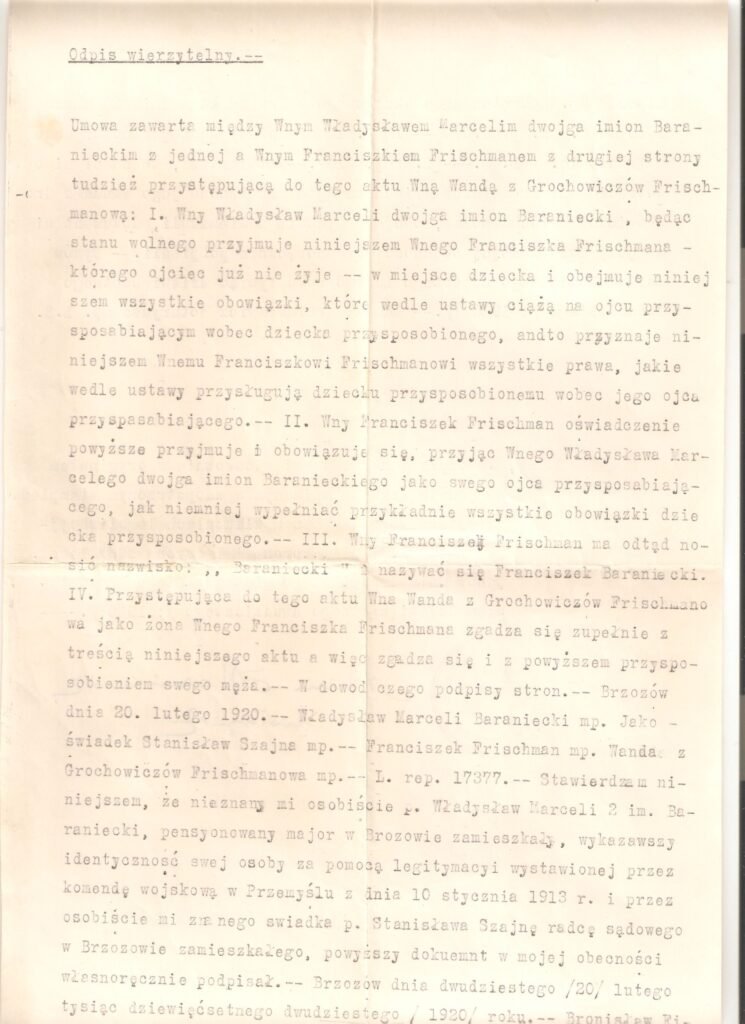
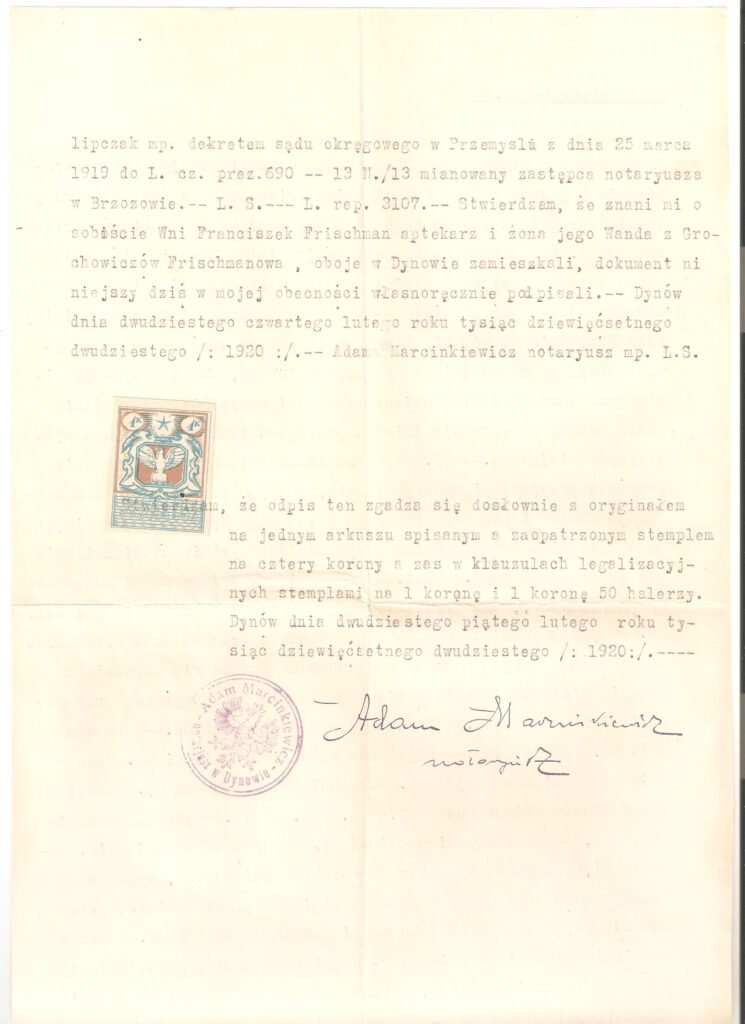
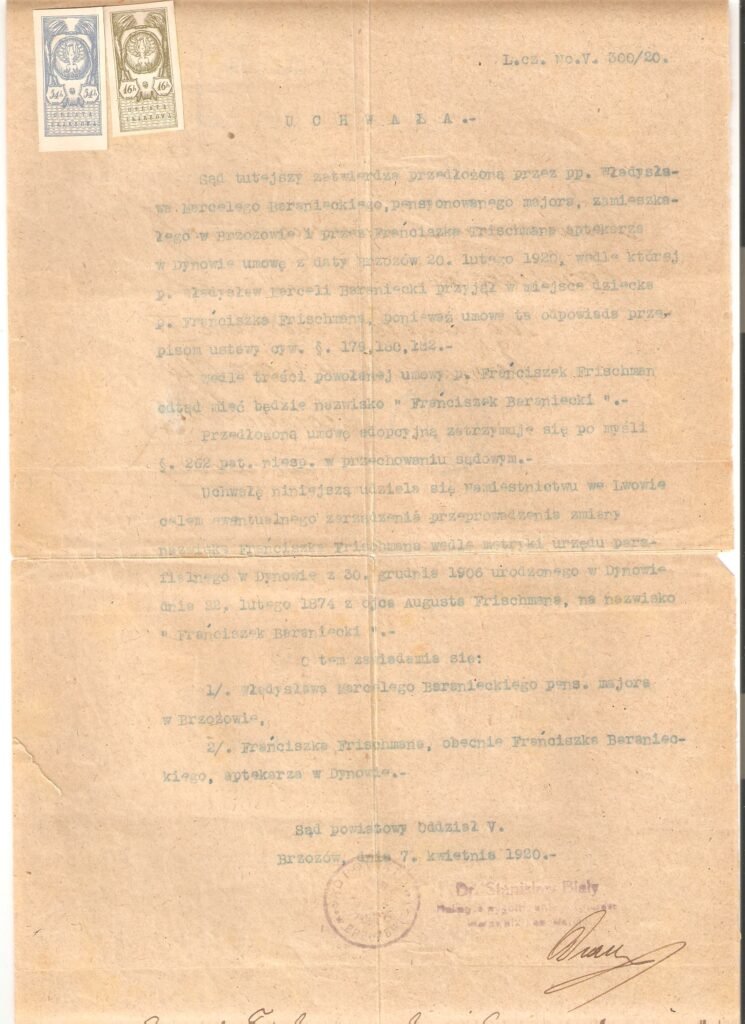
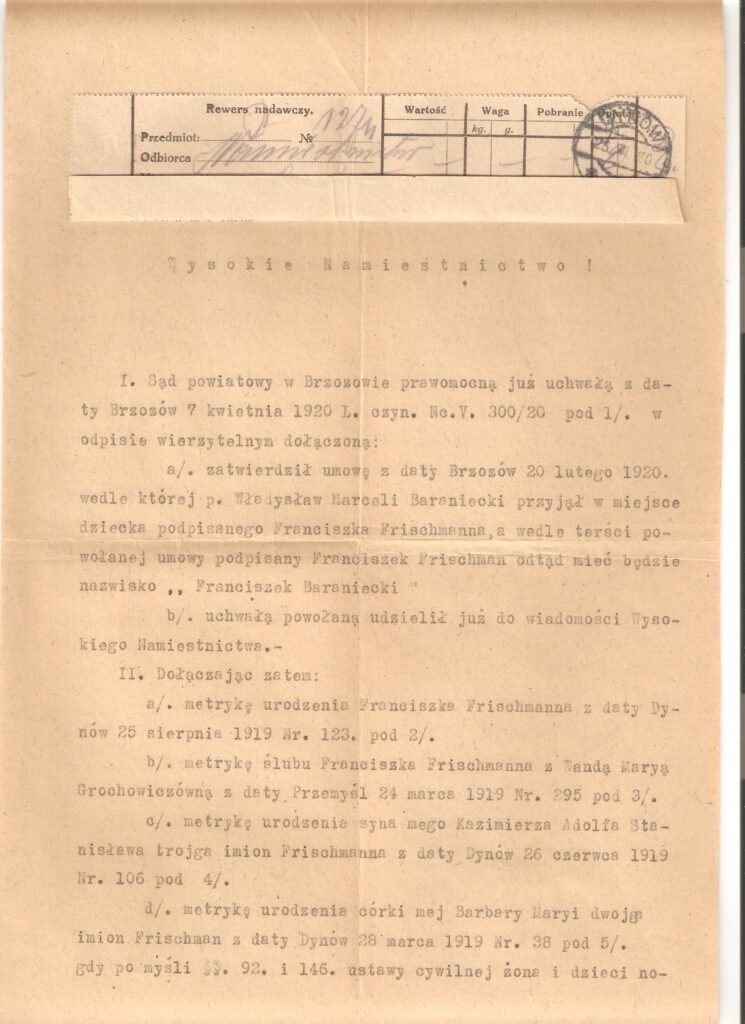
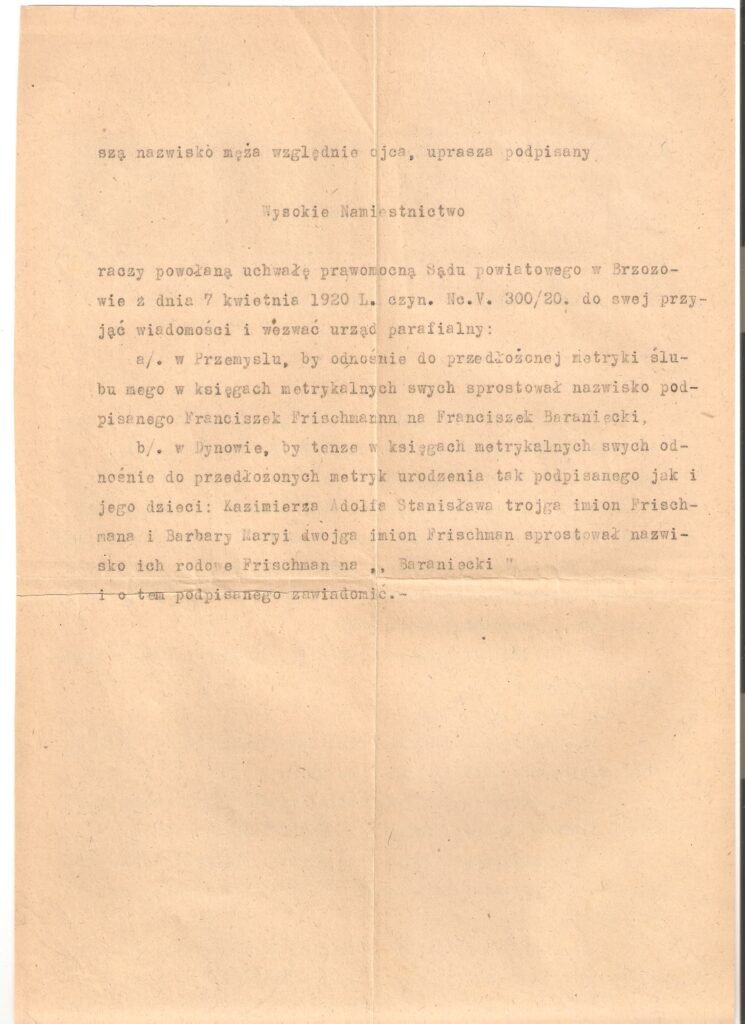
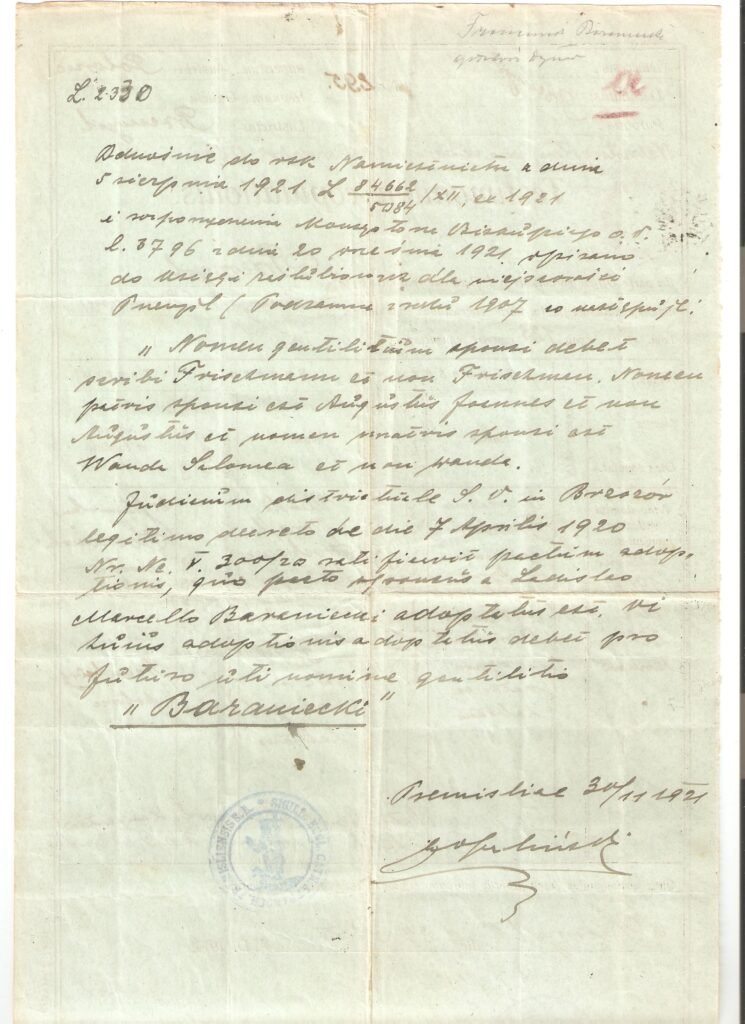
Five Generations – Appendix IX
Staszek Baraniecki’s Letters from Auschwitz
Reading Staszek’s letters from the camp is a difficult experience.
Written in German, they repeat the same phrases: the writer is healthy, satisfied with his circumstances, and concerned only about whether “everything is all right” at home.
At the same time, he continually reminds his family that he can receive money only in German currency, RM, and — heaven forbid — never enclosed in a parcel of clothing.
He receives the money and thanks them for it, while repeatedly reminding them of the camp commandant’s strict rules governing correspondence.
The first letter was written in July 1940, and the last on 24 November 1940.
At the end of January 1941, a telegram arrived from the camp commandant’s office, addressed to Franciszek Baraniecki, announcing his son’s death.
Here is its text:
German Post East
Telegram sent from Auschwitz
31/29 — 29 January — 20:02
Telegram received
30 January 1941 — 08:07
In Reichshof [Rzeszów]
Franciszek Baraniecki
Dynów, Rynek 10, Brzozów district
Your son Stanisław died today in the concentration camp at Auschwitz, as confirmed by the command of the Security Police and Police (?) of the Kraków district (?).
Camp Commandant
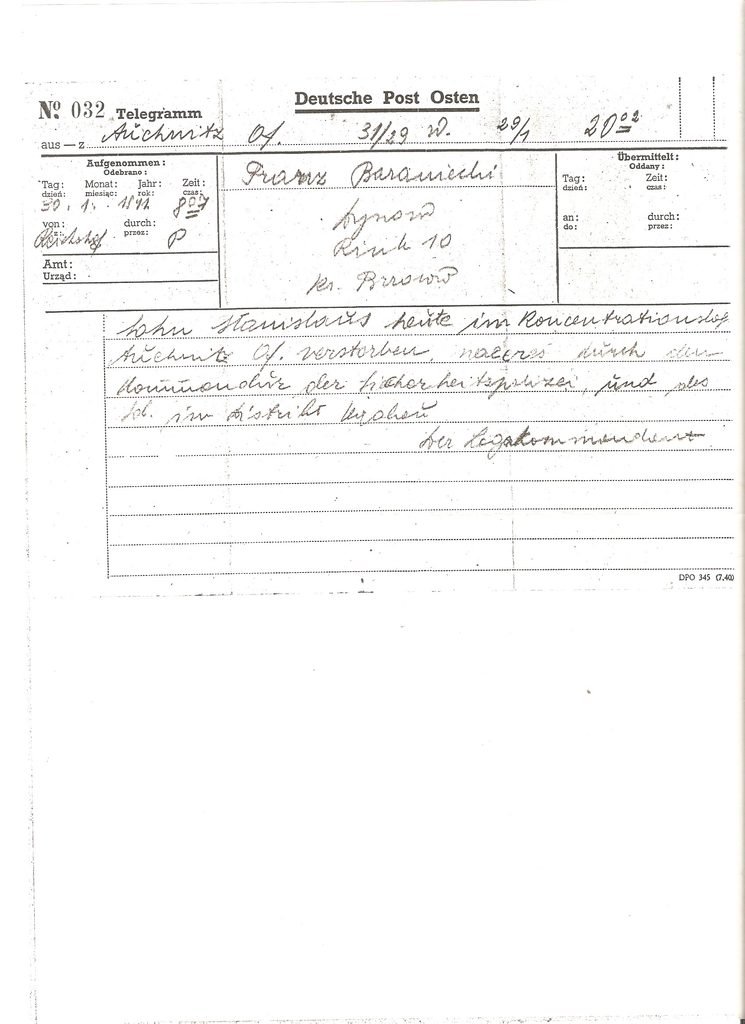
Here are the translations of the letters.
First Letter
Auschwitz, 28 July 1940
Dear Mother!
I am writing to let you know that I am healthy, and I hope this letter finds you in the best of health.
I am here in the camp at Auschwitz and am feeling well. Please note that money can only be sent in German currency, and letters must be written only in German.
When sending letters, please follow the regulations printed on the envelope.
I send warm greetings and kisses to you and everyone at home.
Stanisław
Second Letter
25 August 1940
My Dear Mother!
I received a letter from home and am very glad that everything is all right. I received the money — ten RM.
I am healthy and eagerly await news from home.
Mother! Why did you not answer my letter yourself?
Please have everyone sign the letters to me. Money may continue to be sent to me only in German currency.
Greetings and kisses to you and everyone.
Staszek
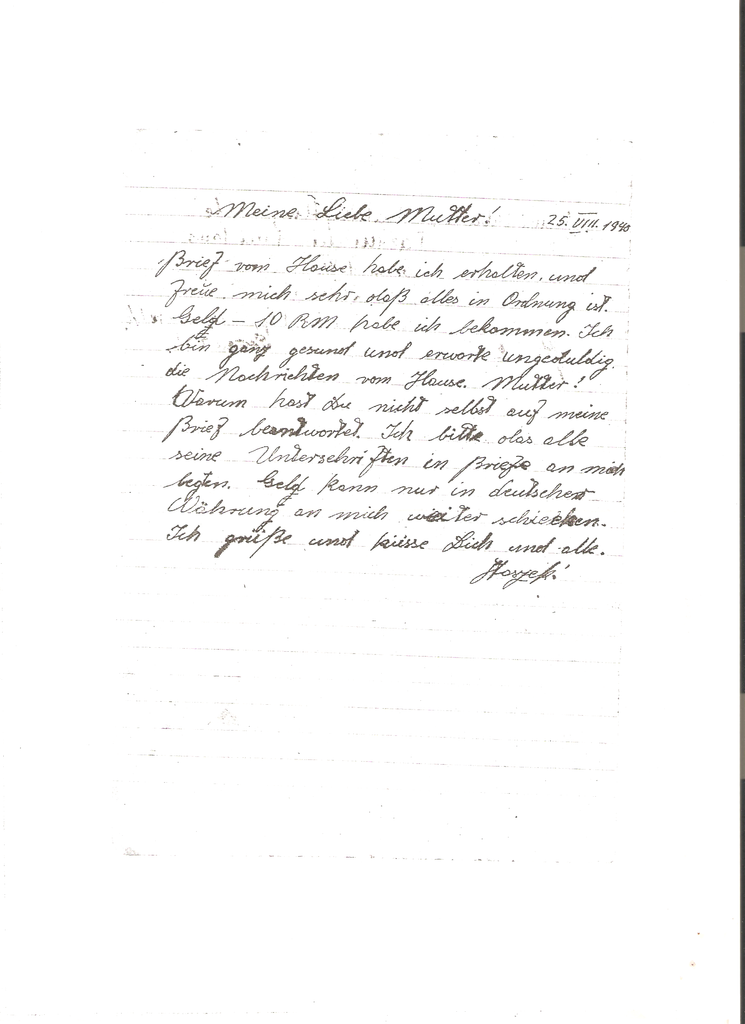
Third Letter
8 September 1940
Dear Mother!
I have received your second letter. It made me very happy. I am pleased. Your second letter crossed with my last one. Money can only be sent here in RM.
Write only about what is happening at home.
Please have everyone sign at the end of the letter. That gives me great joy. I am healthy and am getting along quite well.
Warm greetings to you all. Until we see each other again.
Staszek
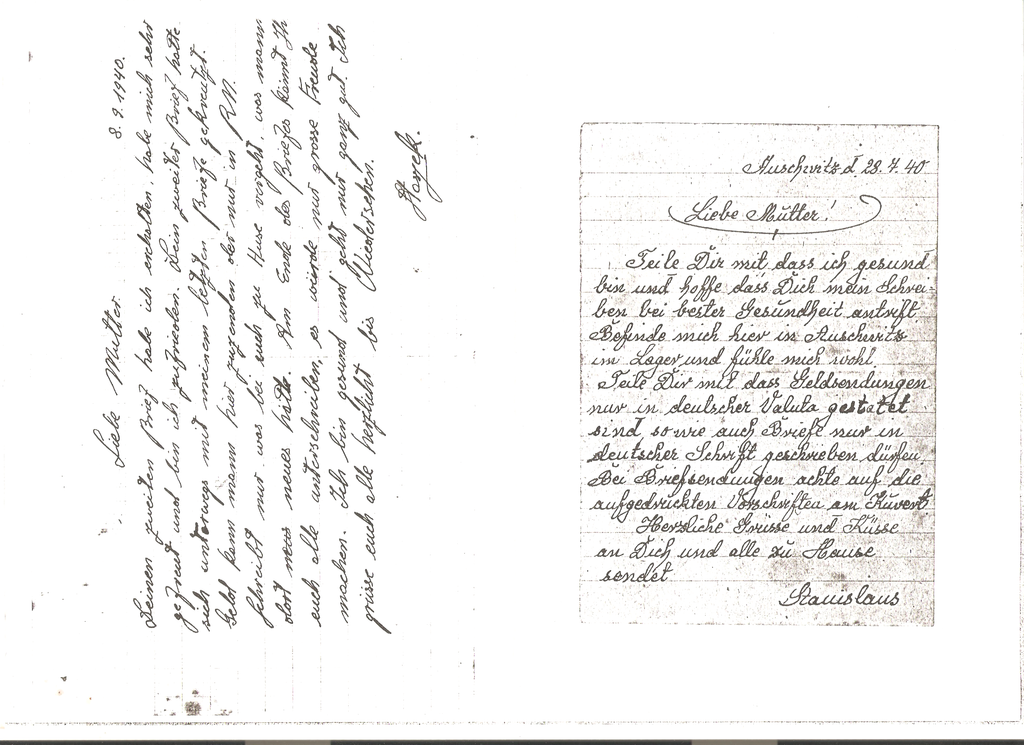
Scan showing two letters from Staszek, dated 28 July and 8 September 1940.
Fourth Letter
Stanisław Baraniecki
Born 4 March 1922
Prisoner No. 208
Block 3
Auschwitz, 13 October 1940
Dear Father!I send you my warmest wishes for all the very best. I received your last letter a week ago. I was very pleased by the news about Jurek and Andrzej. I am healthy and feel well. Every letter from you, my dear Father, gives me so much joy that I eagerly await the next one. Dear Father, always write as much as possible about everything that might interest me.
Greetings and kisses to you and everyone at home.
Your Staszek
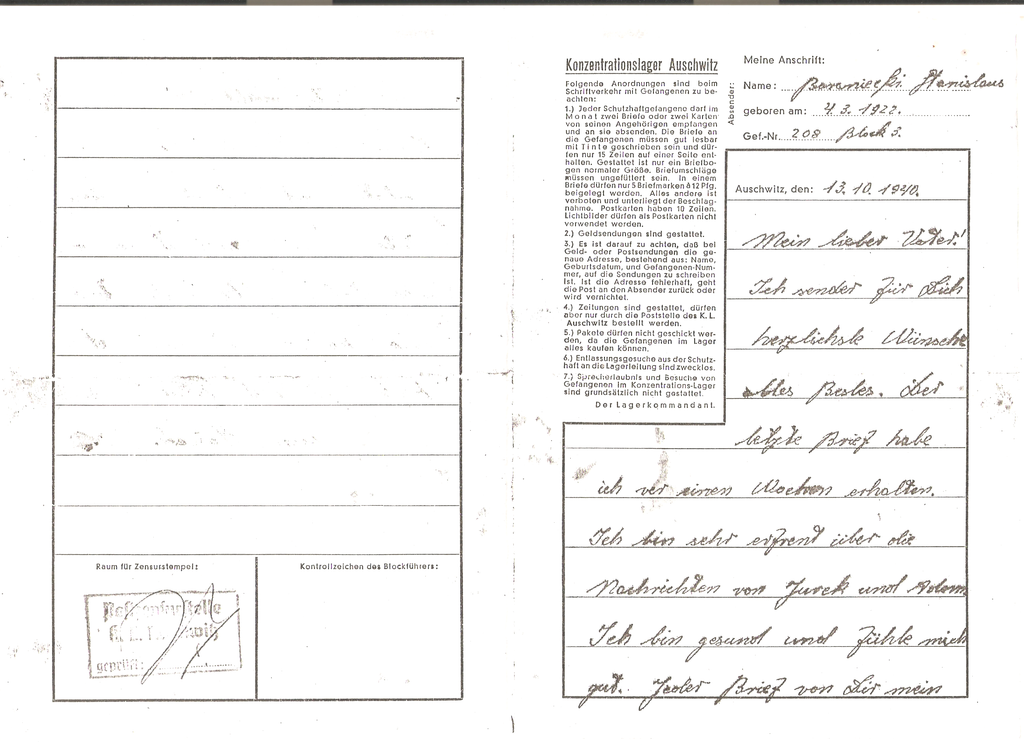
Fifth Letter
My address:
Prisoner in protective custody
Stanisław Baraniecki
Born 4 March 1922
Prisoner No. 208, Block 3
Auschwitz, 10 November 1940
Dear Mother!
Two weeks ago, I received a letter from Father.
I am glad that everything is all right at home. I received the money you sent, for which I thank you warmly.
Warm greetings and kisses to everyone at home. Write to me about everything that may concern me.
Your son,
Staszek
To avoid enquiries from the camp administration and ensure prompt delivery of correspondence, the following rules must be observed:
- Write letters clearly.
- Do not send registered letters.
- Send blank envelopes.
- Send German postage stamps.
- Do not enclose photographs in letters.
- Do not enclose money in letters.
- Write two letters a month.
If all these points are observed, every letter will be delivered without delay.
Failure to comply with any of these instructions will result in punishment and the destruction of the letter.
Please do not send me any warm underwear, as I receive it here.
Once again, greetings and kisses to you, dear Parents, and to all our relatives.
Your son,
Staszek
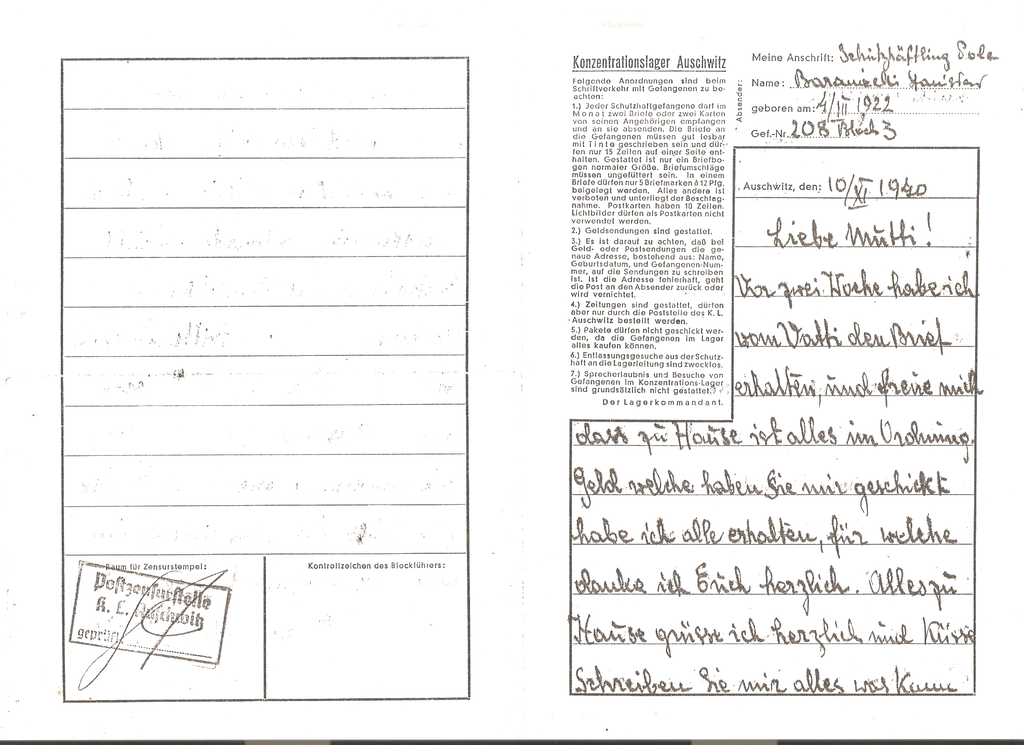
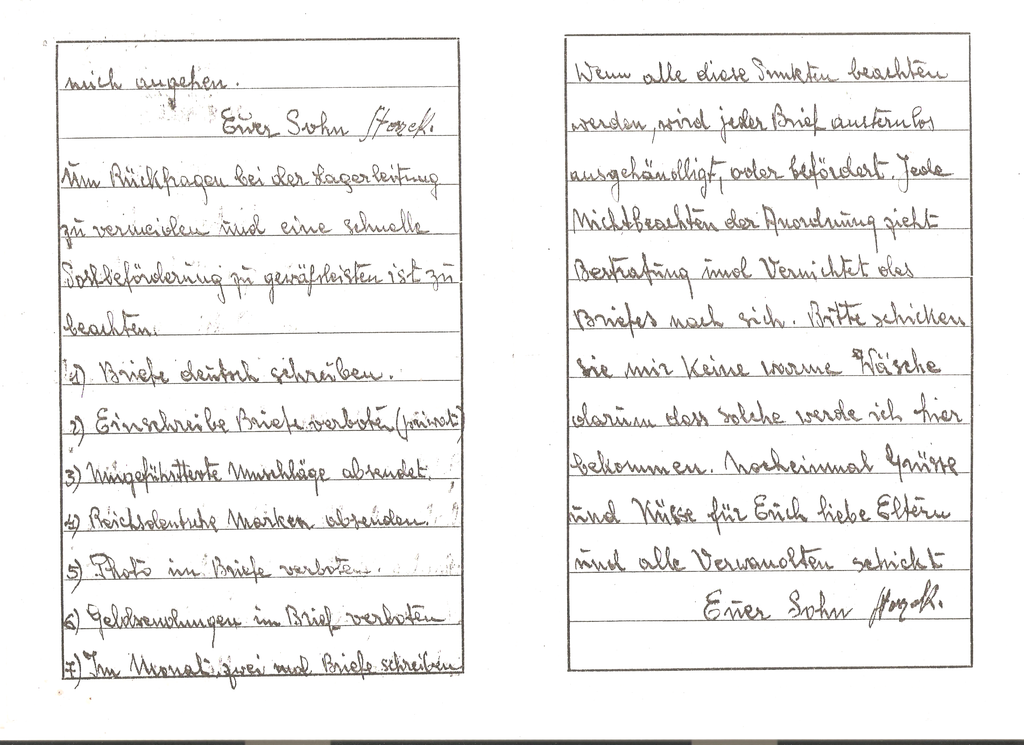
Sixth Letter
My address: Polish prisoner in protective custody
Stanisław Baraniecki
Born 4 March 1922, K.L. A.
Prisoner No. 208, Block 3
Auschwitz Post Office, 24 November 1940
Dearest Mother!
Your letter reached me three days ago and made me very happy. Thank you warmly for the money. With the permission of the camp administration, I ask you to send me immediately:
- A pullover.
- Winter socks — ski socks.
- Gloves.
Nothing else may be added to the parcel, including money, otherwise the parcel will be confiscated.
I send dear Basia my warmest wishes for happiness on her name day.
Everything is all right with me, and I hope it is the same with you. Greetings to everyone at home. Write a great deal, as much as you can.
Warm kisses to you, dearest Mother, and to everyone at home, including Wojtek and Andrzej.
Your son, who loves you with all his heart and longs for you,
Staszek
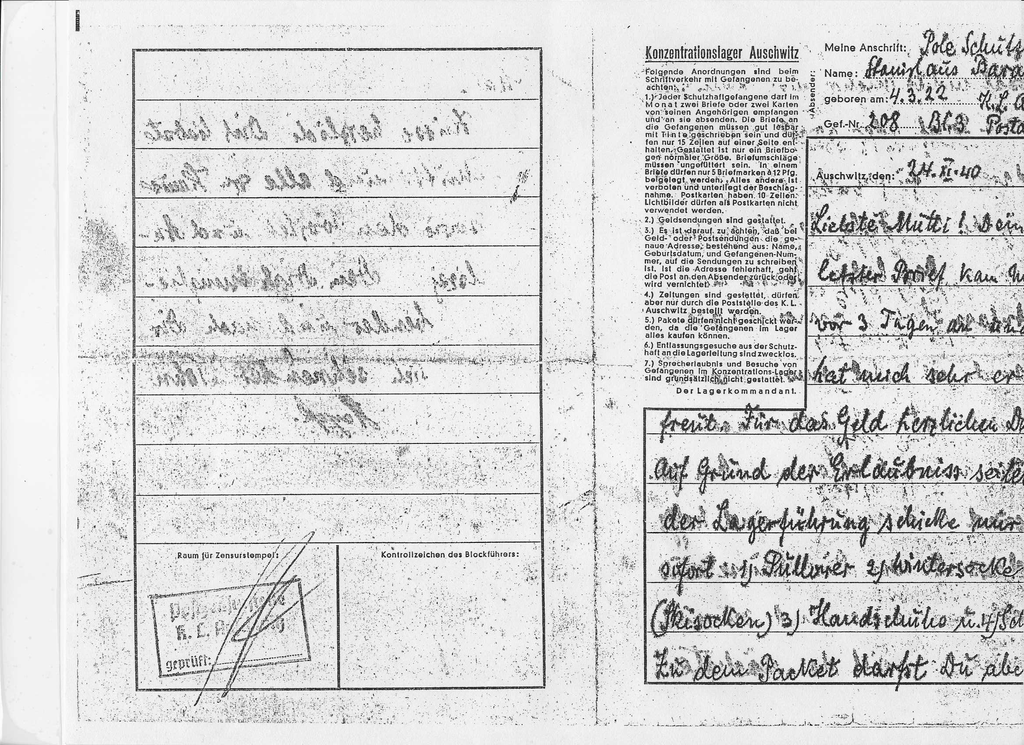
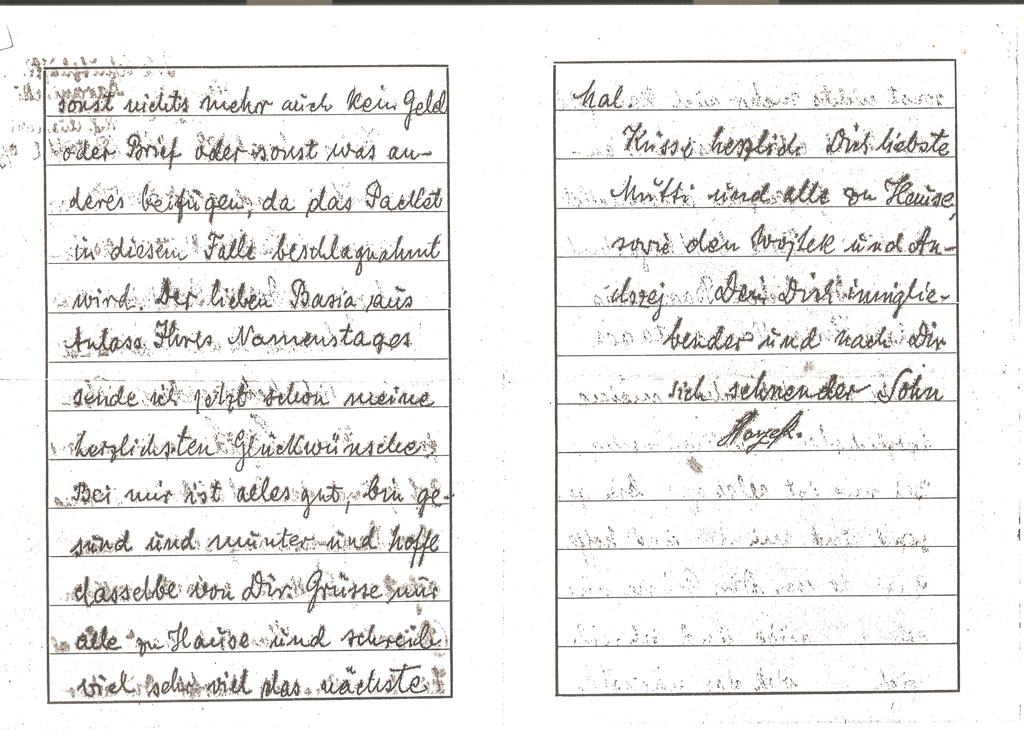
Later Correspondence Preserved by the Family/im
Among my documents are two letters from a certain Dr Stanisław Pełka-Peliński. They were probably written in response to a request from Grandma Wandzia. It is difficult for me to say exactly who this man was.
Peliński was some sort of clairvoyant. Grandma had asked him to explain what had happened to Staszek. These letters date from 1942, so they were written after Staszek’s death…
Here they are:
Warsaw, 14 November 1942
35 Żurawia Street, Flat 5
Dear Madam,
If the vision I have received corresponds to reality, then unfortunately I do not see Mr Stanisław among the living. I write conditionally, because the enclosed photograph is unsuitable for psychometric examination for two reasons: first, the pupils of his eyes are not visible at all; second, Mr St. is in the company of another person whose name is unknown to me. I could not exclude that person’s emanations while in a trance, and the two auras conflict with one another.
Therefore, if you have a better photograph of Mr Stanisław, please be so kind as to send it to me, and I shall try to perceive his fate more precisely. In the present case, I see him suffering grievously, alone at first, then staying in a barrack in an internment camp. There, in the first month of 1941, around 29 January, after prolonged suffering, he leaves this world. Once again, I emphasise that this vision may be inaccurate for the reasons explained above.
Awaiting any reply you may wish to send, together with another photograph or further questions, I remain,
Yours respectfully,
Dr Stanisław Pełka-Peliński
And the second letter, written on 7 December 1942:
Dear Madam,
In accordance with your wishes, I have once again subjected the late Stanisław to psychometric examination. Unfortunately, I confirm the sorrowful news in its entirety, in accordance with what I wrote previously. Divine Providence chose him to be a martyr and evidently assigned him this earthly mission. May the Lord’s words bring inner consolation to the Family, still suffering:
“Blessed are those who suffer persecution for righteousness, for they shall inherit the Kingdom of Heaven.”
Is it not a sign of Divine Grace that the late Stanisław became one of the chosen? We bow our heads humbly before the Lord’s will, believing that the near future will cast a radiant light upon the darkness of the days that we Poles, and the whole world, have been called upon to endure.
Yours respectfully,
Dr Stanisław Pełka-Peliński
For the sake of the historical record, I also include here a strange prediction about Staszek Baraniecki from a fortune-teller in Kraków. It is undated, but one may suppose that it was sent in the autumn of 1940, or perhaps early in 1941.
Here it is:
At present, he [Staszek] is in quarries in north-western Germany, near Hamburg. She received distressing news [this probably refers to the fortune-teller receiving distressing news in her visions], but he will survive the war. Hard labour in underground chambers, blasting rock and clearing rubble. Hot below, draughty above. He will return early in 1943. He will be ill. His health is already beginning to fail. Winter will be very difficult to endure. The air is heavy, thin — he will develop a lung disease. He removes rubble in handcarts. Ten hours of work. There is no question of getting out. This camp was established a year ago. The people there are doomed.
He will return ill and spend two years recovering. He will make up for missed schooling, but then abandon it and take up social work different from what was planned. In 1950, he will marry, but his happiness will not last long, especially because of his health. Death in 1958.
There were round-ups, and he was taken, confronted with his companions, and beaten into admitting political activity, although it was not true. He had only passed on news.
Five Generations – Appendix X
The Family of Filip Frischman-Baraniecki
Here is what my Father wrote about Filip and his family:
“Filip married Eugenia Doczyło in 1916.
Eugenia’s mother was a Decker by birth, the youngest daughter of Fryderyk, whose handsome grave monument stands in the cemetery in Dynów. Walking towards the chapel, you will find it just before the chapel, on the left, along a side path.
Her name was Karolina. Her unmarked grave is in the old cemetery, just beside the path on the left as you enter.
Old Fryderyk leased the Ulanica estate. In old age, he bought himself a house on a corner of the market square, opposite Wrona’s. The house was later bought by Krasnopolski, the baker. It has since been demolished, and the new pharmacy was built on its site.
Fryderyk Decker was an Austrian who had settled here and become thoroughly Polish. He had four daughters and a son, Józef — Ewa Decker’s grandfather — a doctor in Warsaw who was married to a Chmielewska from Przemyśl.
Fryderyk’s youngest daughter married Jakób Doczyło, a court official whom we would today call the ‘head of the land registry’.
This Doczyło, who died in Przemyśl on 26 October 1935, was a Greek Catholic, that is, a Ruthenian, which in the old days made no difference. Politics did not enter into it then.
He was not a Ukrainian in the sense of being a nationalist, but looked rather towards Tsarist Russia — and paid for it.
Through the folly of the Austrian authorities, this quiet man, who had never harmed anyone, was put in prison at Thalerhof in Tyrol.
After his wife’s death, he married again, this time a Ruthenian woman who was the daughter of a priest. They had one son, who died in childhood.
By his first wife, Fryderyk’s daughter, he had three daughters: Eugenia, Janina and Stanisława — the younger ones fiercely Polish — and a son, Stefan, who, like his father, was a Greek Catholic. A very decent man, quiet and gentle. I knew them all well.
He died on 13 May 1942.
He was married to Julia — I cannot remember her surname — a splendid, dark-browed Ukrainian woman who owned a house in Lipowica, at the end of 3 Maja Street, where she also had a few morgens of land. But the marriage was not happy, I think because of their views. She died a few years later, leaving her entire estate to Ukrainian causes. Some society called ‘Prosvita’, or something similar. She could have left it to Filip and his family, who were poor and could have made very good use of it. Well! It could not be helped!
While their father, Jakób Doczyło, was imprisoned during the war — and Stefan too, I believe — the daughters, Stefan’s sisters, sold their house, where the Sokół society was based and later the cinema. They lived at Banat’s in Zamczysko, where Jaśka Patkiewicz later lived.
I visited them there often, and we were all on familiar terms. I used to go with Dusia Banach, who was their friend. They were all intelligent young women, and I learned a great deal in their company.
The father, Leonard Stemerowicz, was a military doctor in Bosnia. Later, after the war, he worked in Poland as a doctor for the Health Insurance Fund in Przemyśl. He had a splendidly equipped consulting room and was a very decent man, but my Mother said he was a poor doctor. He was excessively pious, while his wife, Maria, née Wójcik, had a fiery temperament and could scarcely contain herself — something the older ladies observed with distaste.”
Five Generations – Appendix XI
An Account of the Ukrainian Attack on Dynów, Including Our Pharmacy
On 16 November 1946, before the attack on Dynów, units of the Ukrainian underground assembled in the forests near Dylągowa. These included the companies of the Przemyśl battalion of the Ukrainian Insurgent Army, UPA, commanded by Włodzimierz Szczygelski, “Burłaka”, Jarosław Kociołek, “Kryłacz”, and Michał Duda, “Hromenko”. Also participating were a detachment commanded by “Mrij”, from the Ukrainian Soviet Socialist Republic and temporarily operating in Poland, and a local armed unit of the OUN-B Security Service.
The Ukrainian forces were under the overall command of Mikołaj Sawczenko, “Bajda”, commander of the Przemyśl UPA battalion. The forces involved in the operation are estimated to have numbered at least five hundred armed men. It was one of the larger UPA military operations in Poland.
The principal purpose of the raid was to obtain medicines and everyday supplies for UPA units before the approaching winter. It was also intended to demonstrate the strength of the Ukrainian underground to the Polish population.
The course of the attack on Dynów is best illustrated by the special report of Lieutenant Ludwik Turek, head of the District Public Security Office in Brzozów, dated 18 November 1946. I reproduce it below in full.
Andrzej Stankiewicz
Brzozów, 18 November 1946
To the Head of the Provincial Public Security Office in Rzeszów
Special Report
On 16 November 1946, at 21:30, a UPA gang numbering approximately four hundred men, armed with light machine guns, submachine guns, rifles and hand grenades, entered the town of Dynów from all directions. Some members wore Polish military uniforms, while others wore civilian clothes. Before entering, the gang damaged the telephone lines leading from Dynów towards Przemyśl, Sanok and Brzozów by sawing through telephone poles and severing the wires. Strong detachments were left at the points where the lines had been damaged, also guarding the roads leading to Dynów.
The gang entered Dynów in three UPA groups and one Polish NSZ group under a commander using the pseudonym “Młot”. Each group had been assigned a specific task. Part of “Młot’s” group undertook the robbery of the pharmacy. This group included two doctors and one qualified pharmacist, who specifically searched for the medicines and narcotic drugs they required. The remainder patrolled Dynów. When encountering residents, they presented themselves as members of the Polish Army and addressed their commanders in Polish as “Lieutenant, sir”, “Captain, sir”, and so forth, thereby attempting to confuse the population and the ORMO unit.
Furthermore, the group in the pharmacy informed its owner, Franciszek Baraniecki, that the medicines they were taking were intended for Polish partisan units and the UPA.
One UPA group secured the streets and engaged the ORMO and MO units, while the remaining two groups carried out the looting. The following premises were robbed:
The Agricultural and Trading Cooperative, from which assorted goods worth 300,000 złoty were taken. Its office premises were also set on fire and partially burned.
The private shop of Władysław Tarnawski, from which assorted goods worth 55,600 złoty were stolen.
The private shop of Marian Kędzierski, from which food and catering supplies worth 13,750 złoty were stolen.
The private shop of Marian Bucikowski, from which clothing worth 200,000 złoty was stolen.
The private shop of Bronisław Stankiewicz and Genowefa Kędzierska was robbed of assorted goods worth 500,000 złoty, then set on fire and burned to the ground.
The private shop of Maria Węgrzyn, from which confectionery and state-monopoly goods worth 150,000 złoty were stolen.
The shoemaking workshop of Józef Majda, from which leather worth 200,000 złoty was stolen.
The goods and medicines stolen from the pharmacy were valued at 1,000,000 złoty.
The total losses caused by the gang through the theft of goods amounted to 3,383,500 złoty.
The UPA group securing the town’s streets proceeded, together with the NSZ group, to the MO station, which had been locked from within. Only one militiaman, the duty officer Wojciech Stec, was present. The remaining militiamen had gone with their commander towards the sound of the first shots in the fighting involving the ORMO unit.
On arriving at the station, the gang surrounded it with eight light machine guns and called upon the duty officer, Stec, by name to surrender. They declared that no harm would come to him, but that if they had to break in, his fate would be grim. Militiaman Stec defended himself until he ran out of ammunition, then hid in the attic.
The gang broke in through windows closed with shutters, which had been damaged by bullets, cutting through the bar securing a shutter. Having entered the station in this manner, the gang wrecked the premises with automatic gunfire and grenades. They then stole the militiamen’s clothing, both civilian and uniform, bedding and footwear. They damaged the telephone by gunfire, as evidenced by the receiver shattered by a bullet and the marks on the wall, and then took it.
They also took the militia’s food supplies, which were intended to last until 1 December. Most of the station’s files were destroyed. The furnishings, including desks, cupboards, tables and chairs, were completely wrecked. They also took all the kitchen utensils. After plundering the station, the gang joined the groups looting the shops.
As the gang searched the town, they stopped residents they encountered, took their footwear and outer clothing, and then released them with orders to return home. They fired upon people who defended themselves or offered armed resistance.
Those killed were Jan Sikora, aged fifty-one; Stanisław Domin, aged thirty-two; and Władysław Bałdys, aged forty-two.
Those wounded were Jan Domin, Agata Drozd and Mieczysław Cymbalista.
Members of the ORMO unit killed in the fighting were Józef Rakowski, son of Michał and Paulina, aged twenty-three, and Antoni Ulaniecki, son of Jakub and Aniela, aged forty-nine. Both were from Dynów.
Stanisław Tymowicz and Karol Toczek, also from Dynów, were wounded.
During the fighting, the ORMO unit lost six rifles: two belonging to those killed, two belonging to those wounded, and two taken from men captured alive, who managed to escape after being disarmed. One rifle was captured from the gang by an ORMO member.
Traces of clotted blood indicate that members of the gang were killed or wounded, since blood was found in six places which did not come from our own dead or wounded. Four such traces were in the market square and two outside the station. The gang, however, took its wounded away.
At midnight, under covering fire, the gang withdrew from Dynów with its stolen booty, crossing the San at a ford. It also scattered a dozen or so pamphlets and leaflets among the population. These included duplicated Polish-language pamphlets entitled Polish-Ukrainian Relations and duplicated Polish-language leaflets entitled Our Answer.
The population of Dynów remained fairly calm during the attack. There was no panic. Residents rallied to the defence and resisted with great determination. As a result, their efforts saved many shops from being robbed. The post office and the Cooperative Bank, where substantial sums of cash were held, were also saved. A more complete defence was prevented by the shortage of weapons and ammunition.
It was established that the gang had succeeded in confusing the population, because its advance patrols wore Polish military uniforms, spoke fluent Polish and presented themselves as Polish soldiers.
Head of the District Public Security Office in Brzozów
Signed: Ludwik Turek
The article was based on studies by Artur Brożyniak published in the Institute of National Remembrance journal Pamięć i Sprawiedliwość, No. 1, 2008, and in Jarosławski Rocznik Armii Krajowej, No. 6, 2008.
That concludes the account of these post-war events.
Five Generations – Appendix XII
Franciszek Frischman’s Professional Placements
15 July 1895 – 1 January 1896
“Pod Opatrznością” Pharmacy in Dynów, under the supervision of Franciszek Biechoński.
1 January 1896 – 1 September 1896
Pharmacy in Łańcut, under the supervision of M. Szulc.
1 September 1896 – 1 September 1897
Vienna.
1 September 1897 – 1 January 1898
“Pod Opatrznością” Pharmacy in Dynów, under the supervision of Franciszek Biechoński.
1 January 1898 – 1 July 1898
Pharmacy in Krzeszowice, under the supervision of Edward Rybacki.
1 July 1898 – 1 September 1898
“Pod Gwiazdą” Pharmacy in Kraków, under the supervision of Konstanty Wiszniewski.
1 September 1898 – 1 February 1899
Pharmacy in Cieszyn, under the supervision of Edward Kaschka.
1 February 1899 – 1 May 1900
“Pod Opatrznością” Pharmacy in Dynów, under the supervision of Jan Cetera.
1 May 1900 – 30 June 1900
“Pod Opatrznością” Pharmacy in Dynów, under the supervision of Czesław Chorubski.
1 July 1900 – 15 July 1900
“Pod Gwiazdą” Pharmacy in Kraków, under the supervision of Konstanty Wiszniewski.
Five Generations – Appendix XIII
Kazimierz Baraniecki’s Professional Placements
1. 20 October 1930 – 8 April 1931
In Dynów, under the supervision of Franciszek Baraniecki, Master of Pharmacy.
2. 8 April 1931 – 31 July 1931
In Jaworzno, under the supervision of Józef Szpunar, Master of Pharmacy.
3. 1 August 1931 – 31 December 1931
In Dynów, under the supervision of Franciszek Baraniecki, Master of Pharmacy.
4. 1 January 1932 – 31 December 1932
In Bydgoszcz, under the supervision of Ignacy Rochon, Master of Pharmacy.
5. 1 January 1933 – 1 October 1933
In Dynów, under the supervision of Franciszek Baraniecki, Master of Pharmacy.
6. 1 October 1933 – 31 October 1935
In Brzozów, under the supervision of Dr Jan Zacharski.
7. 1 December 1935 – 31 March 1937
In Zakopane, under the supervision of Bogdan Donigiewicz, Master of Pharmacy.
On 1 April 1937, he moved to Dynów, where he worked for his father until 24 January 1945. On that date, his father, Franciszek Baraniecki, transferred ownership of the Pharmacy to him by notarised deed.
Five Generations – Appendix XIV
Grant of Nobility and a Coat of Arms to Georg Frischman — 3 May 1727
A Coat of Arms Graciously Granted and Bestowed upon Georg Frischman
We, Charles VI, make known to all and sundry whom this matter concerns that, acceding to the most humble petition of certain of Our faithful subjects presented before Our Majesty, and taking into consideration the loyalty and faithful services of Our subject Georg Frischman, permanent estate administrator to Prince Paul Anton Eszterhazy of Galanta at Frakno and of the lordship of Szczukő, that is, Hornstein, which he has faithfully and steadfastly rendered, first to the Holy Crown of Our aforesaid Kingdom of Hungary and thereafter to Our Imperial House and Majesty, in various places and at various times, on diverse occasions and in circumstances of need, and which he promises henceforth to render with the same zeal, loyalty and constancy;
We have therefore graciously deemed it fitting that the said Georg Frischman, who was granted his freedom by the late Prince Michael Eszterhazy of the same Galanta, hereditary lord at Frakno and his lord of the manor, and who was most humbly and successfully recommended to Our Majesty for the grant of nobility, should be admitted, incorporated and enrolled among the nobility;
and, through him, likewise his wife Katharina Händlein; his sons Johann, Joseph, Ignaz and Franz, born of Paula, and Anton Ignaz; and the daughters of the said spouses Georg and Katharina — Rosalie, Anna Theresia and Maria Anna Katharina;
provided, however, that the properties they now actually possess, and those they may possess in future, shall not by this grant of nobility be exempted from the charges to which they are subject.
Charles VI of Habsburg – the monarch who granted nobility to Georg Frischman in 1727.
Coat of Arms
A military shield divided horizontally into two fields.
The upper field is blue and bears three golden stars arranged in a single line.
In the lower, silver field, above a green hillock, is a human arm wearing a red glove and holding in its hand three golden roses with their stems.
Upon the shield rests an open, barred military helmet, adorned with a royal crown, from which emerges another human arm, in every respect similar to the arm described above.
The helmet is adorned with mantling, or flowing bands, gold and blue on one side and silver and yellowish on the other, descending towards the edges of the shield.
As all these things have been depicted and described, so We decree, receive, incorporate and enrol them among the nobility, and give, bestow and grant them the aforesaid coat of arms by virtue of this document.
In perpetual remembrance of this act, We have signed this document and ordered it to be furnished with Our seal.
Given through the hands of Our faithful subject, the illustrious and noble Count Lajos Batthyány, hereditary Count of Németújvár in the county of Vas, administrator of the county of Zala, Our Royal Chief Cupbearer in Hungary, Chamberlain and First Assessor of Our Royal Hungarian Court Chancellery;
at Our castle in Laxenburg, on the third day of May in the Year of Our Lord 1727.
Libri Regii – Hungarian Royal Register. Entry recording the grant of nobility to Georg Frischman