Catalogue of the Paintings of the Baraniecki Family, 1880–1980 — Part III (Entries Nr 81–120)
Contents
Nr 81 — Kossak Juliusz (1824–1899) – “Prince Józef Poniatowski” (Książę Józef Poniatowski)
Editorial comment: A historical-patriotic work immortalising the figure of Kazimierz Pułaski. It must be rigorously and categorically distinguished in the inventory structure from the item by the artist’s son – Wojciech Kossak – which bore exactly the same title and constituted a separate, independent card.
Technique: watercolour on paper
Further fate: picture sold to the Museum; stolen from the exhibition in 1993
Description of the work: The composition showed Prince Józef Poniatowski on horseback (it was one of the great historical-patriotic subjects most frequently taken up by the artist). In the preserved archival photograph, the prince is visible on a beautiful, rearing horse against a broad landscape.
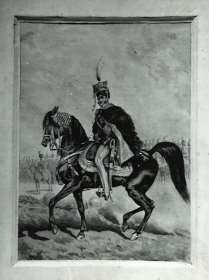
History of the work: The picture adorned the collection in Dynów for years. After the dispersal of the collection it was sold by M. Baraniecka to the Museum of Folk Architecture in Sanok and entered in the institution’s official inventory. In 1993 the work was irretrievably stolen from the exhibition. There is a serious research hypothesis that in the museum or family documentation this work may have temporarily functioned under the name “Pułaski” (or vice versa). This question requires further comparative analysis.
Museum documentation: In the correspondence with Dr Jerzy Ginalski there is unambiguous information: “Picture of Prince Józef Poniatowski – Juliusz Kossak – picture stolen in 1993, struck from the inventory.”
Editorial comment: This is the only picture from Kazimierz
Baraniecki’s entire collection whose wartime presence, post-war sale and later criminal loss in the 1990s have been unambiguously and officially documented.
State of research: Photograph: preserved. Museum correspondence: confirmed. Fate of the picture: stolen (sought).
Sources: Baraniecki Family Archive, Correspondence with Dr Jerzy Ginalski (MBL Sanok).
Nr 82 — JULIUSZ KOSSAK (1824–1899) Pułaski
Description of the work: The work was recorded in the inventory under the title “Pułaski”. The title points to a depiction of Kazimierz Pułaski, hero of the Bar Confederation and the American War of Independence. No photograph or description has survived that would make it possible to establish whether it was a portrait, an equestrian scene, a battle episode or an expanded historical composition.
History of the work: No information has been found concerning the purchase, price or
previous owner. The work must be clearly and consistently distinguished from the Wojciech Kossak picture bearing an identical title (Nr 82), as well as from the image of Poniatowski described above (Nr 68).
Description of the work: The picture was recorded under the title “Pułaski”. It is not known whether it showed Kazimierz Pułaski as commander of the Bar Confederation, as a rider, or as the hero of a particular historical event from the American war. The work must be distinguished from the picture by the father, Juliusz Kossak, of the same title, which received a separate catalogue card earlier (Nr 70).
History of the work: No information has been found on the purchase, price or seller. The fact that two pictures entitled “Pułaski” occurred in the collection, attributed to father and son — Juliusz and Wojciech Kossak — requires the retention of two separate catalogue items in order to reflect the source truth.
Kazimierz Baraniecki’s notes: The preserved entry reads: “W. Kossak – ‘Pułaski’.”
State of research: Artist and title: recorded in the inventory. Distinctness from Juliusz Kossak’s “Pułaski”: follows directly from the structure of the inventory. Photograph: not found. Other data: not established.
Kazimierz Baraniecki’s notes: The preserved inventory entry is limited to the words: “Juliusz Kossak – ‘Pułaski’.”
State of research: Artist and title: recorded in the inventory. Distinctness from Wojciech Kossak’s “Pułaski”: follows directly from the author’s inventory. Photograph:
not found.
Sources: Kazimierz Baraniecki’s collection inventory, Baraniecki Family Archive.
Nr 83 — Kossak Juliusz (1824–1899) – “Squadron Staff” (Sztab Dywizjonu)
Main catalogue number: New discovery (from the handwritten division inventory) Description: A watercolour military scene with field commanders and mounted adjutants, analysing maps or reports against the background of a military encampment.
Nr 84 — WOJCIECH KOSSAK (1856–1942) — A Horse’s Head against the Mosque in Tunis / a Muslim Temple (Głowa konia na tle meczetu w Tunisie / muzułmańskiej świątyni)
Technique: oil
Signature: Kossak seal or coat of arms and the artist’s handwritten signature Date of purchase: November 1941
Purchase price: 300 zł
Value according to the note: 450 zł
Seller: most probably Mieczysław Horski
Further fate: not established
Description of the work: The picture showed a horse’s head against a monumental Muslim building. In one inventory the background was defined as a mosque in Tunis, in another as a Muslim temple, and the picture itself was geographically linked with Algiers. Kazimierz Baraniecki noted the valuable information that the artist himself had supposedly valued precisely the atmospheric background of this picture extremely highly — perhaps even more than the study of the horse itself. The work had a rare and particular confirmation of authenticity: it was marked with the official seal or coat of arms of the Kossaks and the handwritten, legible signature of Wojciech Kossak.
History of the work: Kazimierz Baraniecki bought the picture in November 1941 for
300 zł, valuing it at 450 zł. The purchase took place during a period of intensive occupation-era contacts with Mieczysław Horski. In the same financial note the collector described the settlement of a loan of 2,000 zł, for which he first received Matejko’s “Angel”, and then Leon Wyczółkowski’s pastel showing the Kościeliska Valley.
Kazimierz Baraniecki’s notes: “I also bought at that time Wojciech Kossak’s ‘A Horse’s Head against a Muslim Temple’. A picture from Algiers. Supposedly the artist values [the background] higher than the horse itself. I paid 300 zł. Value 450 zł. Oil. Signed with the Kossak seal and coat of arms and confirmed by a handwritten signature.” Editorial comment: The sources give divergent topographical descriptions of the place:
Tunis and Algiers. Without a photograph, an inscription on the reverse of the picture or an additional manuscript, it cannot be resolved which of them is correct, therefore both variants of the information have been retained as source evidence.
State of research: Artist, subject, technique, manner of signing, price and valuation: confirmed. Date of purchase — November 1941: confirmed. Photograph: not found.
Sources: Kazimierz Baraniecki’s manuscripts, Collection inventory, Baraniecki Family Archive.
Nr 85 — WOJCIECH KOSSAK (1856–1942) The White Horse (Koń biały)
Description of the work: The picture was recorded in the inventory under the title “The White Horse”. The lack of a photograph makes it impossible to establish whether it showed an independent study of the animal at pasture, a horse with a rider, a military scene, or a fragment of a larger historical or battle composition.
History of the work: No separate note on the date of purchase or price has been found. The work occurs in the collective inventory together with three other works by Wojciech Kossak (“A Horse’s Head…”, “Kościuszko”, “Pułaski”). It is not known whether these pictures were acquired together as one collection, or whether they entered the collection gradually.
Kazimierz Baraniecki’s notes: Apart from the title in the inventory, no separate information has been found: “W. Kossak – ‘The White Horse’.”
State of research: Artist and title: recorded in the inventory. Photograph: not found. Technique, dimensions, provenance and further fate: not established.
Sources: Kazimierz Baraniecki’s collection inventory, Baraniecki Family Archive.
Nr 86 — WOJCIECH KOSSAK (1856–1942) Kościuszko
Description of the work: The work appears in the inventory as “Kościuszko”. The title unambiguously points to a depiction of the figure of Tadeusz Kościuszko, but the lack of iconographic material makes it impossible to establish whether it was an official portrait, an equestrian scene, a battle episode (e.g. Racławice), or another historical event. This work must not be identified with Aleksander Orłowski’s drawing “Kościuszko at Maciejowice”, which appears in a separate transaction note.
History of the work: No information has been found on the details of acquisition or later fate. The picture was, however, clearly listed as a separate work by Wojciech Kossak.
Kazimierz Baraniecki’s notes: The preserved entry reads: “W. Kossak – ‘Kościuszko’.”
State of research: Artist and title: recorded in the inventory. Identity with other depictions of Kościuszko in the collection: excluded on the basis of a separate author’s entry. Photograph: not found.
Sources: Kazimierz Baraniecki’s collection inventory, Baraniecki Family Archive.
Nr 87 — Kostrzewski Franciszek (1826–1911) – “Two Cavaliers” (Dwaj kawalerowie)
Main catalogue number: Item 70 (in the inventory as Koszy F. / and Nr 28 / Nr 195)
Technique: Drawing in crayon or pen on paper
Date of acquisition: Deep pre-war period (before 1914)
Provenance source: The Banach family
Acquisition price: Bought by Grandma in one old package of three prints (together with two caricatures by Kruszewski) for a total of 20 crowns. Given to Horski on 8 December 1943 for the Grottger (in the Nowakowska subgroup).
Technique: drawing
Date of purchase: before 1914
Seller: Adam Banach
Buyer: most probably Franciszek Baraniecki
Description of the work: The drawing showed two cavaliers. No photograph or more precise description has survived, therefore it is not known whether they were mounted riders, elegant young men, soldiers, or heroes of a satirical humorous scene, for which the artist was famous. In old notes the artist’s surname was shortened or distorted as “Koszy F.”, and then in the ordered inventory it was correctly recognised and attributed to Franciszek Kostrzewski.
History of the work: The drawing was purchased even before the outbreak of the First World War from Adam Banach. This information unambiguously indicates that it belonged to the oldest part of the family collection, created before Kazimierz Baraniecki’s own purchases began. In the transaction register the work was recorded as a purchase before 1914, without giving a price.
Kazimierz Baraniecki’s note: “Koszy F. /Kostrzewski/ – drawing ‘Two Cavaliers’. Purchased before 1914 from Adam Banach.”
Editorial comment: The attribution of authorship to Franciszek Kostrzewski results from the family’s reading of the abbreviated entry “Koszy F.”. Until the drawing or its signature is found, critical caution must be retained, although this identification is highly probable. Acquisition by Franciszek Baraniecki follows from the pre-war date and the family character of the collection.
State of research: Title, technique, cut-off date of purchase (before 1914) and seller’s surname: confirmed. Authorship of Franciszek Kostrzewski: highly probable. Photograph: not found.
Sources: Kazimierz Baraniecki’s notes, Transaction register, Collection inventory, Baraniecki Family Archive.
Nr 88 — Kruszewski Józef – “The Trial” (Sąd) (pen caricature)
Artist’s years in the inventory: 1853–1920
Technique: Pen-and-ink drawing on paper
Date of acquisition: Deep pre-war period (well before 1914)
Provenance source: The Banach family
Acquisition price: Bought by Grandma in one old package of three prints (together with the drawing “In the Monastery” and Kostrzewski’s “Two Cavaliers”) for a total of 20 crowns (or Russian roubles).
Further fate: Handed over to Mieczysław Horski on 8 December 1943 as a component part of the great package (valued collectively at 8,700 zł) financing the purchase of Grottger’s “Cross-Hewing”.
Nr 89 — Kruszewski Józef – “In the Monastery” (W klasztorze) (pen caricature)
Technique: Pen-and-ink drawing on paper
Provenance and fate: Identical to the previous item (Item 34) – a pre-war family keepsake from the Banach family, released to Horski in the December 1943 settlement.
Nr 90 — Laveaux Ludwik de (1868–1894)
Status in the monograph: Artist extracted directly from Kazimierz Baraniecki’s Main Indexed
Division Plan for the collection. One of the most mythical creators of the Young Poland era, who died tragically in Paris (immortalised by Wyspiański in the figure of the Spectre in the drama “The Wedding”). The monographic card remains open and prepared for the insertion of a detailed transaction note from the remaining pages of the family archive.
Nr 91 — Lentz Stanisław (1861–1920)
Status in the monograph: New artist extracted from the official collection index (an outstanding Polish portraitist, a representative of realism with a powerful, Dutch brushstroke and deep characterisation of his models). The card awaits identification of the particular work.
Nr 92 — Leopoldski Wilhelm (1828–1892)
Status in the monograph: Artist included in the official matrix of the collection division plan. An outstanding historical and genre painter of the Lviv–Kraków school. The card is prepared for the implementation of detailed inventory data.
Nr 93 — Loeffler Leopold (1827–1898)
Status in the monograph: New artist extracted from Kazimierz Baraniecki’s official table of contents (an esteemed Kraków academic professor, master of atmospheric historical-genre scenes). The card awaits the discovery of a description of the work.
Nr 94 — GUSTAVE LINO (1893–1961) — The Blue Grotto on Capri (Lazurowa Grota na Capri / Grotta Azzurra)
Technique: not established
Dimensions: not established
Signature: not established Date of purchase: 1938
Place of acquisition: Italy, during a trip to the island of Capri
Purchase price: unknown
Further fate: In the possession of Marcin Baraniecki
Description of the work: The picture showed the famous Blue Grotto on the island of Capri (Grotta
Azzurra). In the family materials it appears under the Polish title “The Blue Grotto on Capri”, and in reminiscences also under the original Italian name. No photograph or description has survived that would make it possible to establish whether the composition showed the deep interior of the grotto, the characteristic small entrance from the sea side, a tourist boat, or the intense, luminous reflections of blue on the water.
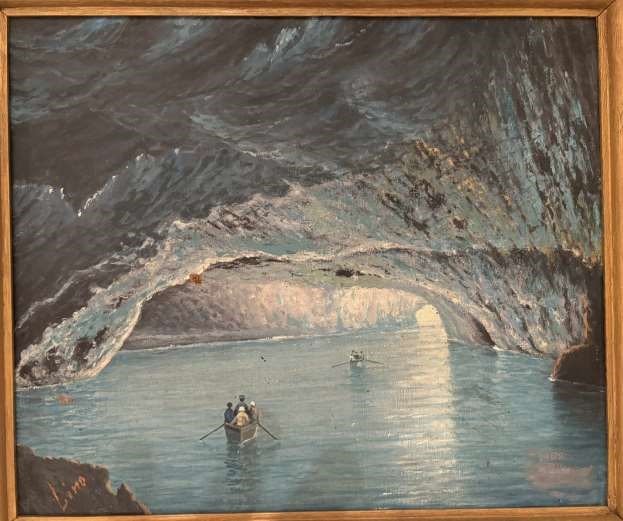
History of the work: Kazimierz Baraniecki bought this work personally during a foreign tourist trip to Italy in pre-war 1938. It was therefore a unique purchase made directly on the spot from the artist or in a local gallery, and not through Kraków dealers. In a later period (December 1941) two frames from Gustave Lino’s pictures were used as a real component of payment at the purchase
of Fałat’s “Landscape from Bystra” from Mieczysław Horski. It is not known whether Lino’s pictures were then permanently deprived of their framing, or whether they later received other frames.
Kazimierz Baraniecki’s note: “Gustave Lino — ‘The Blue Grotto on
Capri’. Bought during the trip to Italy in 1938.”
State of research: Artist, title, place and year of purchase: confirmed. Photograph: not found. Technique, dimensions and post-war fate: not established.
Sources: Kazimierz Baraniecki’s collection inventory, Notes concerning the trip to Italy, Baraniecki Family Archive.
Nr 95 — GUSTAVE LINO (1893–1961) Dr Axel Munthe’s Villa on Capri (Willa doktora Axela Munthe na Capri)
Date of acquisition: probably 1938 — Place of acquisition: Capri, Italy
Description of the work: The picture showed the famous property of the Swedish doctor and writer Axel Munthe — Villa San Michele on Capri. In the inventory it was recorded precisely: “Gustave Lino — ‘Dr Axel Munthe’s Villa on Capri’.” No photograph or more precise description of the view has survived. It is not known whether the artist showed the bright mass of the villa’s architecture, the Mediterranean garden, the sculpted terrace, a fragment of ancient Roman ruins, or the extensive panorama of the island and the bay. History of the work: The work was listed in the inventory directly after “The Blue Grotto on Capri” (Nr 84). For this reason of topographical and authorial coincidence it is highly probable that both pictures were acquired at the same time during the same trip to Italy in 1938. The source does not, however, state this fact directly for the second work, hence the chronology of the purchase has been left as very probable. Two frames from these pictures served in December 1941 as a barter supplement (worth 50 zł) for the Fałat.
Editorial comment: At this stage of research it is not known whether the term “Dr Axel Munthe’s villa” was a title originally given by the artist, or merely a working topographical description adopted by Kazimierz Baraniecki for identifying the motif.
State of research: Artist and title: recorded in the inventory. Probable date and place of purchase: follow from the proximity of the entries. Photograph: not found. Sources: Kazimierz Baraniecki’s collection inventory, Baraniecki Family Archive.
Nr 96 — HENRYK LIPIŃSKI — Landscape (Krajobraz)
Description of the work: The picture appears in the family inventory as “Landscape” by Henryk Lipiński. No photograph or archival description has survived that would make it possible to establish the particular subject of the landscape, the season shown, the painting technique or the format of the support.
History of the work: No transaction note concerning the circumstances of acquisition or post-war fate has been found so far. This item must be clearly and consistently distinguished from the small picture by Zygmunt Lipiński (Nr 87), painted in 1895 on a board from a cigar box, with which it has no technical or chronological connection.
Kazimierz Baraniecki’s notes: Apart from the laconic inventory entry
no separate manuscript has been found: “H. Lipiński – ‘Landscape’.” State of research: Artist and basic title: recorded in the inventory. Full identification of the artist’s identity: not established. Photograph: not found. Sources: Kazimierz Baraniecki’s collection inventory, Baraniecki Family Archive.
Nr 97 — ZYGMUNT LIPIŃSKI / SIGMUND LIPINSKY (1873–1940) — Landscape (Krajobraz) (Miniature on a cigar box)
Technique: oil
Support: small cedarwood board from a cigar box
Dimensions: 11 × 21 cm Date of creation: 1895
Description of the work: It was a small, intimate oil landscape painted on a very unusual, original support — a cedar board from a dismantled cigar box. This particular painting support was recorded by the owner in the collection inventory with extraordinary precision and attention. The picture had miniature dimensions of only 11 × 21 cm and was dated directly by its creator to early 1895. The lack of a photograph makes it impossible to establish the character of the landscape or its colour tone.
History of the work: No information has been found on the date or circumstances of acquisition of this work. However, the exceptionally precisely recorded physical parameters, dimensions, support and exact year of creation (1895) in the notes constitute indisputable proof that Kazimierz Baraniecki had direct access to this picture or possessed its perfect, professional inventory description.
Kazimierz Baraniecki’s note: “Zygmunt Lipiński vel Sigmund Lipinsky –
‘Landscape’, painted on a board from a cigar box. 11 × 21 cm. Painted in 1895.”
State of research: Artist, title, technique, particular support, exact dimensions and year of creation: confirmed. Photograph: not found.
Provenance and post-war fate: not established.
Sources: Kazimierz Baraniecki’s notes, Collection inventory, Baraniecki Family Archive.
Nr 98 — JACEK MALCZEWSKI (1854–1929) — Self-Portrait with the Genius of Life / Self-Portrait (Portret własny z geniuszem życia / Autoportret)
Technique: oil
Support: wooden board
Description of the work: The picture was recorded in the inventory under the expanded title “Self-Portrait with the Genius of Life”. It was an oil composition painted directly on board. The title unambiguously points to a self-portrait of Jacek Malczewski supplemented by a symbolic figure or allegorical representation described by the collector as the “genius of life”. The lack of a photograph makes it impossible to describe the master’s appearance, the arrangement of the accompanying figure, the props, the background and the colouring characteristic of the painter.
History of the work: No information has been found concerning the date and manner of acquisition, price or previous owner. The work appears in the old inventory as an independent, permanent item, without an annotation indicating that it was merely a temporary wartime pledge. In the ordered family inventory, directly after this item, there occurred a second entry recorded more briefly as “Self-Portrait. Painted on board”. In the critical editorial study it was noted that this second entry most probably constitutes a simplified record-keeping repetition (duplicate entry) of the same picture or of a work closely connected with it. Until a photograph or transaction documents are found, both source entries have been integrated into this single catalogue card, in order to avoid a fictitious multiplication of objects.
Kazimierz Baraniecki’s note: “Jacek Malczewski – ‘Self-Portrait with the Genius of Life’. Oil, painted on board. J. Malczewski – ‘Self-Portrait’. Painted on board.”
Editorial comment: Authorship, title and technique follow solely from the entry in the Baraniecki family inventory. Without a photograph, signature or independent expert documentation on Jacek Malczewski’s oeuvre, this attribution cannot currently be verified. State of research: Data from the inventory (artist, title, technique and board support): confirmed. Existence of two different self-portraits on board: unconfirmed (considered a duplicate entry). Photograph: not found.
Sources: Kazimierz Baraniecki’s collection inventory, Baraniecki Family Archive.
Nr 99 — JAN MATEJKO (1838–1893) — Angel (Anioł) (Study for the polychromy of St Mary’s Church)
Technique: watercolour on paper
Character of the work: finished sketch or compositional study Date of creation: c. 1889–1891
Date of receipt: November 1941
Source: Mieczysław Horski
Manner of acquisition: gift (donation) connected with a financial loan
Value according to the collector: 450 zł
Horski’s commercial valuation: 850 zł (and “for an amateur” even up to 3,000 zł)
Further fate: the work was subsequently covered by further barter settlements with Horski.
Description of the work: The watercolour showed an angel and was defined as a finished, independent preparatory study for the famous, monumental polychromy of St Mary’s Church in Kraków. In the old inventory the work appears in two places, but the second entry was unambiguously considered a record-keeping repetition of the same item. No photograph has survived that would allow this study to be compared with a particular angelic figure from the wall polychromy of the presbytery or nave of St Mary’s Church.
History of the work: In November 1941 Kazimierz Baraniecki lent
Mieczysław Horski the sum of 2,000 zł. As an expression of gratitude and a non-cash adjunct to the loan, Horski handed him this Matejko watercolour as a gift. According to Kazimierz Baraniecki’s critical and cautious assessment, the real market value of the picture was then 450 zł. Horski himself valued it higher, at 850 zł, additionally claiming that in the case of a determined collector (“for an amateur”) its value was even 3,000 zł. The aforementioned loan of 2,000 zł was not repaid in cash — in its place Horski later handed over Wyczółkowski’s pastel “Kościeliska Valley”. From later financial notes it follows that the matter of the “Angel” and its settlements was still taken into account in subsequent complicated transactions with Horski, among others at the acquisition of Wierusz-Kowalski’s “A Merry Ride”.
Kazimierz Baraniecki’s note: “Jan Matejko – ‘Angel’ – watercolour as a study for the polychromy of St Mary’s Church. November 1941. Mr Mieczysław Horski, for a loan of
2,000 zł, gave as a gift Matejko’s ‘Angel’, a finished sketch for the polychromy in St Mary’s Church. Value 450 zł, priced at 850 zł, for an amateur even 3,000 zł.” Here is the literal text of the note:
“November 1941. Mr Mieczysław Horski, for a loan of 2,000 zł, gave as a gift:
Matejko’s “Angel”, a finished sketch for the polychromy in St Mary’s Church. Value 450 zł, priced at 850 zł, for an amateur even 3,000 zł. He did not return the money, he gave in return
Wyczółkowski’s: “Kościeliska Valley, entrance from Pisana”, a pastel, originally priced at 2,800 zł, and worth even up to 4,000 zł. I also bought at that time Wojciech Kossak’s “A Horse’s Head against a Muslim Temple”. A picture from Algiers. Supposedly the artist values [the background] higher than the horse itself. I paid 300 zł. Value 450 zł.
Wyczółkowski, made in 1907, left in the Grand Hotel Stamary and bought after the sale of the villa directly from the owner just before the war.
A week before that I acquired Andriolli’s “Quarrel at the Table”, a drawing for 1700 zł. I gave 1,000 zł in cash and the picture by Wodzinowski “Motherhood”, an oil, made in the last years of the master’s activity, bought from a Jew for 300 zł in January 1939, handed over to Mr Horski for 700 zł.
I have the impression that I overpaid somewhat for Andriolli.
Mr Horski borrowed for copying our picture by Hoffman “Fishermen”, then Tondos’s “Barbican”, for which he left Fałat’s “Hunting in Nieświeżu”, a watercolour worth 1,800 zł, which I later acquired for 700 zł, and gave the picture by T. Radwan “Gdańsk”, made with a palette knife, large, for which I gave a Jew 250 zł in January 1939, now for 500 zł, that is together 1,200 zł.
Previously, in spring 1939, I acquired Piotr Stachiewicz’s pastel “Autumn, or Longing”, depicting a woman’s head gazing at departing swallows. I gave 400 zł in cash.
Somewhat earlier, also from Mr Horski, I acquired Mrazek’s picture “Storm” for 550 zł; I gave 300 zł in cash, or for 400 zł I gave 200 zł in cash and for 200 zł a picture.
On Capri I bought 2 pictures by the local painter Lino:
Depicting the Blue Grotto,
A view of the villa of the doctor Aksel Munthe, formerly the palaces of Tiberius.
The first for 40, the second for 100 Italian lire, that is about 38 zł. From the Jew Mieczysław Filipkiewicz I bought “Winter Landscape with a View of the Mountains” for 400 zł. At that time I also bought T. Radwan’s “Gdańsk” for 250 zł, later exchanged during the war for Fałat’s “Hunting in Nieświeżu” for 500 zł with a supplement of 700 zł, and also Wodzinowski’s
Wincenty “Motherhood” for 300 zł, later exchanged for Andriolli’s “Quarrel at the Table” for 700 zł, with a supplement of 1,000 zł.
These were the last 3 pictures bought from a Jew.
Later I traded with Mr Horski.
Piotr Stachiewicz’s: “Hanka”, a pastel I bought for 650 zł, exchanging for it the following pictures: 2 pictures bought for 5 zł as the last ones, that is as a clearance sale from a passing lady, showing landscapes on a very light background for 20 zł. 2 or 3 pictures by Godlewski showing the seasons, bought by Dad even before the Great War for 5 zł each, now also 25 zł each. 1 picture by Brach “Russian Church” bought from a Jew for 75 zł, sold for 60 zł. 1 picture by Dietzówna “View from Tyrol”. 1 picture by Mieczysław Dąbrowski “Winter”, which before the Great War we received from Mr Eugeniusz Dąbrowski, the painter’s brother. Rowiński’s picture “Grandma Telling Tales to Her Granddaughter”, 2 pictures by Schiffer: Three Crowns and View of the Pieniny.
One picture bought from a Russian émigré, one picture by Bieszczad: View from the Krosno Region for 100 zł, which picture was then sent from the exhibition in Krynica to Lviv and was lost in the turmoil of war.”
Editorial comment: This card fully integrates and merges the laconic entry from the general inventory (item no. 41) with the extensive, precise financial-provenance notes from November 1941. The connection with the St Mary’s polychromy gives the work enormous historical significance.
State of research: Artist, study purpose and watercolour technique: confirmed. Circumstances of receipt, date and complicated valuations:
documented in the manuscripts. Photograph: not found.
Sources: Kazimierz Baraniecki’s manuscripts, Collection inventory, Note concerning the loan of November 1941, Baraniecki Family Archive.
Nr 100 — Jan Matejko — The Pages from the Prussian Homage (Paziowie z Hołdu Pruskiego)
Dimensions: 100×60.
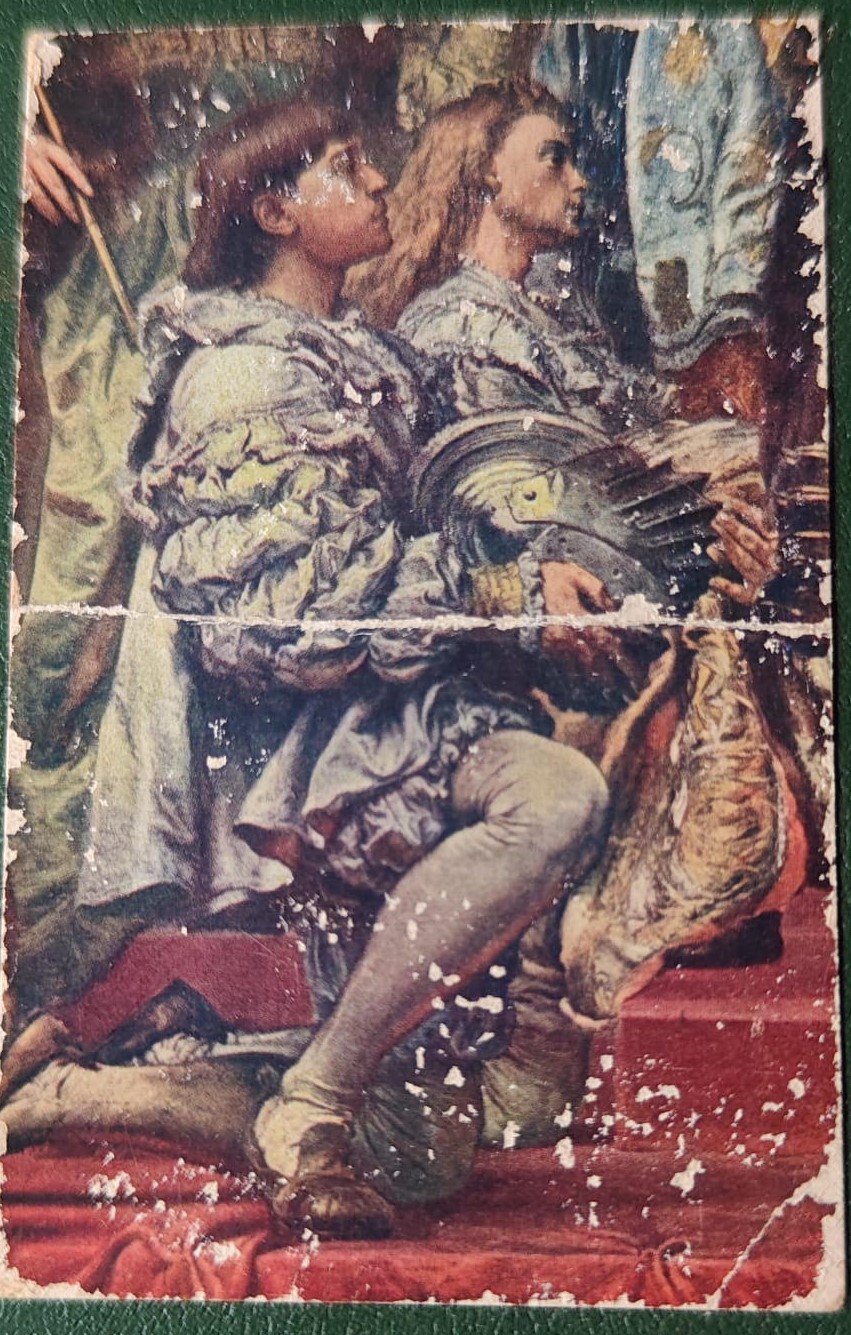
Oil on canvas, a very damaged picture, paint cracked in fire, restored by Stanisław Pochwalski /painter-conservator/, for the price of 6000 zł, but not completely — the fair page’s face with a few cracks.
Dad’s note:
I bought it from Mr Horski on Ash Wednesday, 6 March 1946, for the price of 28,000 zł cash, that is about 60 dollars.
In addition I gave 2 Karaman [rugs], Bulgarian kilims bought from Aunt Jaszczurowska for the price of 4000 zł, that is about 10 dollars, together about 20 dollars = 8000 zł.
Apart from that, the pictures by Chełmoński: “Horse Seen in Foreshortening”, received as a gift for lending money, valued at 5,000 zł, Fałat’s: “Sketches from the Restaurant in Pen”, received as a gift, valued at 3,000 zł, Andriolli’s: “Quarrel”, a watercolour, received as a gift — valued at 3,000 zł, a small watercolour sketch by Juliusz Kossak, with the signature and dedication of Wojciech Kossak for Mr Horski, received by Dad as a gift, valued at 2000 zł, finally Brandt’s: Rotmistrze, bought for 50 dollars and now counted at about the same sum, because 20,000 zł, that is together 5 pictures for the sum of 33,000 zł, that is about 75 dollars; in addition the boots which I once brought for Staszek already after his arrest, valued at 3000 zł — together: cash with kilims 36,000 zł, pictures: 33,000, boots 3000 — together 72,000 zł, that is counting both these pictures cost /dollar = from 430 to 480 zł/ 167–150 dollars.
Nr 101 — Piotr Michałowski (1800–1855)
Status in the monograph: A new name fished out of the official plan for the division of the collection, forming item no. 1 in the left column of the Father’s index. An absolute genius of Polish Romanticism and one of the most outstanding European painters of horses and battle scenes of the 19th century. The presence of an artist of this stature in the structure of the Dynów holdings raises the entire Baraniecki archive to a leading place among private collections in the Subcarpathian region. The card awaits a detailed note from the manuscripts.
Nr 102 — Józef Mehoffer (1869–1946)
Status in the monograph: A new artist fished out directly from the main index of names. The presence of this legendary pillar of Secession and Young Poland (master of decorative, light-filled portraits and stained-glass designs) alongside Stanisław Wyspiański finally completes the Young Poland wing of the Dynów collection. The card awaits the incorporation of inventory data.
Nr 103 — FRANTIŠEK MRÁZEK / MRAZEK (1876–1933) — The Storm (Burza)
Value in the settlement: 440 zł
Further fate: handed over to Mieczysław Horski in settlement for the work by Artur
Grottger
Description of the work: The picture is listed under the dramatic title “The Storm (Burza)”. In the documentation the artist was characterised as a Czech or Slovak painter and illustrator who studied painting in Kraków and then lived and worked in Biała Spiska. The lack of a photograph makes it impossible to establish whether the dynamic work depicted a rugged mountain landscape, a tempest over a plain, or a genre scene with figures against the background of a sudden change in the weather.
History of the work: No information has been found about the date or price of the family’s original acquisition of this picture. In December 1943 the work was included as a real component of payment in the enormous, complicated barter settlement with
Mieczysław Horski for Artur Grottger’s masterpiece “The Hewing of the Cross by the Siberian Exiles (Ciosanie krzyża przez
Sybiraków)”. In the summary of the value of this transaction, drawn up by Kazimierz Baraniecki, the Mrázek picture was appraised and credited at 440 zł. The wording in one of the notes: “I sold 2 Mrazek pictures: The Storm (Burza)…” may have been a syntactical slip by the author, since in the later transaction lists only one picture by this artist with the title “The Storm (Burza)” appears consistently. Kazimierz Baraniecki’s note: “I sold 2 Mrazek pictures: The Storm (Burza) and
Wygrzywalski’s Swallows (Jaskółki)… Mrazek — ‘The Storm (Burza)’. Mrazek 440 zł.”
Editorial comment: The value of 440 zł comes directly from the wartime settlement with Horski and reflects the barter parity established between the men; it need not, however, correspond to the original purchase price or to the objective market value of that day.
State of research: Artist, title, national attribution and participation in the transaction for the Grottger: confirmed. Valuation of 440 zł: recorded in the manuscript. Photograph: not found.
Sources: Manuscripts of Kazimierz Baraniecki, Collection list, Notes concerning the transaction of 8 December 1943, Baraniecki Family Archive.
Nr 104 — ALEKSANDER MROCZKOWSKI — Wawel
Description of the work: The second of Aleksander Mroczkowski’s pictures devoted to Kraków themes was recorded in the list under the general title “Wawel”. No photograph or archival description has survived that would make it possible to establish whether it was a panoramic view of the hill from the Vistula side, the mass of the Renaissance castle, the courtyard, or a fragment of the cathedral.
History of the work: No separate note concerning the purchase or later financial settlement has been found. This work must not be identified with the item “Wawel in the Mist (Wawel we mgle)” (No. 92), because both titles appear separately and independently of each other in the source inventory list.
Kazimierz Baraniecki’s notes: Apart from the laconic entry in the list, no separate information has been found.
State of research: Artist and title: recorded in the list. Distinctness from the item “Wawel in the Mist (Wawel we mgle)”: follows from the structure of the inventory, but requires final iconographic confirmation. Photograph: not found.
Sources: Collection list of Kazimierz Baraniecki, Baraniecki Family Archive.
Nr 105 — ALEKSANDER MROCZKOWSKI Wawel in the Mist (Wawel we mgle)
Date of acquisition: before 3 September 1943
Value in the settlement: 1,500 zł
Further fate: handed over to Mieczysław Horski as part of the payment for the picture by Józef Chełmoński
Description of the work: The picture showed a moody view of Wawel shrouded in thick mist. No photograph has survived that would make it possible to establish the viewpoint or the scope of the composition, but the title itself clearly indicates that the key element of the depiction was the specific, misty atmosphere of the Kraków hill.
History of the work: The work was in the collection before the autumn of 1943. On 3 September 1943 it was included as a real component of barter payment towards the picture by Józef Chełmoński “Landscape from Volhynia – Wild Ducks in Early Spring (Krajobraz z Wołynia – dzikie kaczki wczesną wiosną)”. Kazimierz Baraniecki credited and valued “Wawel in the Mist (Wawel we mgle)” in this settlement at 1,500 zł. The same settlement package also included Alfred Żmuda’s work “Polish Nike (Nike polska)”, pure cash, and a gold watch.
Kazimierz Baraniecki’s notes: “Aleksander Mroczyński (Mroczkowski) – ‘Wawel in the Mist (Wawel we mgle)’. Mroczkowski’s picture ‘Wawel in the Mist (Wawel we mgle)’ — 1,500 zł.”
Editorial comment: In the family’s working list, beside Mroczkowski’s name (sometimes recorded in the distorted form “Mroczyński”), erroneous or uncertain life dates were given. They must not be repeated in the official study. State of research: Artist, title and participation in the settlement for the Chełmoński: confirmed. Exchange value of 1,500 zł: documented in the transaction notes. Photograph: not found.
Sources: Manuscripts of Kazimierz Baraniecki, Collection list, Note concerning the purchase of the Chełmoński of 3 September 1943, Baraniecki Family Archive.
Nr 106 — Nowakowski (first name undetermined) – Forest Landscape (Krajobraz leśny)
Technique: Undetermined (most probably oil or watercolour)
Provenance: Permanent family property or a transitory element of debt claims in the Nowakowski family circle. The card awaits the finding of a precise description of the work among the remaining pages of the manuscript.
Nr 107 — Aleksander Orłowski (1777–1832) – “Kościuszko at Maciejowice (Kościuszko pod Maciejowicami)”
Technique: Pencil and ink drawing on paper
Character of the work: A rare, youthful, unique drawing by the artist
Market settlement value: 1,000 zł
Further fate: Returned and withdrawn from Dynów by Mieczysław Horski on 29 September 1945
Description and history of the work:
The drawing depicted a dramatic, highly expressive episode from the Battle of Maciejowice featuring the wounded Commander Tadeusz Kościuszko. In his notes Kazimierz Baraniecki characterised this object as exceptionally valuable and unique on account of the rarity of youthful Orłowski sketches on the Polish antiquarian market. This work was not a permanent purchase but circulated in the wartime system of wartime property securities against cash funds borrowed from the family. At the end of September 1945 — during the great cash-and-exchange transaction KBN008 — Horski took this drawing back from Dynów, crediting it in the settlement balance at the fixed sum of 1,000 zł.
Status in the collection: pledge, or temporarily held property connected with a loan to Mieczysław Horski
Further fate: returned to Mieczysław Horski in the settlement of 29 September 1945
Description of the work: The drawing depicted Tadeusz Kościuszko at Maciejowice.
Kazimierz Baraniecki described it in his notes as a rare, youthful work by Aleksander Orłowski. No photograph or description of the scene has survived. It is not known whether it showed Kościuszko himself on horseback, the moment of his fall, the dramatic moment of his capture by Russian troops, or a broader, multi-figure battle episode.
History of the work: The work appears in the documentation of the great transaction with Mieczysław Horski of Saturday, 29 September 1945, concerning the acquisition of Fałat’s “The Hunt (Polowanie)” and the small Brandt. The Orłowski drawing had previously been connected with money lent to Horski against a pledge. In the final settlement of that day the work was returned to Horski, and its settlement value was calculated and counted at 1,000 zł.
Kazimierz Baraniecki’s notes: “Moreover: Wyczółkowski – Wawel – crayon drawing, Ruszczyc – Ploughing (Orka), but unsigned, and Orłowski – Kościuszko at Maciejowice (Kościuszko pod Maciejowicami) – his youthful drawing.” In the list of returnable sums it was recorded:
“Orłowski — Kościuszko… 1,000 zł.”
State of research: Artist, subject and youthful character of the work: recorded in the manuscript. Function as a wartime pledge and return to Horski in 1945: documented. Photograph: not found. Dimensions: undetermined.
Sources: Manuscripts of Kazimierz Baraniecki, Notes on the transaction of 29 September 1945, Baraniecki Family Archive.
Nr 108 — ANDRZEJ OLEŚ (1886–1952) — Wawel
Date of acquisition: June 1942
Source: Zofia Nowakowska, in settlement of a debt
Value in 1942: 150 zł
Further fate: handed over to Mieczysław Horski in settlement for the work by Artur
Grottger Description of the work:
A watercolour depicting Wawel. No photograph or more precise description has survived, so it is not known whether the whole castle hill, the courtyard, the Renaissance walls, the cathedral or a romantic view of the castle from the Vistula side was shown.
History of the work:
The work belonged to a group of seven pictures handed over to the Baraniecki family by Zofia Nowakowska in June 1942 against a debt of about 3,500 zł. Oleś’s work was then valued in Kraków at 150 zł. Later the picture entered the complicated barter settlement of 8 December
1943, connected with the acquisition from Mieczysław Horski of Artur Grottger’s monumental work “The Hewing of the Cross by the Siberian Exiles (Ciosanie krzyża przez Sybiraków)”. Together with three other works from the same group (by Zarzycki, Tyc and an unknown artist) it was credited to a package valued in total at 2,000 zł.
Kazimierz Baraniecki’s notes: “Oleś: Wawel – watercolour.” In the statement of values of June 1942: “Oleś 150 zł.” In the account concerning the Grottger, listed collectively: “Zarzycki: Foxglove Flowers (Kwiaty naparstnicy), Tyc E.: Beehives (Ule), Oleś: Wawel and
the Barbican by an unknown artist. These 4 pictures were valued at 2,000 zł.”
Editorial comment: The artist’s full first name has not yet been definitively established — in the original manuscripts only the initial “A.” and the surname “Oleś” appear.
State of research: Artist’s surname, title, technique, source of acquisition and valuations: confirmed. Participation in the settlement for the Grottger: documented. Photograph: not found.
Sources: Manuscripts of Kazimierz Baraniecki, Collection list, Notes concerning the transactions with Mieczysław Horski, Baraniecki Family Archive.
Nr 109 — Władysław Podkowiński (1866–1895)
Status in the monograph: An outstanding name fished out of the official index of the collection matrix. A precursor of Polish Impressionism and one of the most famous painters of the late
19th century (author of the much-discussed “Frenzy of Exultation (Szał uniesień)”). His works are among the extreme rarities in private collections. The card awaits identification of the work in the remaining pages of the manuscript.
Nr 110 — Tadeusz Popiel (1863–1913)
Status in the monograph: A new artist fished out of Kazimierz Baraniecki’s plan for the division of the holdings (an outstanding pupil of Jan Matejko, an esteemed creator of historical and religious scenes, and co-author of the monumental Racławice Panorama). The card awaits the incorporation of detailed inventory data.
Nr 111 — Kazimierz Pochwalski (1855–1940)
Status in the monograph: An artist included in the official matrix of the division plan. An outstanding Kraków painter and long-time professor at the Vienna Academy of Fine Arts, a legendary portraitist of European elites. This figure is of fundamental importance to the Monograph, because it was Kazimierz Pochwalski who, at the end of the 19th century, personally subjected to a full, elite conservation and securing of its structure the most precious pre-war curiosity in the holdings — the authentic cut-off strip of canvas from Jan Matejko’s “Battle of Grunwald (Bitwa pod Grunwaldem)” (“Pages (Paziowie)”). The card is prepared for the insertion of a description of the artist’s autonomous work.
Nr 112 — Witold Pruszkowski (1846–1896) / Tadeusz Pruszkowski (1888–1942)
Status in the monograph: A name included in the official list of the matrix (the coincidence of the spelling Pruszkowski refers either to the outstanding Young Poland symbolist Witold, or to the legendary professor of the Warsaw Academy of Fine Arts, creator of the so-called Pruszkowski School, Tadeusz). The card is secured in the system for further research and verification of the notes.
Nr 113 — Wacław Radwan – “Gdańsk” (in the lists also as “Gdańsk Harbour (Gdański port)”)
Technique: Oil on canvas
Format: Large picture
Pre-war purchase date: January 1939
Seller: Mieczysław Filipkiewicz (dealer from Kraków)
Purchase price: 250 zł | Exchange value in 1941: 500 zł
Further fate: handed over to Mieczysław Horski in settlement for the picture by Julian
Fałat “The Hunt in Nieświeżu (Polowanie w Nieświeżu)”
Description of the work: The picture depicted a port or architecture in Gdańsk. Kazimierz Baraniecki described it in his notes as a large, very decorative picture executed entirely in the palette-knife (spatula) technique. No photograph or more precise description of the view has survived. It is not known whether historical views of the Motława waterfront with the Crane, the buildings of the Main Town, merchant ships, or a harbour panorama were shown. In one working inventory list the work appeared under the shortened name “Gdańsk”.
History of the work: Kazimierz Baraniecki bought this picture in pre-war January 1939 from the Kraków dealer Mieczysław Filipkiewicz for 250 zł. It belonged to a group of the last three pictures acquired from this source before the outbreak of war (alongside Stefan Filipkiewicz’s landscape and Wodzinowski’s “Motherhood (Macierzyństwo)”). At the end of 1941 the work was used as part of the payment in the settlement with Mieczysław
Horski for Julian Fałat’s watercolour “The Hunt in Nieświeżu (Polowanie w Nieświeżu)”. In this transaction Radwan was credited at the doubled value of 500 zł, and the remaining 700 zł was paid in cash (the total cost of the Fałat was 1,200 zł).
Kazimierz Baraniecki’s notes:
“The Hunt in Nieświeżu (Polowanie w Nieświeżu), bought for 1,200 zł, including 700 zł in cash, and the picture by T.
Radwan ‘Gdańsk’, done with a palette knife, large, for which I gave the Jew 250 zł in January 1939, now worth 500 zł.” In another passage: “Mr Horski borrowed for copying our picture by Hoffman ‘Fishermen (Rybacy)’, then Tondos’s ‘Barbican (Barbakan)’, against which he left Fałat’s ‘The Hunt in Nieświeżu (Polowanie w Nieświeżu)’ […] which I later acquired for 700 zł and gave Radwan T.’s picture ‘Gdańsk’, done with a palette knife, large […] now for 500 zł, that is, 1,200 zł in total.”
Editorial comment: In the text of the original notes, beside the initial of the artist’s surname, a sporadic letter error appears (“T. Radwan”), but the inventory list and the working catalogue unambiguously attribute this work to Wacław Radwan.
State of research: Artist, subject, palette-knife technique, year, purchase price and later valuation: confirmed. Participation in the exchange for the Fałat: documented. Photograph: not found.
Sources: Manuscripts of Kazimierz Baraniecki, Register of pre-war transactions, Collection list, Baraniecki Family Archive.
Nr 114 — Henryk Rodakowski (1823–1894)
Status in the monograph: A new artist fished out of the official matrix of the plan for the division of the holdings. One of the most outstanding European portraitists of the 19th century. The card is prepared in the system for the incorporation of detailed inventory data from the remaining pages of the manuscript.
Nr 115 — Ferdynand Ruszczyc (1870–1936) – “Ploughing (Orka)”
Technique: Undetermined (most probably an oil sketch or drawing)
Signature: None (picture unsigned / not signed)
Further fate: Returned and withdrawn from Dynów by Mieczysław Horski on Saturday, 29 September 1945
Editorial comment:
An outstanding work in terms of expression and emotional charge, identified with the brush of the creator of “The Earth (Ziemia)” – Ferdynand Ruszczyc, immortalising his classic motif of a peasant ploughing the earth with oxen in the spirit of Symbolism. This picture was not the permanent property of the family but circulated among the Baranieckis as a temporary, months-long wartime pledge against money borrowed by Horski. At the end of September 1945, at the great post-war settlement for the Fałat–Brandt package (NKB-012), the unsigned Ruszczyc work was finally returned and taken back by the dealer.
Nr 116 — LUDWIK ROWIŃSKI — Grandmother Telling a Fairy Tale to Her Granddaughter (Babunia opowiadająca bajkę wnuczce)
Date of acquisition: before spring 1939
Further fate: handed over in settlement on the purchase of Piotr Stachiewicz’s pastel “Hanka”
Description of the work: The picture depicted an elderly woman telling a fairy tale to her granddaughter. The title has survived in the materials in two almost identical, closely similar language versions: “Grandmother Telling Fairy Tales to Her Granddaughter (Babunia opowiadająca bajki wnuczce)” and “Grandmother Telling a Fairy Tale to Her Granddaughter (Babunia opowiadająca bajkę wnuczce)”. The lack of documentary photography makes it impossible to determine the arrangement of the figures, the furnishings of the room, or whether it was an intimate genre scene set in a domestic interior (e.g. at a table or by the child’s bed).
History of the work: The work belonged to the older, pre-war part of the family collection. In spring 1939 it was used as one of many material components of the barter settlement on the purchase of Piotr Stachiewicz’s valuable pastel “Hanka” for a total of 650 zł. Kazimierz Baraniecki mentioned it in his notes directly alongside Godlewski’s landscapes, Brach’s picture, Schiffer’s works, Dietzówna’s and other works handed over to Horski at that time.
Kazimierz Baraniecki’s notes: “Rowiński’s picture: ‘Grandmother Telling Fairy Tales to Her Granddaughter (Babunia opowiadająca bajki wnuczce)’.” In another inventory compilation: “Ludwik Rowiński – ‘Grandmother Telling a Fairy Tale to Her Granddaughter (Babunia opowiadająca bajkę wnuczce)’.”
State of research: Artist, full title and participation in the pre-war settlement for “Hanka”: confirmed. Photograph: not found. Technique, dimensions, original price and date of earlier acquisition: undetermined.
Sources: Manuscripts of Kazimierz Baraniecki, Collection list, Notes concerning the purchase of the pastel “Hanka”, Baraniecki Family Archive.
Nr 117 — ZYGMUNT ROZWADOWSKI (1870–1950) — A Four-in-Hand in a Carriage (Czwórka w powozie)
Technique: oil
Value in one of the settlements: 400 zł
Further fate: handed over or sold as part of the settlement for the picture by Artur Grottger
Description of the work: The picture depicted four horses harnessed to a representative carriage. In the source inventory it is listed as a work executed in oil technique, titled “A Four-in-Hand in a Carriage (Czwórka w powozie)”. No photograph or archival description has survived that would make it possible to establish the appearance of the vehicle, the number of passengers, the season, or the surrounding landscape.
History of the work: No separate record concerning the date and price of the original purchase has been found. During the occupation the work was included in the complicated and powerful settlement with Mieczysław Horski of 8 December 1943, connected with obtaining Artur Grottger’s work “The Hewing of the Cross by the Siberian Exiles (Ciosanie krzyża przez Sybiraków)”. In one of the transaction accounts Kazimierz Baraniecki recorded the value of this Rozwadowski at 400 zł.
Kazimierz Baraniecki’s notes: “Zygmunt Rozwadowski – ‘A Four-in-Hand in a Carriage (Czwórka w powozie)’, oil.” In the account concerning the Grottger, noted briefly: “Rozwadowski 400 zł.” Editorial comment: Two very similar titles occur in the family materials: “A Four-in-Hand in a Carriage (Czwórka w powozie)” and “Four Horses (Czwórka koni)” (No. 98). It cannot currently be definitively decided whether they were two entirely separate works by the painter in the collection, or variants of the description of a single work. In view of the radically different transaction contexts (the settlement for the Grottger in 1943 at 400 zł versus the settlement for the Fałat in 1945 at 3,000 zł), two independent cards have been kept for them. State of research: Artist, title, oil technique and participation in the settlements: confirmed. Valuation of 400 zł: recorded in the account. Distinctness from the second item: undetermined. Photograph: not found.
Sources: Manuscripts of Kazimierz Baraniecki, Collection list, Notes concerning the purchase of the Grottger, Baraniecki Family Archive.
Nr 118 — ZYGMUNT ROZWADOWSKI (1870–1950) — Four Horses (Czwórka koni) / Four-in-Hand (Czwórka)
Technique: undetermined; possibly oil
Earlier owner: Franciszek Baraniecki
Value in the 1945 settlement: 3,000 zł
Further fate: handed over to Mieczysław Horski in settlement for Fałat’s “The Hunt (Polowanie)” and Józef Brandt’s picture
Description of the work: The picture depicted a team or a dynamic group of four horses. In various family notes it appears as “Four Horses (Czwórka koni)” or, more briefly, “Four-in-Hand (Czwórka)”. The lack of a photograph makes it impossible to establish whether any harnessed vehicle was visible in the picture or whether the composition corresponded to the preceding item.
History of the work: The work originally belonged to the older part of the collection and was the property of Franciszek Baraniecki (Grandpa Franio). It was handed over to Mieczysław Horski as part of the great, multi-element transaction carried out on 29 September 1945 for Julian Fałat’s tempera “The Hunt (Polowanie)” and the small Brandt. The Rozwadowski picture was then officially valued and credited at 3,000 zł. It formed part of a package of three works formerly belonging to Grandpa (together with Gierymski and Jaxa-Małachowski) valued in total at 7,000 zł. Kazimierz Baraniecki’s notes: “Moreover Rozwadowski – Four Horses (Czwórka koni) for 3,000 zł. There were also three pictures belonging to Grandpa Franio: Rozwadowski’s, Gierymski’s and
Jaxa-Małachowski’s, calculated together at 7,000 zł. Rozwadowski ‘Four-in-Hand’
Dad’s literal note:
[…]”Rozwadowski, Four Horses (Czwórka koni), listed under no. 35, valued at 3,000 zł.,
Wincenty Wodzinowski, Head of a Village Girl, barely sketched (Główka dziewczynki wiejskiej), Dad received /i.e. the father of my Father — Franciszek/ from Zosia Nowakowska /niece of Franciszek/ at the settlement for borrowed money in June 1942, then valued at 100 zł, and a year later Horski offered 300 zł.
Fabijański — St Barbara’s Church in Kraków (Kościół św. Barbary w Krakowie), done in ink and crayon. A picture from 1916, as indicated by the technique of execution. Sent to Dad by the Banach family for 150 crowns. Valued at 500 zł.
Gajewski — Head of a Boy (Główka chłopca), oil, a small picture from 1883, given to me by Mr
Horski in August 1942, valued at 200 zł. Moreover, pictures not recorded here, which Dad received together with the above-mentioned Wodzinowski from Zosia Nowakowska for lending money, namely:
Zarzycki: Foxglove Flowers (Kwiaty naparstnicy),
Tyc Z — Beehives in Ostrzeszów (Ule w Ostrzeszowie) and
the Kraków Barbican (Barbakan Krakowski) painted by an unknown painter and
Oleś: Wawel — watercolour.
These 4 pictures were valued at 2,000 zł.
Altogether 12 pictures valued at 21,000 zł.
Moreover, he took his picture by Jan Styka, A Woman in Rapture (Kobieta w zachwyceniu), deposited as a pledge for Wygrzywalski’s Arabs (Arabów), which picture he took for copying and which was lost on the way.
For this picture he charged 10,000 zł, on condition that it be returned to him after he hands over some Wygrzywalski picture.
Moreover, I owe 4,500 zł, so the picture costs 14,500 zł in cash, I owe 4,500 zł, the price of 13 pictures is 21,000 zł and the deposit for the Styka is 10,000 zł. Altogether 50,000 zł.
Effectively I gave for it, deducting Juliusz Kossak, which I received as a gift,
10,000 zł, moreover Rozwadowski — 3,000 zł, Gajewski — 300 zł, both also given as gifts, 13,300 zł, and if we were to omit Rozwadowski, who in reality was paid 10,300 zł /500 dollars/, I gave for it 36,700 zł.” Editorial comment: The clear and glaring discrepancy in values (3,000 zł in the 1945 settlement versus 400 zł in the settlement for the Grottger of 1943) speaks decisively against automatically mechanically merging the two items, suggesting the existence of two separate horse compositions by the artist. Until photographic material is found, the cards must remain separate.
State of research: Artist, title, provenance from Franciszek Baraniecki’s collection and exchange value of 3,000 zł: confirmed. Handover to Horski on 29 September 1945: documented. Photograph: not found.
Sources: Manuscripts of Kazimierz Baraniecki, Note on the transaction of 29 September 1945, Collection list, Baraniecki Family Archive.
Nr 119 — BRONISŁAWA RYCHTER-JANOWSKA (1868–1953) Interior of a House (Wnętrze domu)
Description of the work: The picture is listed in the collection list under the title “Interior of a House (Wnętrze domu)”. The artist was famous for painting moody, nostalgic interiors of Polish noble manor houses. No photograph or archival description of the room’s furnishings has survived, however. It is therefore impossible to establish precisely whether the work depicted a manor drawing room, a dining room, a vestibule, a landowner’s dining room or some other living interior.
History of the work: No information has been found about the date or circumstances of the Baraniecki family’s purchase of this work. The item was, however, clearly, purely and indisputably listed in the ordered list among the works of fully identified Polish artists.
Kazimierz Baraniecki’s notes: In the inventory list it was recorded: “Bronisława Rychter-Janowska – ‘Interior of a House (Wnętrze domu)’.”
State of research: Artist and title: confirmed in the list. Photograph: not found. Technique, dimensions, provenance and post-war fate: undetermined.
Sources: Collection list of Kazimierz Baraniecki, Baraniecki Family Archive.
Nr 120 — Aleksander Rutsch /1916–1997 – “A Hutsul (Hucuł)”
Number in the main catalogue: New supplement from the list; an ethnographic card awaiting the finding of a description in the handwritten notes.