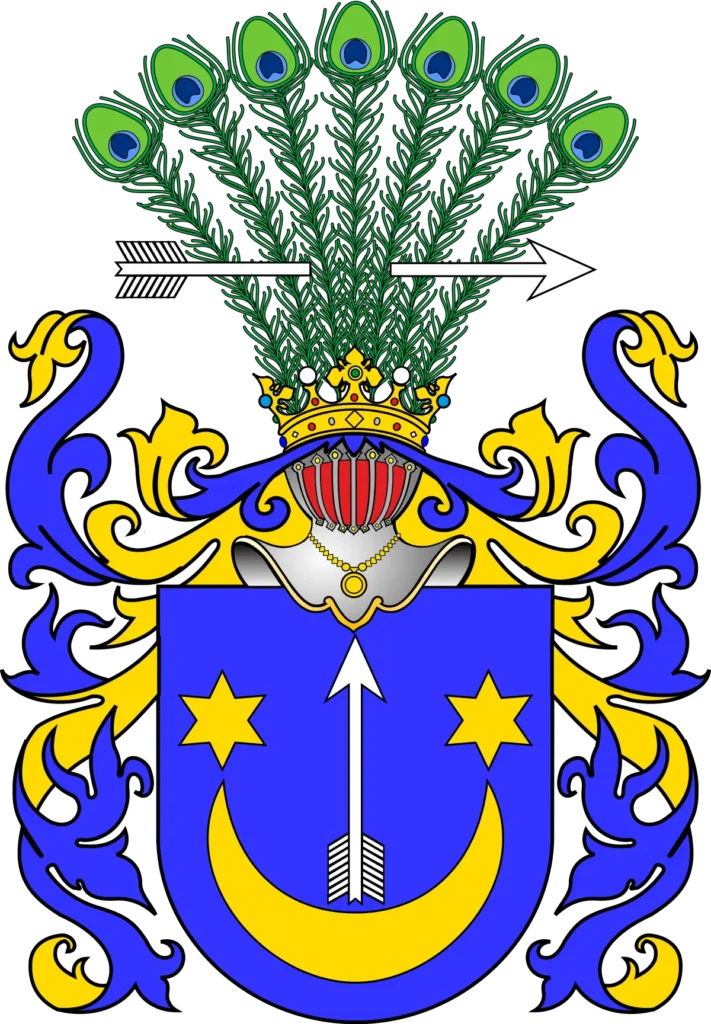
Catalogue of the Paintings of the Baraniecki Family, 1880–1980
Contents
Compiled by Marcin Baraniecki
2026
To the memory of my Father, Kazimierz Baraniecki, I dedicate this work.
Introduction
I want to tell here about the collection of paintings which, over at least a hundred years, belonged to the Baraniecki Family of Dynów.
The events described took place over eighty years ago and more.
The people who took part in them are long gone.
The events are true, and although a long period of time separates us from them, and a third generation of our Family has already grown up since those years, many questions still await answers.
There are, however, things which — perhaps — will never be explained…
The catalogue of works has been prepared to a uniform pattern. I have attached the source materials and, where I could, a photograph of the painting described.
The basic aid in constructing it was the original notes which Dad made in the years 1943–1950.
These notes are a unique document reflecting the conditions of life and earning a living during the German occupation, the complex nature of trade, and in particular trade in works of art, the payment terms of individual transactions, and everything connected with them.
They are also a mine of knowledge about the prices of goods at the time, the value of currencies, the price of gold, and above all the prices of paintings.
I have tried to preserve their original style, although in some places I have made grammatical and punctuation corrections.
While in the text I cite many paintings from our collection, I do not cite them all. Nevertheless, I am still stubbornly looking for them. I think this catalogue will live on and will be supplemented.
History
The Baranieckis have bought paintings from time immemorial, and certainly since the mid-nineteenth century. The period described therefore covers almost a hundred years. During this time, successive generations of the Family enlarged the collection.
Paintings were bought, sold, exchanged, given away and lent. The fortunes of this collection varied. Sometimes there were valuable works, and sometimes paintings from the very lowest shelf were bought.
Our great-great-grandfather, Feliks Antoni Baraniecki, already bought paintings for his home and the family pharmacy in Dynów. He had in his collection works by Michałowski, Suchodolski and several others, but there is no more detailed information about them.
His daughter — Wanda Salomea — also bought paintings, but it seems to me that she was guided rather by the price and the appearance of the painting offered than by its artistic value.
Some dealer would come along, show something, and great-grandmother would buy it because the price was affordable. That is more or less how it went, but the quality of these purchases was not of the highest order.
And it must be said that at the turn of the nineteenth and twentieth centuries there appeared — especially on the Galician market — many luxurious oleographs issued by renowned lithographic establishments, which with great success imitated originals.
They were splendid, heavy, thickly printed oleographs, issued in a wall version deceptively resembling the original works of the masters.
Very often they were sold in decorative frames.
They were printed on paper or canvas with mechanical embossing imitating brushstrokes.
All sorts of dealers and peddlers sold them, travelling around the wealthier homes. It should be noted here that although they did not present them as original works, in reality few potential buyers cared. What mattered was the relatively low price and the very presentable appearance.
Law offices, doctors’ surgeries, presbyteries, various offices, landed estates and finally pharmacies bought them and hung them on their walls to enhance their splendour.
And it must be said that it worked.
In this way, great-grandmother Wanda Salomea bought in 1899 four large paintings by Michał Alfred Godlewski (1838–1918) entitled “The Four Seasons (Cztery pory roku)”.
She paid 5 crowns apiece for them, which indicates that they must have been oleographs.
5 crowns was not little, but it could in no way have been the price of an original.
5 crowns, that is 2.5 Rhenish gulden, was the equivalent of 2–3 days’ work by a labourer.
But apart from these eye-catching oleographs, genuine works were also sold, which in those years were not so expensive, because at the turn of the nineteenth and twentieth centuries the purchase of original paintings cannot in any way be compared with the same purchase today.
The Galician art market was only just becoming professional.
Many earlier masters of Romanticism were regarded as classics, but their prices had not yet reached today’s status of rare, national relics.
Sellers of such paintings were fairly frequent guests in pharmacies, because it must be said that in that reality it was precisely the Pharmacist who enjoyed particular social trust.
Why was that?
Mainly because, traditionally, discretion, tact and understanding were guaranteed in the pharmacy. It was also commonly known, and it was no secret, that the Pharmacist was wealthy.
And that too was important.
People went to the Pharmacy not only for medicines and medical advice, but also with all sorts of business for which discretion was advisable.
Someone who had gold coins, dollars, or some jewel from years gone by to sell, and did not want to flaunt it in public, and needed money, headed for the pharmacist.
Small towns and villages were communities in which people watched very carefully “how well off everyone was”, so discretion was very much in demand.
And money was needed.
So carefully hidden gold “pigs”, or Austrian ducats, dollars sent from America, or French francs were brought out, and people went to the Pharmacy, where they could count on complete discretion and on the sale being carried out.
That was how it was before the war, during the war, and after the war, when secrecy was especially required, because in the difficult, Stalinist years, for the mere possession of gold one could end up on the scaffold.
It was similar with paintings.
Someone who wanted to sell something left over from years gone by, which today was a burden, although it possessed its own value, went to the pharmacist.
Whoever did not want publicity, gossip and envy, and at the same time counted on obtaining a good price, went to the pharmacist.
For the Galician pharmacy was not an ordinary place of trade. It was also a cultural centre, a place where one could get advice, talk in confidence and ask for help. Not only in medical matters.
In our Pharmacy one could also borrow an interesting book, because Dad had a large library and did not keep it only for himself. So paintings were bought. Of varying value. Originals too.
Nevertheless, this was not treated as a source of any earnings. It was not a business. It was rather a hobby.
That was how it was until the time of our Father, who in the second half of the 1930s took up this “hobby” from the point of view of capital investment, earnings, and also collector’s value.
From childhood he was surrounded by paintings bought by his parents, grandparents and great-grandparents. He therefore had a base on which he could build.
Consequently — already after finishing his studies and starting his professional work — he became keenly interested in the collection owned by his parents.
Over the years — 1935–1946 — he bought very different paintings in various places and from various people. Sometimes during his trips abroad, sometimes at exhibitions, from chance dealers, and also privately from acquaintances.
The collection grew.
It was then, in the spring of 1939, that something happened which diametrically changed the pace and the established routine of the calm, considered enlargement of the collection.
Dad met Horski!
Mieczysław Horski
Grandpa Franio, and then Dad, stocked up on medicines for our Pharmacy at several wholesalers.
In Kraków — at the “Pharmie” wholesaler belonging to magister B. Jawornicki, and also at the Pharmaceutical Depot “Zoria”. They also travelled to Vienna, mainly to the famous wholesaler Philipp Röder-Bruno Raabe A.G.
During one such monthly trip for medicines for our Pharmacy, Dad met a man who from the very start dazzled him with his stories about the possibilities and prospects for developing the collection.
His name was Mieczysław Horski.
He knew how to talk, persuade, and sketch fairy-tale prospects.
He came from the East. Born on 16 July 1908 in the village of Wygnanka, Czortków parish — son of Hipolit and Wanda Kuliczkowska — he had settled in Kraków and Silesia since the 1920s, and he was active!
In a very short time, after their first meeting, he became the main partner in Father’s business!
From then on, he became a regular guest in Dynów. He brought paintings, praised them, persuaded, sold, lent and exchanged them. He knew how to tell stories, lie and embellish, and Dad — as if hypnotised — listened, nodded and paid! He paid dearly!
What was astonishing was that he did not ask about Horski’s reputation, did not check his words, and believed almost boundlessly.
And Horski was a man with a very disgraceful past.
Dad did not know about it, or did not want to know, because the mirages spread by Horski of a wonderful enlargement of the collection clouded sound judgement.
The truth was that although in the 1930s Mieczysław Horski was registered in Kraków and in Silesia as a “commercial agent” and officially traded in goods and works of art, in reality he lived by fraud.
Court documents from those years give specific dates, the names of his victims, and the amounts.
And so — in 1935 — Horski was accused of extorting a promissory note for the sum, huge for those times, of 2,000 zł! That was a large sum. For comparison — a teacher’s salary at the time was 150–200 zł a month.
Horski was then living in Prądnik Czerwony (at that time still the outskirts of Kraków, a cheap working-class and residential district).
In the same case there appears the first direct evidence of his links with the painting market: he took paintings worth 300 zł from a victim to sell, and then disappeared with the goods and the money.
Horski moved his activity to wealthy Upper Silesia. His victim was an acquaintance from Katowice — Walter Mańka. Mańka had promissory notes amounting to 450 zł, which he wanted to discount.
Horski offered that he would “sort it out” through his Kraków connections, took Mańka’s promissory notes, went by train to Kraków, cashed them there, bought paintings with the money he had obtained, then brought them back to Silesia, sold them for cash to wealthy Silesians, and appropriated all the cash.
The verdict: the Grodzki Court in Katowice sentenced him to 3 months’ unconditional imprisonment. In press articles from this period it was written outright that Horski “was answering again”, which means that he was a recidivist, well known to the local judges.
The outbreak of war saved him from serving the rest of his sentence and from the collapse of his commercial career. The occupation period and the post-war years (his alliance with Captain Tomisław Michniewicz of the Security Office) were the period of his greatest profits.
Including profits from dealings with our Father.
After 1945, as a man “convicted of financial fraud” in the Second Polish Republic, he paradoxically became, for the new people’s authorities… invisible. Many pre-war police files in Silesia and in Kraków had burned. Horski could officially pretend to be a “victim of the Sanation judicial system” or simply an honest merchant who had made his money in the chaos of migration following the reclamation action.
Mieczysław Horski lived to the age of 53. He died in 1961 — in the period of deep People’s Poland, when private trade in works of art had been almost completely eliminated by the state, because the state monopoly Desa had been created.
He was buried in the family tomb in the prestigious Rakowicki Cemetery in Kraków, together with his wife Karolina Horska (who probably safeguarded the property and protected the memorabilia after her husband).
The fact that he rests at Rakowice testifies that, despite his criminal and turbulent past, the family maintained its bourgeois status and had the means for a burial in one of the most important necropolises in Poland.
Such a man wormed his way into our Father’s trust and possessed him like an evil spirit.
Documents and an analysis of his activity over the years 1935 to at least 1946 mercilessly debunk the myth of Mieczysław Horski as a legal, respected Kraków art dealer, or gallery owner.
He was an intelligent, but ruthless, speculator and financial fraudster.
Some of our Father’s notes indicate that Horski may have been coming to Dynów as early as 1939.
The list of paintings presented here is as complete as — on the basis of the materials — it can be. Among them are paintings by great masters, but there are also those from the lower shelf.
They represent a broad range of Polish artists.
At this point I must emphasise one very important thing:
Almost all the paintings described here are original works by their creators.
It is true that in a dozen or so cases specialist research is needed to check their authenticity, but the vast majority are originals.
It is also true that they were sometimes overpaid, and Horski more than once cheated Dad in an obvious way, but even so, in the final reckoning, if this collection had survived to our times, it would have been worth very serious sums, running into millions of złoty.
All of them were the property of our Family.
The Baraniecki Family.
INTEGRAL MONOGRAPHIC CATALOGUE OF THE BARANIECKI COLLECTION FROM DYNÓW
Contents
Appendix — Specification of Wartime Pledges and Guest Objects