Catalogue of the Paintings of the Baraniecki Family, 1880–1980 — Part I (Entries Nr 1–40)
Contents
Nr 1 — Andriolli Michał Elwiro (1836–1893) – “The Quarrel at the Table (Awantura przy stole)” (in lists also as “The Quarrel (Kłótnia)”)
Technique: Chalk and ink drawing on paper
Date of purchase: End of 1941
Seller: Mieczysław Horski
Price and settlement structure: 1,000 zł in cash and the pre-war picture
by Wincenty Wodzinowski, “Motherhood (Macierzyństwo)” (bought in January 1939 for 300 zł), which in this wartime settlement was valued highly at 700 zł. Total cost of acquisition: 1,700 zł.
Post-war inventory value (1945): 2,000 – 2,500 zł
Description and history of the transaction:
A dynamic, multi-figure illustrative drawing depicting an expressive scene of a quarrel or a social feast at tables. This work was the first object purchased from Horski after the trading relations interrupted by the outbreak of war.
Kazimierz Baraniecki noted, with hindsight, a subtle financial observation: “I have the impression that I overpaid somewhat for the Andriolli.” The dealer delivered the frame for this work at a later date from Kraków.
Description of the work: “The Quarrel at the Table (Awantura przy stole)” belongs to the group of genre compositions by Michał Elwiro Andriolli depicting scenes from everyday life. The artist depicted several participants in a violent quarrel taking place indoors. The dynamic gestures of the figures, the lively expression of their faces and the excellent draughtsmanship testify to the author’s superb craftsmanship. Although Andriolli is remembered above all as an outstanding illustrator of Polish literature – especially “Pan Tadeusz”, “Konrad Wallenrod” and numerous novels by Józef Ignacy Kraszewski – he also left many independent genre compositions. Drawings of this kind are now among those more rarely encountered on the art market.
History of the work: This was the first picture purchased by Kazimierz Baraniecki from Mieczysław Horski.
The transaction was concluded in 1941 and began a collaboration of several years between the two men, which led to the creation of one of the most interesting private collections of Polish painting in the Subcarpathian region.
The price of the picture ultimately amounted to 1,700 zł. It was not, however, an ordinary cash transaction. Already at the first purchase there appeared the manner of settlement characteristic of the collaboration with
Horski – part of the amount due was later settled with Wincenty Wodzinowski’s picture “Motherhood (Macierzyństwo)”, valued at 700 zł, and a cash payment of 1,000 zł.
With hindsight, this purchase takes on symbolic significance. From this moment began a series of transactions encompassing pictures by Józef Brandt, Julian Fałat, Stanisław Wyspiański, Artur Grottger, Alfred Wierusz-Kowalski and many other outstanding painters.
Quotation from the notes:
“Andriolli: The Quarrel at the Table (Awantura przy stole), chalk and ink drawing, bought in 1941 as the first after the trading relations with Mr Horski interrupted by the war. 1,000 zł paid in cash, for the remainder the Wodzinowski picture was given: Motherhood (Macierzyństwo) […] handed over to Mr Horski for 700 zł. The frame he brought later.”
Nr 2 — MICHAŁ ELWIRO ANDRIOLLI (1836–1893) — The Farewell of Wacław and Maria (Pożegnanie Wacława z Marią)
Description of the work: The work was recorded in the collection inventory under the title “The Farewell of Wacław and Maria (Pożegnanie Wacława z Marią)”. The title indicates a literary scene, probably referring to the protagonists of Antoni Malczewski’s poem “Maria”. No photograph or detailed description has survived, however, that would allow the episode depicted to be identified. Nor is it known whether it was an independent drawing composition, an illustration design, or a work executed in another technique.
History of the work: No information has been found about the circumstances of acquisition, the price, or the previous owner. The work was listed as Andriolli’s second work in the collection, alongside the drawing “The Quarrel at the Table (Awantura przy stole)”. In the ordered inventory both items appear separately.
Kazimierz Baraniecki’s notes: The preserved entry reads: “E.M. Andriolli – ‘The Farewell of Wacław and Maria (Pożegnanie Wacława z Marią)’.”
Sources: Kazimierz Baraniecki’s collection inventory, Baraniecki Family Archive.
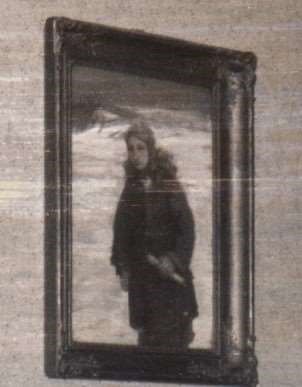
Nr 3 — Axentowicz Teodor (1859–1938) – “The Hutsul Girl (Hucułka)”
Technique: Coloured pastel on paper
Date of purchase: 1934–1935
Place of purchase: Kraków, Salon of Polish Painters (Salon Malarzy Polskich)
Buyer: Franciszek Baraniecki (Dad)
Purchase price: 650 zł (bought in instalments in a package with the Fabijański gate)
Post-war inventory value: 2,500 zł
Description and history of the work:
An excellent pastel in terms of colour expression, finished by the artist to the highest limits of craftsmanship, depicting a young woman in traditional, rich Hutsul dress. Hutsul subject matter represented the absolute peak of collecting pursuits in Axentowicz’s oeuvre. The picture was purchased by the collector’s father directly from the Kraków Salon of Polish Painters in the 1930s.
Quotation from the notes:
“Axentowicz Teodor: The Hutsul Girl (Hucułka), an excellent coloured pastel finished to the last possibilities. Bought in 1934–5 by Dad from the Salon of Polish Painters for 650 zł in
instalments.”
The photograph of this picture was taken around 1965 in Dynów.
Nr 4 — TEODOR AXENTOWICZ (1859–1938) — Lady with Flowers (Dama z kwiatami)
Technique: oil on canvas
Post-war asset value: 2,000 zł (in wartime settlements reduced to 1,000 zł)
Later fate: Museum of Folk Architecture in Sanok (Muzeum Budownictwa Ludowego w Sanoku)
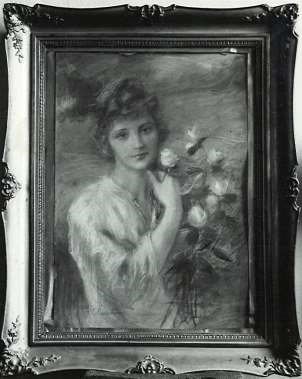
Description of the work: The portrait of a young woman holding a bouquet of flowers is among the most characteristic subjects taken up by Teodor Axentowicz.
The artist, one of the most outstanding representatives of Young Poland, created his own easily recognisable type of female portrait. The subtle modelling of the face, soft light, delicate range of colours and decorative treatment of the dress mean that these pictures are among the most valued works of his oeuvre.
The picture from Kazimierz Baraniecki’s collection depicts a young woman shown to the waist.
In her hands she holds a bouquet of flowers, which constitutes not only an element of the composition but also an important colour accent.
The preserved photograph makes it possible to recognise the characteristic manner of brushwork and the type of beauty of the models often encountered in Axentowicz’s work.
It is known only that for many years it was in Kazimierz Baraniecki’s house in Dynów and belonged to the group of pictures displayed in the main living rooms.
After the dispersal of the collection, the picture was sold to Aleksander Rybicki /curator/, for the Museum of Folk Architecture in Sanok. Its identification was confirmed by correspondence with Dr Jerzy Ginalski, who, on the basis of the museum inventory, conveyed the information:
“Purchased from M. Baraniecka: Picture Lady with Flowers (Dama z kwiatami) – Teodor Axentowicz.” This made it possible to establish the work’s proper title definitively.
Editorial comment: The picture belongs to the group of works whose history has survived only fragmentarily. Despite the lack of notes by Kazimierz Baraniecki, its later fate is exceptionally well documented thanks to the documentation of the Museum of Folk Architecture in Sanok and the preserved family photograph.
State of research: Photograph: preserved. Kazimierz Baraniecki’s manuscripts:
not found. Place of keeping: Museum of Folk Architecture in Sanok. Further research: establishing the date of purchase and earlier provenance is indicated.
Sources: Baraniecki Family Archive, Correspondence with Dr Jerzy Ginalski, Museum of Folk Architecture in Sanok.
Letter from Dr Jerzy Ginalski, chairman of the Board
of the Ignacy Łukasiewicz Museum of the Oil and Gas Industry Foundation
Bóbrka, ul. Kopalniana 35
38-458 Chorkówka
Dear Sir! I hereby send you information on the pictures purchased for the Museum of Folk Architecture in Sanok from Kazimierz Baraniecki and M. Baraniecka. Some titles are different, but that may be misleading – e.g. J. Kossak’s “The Market in Praga (Targ na Pradze)” is perhaps the picture “The Horse Market (Targ na konie)”, or Axentowicz’s “Portrait (Portret)”
may be the picture “Lady with Flowers (Dama z kwiatami)”, and J. Kossak’s picture “Pułaski” (stolen) corresponds to the picture “Prince Józef Poniatowski (Ks. Józef Poniatowski)”? That is all I managed to establish on the basis of the museum inventory (at present the reorganisation of the art store in the Sanok open-air museum is under way, so it took a while). Warm regards, Jerzy Ginalski.
Purchased from Kazimierz Baraniecki:
Picture Kraków Wedding (Wesele Krakowskie), Juliusz Kossak
Picture The Horse Market (Targ na konie), Juliusz Kossak
Picture Scene with Horses (Scena z końmi), Juliusz Kossak
Picture Prince Józef Poniatowski (Ks. Józef Poniatowski), Juliusz Kossak – picture stolen in 1993, struck from the inventory.
Purchased from M. Baraniecka:
Picture Lady with Flowers (Dama z kwiatami), Teodor Axentowicz – Picture Fishermen (Rybacy), L.S.
Nr 5 — Axentowicz Teodor (1859–1938) – “Two Generations (Dwa pokolenia)”
Description of the work:
Description of the work: The title “Two Generations (Dwa pokolenia)” indicates a composition depicting two persons belonging to different generations — probably an older woman and a child or a young girl. The lack of a photograph does not allow the arrangement of the figures or the character of the composition to be determined. The work appears as the second of three works by Teodor Axentowicz in the family inventory.
History of the work: No separate information about the purchase, price or previous owner has been found. Nor is it known whether the picture belonged to the collection for a longer time or appeared only transiently as the object of a single transaction.
The work was a permanent element of the pre-war core of the collection.
Nr 6 — TEODOR AXENTOWICZ (1859–1938) — Portrait of the Artist’s Daughter-in-Law (Portret synowej artysty)
Description of the work: The picture was recorded as “Portrait of the Artist’s Daughter-in-Law (Portret synowej Artysty)”. The title suggests that the person depicted was identified in the family documentation as Teodor Axentowicz’s daughter-in-law. The lack of a photograph and further information does not, however, allow the model’s identity to be confirmed. Nor is it known whether the title came from the artist himself, a previous owner, Mieczysław Horski or Kazimierz Baraniecki. The picture depicted a subtle portrait of the daughter-in-law of the outstanding Kraków professor Teodor Axentowicz. The artist was famous for technically brilliant, salon portraits of women, in which he idealised the models’ features while preserving extraordinary psychological depth. The work was a permanent possession of the collection in Dynów. In the final asset summaries Kazimierz Baraniecki valued its real market value at at least 2,000 zł.
History of the work: No separate record concerning the acquisition has been found. The picture appears in the inventory as Axentowicz’s third work, alongside “The Hutsul Girl (Hucułka)” and “Two Generations (Dwa pokolenia)”.
Editorial comment: The designation of the person portrayed should be treated as source information, not as a confirmed historical identification. Sources: Kazimierz Baraniecki’s collection inventory, Baraniecki Family Archive. Asset value: 2,000 zł (in wartime settlements reduced to 1,000 zł)
Nr 7 — SEWERYN BIESZCZAD — Landscape from the Krosno Region (Krajobraz z krośnieńskiego) / View from the Krosno Region (Widok z Krośnieńskiego)
Date of purchase: before spring 1939
Purchase price: 100 zł
Later fate: sent from the exhibition in Krynica to Lwów; lost during the war
Description of the work: The picture depicted a landscape of the Krosno area. In the materials the title occurs in two forms: “Landscape from the Krosno Region (Krajobraz z krośnieńskiego)” and “View from the Krosno Region (Widok z Krośnieńskiego)”. No photograph or more precise description of the place depicted has survived.
History of the work: Kazimierz Baraniecki recorded that the picture cost 100 zł.
The work was then shown at the exhibition in Krynica.
From the exhibition it was sent to Lwów, where it was lost during the turmoil of war.
In one record the picture was listed among the works connected with the settlement for Piotr Stachiewicz’s pastel “Hanka”. At the same time, the explicit information about its loss indicates that it was not effectively handed over in that transaction or that the record concerned an earlier intention.
There are no grounds for identifying this picture with the watercolour “At the Watering Place (Przy wodopoju)”. Both titles occur separately.
Kazimierz Baraniecki’s notes: “One Bieszczad picture: View from the Krosno Region (Widok z
Krośnieńskiego) for 100 zł, which picture was then sent from the exhibition in Krynica to Lwów and lost in the turmoil of war.”
Editorial comment: This is one of the few items for which specific news of a wartime loss of the work has survived.
Sources: Kazimierz Baraniecki’s manuscripts, Collection inventory, Note concerning the purchase of “Hanka”, Baraniecki Family Archive.
Nr 8 — SEWERYN BIESZCZAD — At the Watering Place (Przy wodopoju)
Technique: watercolour
Description of the work: The watercolour bore the title “At the Watering Place (Przy wodopoju)”. In the notes the artist was described as a painter connected with Krosno. The title indicates a scene with animals stopped at the water, presumably horses or cattle. The lack of a photograph does not allow the number of animals, the presence of people or the surrounding landscape to be described.
History of the work: No information concerning the purchase or price has been found. The work was, however, unequivocally listed in the inventory as a separate work by Seweryn Bieszczad, independently of the lost “Landscape from the Krosno Region (Krajobraz z krośnieńskiego)”.
Kazimierz Baraniecki’s notes: “Seweryn Bieszczad – painter connected with Krosno – ‘At the Watering Place (Przy wodopoju)’. Watercolour.”
Sources: Kazimierz Baraniecki’s notes, Collection inventory, Baraniecki Family Archive.
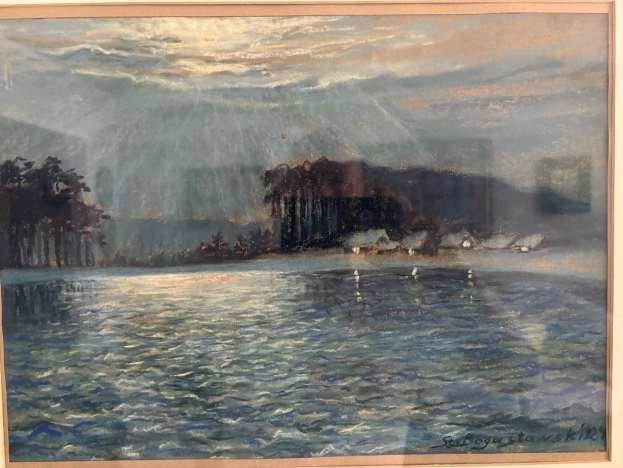
Nr 9 — STANISŁAW BOGUSŁAWSKI — The Lake in Namysłaki (Jezioro w Namysłakach)
Technique: oil on canvas
Description of the work: “The Lake in Namysłaki (Jezioro w Namysłakach)” is a calm landscape depicting a broad expanse of water surrounded by tall trees. The foreground is occupied by a wooden jetty leading out into the lake. Small boats are moored at its end. The surface of the water reflects the sky and the greenery of the trees, giving the whole composition exceptional harmony. Bogusławski was among the painters particularly sensitive to effects of light and mood. The picture from the Baraniecki collection is an excellent example of this. There are no violent contrasts or dramatic accents here. The whole is kept in a calm tonality
History of the work: No manuscripts by Kazimierz Baraniecki describing the purchase of the picture have survived. The picture remains in the Family. It is in the possession of Marcin Baraniecki. Editorial comment: Despite the modest documentation, the picture deserves a place in the catalogue. It is one of the best-preserved examples of landscape in the collection and has been documented photographically.
Kazimierz Baraniecki’s notes:
“Bogusławski St.: The Lake in Namysłaki (Jezioro w Namysłakach), oil, painted for Dusia /Wanda/
Banachówna in 1928. The only one remaining of the 7 pictures given to Dad on account of the debt by Zosia Nowakowska. The remaining pictures; Digitalis, Tyc: Beehives in Ostrzeszów (Ule w Ostrzeszowie), Oleś’s ‘Wawel’, a watercolour, and the Barbican (Barbakan) by an unknown artist and
Wodzinowski’s sketch: Head of a Girl (Główka dziewczynki) were exchanged for Grottger’s Hewing of the Cross (Ciosanie
Krzyża). Żmuda’s Nike Polska was exchanged for Chełmoński’s Landscape from Volhynia (Krajobraz z
Wołynia). These pictures were valued in June 1942 in Kraków at: Zarzycki and Żmuda 225 zł each, Bogusławski 150 zł, Oleś 150 zł, Wodzinowski 100 zł, the 2 remaining pictures at 250 zł, together 1,100 zł. The whole debt amounted to much more – if I am not mistaken – 3,500 zł. The remainder of the debt remained unpaid and unreceipted.”
State of research: Photograph: preserved. Kazimierz Baraniecki’s manuscripts: not found. Provenance: undetermined.
Sources: Baraniecki Family Archive.
Nr 10 — STANISŁAW BOGUSŁAWSKI (1893–1963) — The Lake in Namysłaki (Jezioro w Namysłakach) (1928 version)
Technique: oil
Date of creation: 1928
Original purpose: picture painted for Wanda “Dusia” Banachówna Date of entry into the collection: June 1942
Provenance: Zofia Nowakowska, on account of a debt
Value in 1942: 150 zł
Later fate: remained in the collection after the exchange of the other six pictures Description of the work:
The picture depicted the lake in the locality recorded in the manuscript as Namysłaki. It was an oil composition, painted in 1928 for Wanda Banachówna, called Dusia in the family. The preserved photograph was linked in the family materials precisely with this work.
History of the work: “The Lake in Namysłaki (Jezioro w Namysłakach)” belonged to a group of seven pictures handed over to Franciszek or Kazimierz Baraniecki by Zofia Nowakowska in June 1942 on account of a debt. The total debt was said to have amounted to about 3,500 zł, whereas the seven works handed over were valued jointly at only 1,100 zł. The Bogusławski picture was valued at 150 zł. The remaining works from this group were later exchanged or handed over in settlements (for the Grottger and for the Chełmoński picture). “The Lake in Namysłaki (Jezioro w Namysłakach)” was, according to the note, the only one of the seven pictures that remained in the family collection.
Kazimierz Baraniecki’s notes: “Bogusławski St.: The Lake in Namysłaki (Jezioro w Namysłakach), oil, painted for Dusia /Wanda/ Banachówna in 1928. The only one remaining of the 7 pictures given to Dad on account of the debt by Zosia Nowakowska. These pictures were valued in June 1942 in Kraków at: Zarzycki and Żmuda 225 zł each, Bogusławski 150 zł, Oleś 150 zł, Wodzinowski 100 zł, the two remaining pictures at 250 zł, together 1,100 zł.”
Editorial comment: This is one of the best-documented works originating from the settlement with Zofia Nowakowska. Particularly valuable is the information about the person for whom the picture was originally painted.
State of research: Photograph: preserved or indicated in the materials. Dimensions and later fate after the collection period: undetermined.
Sources: Kazimierz Baraniecki’s manuscripts, Collection inventory, Family photograph, Baraniecki Family Archive.
Nr 11 — OLGA BOZNAŃSKA (1865–1940) — Portrait of Two Village Girls (Portret dwóch dziewczynek wiejskich) (On the reverse: Peonies (Piwonie))
Technique: oil on canvas Dimensions: 68 × 53 cm
Date of appearance in Dynów: 14 September 1946
Brought by: Mieczysław Horski
Description of the work: This was a unique double-sided picture. On one side was the portrait of two village girls, and on the other a flower composition depicting peonies. Such a use of both sides of the canvas made the work particularly interesting. No photograph has survived that would allow it to be established whether both compositions were fully finished or whether one side was sketchy in character.
History of the work: According to the preserved inventory, the picture was brought by
Mieczysław Horski to Dynów on 14 September 1946. This is exactly the same date on which Kazimierz Baraniecki bought from Horski Fałat’s “Hunting in Nieśwież. Berlin 1888 (Polowanie w Nieświeżu. Berlin 1888)” for 8,000 zł. No information has been found, however, that would allow it to be stated whether the Boznańska was actually bought that day, left in pledge, merely shown, or entrusted for further negotiations.
Kazimierz Baraniecki’s notes: “Olga Boznańska – ‘Portrait of Two Village Girls (Portret dwu dziewczynek wiejskich)’, oil on canvas, 68 × 53 cm. Unique: on the other side Peonies (Piwonie) painted. Brought by Mr Horski on 14.09.1946.” It cost 16,000 zł, that is 26 dollars.
In March I also gave Mr Horski 5,000 zł for the purchase of medicines for our pharmacy.
Horski took the money and left. After about half a year he returned with neither the medicines nor the money, explaining that in the meantime he had ended up in a concentration camp and the money was lost. He asked to borrow 10,000 zł for the purchase of Fałat /68×118, Berlin 1888 – Hunting in Nieśwież (Polowanie w Nieświeżu)/ and the Boznańska.
In addition he received 1,000 zł for travel. Together 16,000 zł. He did not return the money. He left this picture.
Editorial comment: A distinction must be drawn between the certain fact of the picture having been brought by Horski and the unconfirmed purchase. Until an additional financial document is found, the work remains an item of undetermined ownership status and should be included in the section of works offered or temporarily brought.
State of research: Data from the documentation (dimensions, double-sidedness): confirmed. Photograph: not found.
Sources: Kazimierz Baraniecki’s collection inventory, Ordered index of the collection, Baraniecki Family Archive.
Nr 12 — JÓZEF BRACH — Ruthenian Church (Cerkiew ruska) / Landscape (Pejzaż)
Purchase price: 75 zł
Seller: a dealer described in the manuscript as “a Jew”
Value at settlement: 60 zł
Later fate: handed over at the purchase of Piotr Stachiewicz’s pastel “Hanka”
Description of the work: In the detailed transaction note the picture was called the “Ruthenian Church (Cerkiew ruska)”. In the general inventory, on the other hand, Józef Brach appears with a work described more simply as “Landscape (Pejzaż)”. It is not known whether these were two separate works or whether “Landscape (Pejzaż)” was a general description of the picture depicting the church.
History of the work: Kazimierz Baraniecki originally bought the work for 75 zł. At the settlement in spring 1939, connected with the purchase of Stachiewicz’s pastel “Hanka”, the picture was credited at a value of 60 zł. This meant a loss of 15 zł in relation to the purchase price.
Kazimierz Baraniecki’s notes: “1 Brach picture ‘Ruthenian Church (Cerkiew ruska)’ bought from a Jew for 75 zł, sold for 60 zł.” Editorial comment: Until a photograph is found, both titles should be retained.
The more detailed title “Ruthenian Church (Cerkiew ruska)” does, however, have stronger support in the author’s direct financial note.
State of research: Author, title, purchase price and value at settlement: confirmed. Photograph: not found.
Sources: Kazimierz Baraniecki’s manuscripts, Collection inventory, Baraniecki Family Archive.
Nr 13 — JÓZEF BRANDT (1841–1915) — Cossack Awaiting the Return of the Commanders (Kozak oczekujący na powrót panów dowódców) (with three horses and three dogs)
Technique: oil on board
Dimensions: 37 × 57 cm
Date of acquisition: 29 September 1945
Seller: Mieczysław Horski
Form of acquisition: joint, multi-element transaction with Julian Fałat’s picture “Hunting (Polowanie)”
Later fate: undetermined
Description of the work: The picture depicted a Cossack awaiting the return of the commanders. He was accompanied by three horses and three dogs. The full title or precise description of the composition has survived in Kazimierz Baraniecki’s note. The work was painted in oil on board and had the handy dimensions of 37 × 57 cm. No photograph has survived that would allow the arrangement of the scene to be described.
History of the work: The picture was acquired together with Julian Fałat’s large tempera
“Hunting (Polowanie)” (50 × 117 cm). The whole transaction of Saturday 29 September 1945 was enormous and extremely complex – it encompassed cash, dollars, spirit, and numerous older pictures handed over to Mieczysław Horski (among them works by Stryjeńska, Kaleta, Rozwadowski, Gierymski, Jaxa-Małachowski, Wierusz-Kowalski,
Wyczółkowski, Ruszczyc and Orłowski). Kazimierz Baraniecki recorded the financial summary: “So then, for both these pictures I paid 35,000 zł, and I still owe him 15,000 zł.”
Kazimierz Baraniecki’s notes: “Also included in this transaction: Brandt Józef – Cossack Awaiting the Return of the Commanders with 3 Horses and 3 Dogs (Kozak oczekujący na powrót panów dowódców z 3 końmi i 3 psami), oil, on board 37 × 57 cm. So then, for both these pictures I paid 35,000 zł, and I still owe him 15,000 zł. I spent my last money on this and sold Dad my last ducats.”
Editorial comment: On the basis of the preserved record, no separate, clean price for this particular Brandt can be isolated. All amounts concern the joint, package settlement for two outstanding works (the Fałat and the Brandt).
State of research: Author, subject, technique, ground and dimensions: confirmed. Connection with the 1945 transaction: confirmed. Photograph: not found.
Sources: Kazimierz Baraniecki’s manuscripts, Working catalogue of the Baraniecki Collection, Baraniecki Family Archive.
Nr 14 — JÓZEF BRANDT (1841–1915) Lisowczyk / Lisowszczyk
Technique: oil on canvas
Later fate: In the possession of Ela Brueckner.
Description of the work: The picture depicts a lone rider – a Lisowczyk – mounted on a dark horse. The warrior is dressed in a red żupan and a fur cap, and a sabre is visible at his belt. The Lisowczyk theme was among Józef Brandt’s favourite motifs, and he repeatedly returned to depicting the light cavalry of the Commonwealth, showing scouts or patrols on the steppes. In the preserved photograph, attention is drawn to the superb drawing of the horse and Brandt’s characteristic ability to build mood through a broad landscape and a low horizon line.
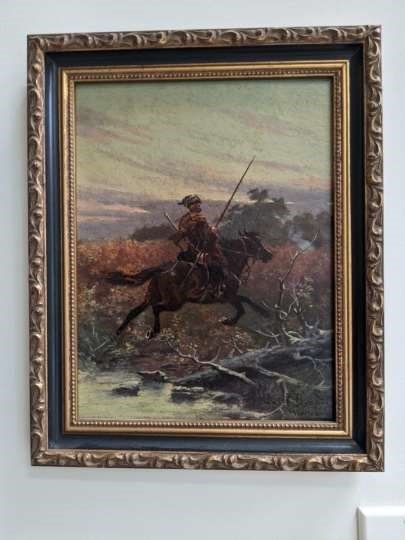
History of the work: No manuscripts by Kazimierz Baraniecki relating to the details of the purchase of this picture have been found so far. Neither the price nor the seller’s name has been established. The only surviving testimony remains the photograph taken in the Baraniecki house, thanks to which identification of the composition was possible. In the general inventory there is a short entry: “J. Brandt – Lisowczyk.”
The picture was given by Małgorzata Baraniecka to her sister Teresa Gołąb in 1965.
It remains in the possession of Teresa’s daughter – Ela Bruckner.
Editorial comment: Despite the scant textual documentation, the picture fully deserves a catalogue card, since its physical presence in the family home has been documented photographically beyond doubt.
State of research: Photograph: preserved. Manuscripts: not found.
Sources: Collection inventory, Baraniecki Family Archive.
Nr 15 — JÓZEF BRANDT (1841–1915) — Boat on the Lake (Łódź na jeziorze)
Description of the work: The picture was recorded under the title “Boat on the Lake (Łódź na jeziorze)”. The lack of a photograph and a broader description makes it impossible to establish whether it was an independent landscape composition, a scene with figures, a sketch or a preparatory study.
History of the work: No separate note about the purchase has been found. The title distinctly sets this work apart from the other Brandt pictures in the collection, which are connected almost exclusively with equestrian, military and Borderlands themes. The character of the work should not, however, be supplied without iconographic material. This work may have constituted an outstanding plein-air study, executed by the artist in his beloved estate at Orońsko.
Kazimierz Baraniecki’s notes: “J. Brandt – Boat on the Lake (Łódź na jeziorze).”
Sources: Kazimierz Baraniecki’s collection inventory, Baraniecki Family Archive.
Nr 16 — JÓZEF BRANDT (1841–1915) — Polish Rotmistrz at the Head of a Banner Attacking the Enemy (Rotmistrz polski na czele chorągwi w ataku na nieprzyjaciela)
Technique: oil
Dimensions: 67 × 54 cm
Date of acquisition: 30 November 1945, Friday
Seller: Mieczysław Horski
Purchase price: 15,000 zł in cash
Conversion according to the note: about 50 dollars (that is, about 250 pre-war zł)
Description of the work: The picture depicted a Polish rotmistrz leading a banner into an attack on the enemy. The fuller title preserved in the note reads: “Polish Rotmistrz at the Head of a Banner Attacking the Enemy (Rotmistrz polski na czele chorągwi w ataku na nieprzyjaciela)”. It was an oil composition measuring 67 × 54 cm. No photograph has survived that would allow the rotmistrz’s uniform, the number of riders or the armament to be described. In the working inventory it initially appeared under the shortened name “Rotmistrz at the Head of a Banner (Rotmistrz na czele chorągwi)”.
History of the work: Kazimierz Baraniecki bought the work from Mieczysław Horski on Friday
30 November 1945. He paid 15,000 zł in cash for it. Taking the dollar exchange rate at the time of about 300 zł, he calculated the cost of purchase at 50 dollars, which corresponded to 250 pre-war zł. Kazimierz Baraniecki assessed in his manuscript that the real value of the picture was at least four times greater than the amount paid.
Kazimierz Baraniecki’s notes: “Brandt Józef: Polish Rotmistrz at the Head of a Banner Attacking the Enemy (Rotmistrz polski na czele chorągwi w ataku na nieprzyjaciela). Oil, 67 × 54, acquired from Mr Horski on 30 XI 1945, on Friday. I gave 15,000 zł in cash for it. Counting the dollar at 300 zł, this amounts to 50 dollars, that is, 250 pre-war zł. The picture is unquestionably worth four times as much.”
Editorial comment: This precise card fully complements and closes the fragmentary entry from the general inventory (item no. 134). It allows the technique, dimensions, price and exact day of the transaction to be established beyond dispute.
State of research: All technical and financial data: confirmed. Assessment of the four-times-higher value: this is the collector’s personal opinion. Photograph:
not found.
Sources: Kazimierz Baraniecki’s manuscripts, Working catalogue of the Baraniecki Collection, Collection inventory, Baraniecki Family Archive.
Nr 17 — JÓZEF BRANDT (1841–1915) — Tatars on the Steppe (Tatarzy na stepie)
Technique: oil on canvas
Dimensions: in the materials 140 × 90 cm and 149 × 90 cm
Degree of completion: picture unfinished Date of purchase: 26 May 1944
Purchase price: about 40,000 zł
Seller: Mieczysław Horski
Description of the work: “Tatars on the Steppe (Tatarzy na stepie)” was among the most valuable and largest works in the collection. The composition depicts a group of Tatar riders crossing the boundless steppe.
In the foreground a group of mounted warriors is visible, their silhouettes standing out against the broad panorama. Brandt’s characteristic mastery in depicting horses and weaponry gave the work enormous value.
Kazimierz Baraniecki emphasised that the picture had not been completely finished, which did not, however, affect his admiration for its artistic value. In the inventory the dimensions 140
× 90 cm are given, whereas in other materials the dimension 149 × 90 cm appears – this discrepancy should not be resolved without measuring the original.
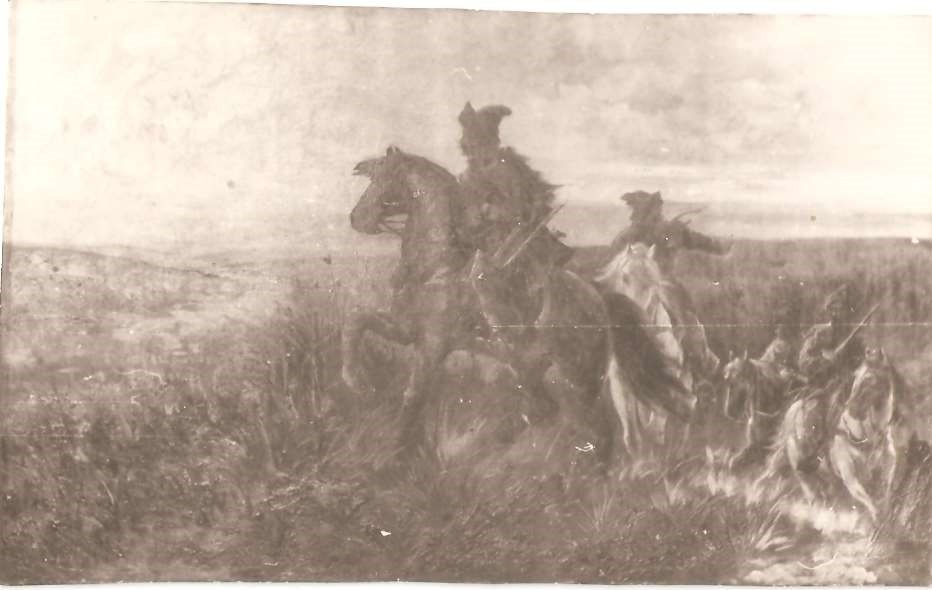
History of the work:
The purchase is one of the best-documented, multi-stage wartime transactions. The picture was acquired on 26 May 1944.
The agreed value was 40,000 zł.
The settlement encompassed earlier loans granted to Horski (including a claim for 15,000 zł secured by the alleged Siemiradzki “Melancholy (Melancholia)”, which
was lost), further cash payments, and the return of the small picture by Roman Kochanowski, “Summer (Lato)” (valued at 4,000 zł).
The transaction also involved material goods: a dinner suit, a kilim and a silver coffee service.
Alongside four monumental Fałat pictures and Wyspiański’s “Church (Cerkiew)”, the Brandt constituted the core of the collection.
Kazimierz Baraniecki’s notes: “Józef Brandt – ‘Tatars on the Steppe (Tatarzy na stepie)’. Oil. 140 ×
90. Unfinished. Return of Kochanowski’s ‘Summer (Lato)’ — 4,000 zł.” Kazimierz kept extremely precise records of payments, which made it possible to reconstruct this complicated wartime barter exchange.
Editorial comment: Considerations appearing in some family notes about the possible origin of this picture directly from Brandt’s studio in Orońsko are purely a later hypothesis, not an established fact from Kazimierz Baraniecki’s notes. They should not be presented as established provenance.
Hypothesis concerning the picture “Tatars on the Steppe (Tatarzy na stepie)”:
How did Horski come into possession of it at all?
Well, Józef Brandt spent almost every summer on his estate in Orońsko near Radom. There he had his second, enormous painting studio. When the First World War broke out, Brandt had to flee Orońsko before the front to Radom, where he died in June 1915.
In Orońsko, the artist left dozens of underpaintings, oil sketches and unfinished large canvases.
After his death, the manor in Orońsko was plundered by Russian and Austrian troops, and the unfinished works remaining in the studio (often unsigned or bearing only a posthumous stamp) were dispersed.
They came into the hands of private collectors in Mazovia and Lesser Poland. Horski – the dealer with whom Father settled the overwhelming majority of transactions – could easily have bought such an unfinished, “orphaned” large Brandt project from someone during the chaos of 1944.
In the world of art collectors, unfinished pictures by Józef Brandt (often called in catalogues, for example, “Study of a Rider (Studium jeźdźca)” or “Sketch for a Picture… (Szkic do obrazu…)”) enjoy enormous recognition.
Brandt was famous for his brilliant, extremely dynamic drawing of horse and man. In finished works he applied many layers of paint (glazes).
In unfinished works, on the other hand, the whole genius of his craft is visible: a raw, predatory charcoal sketch directly on the canvas, the first patches of colour, impastos, and masterly capturing of movement that had not yet been “smoothed” by the final finish.
Date of purchase – 26 May 1944.
In May 1944 Kraków was still under German occupation. The art trade took place in very unusual conditions: – restrictions and uncertainty applied, – many people urgently needed cash, – material goods (clothes, silver, carpets) were often more valuable than money, – there was no normal, transparent art market.
Father paid about 40,000 zł for it, that is 200 US dollars, although a large part was paid in such goods as carpets or silver.
The fact that Horski was already operating in the Dynów area at that time with such a powerful, nearly metre-and-a-half-long Brandt canvas shows that this dealer must have had no small contacts.
Our “Tatars on the Steppe (Tatarzy na stepie)” is, in Józef Brandt’s oeuvre, a composition known as Tatar Reconnaissance (Zwiad tatarski) (also functioning in the literature and on the market under the titles Tatars on the Steppe (Tatarzy na stepie), Tatar Guard (Straż tatarska) or Tatar Scouts (Czatownicy)).
In the foreground of our picture a group of Tatar riders crossing the boundless, undulating steppe was visible.
At the centre of attention is the powerful figure of the commander or guide on a rearing horse, looking to the left (into the steppe, whence danger may come).
Behind him follow further Tatar riders – one of them turns back, drawing his bow or giving a sign to the rest of the detachment. This arrangement is the quintessence of Józef Brandt’s so-called “Munich school” – incredible dynamism, care for the anatomy of horses and Eastern requisites (characteristic caps, quivers, bows). In Brandt’s painting, finishes (so-called glazes and details of garments, the sheen of weapons or horsehair) were crucial. In our picture the entire background (the sky and the distant steppe on the left) was treated very flatly, almost mistily and sketchily.
The artist concentrated on painting the dynamic group of riders, leaving the landscape in the underpainting phase (so-called imprimatura). The original Brandt of such dimensions was probably worth that money, that is, the 40,000 zł Father paid. In normal conditions – that is, not wartime – it could have been worth perhaps much more. Today – that is, in 2026 – its price could reach the order of 1.5 – 2 million zł, but these are only very loose conjectures.
State of research: Date of purchase and unfinished character: confirmed. Dimensions: source discrepancy (140/149 cm). Photograph: preserved.
Sources: Kazimierz Baraniecki’s manuscripts, Collection inventory, Working catalogue of the Baraniecki Collection, Preserved photograph of the picture, Baraniecki Family Archive.
Nr 18 — Brandt Józef (1841–1915) – “Bogurodzica”
Description: An outstanding work of historical art in terms of its emotional and patriotic charge. Brandt, as the chief celebrant of the seventeenth-century Borderlands, probably painted here hussars or Polish knights in combat armour, singing the old state song before striking at the enemy.
Nr 19 — Chełmoński Józef (1849–1914) – “Landscape from Volhynia (Krajobraz z Wołynia)” / “Wild Ducks in Early Spring (Dzikie kaczki wczesną wiosną)”
Technique: Oil
Ground: Cardboard
Dimensions: 98 × 68 cm (large format)
Framing: Original gilded frame, picture framed under glass Exact date of purchase: Friday, 3 September 1943
Seller: Mieczysław Horski (brought from Jabłonna)
Price and settlement structure: Nominally 40,000 zł (the owner demanded 35,000 zł,
Horski 5,000 zł commission). Settled by deduction of a 12,000 zł loan for Andriolli’s huge picture “The Farewell of Wacław and Maria (Pożegnanie Wacława i Marii)”, 3,000 zł of interest added, 3,000 zł of pure cash, two pictures given (Mroczkowski’s “Wawel in the Mist (Wawel we mgle)” for 1,500 zł and Alfred Żmuda’s “Allegory of Nike…” for 1,500 zł) and Mum’s personal gold ladies’ watch valued at 10,000 zł. The family’s net cash outlay closed at 15,000 zł (which in pre-war terms corresponded to 125 dollars, the watch 375 zł, the two pictures 720 zł, giving a total of 1,720 pre-war zł).
Post-war asset value: 20,000 zł Description and history of the work:
An outstanding, museum-quality canvas showing the broad marshy Volhynian meadows with a flock of wild ducks rising into flight in early spring. Horski brought it from a transport from Jabłonna together with a second large Chełmoński depicting winter teams before a manor house, which vividly recalled the old, beloved Dynów manor, arousing great emotion among the Baranieckis. In order to finalise this purchase, Kazimierz Baraniecki had to give away his wife’s gold wristwatch, accompanying this drastic wartime step with a solemn note of honour: “with the proviso that after the war I am to give Mum a gold watch”.
Transaction value according to the summary: about 28,000 zł
Later fate: undetermined
Description of the work: The picture occurs under two complementary titles: “Landscape from Volhynia (Krajobraz z Wołynia)” and “Wild Ducks in Early Spring (Dzikie kaczki wczesną wiosną)”. The second title describes the subject of the composition more precisely. The work depicted a moody, marshy spring landscape with wild ducks, probably against a background of wetlands, floodplains or marshy fields. It was a large composition measuring 98 × 68 cm.
History of the work: The picture was acquired from Mieczysław Horski on Friday 3 September 1943. According to the working catalogue data, Horski brought it directly from Jabłonna (together with a second work depicting two teams before a manor house). The original asking price was said to have been as much as 40,000 zł, of which 35,000 zł went to the owner and 5,000 zł to Horski as commission. The final settlement was of the nature of a complicated wartime barter and encompassed several components: 15,000 zł in the form of an earlier loan and cash, Aleksander Mroczkowski’s picture “Wawel in the Mist (Wawel we mgle)” (credited at 1,500 zł), Alfred Żmuda’s work “Allegory of Victorious Nike Watching over the Polish Soldier (Alegoria Nike Zwycięskiej czuwającej nad polskim wiarusem)” (1,500 zł) and a gold watch (valued at about 10,000 zł). The total value of the settlement was determined by Kazimierz Baraniecki at about 28,000 zł.
Kazimierz Baraniecki’s notes: In the preserved financial summary the picture was described as “Spring Landscape (Krajobraz wiosenny)” and directly compared in value with two later-acquired Chełmońskis: “Autumn Mists (Mgłami jesiennymi)” and “Woman Returning from the Meadow (Kobietą wracającą z łąki)”. In the note concerning the group of pictures from Zofia Nowakowska it was also recorded: “Alfred Żmuda’s… Nike Polska was exchanged for Chełmoński’s: Landscape from Volhynia (Krajobraz z Wołynia).”
Kazimierz Baraniecki’s note in its literal wording:
Oil, large, painted on cardboard. 98×68. Framed in a gilded frame, under glass. Brought by Mr Horski from Jabłonna together with the second Chełmoński depicting two teams in winter before a manor house, vividly recalling the old Dynów manor.
I paid for it 12,000 zł of the loan previously taken for Andriolli’s huge picture depicting “The Farewell of Wacław and Maria (Pożegnanie Wacława i Marii)” by Malczewski. “The Farewell”, however, he took away; in exchange he brought the above “Landscape (Krajobraz)”. 3,000 zł he added as interest for the loan. I also gave him 3,000 zł in cash and 2 pictures: Mroczkowski’s “Kraków – Wawel in the Mist (Kraków – Wawel we mgle)”, barely underpainted, valued at 1,500 zł, before the war at 500 zł, and Alfred Żmuda’s “illustrations for Wyspiański’s Warszawianka or November Night (Noc Listopadowa) or else Allegory of Victorious Nike Watching over the Polish Soldier (Alegoria Nike Zwycięskiej czuwającej nad polskim wiarusem)”, valued at 1,500 zł, before the war 220 zł, received from Zosia Nowakowska for money lent. In addition I gave a gold watch valued at 10,000 zł. As a result, the picture originally valued at 40,000 zł, with 35,000 zł demanded by the owner and 5,000 zł by the intermediary Mr Horski, costs me 15,000 zł in cash, two pictures 3,000 zł and a gold watch. Together 28,000 zł. I bought it
on 3.IX.1943, Friday. Counting at the pre-war price, I paid 15,000 zł = 125 dollars = 625 zł, the watch 375 zł, together 1,000 zł, and two pictures 720 zł, together 1,720 zł. Before the war the picture must have cost considerably more.
Editorial comment: The titles “Landscape from Volhynia (Krajobraz z Wołynia)”, “Spring Landscape (Krajobraz wiosenny)” and “Wild Ducks in Early Spring (Dzikie kaczki wczesną wiosną)” unquestionably refer to one work. All variants should be retained, since each of them comes directly from authentic family documentation.
State of research: Author, technique, dimensions, date, seller and complex settlement: confirmed. Photograph: undetermined.
Sources: Kazimierz Baraniecki’s manuscripts, Working catalogue of the Baraniecki Collection, Transaction register, Baraniecki Family Archive.
Nr 20 — Chełmoński Józef (1849–1914) – “Autumn Mists over Reeds and Rushes (Mgły jesienne nad oczeretami i szuwarami)”
Technique: Oil
Ground: Cardboard
Dimensions: 69 × 49 cm
Date of purchase: Saturday, 25 September 1943
Seller: Mieczysław Horski
Price and payment structure: Total value about 17,000 zł. Settled entirely without cash: a gold three-case pocket watch was given (a family keepsake which Franciszek had received from his mother – Grandma) worth 8,000 zł, Mum’s gold Doxa wristwatch (valued at 4,000 zł) and Seweryn Bieszczad’s watercolour “At the Watering Place (Przy wodopoju)”.
Post-war asset value: 20,000 zł Description and history of the work:
A masterpiece of moody waterside landscape, showing autumn mist rising over a thicket of reeds. During the negotiations the Baranieckis tried to save the family watches, offering Horski a package of three other painters (Rozwadowski for 4,000 zł, Ichnowski and Oleś for 1,000 zł), but the dealer rejected those works. At the moment when the Doxa watch became Horski’s property, he withdrew from Dynów and took back his picture by A. Gierymski, which had hung there as a pledge.
The picture depicted a moody autumn waterside landscape with dense mist rising over reeds and rushes. The title occurs in the sources in two similar versions: “Autumn Mists over Reeds (Mgły jesienne nad oczeretami)” and “Autumn Mists over Reeds and Rushes (Mgły jesienne nad oczeretami i szuwarami)”. The second form is fuller and has been adopted as the main title of the card. The work was painted in oil on cardboard and measured 69 × 49 cm.
History of the work: Kazimierz Baraniecki bought the picture from Mieczysław Horski on Saturday 25 September 1943. The payment was of a very complex, cashless character. According to the financial notes it encompassed: a gold three-case pocket watch of a then market value of 8,000 zł, Seweryn Bieszczad’s picture, and a gold wristwatch worth 4,000 zł. Initially Kazimierz Baraniecki proposed to Horski a set of three other works: Rozwadowski (valued at 4,000 zł), Ichnowski and Oleś
(together for 1,000 zł). Horski, however, gave up those three proposals in favour of the aforementioned Bieszczad picture. Kazimierz ultimately calculated the total cost of this Chełmoński at about 17,000 zł.
Kazimierz Baraniecki’s notes: “Chełmoński Józef: ‘Autumn Mists over Reeds and Rushes (Mgły jesienne nad oczeretami i szuwarami)’. Oil on cardboard 69 × 49. Bought 25 September 1943, Saturday, for the price of a gold three-case pocket watch worth today 8,000 zł; in addition I gave the Bieszczad picture. Originally I gave Mr Horski Rozwadowski valued at 4,000 zł, Ichnowski and Oleś for 1,000 zł. He gave up, however, those three pictures in favour of Bieszczad. In addition I gave a gold wristwatch worth 4,000 zł. So this picture cost about 17,000 zł.”
Editorial comment: In the note on this transaction there also appears an extremely important mention: “Mr Horski took the Gierymski, since the Doxa watch had already passed into his ownership.” This record directly links this transaction with earlier settlements concerning Aleksander Gierymski’s picture “Landscape (Krajobraz)” and the Doxa watch. State of research: Author, full title, technique, dimensions, date and seller: confirmed. Payment components and final value: documented in the manuscript. Photograph: undetermined.
Sources: Kazimierz Baraniecki’s manuscripts, Working catalogue of the Baraniecki Collection, Transaction register, Baraniecki Family Archive.
Nr 21 — Chełmoński Józef (1849–1914) – “Woman Returning from the Meadow with Grass and Resting against a Summer Landscape (Kobieta wracająca z łąki z trawą i odpoczywająca na tle letniego krajobrazu)”
Technique: Oil
Ground: Cardboard
Dimensions: 68 × 48 cm
Date of purchase: Saturday, 25 September 1943 (purchased together with “Autumn Mists (Mgłami jesiennymi)”)
Purchase price: 8,500 zł directly in cash (the whole package of the two works cost 25,000 zł, which Father converted to 1,060 pre-war zł).
Post-war asset value: 20,000 zł
Seller: Mieczysław Horski
Cash price: 8,500 zł Description of the work: The picture depicted a woman returning from the meadow with an armful or bundle of grass. The figure rested against a sunny summer landscape. In the shortened inventory the work appears briefly as: “Woman Returning from the Meadow with Grass (Kobieta wracająca z łąki z trawą)”, whereas the full note gives the expanded description quoted in the main title of the card. The picture was painted in oil on cardboard and measured 68 × 48 cm.
History of the work: The work was acquired together with the second Chełmoński picture —
“Autumn Mists over Reeds and Rushes (Mgły jesienne nad oczeretami i szuwarami)”. Kazimierz Baraniecki paid 8,500 zł in pure cash for “Woman Returning from the Meadow (Kobietę wracającą z łąki)”. According to his notes and calculations, both works acquired on one day cost him jointly about 25,000 zł. He compared that amount with the price of the previously acquired Chełmoński, described as “Spring Landscape (Krajobraz wiosenny)” or “Landscape from Volhynia (Krajobraz z Wołynia)”
Kazimierz Baraniecki’s notes: “Chełmoński Józef — ‘Woman Returning from the Meadow with Grass and Resting against a Summer Landscape (Kobieta wracająca z łąki z trawą i odpoczywająca na tle letniego krajobrazu)’. Oil. Dimensions 68 × 48, painted on cardboard, acquired from Mr Horski. I paid 8,500 zł in cash, that is, both these pictures cost more or less 25,000 zł, that is, in price they equal the ‘Spring Landscape (Krajobraz wiosenny)’ Chełmoński I bought.
In his notes Kazimierz also tried to convert the value of the whole transaction into dollars and pre-war zł, taking into account the previously given Doxa watch, the gold watch and the Bieszczad picture.
Note in its literal wording:
Chełmoński Józef – “Woman Returning from the Meadow with Grass and Resting against a Summer Landscape (Kobieta wracająca z łąki z trawą i odpoczywająca na tle letniego krajobrazu)”. Oil. Dimensions 68×48, painted on cardboard, acquired from Mr Horski. I paid 8,500 zł in cash, that is, both these pictures cost more or less 25,000 zł, that is, in price they equal the “Spring Landscape (Krajobraz wiosenny)” Chełmoński I bought. Converted into dollars they cost: 8,500 zł = 85 dollars = 425 zł, the Doxa watch 160 zł = 32 dollars, the gold watch 375 zł and Bieszczad 100 zł. Together 1,060 zł.
Editorial comment: The record in the documentation unequivocally suggests that both these Chełmoński works were treated as a joint, package purchase and directly compared in terms of financial scale with the earlier “Spring Landscape (Krajobraz wiosenny)”.
Sources: Kazimierz Baraniecki’s manuscripts, Working catalogue of the Baraniecki Collection, Transaction register, Baraniecki Family Archive.
Nr 22 — Chełmoński Józef (1849–1914) – “A Pair of Horses in Harness (Dwójka koni w zaprzęgu)”
Technique: Oil
Effective price: 5,200 zł in cash (estimated in the package settlement with Malczewski at 5,600 zł)
Real market value in the salon: 14,000 zł
Description of the work: The picture appears in the inventory under the title “A Pair of Horses (Dwójka koni)”. It is not known whether it depicted a pair of horses in harness, two horses at pasture, a study of the animals alone, or a genre scene involving people.
History of the work: No information concerning the details of acquisition or price has been found. The work should remain a separate item in the catalogue, since in the source inventory it was listed independently of “Horse Rearing (Koń stający dęba)” and the three great Chełmoński landscapes.
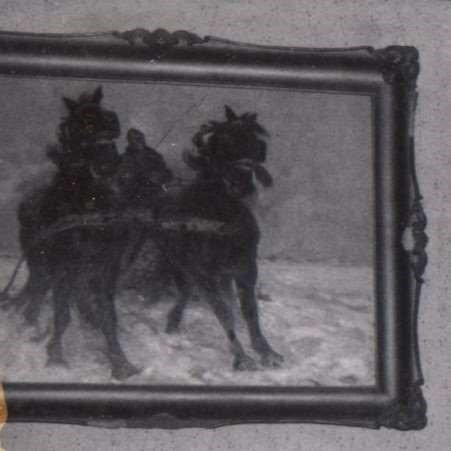
Kazimierz Baraniecki’s
notes: The preserved entry reads briefly: “J. Chełmoński — A Pair of Horses (Dwójka koni).”
State of research: Author and title: recorded in the inventory. Photograph: not found. All other technical and provenance data: undetermined.
Sources: Kazimierz Baraniecki’s collection inventory, Baraniecki Family Archive.
The photograph comes from Dynów.
Nr 23 — Chełmoński Józef (1849–1914) – “Horse Rearing (Koń stający dęba)”
Technique: Undetermined (most probably oil or a dynamic sketch)
Editorial comment:
A work of animalistic character, focused on Chełmoński’s beloved motif of the power and expression of the horse. The depiction of a lone horse rearing is a rare and extremely sought-after motif, a display of the master of realism’s brilliant knowledge of animal anatomy.
Description of the work: The work appears in the collection inventory under the title “Horse Rearing (Koń stający dęba)”. The title indicates a dynamic, highly expressive study of a horse raised on its hind legs. No photograph or description has survived that would allow it to be established whether the animal was depicted alone, with a rider, or as a fragment of a larger battle or genre composition.
History of the work: No separate note concerning the purchase, price or seller has been found. The work was, however, clearly listed as one of five works by Józef Chełmoński in the former, complete collection inventory.
Kazimierz Baraniecki’s notes: Apart from the laconic entry: “J. Chełmoński — Horse Rearing (Koń stający dęba)”, no separate note has been found so far.
State of research: Author and title: recorded in the inventory. Photograph: not found. Technique, dimensions, provenance and later fate: undetermined.
Sources: Kazimierz Baraniecki’s collection inventory, Baraniecki Family Archive.
Nr 24 — Chełmoński Józef (1849–1914) – “At Pasture (Na pastwisku)”
Number in the main catalogue: New discovery (from the handwritten division inventory)
Description: A beautiful landscape-and-genre composition depicting a herd of cattle or a drove of horses grazing freely on the broad, marshy meadows of the eastern Borderlands.
This picture is outside the numbering, because it is not known whether it was bought by Dad.
JÓZEF CHEŁMOŃSKI (1849–1914) — Two Teams in Winter before a Manor House (Dwa zaprzęgi w zimie przed dworem) – descriptive title
Date of appearance in the documentation: 3 September 1943
Provenance: brought by Mieczysław Horski from Jabłonna together with “Landscape from Volhynia (Krajobraz z Wołynia)”
Description of the work: The picture depicted two teams in winter before a manor house. Kazimierz Baraniecki noted in his manuscript a fascinating detail: the building visible in the background of the composition vividly and astonishingly reminded him of the old, historic manor in Dynów. The work’s proper title has not survived — the name adopted on this card is purely descriptive in character and was taken directly from the text of the note.
History of the work: Mieczysław Horski brought this picture from Jabłonna together with the second
Chełmoński — “Landscape from Volhynia, Wild Ducks in Early Spring (Krajobraz z Wołynia, dzikie kaczki wczesną wiosną)”. It follows from the further part of the note that Kazimierz Baraniecki made the final financial settlement for “Landscape from Volhynia (Krajobraz z Wołynia)”. No unequivocal information has been found in the archives, however, as to whether he also purchased the picture with the two teams or whether it returned to the dealer.
Kazimierz Baraniecki’s note: “Brought by Mr Horski from Jabłonna together with the second Chełmoński depicting two teams in winter before a manor house, vividly recalling the old Dynów manor.”
Editorial comment: This is an item of typically transitional status: it is known one hundred per cent that Kazimierz Baraniecki saw it and described it, but there is no final proof of its acquisition (payment). That is why the item has been placed in this separate section of the inventory, protecting research completeness.
Sources: Kazimierz Baraniecki’s manuscripts, Note concerning the purchase of
Chełmoński’s “Landscape from Volhynia (Krajobraz z Wołynia)”, Baraniecki Family Archive.
Nr 25 — AMELIA DIETZÓWNA — View from the Tyrol (Widok z Tyrolu)
Later fate: handed over in the settlement at the purchase of Piotr Stachiewicz’s pastel “Hanka”
Description of the work: The picture depicted a view from the Tyrol. The lack of a photograph and a more precise description does not allow it to be established whether it was a pure Alpine landscape, a view of a valley, the characteristic buildings of a mountain locality, or a genre scene against a mountain background. In the preserved inventory the work was recorded as: “Amelia Dietzówna – ‘View from the Tyrol (Widok z Tyrolu)’.”
History of the work: The work belonged to the earlier part of the collection. In spring 1939 it was handed over as part of a barter settlement for Piotr Stachiewicz’s pastel “Hanka”. Kazimierz Baraniecki listed “View from the Tyrol (Widok z Tyrolu)” in the compilation alongside pictures by Godlewski, Brach, Dąbrowski, Rowiński and Schiffer.
A moody Alpine landscape, which possessed a deep family context – it was the beloved picture given to Basia by Aunt Fela. In spring 1939, owing to the need to finance the outstanding pastel by Piotr Stachiewicz, “Hanka”, this work was withdrawn from the salon with regret and given to Horski in a package of 13 smaller barter supplements.
Kazimierz Baraniecki’s notes: “1 Dietzówna picture ‘View from the Tyrol (Widok z Tyrolu)’.”
State of research: Author and title: confirmed. Participation in the settlement for “Hanka”:
documented. Photograph: not found. Technique, date of earlier acquisition, value and later fate: undetermined.
Sources: Kazimierz Baraniecki’s manuscripts, Collection inventory, Baraniecki Family Archive.
Nr 26 — Dąbrowski Stanisław (1892–1973) – “Snow (Śnieg)” / “Winter (Zima)”
Technique: Oil or pastel landscape
Earliest provenance:
The picture represents the pre-war memorial core – the family received it long before the First World War personally and as a gift from Eugeniusz Dąbrowski, the painter’s brother. In spring 1939 it was included as a barter supplement in the transaction for Stachiewicz’s “Hanka” and handed over to Horski.
Nr 27 — MIECZYSŁAW DĄBROWSKI – Winter (Zima)
Date of entry into the collection: before 1914
Provenance: Eugeniusz Dąbrowski, the painter’s brother
Manner of acquisition: gift
Later fate: handed over in the settlement at the purchase of Piotr Stachiewicz’s pastel “Hanka”
Description of the work: The picture depicted a winter landscape and bore the title “Winter (Zima)”. No photograph or description of the composition has survived. It cannot be established whether it depicted a village, a road, open fields, a forest or buildings in a snowy setting.
History of the work: Kazimierz Baraniecki recorded that the work had been in the family even before the outbreak of the First World War. The picture was given to the Baranieckis by Eugeniusz Dąbrowski, the painter’s brother. In spring 1939 “Winter (Zima)” was handed over together with a group of older, less valued pictures in the settlement at the purchase of Piotr Stachiewicz’s pastel “Hanka”. The inventory also contains works attributed to Stanisław Dąbrowski (“Snow (Śnieg)” and “Winter (Zima)”), but there are no grounds for automatically linking them with this item. The note concerning the exchange for “Hanka” clearly and unequivocally names Mieczysław Dąbrowski and the old gift from his brother Eugeniusz.
Kazimierz Baraniecki’s notes: “1 Mieczysław Dąbrowski picture ‘Winter (Zima)’, which before the Great War we received from Mr Eugeniusz Dąbrowski, the painter’s brother.” State of research: Author, title, origin from Eugeniusz Dąbrowski and acquisition before 1914: confirmed. Handing over at the purchase of “Hanka” in 1939: confirmed. Photograph: not found.
Sources: Kazimierz Baraniecki’s manuscripts, Note concerning the purchase of the pastel “Hanka”, Baraniecki Family Archive.
Nr 28 — STANISŁAW DĄBROWSKI (1892–1973) Snow (Śnieg)
Technique: landscape; exact technique undetermined
Description of the work: The picture appears in the inventory as a landscape entitled “Snow (Śnieg)”. The lack of a photograph and description does not allow it to be determined whether the depiction showed a village, forest, fields, road or urban buildings in a winter setting.
History of the work: No separate note concerning the purchase has been found. In the inventory, alongside “Snow (Śnieg)” there also appears an item “Winter (Zima)”, attributed probably to the same artist. It is not known whether these were two different pictures or two title variants of one work.
Editorial comment: Since in the old source inventory “Snow (Śnieg)” and “Winter (Zima)” occur as two separate entries, separate catalogue cards have been kept for them. State of research: Author and title “Snow (Śnieg)”: confirmed in the inventory. Photograph: not found. Possible identity with the picture “Winter (Zima)” by the same author:
undetermined.
Sources: Kazimierz Baraniecki’s collection inventory, Baraniecki Family Archive.
Nr 29 — STANISŁAW DĄBROWSKI (1892–1973) Winter (Zima)
Description of the work: The work was recorded under the title “Winter (Zima)” and attributed to Dąbrowski. In the working compilation it was noted that probably the same author is meant as for the picture “Snow (Śnieg)”. There are currently insufficient data to establish indisputably whether “Winter (Zima)” was a completely separate work.
History of the work: No note about the details of purchase. The item has been kept as a separate one, corresponding to the structure of the old inventory, in which both titles occur separately. This work should not be confused with Mieczysław Dąbrowski’s winter landscape (Nr 27).
Kazimierz Baraniecki’s notes: Apart from the entry in the inventory, no separate manuscript has been found.
State of research: Author and title: recorded in the inventory. Identity with “Snow (Śnieg)”:
possible, but unconfirmed. Photograph: not found.
Sources: Kazimierz Baraniecki’s collection inventory, Baraniecki Family Archive.
Nr 30 — Fabijański Stanisław (1865–1947) – “The Royal Castle – Entrance in the Snow (Zamek Królewski – wejście w śniegu)”
Technique: Oil or pastel
Date of purchase: 1934–1935
Purchase price: 180 zł (bought in instalments in a package with Axentowicz)
Post-war inventory value: 350 zł
Description and history of the work:
An excellent view depicting the architecture of the Wawel hill – the monumental castle entrance gate covered with a thick layer of winter snow.
Description of the work: The work appears in the preserved inventory as “The Royal Castle – Entrance in the Snow (Zamek Królewski – wejście w śniegu)”. The title unequivocally indicates a winter, moody view of the entrance part of the castle complex on Wawel. The lack of a photograph and a more extensive note makes a more precise description of the composition, colouring and format impossible.
History of the work: No information has been found so far about the circumstances of acquisition, price or the person from whom the picture originally came. Nor can it be established whether it remained in the collection after the war or whether it was used in one of the numerous exchange transactions conducted by the family.
Kazimierz Baraniecki’s notes: No separate descriptive note has been found apart from the general register entry in the collection inventory.
State of research: Author and title: confirmed in the inventory. Photograph: not found. Other technical and provenance data: undetermined.
Sources: Kazimierz Baraniecki’s collection inventory, Baraniecki Family Archive.
Nr 31 — Fabijański Stanisław (1865–1947) – “The Church of St Barbara in Kraków (Kościół św. Barbary w Krakowie)”
Technique: Ink and pen on paper Date of creation: 1916
Pre-war valuation: 150 zł | Settlement valuation 1943: 500 zł
The collector’s critical comment:
In his asset summary, Kazimierz Baraniecki made an outstanding, expert assessment of the class of this drawing. He stressed with great pride that the work possessed considerable collector’s value owing to its “excellent and original pen-painting technique, later no longer encountered in this artist”, which drastically raised its post-war inventory value. Given to Horski on 8 December 1943
for the Grottger.
Source of acquisition: the Banach family
Price or value on receipt: 150 crowns
Later value in the settlement: 500 zł
Further history: the work was handed to Mieczysław Horski in settlement for a work by Artur Grottger
Description of the work: The work depicted the Church of St Barbara in Kraków. The catalogue record defines the technique as ink and crayon and gives the year of execution — 1916 (as is directly indicated by the style and craftsmanship characteristic of the artist in this period). As no photograph has survived, it cannot currently be established whether the artist showed the church façade, its interior, or a fragment of the buildings on Mariacki Square.
History of the work: The work originally belonged to the older part of the collection — it had been sent to Franciszek Baraniecki by the Banach family for 150 crowns.
At a later period its value was estimated at 500 zł. During the occupation the work entered the group of works handed to Mieczysław Horski as part of the complex barter settlement of 8 December 1943, connected with the acquisition of the monumental work by Artur Grottger, “The Siberian Exiles Hewing a Cross (Ciosanie krzyża przez Sybiraków)”.
The same settlement group included, among others, works by Mrazek, Rozwadowski, Jerzy Kossak, Ichnowski and Wodzinowski.
Kazimierz Baraniecki’s note: “Fabijański — The Church of St Barbara in Kraków (Kościół św. Barbary w Krakowie), executed in ink and crayon. A work from 1916, as indicated by the technique of execution. Sent to Dad by the Banachs for 150 crowns. Valued at 500 zł. I sold
[…] Fabijański: the Church of St Barbara […] I sold 2 works by Mrazek: The Storm (Burza) and
Wygrzywalski’s Swallows (Jaskółki), Rozwadowski’s ‘Four-in-Hand (Czwórka)’, Fabijański: the Church of St Barbara, Jerzy Kossak: The Hunt (Polowanie), Ichnowski: The Knight (Rycerz), Wodzinowski: A Boy’s Head (Główka).”
State of research: Author, title, technique, provenance from the Banachs, value and year of creation: confirmed. Participation in the transaction concerning the Grottger: confirmed. Photograph: not found.
Sources: Kazimierz Baraniecki’s manuscripts, List of the collection, Notes concerning the settlement for the Grottger, Baraniecki Family Archive.
Despite a very detailed description of the whole transaction, this work by Julian Fałat entitled “The Hunt in Nieśwież (Polowanie w Nieświeżu)” stands outside the general numbering, because there is no confirmation that it was bought.
It was certainly presented by Horski.
Fałat Julian (1853–1929)
“Setting Out for the Hunt in Nieśwież (Wyjazd na polowanie w Nieświeżu) (The Aristocracy’s Breakfast (Śniadanie arystokracji))”
Format: An enormous, panoramic gouache/tempera of monumental dimensions 127 × 265 cm, rescued from the fire in the imperial gallery in Berlin, folded in four and drastically cracked. Brought by Horski from Captain Michniewicz of the UB on 17 December 1945. Because of the catastrophic damage to the paper and the torn holes, the transaction was not finalised and the work was returned to the dealer, so it was only an object temporarily hosted and offered. Permanent ownership: excluded.
This is what my Father wrote about it:
“An enormous work measuring 127×265 cm. Tempera on paper. It came — allegedly — from the private gallery of Emperor Wilhelm II — in Berlin.
It was brought to the Country by an officer of the Public Security Office in Kraków — a certain Captain Michniewicz — who had been sent on official duty to collect works looted from the Jagiellonian Library.
As a result of that journey, he brought to Kraków an enormous transport of works of art taken away by the Germans, and among them — ‘The Hunt in Nieśwież (Polowanie w Nieświeżu)’ — which … he appropriated for himself arbitrarily, as looting subsistence, or perhaps as a war trophy, and after returning from the Berlin delegation, he sold it in Kraków.”
The buyer of this work was Horski. Horski was an art dealer, very enterprising.
He travelled, bought, sold, knew everyone, felt at home everywhere and knew how to make money. He brought ‘The Hunt in Nieśwież (Polowanie w Nieświeżu)’ to our House in Dynów on 17 December 1945.
The work was damaged. This happened because — as Horski told it — Fałat’s work had been rescued from the burning palace gallery.
The whole left side had already been touched by the flames and their traces were clearly visible.
The paint had also cracked. The work suffered not only from the fire, but also from unprofessional care, because it had been folded in four like a sheet of paper, rather than rolled up. As a result it cracked along the folds and tore in several places. All four sides at the edges had become frayed, and in the middle there was a torn hole.
It depicts the aristocracy gathered in Nieśwież for a hunt, during the day, at the breakfast break.
I paid for it as follows:
Over the course of several preceding weeks, I lent Horski about 13,000 zł.
As interest on that loan, Horski gave me two works. One — allegedly — by Józef
Chełmoński, depicting a horse at full gallop, seen foreshortened. That work measured 78×103 cm. It was painted on cardboard. The second work was some lithograph by Wyczółkowski.”
Against those works as security, Horski left two others. These two new ones were: one — by Jan
Styka, ‘A Country Girl (Dziewczyna wiejska)’, and the other — by Wierusz Kowalski — entitled ‘The Harness (Zaprzęg)’.”
Does this whole long account concern the purchase of that great, damaged ‘Hunt (Polowanie)’, brought by Horski on 17 December 1945? It is not known. Father returned
those two works to Horski together with the completion (?) of the transaction for ‘The Hunt in Nieśwież (Polowanie w Nieświeżu)’! He also gave Horski back the Wyczółkowski lithograph, for which Horski charged 2,000 zł.
All indications are that this is a continuation of that note:
…I got 13,000 zł in cash, I borrowed it from Dad, and in addition I gave him, borrowed from Mum, 10 pieces of 10 Austrian crowns, including one jubilee issue of 1908, 2 Hungarian pieces, 3 pieces formerly borrowed 10-crown coins and 1 piece of a 20-crown coin in gold and 1 piece of a 10-German-mark coin bought by Dad in 1943 in February for 932 złoty of the time.
These gold coins weighed approximately: 1 piece of 10 crowns at 3–4 grams of gold, i.e. 51 grams of gold in total, and 1 piece of a 10-German-mark coin weighs slightly more — about 4 grams, i.e. 55 grams of gold in total. And 1 piece of a 10-crown coin cost at that time 1,800 zł, i.e. 27,000 zł in total, and 1 piece of a 10-German-mark coin over 2,000 zł. Together these coins came to 29,200–29,400 zł, i.e. 1 gram of gold in an Austrian coin cost about 525 zł. It is interesting that a 20-dollar gold coin cost at that time 25,000 zł, i.e. accordingly 1 piece of a 10-crown coin should have cost 2,500 zł. If we also accepted that sum — all the gold would have cost at that time 38,000 zł.
In addition I gave him 3–6 litres of spirit, for which I paid 250 zł each, i.e. 750–1,500 zł in total.
Together, therefore, these two works cost 58,000–69,000 zł. The paper dollar then stood at 400 zł, i.e. 145–173 dollars.
Deducting the Wyczółkowski lithograph received as a gift and a few inaccuracies and uncertainties in some items, we arrive at an even smaller sum of 135–140 dollars. Fałat’s work of a pre-war value of about 2,500 dollars. Chełmoński’s work of a pre-war value of at least 200 dollars, and at today’s valuation by Mr Horski at half that value, i.e. about 40,000 zł.
Explanation concerning the person of Captain Michniewicz of the UB:
The place in question is Kraków. Captain Michniewicz was reportedly sent to Berlin in 1945 to reclaim Polish works of art
Clarifying the context (Kraków 1945, the journey to Berlin to recover historic objects) makes it possible to identify the person sought
“Captain Michniewicz” is Zbisław Roman Michniewicz (1909–1979). He was not, however, in reality a brutal UB officer, but a respected art historian, museologist and archivist.
Many post-war myths have grown up around his biography, which explain why in some accounts he was remembered as “a captain from the security service”.
He was born in Lwów, where he completed his studies in history and art history at the Jan
Kazimierz University. From 1937 he worked as an archivist at the Land Archive in Lwów
After the war, in 1945, he found himself in Kraków, where he immediately joined the activities of the newly emerging Ministry of Culture and Art. He was employed in the Department of Reclamation and Compensation of that ministry, which was headed, among others, by the famous Professor Karol Estreicher.
As an expert and ministry official, Michniewicz was indeed delegated to Germany (including Berlin and Nuremberg) to identify and secure Polish works of art looted by the Nazis (including, among others, the Kraków collections).
The key to this riddle lies in the political and logistical realities of the second half of 1945:
For Polish civilian officials and art historians (such as Estreicher or Michniewicz) to be able
to move around ruined Germany at all and to talk to the Allied
(American, British and Soviet) occupation authorities, they had to receive official military ranks and Polish Army uniforms. Michniewicz was assigned a so-called “wartime establishment” post in military structures or in the Ministry of Public Security (which supervised foreign journeys by couriers and officials). Hence he was formally entitled in that period to an officer’s rank (captain or lieutenant).
Every delegation travelling to the occupation zones in Germany in 1945–1946 was closely controlled by the communist security apparatus. Some reclamation officials received RBP/MBP identity cards exclusively for formal pass-through reasons (so that the Soviets would let them through checkpoints).
In the later period, in Kraków and in security-service documents, the name of a certain Romuald Michniewicz (a genuine UB/MSW colonel) became very loud, so that in human memory and post-war notes these two extremely different biographies (the art historian and the security-service officer) merged into a single figure.
After the reclamation missions ended, Zbisław Michniewicz did not continue his career in the structures of the security forces. He moved to Lower Silesia, where for years he served as curator and director of the Karkonosze Museum in Jelenia Góra and of the National
Museum in Wrocław. He was the author of many valued scholarly works in the field of Silesian heraldry.
Nr 32 — Fałat Julian (1853–1929) – “Setting Out for the Hunt in Nieświeżu (Wyjazd na polowanie w Nieświeżu) (Fog (mgła))”
Technique: Tempera on paper (mounted on canvas) Dimensions: 110 × 145 cm (Final clarification of dimensions)
Exact date of purchase: Wednesday, 8 December 1943
Seller: Mieczysław Horski
Form of final payment: Exchanged directly for the large oil canvas by Stanisław Wyspiański, “The Church (Cerkiew)” (diary item Nr 42, measuring 100 × 75 cm), which the dealer had been awaiting for a year.
Post-war market value: 30,000 zł
Description and compositional analysis:
A monumental, representative panoramic canvas of rare salon dimensions, purchased on the historic day of 8 December 1943. The work was kept in the brilliant, deep bluish tone characteristic of Fałat’s winter works, depicting a forest landscape at the very frosty dawn, against the wild Nieśwież primeval forest. From the ground rise clouds of dense fog steaming from the burning campfires watched over by the beaters, through which gallop hunting sledges with draught dogs, driving directly onto the designated shooting stand.
Original text from the notes: “Fałat — The Hunt in Nieświeżu (Polowanie w Nieświeżu), enormous, painted in tempera 110×145, bought from Mr Horski on 8.XII.1943. In a bluish tone, at dawn, against the forest and the burning campfires, sledges with dogs drive onto the stand. I exchanged it for Wyspiański’s Church (Cerkiew).”
Description of the work: The work presents an extensive scene of a winter hunt involving several hunters. It is one of the earliest large-format compositions by Julian Fałat to enter Kazimierz Baraniecki’s collection.
In this work the artist achieved the fullness of his unique style — free, synthetic, based on the colour patch and a brilliant sense of light reflected from snow. The figures of the hunters and hounds were merged into the winter forest and shown as an element of a larger landscape composition. This work directly anticipated the later monumental depictions of the hunts in Nieświeżu.
History of the work: Kazimierz Baraniecki bought this work from Mieczysław Horski on 8 December 1943.
The transaction had a distinctly wartime, barter character. The settlement involved the unique oil painting by Stanisław Wyspiański, “The Church (Cerkiew)” (measuring approx. 100 × 75 cm), which Horski received as the main part of the payment.
This was undoubtedly one of the most important and most spectacular transactions in the wartime history of the collection. From that breakthrough moment, Julian Fałat became the best and most numerously represented great master in the Baraniecki holdings. Editorial comment: The purchase of this work officially opens the history of the remarkable, coherent group of four great panoramic Fałats which, over the following decades, constituted the greatest pride and ornament of the Baranieckis’ salon.
State of research: Photograph: preserved. Manuscripts and confirmed date of purchase: preserved. Seller: Mieczysław Horski.
Sources: Kazimierz Baraniecki’s manuscripts, Baraniecki Family Archive.
Nr 33 — Fałat Julian (1853–1929) – “Setting Out for the Hunt in Nieświeżu (Wyjazd na polowanie w Nieświeżu) — Berlin 1888”
Technique: Watercolour / gouache on paper
Dimensions: 63.5 × 113.5 cm (Dimensions of the face itself — the window in the light of the passe-partout) / In old notes given with the frame as 68 × 118 cm.
Place and date of creation: Berlin, 1888 (From the cycle of great masterly hunting compositions from Nieśwież).
Date of wartime purchase: End of December 1941 (Acquired just after the Wyczółkowski pastel).
Seller: Mieczysław Horski
Wartime cash-and-barter payment structure: Redeemed as property for a total of 1,200 zł. The family put up 700 zł in pure wartime cash, and for the remaining 500 zł Dad gave from the collection the large oil painting by Wacław Radwan, “Gdańsk” (made with a palette knife, bought before the war for 250 zł).
Sensational post-war history (Auction in Warsaw 2005):
This entry brings an invaluable contemporary documentary trace which ideally closes the history of the work.
In 1958 this particular pre-war Fałat was chosen from the holdings and given as a ceremonial wedding present within the family. The work remained in the hands of the recipients’ heirs for several decades. Then, around 2005, the work was officially put up and sold at a prestigious art auction in Warsaw. In the course of rigorous expert examination, the auction house fully confirmed its authenticity, its precise face dimensions (63.5 × 113.5 cm) and its historic Berlin provenance from 1888. At present this masterpiece is in a luxurious private collection.
Wartime pledge history:
This work was initially not a purchase. In December 1941 Mieczysław Horski urgently needed to borrow the oil painting by Vlastimil Hofman, “Fishermen (Rybacy)”, from the Baraniecki family in order to take it to Kraków to be copied. As hard financial security (a pledge) the dealer left this Berlin Fałat watercolour in Dynów. Perceiving its astonishing, museum class, the Baranieckis decided at the end of December to redeem it as permanent property.
Original text from the notes:
“Julian Fałat ‘The Hunt in Nieświeżu (Polowanie w Nieświeżu)’, bought for 1,200 zł, including 700 zł in cash, and the work by T. Radwan ‘Gdańsk’ made with a palette knife, bought before the war for 250 zł and now worth 500 zł. The watercolour bought from Mr Horski, after the Wyczółkowski, at the end of 1941, for copying Hofman’s ‘Fishermen (Rybacy)’ […] This work was given in 1956 as a wedding present. It passed to the heirs. Around 2005 it was sold at an auction in Warsaw. It is now in private hands.”
Dimensions: 68 × 118 cm
Signature: Berlin 1888
Date of purchase: 14 September 1946
Purchase price: 8,000 zł
Seller: Mieczysław Horski
Further history: subjected to expert examination and sold at auction at the Sopot Auction House in 2022
Description of the work: This is undoubtedly one of the most important and best historically documented works in Kazimierz Baraniecki’s entire collection. It depicts a fragment of the great hunt in Nieświeżu.
Three hunters at their stands and the winter nature surrounding them were shown with extraordinary craftsmanship, which drew the collector’s particular attention.
The work stands out among the other Fałats in the holdings in that it bears the exact place and date of execution applied by the artist: Berlin 1888. It is the only work by this artist in the collection furnished with such precise chronological and topographical information.
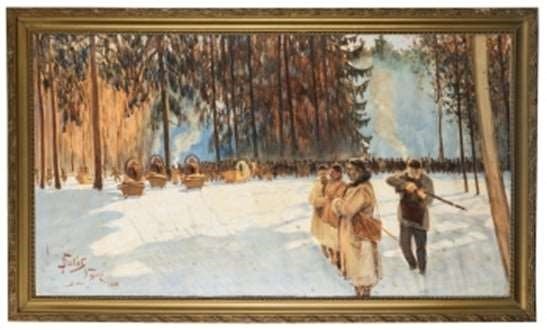
History of the work: Kazimierz Baraniecki bought the work from Mieczysław Horski on 14 September 1946. He paid 8,000 zł in cash for it, although the earlier, initial valuation had been 35,000 zł.
The collector himself described this bargain purchase in his notes as an almost improbable event.
For a decade the work hung in the place of honour in the Baranieckis’ house in Dynów.
In 1956 it was given by Kazimierz and Małgorzata Baraniecki to Stefania Lasko on the occasion of her wedding. It remained in the family’s possession for over sixty years. In 2022 it was subjected to specialist expert examination at the Sopot Auction House, and then successfully sold at auction to a private collector. Thanks to the preserved manuscripts and Joanna Lasko’s account, it was possible to reconstruct the work’s history fully, from 1888 to the 21st century.
Kazimierz Baraniecki’s note:
“‘The Hunt in Nieświeżu (Polowanie w Nieświeżu)’. Dimensions 68×118. Painted in tempera in Berlin in 1888. My only Fałat work dated and marked with the place of painting. Technique of painting and subject as in all my other Fałat works,
Three superbly executed figures of hunters. A work painted with extraordinary care and beauty and perfectly preserved. Horski brought it from Kraków.
I bought it on Saturday 14 September 1946. Valued earlier at 35,000 zł, he sold it to me for 8,000 zł! / Quite unheard of — my note./ The dollar then stood at 800 zł (?), i.e. I paid 13 dollars for it, i.e. 65 pre-war złoty.”
Additional documentation:
The history of Julian Fałat’s work “The Hunt in Nieświeżu (Polowanie w Nieświeżu)” (1888). Written by Ms Joanna Lasko.
In 1990, after marrying Zbigniew Lasko, I moved into his family home in Dynów. My attention was drawn to a work hanging in the living room above the sofa bed. It was a work executed on paper, framed in gilded, carved frames behind glass, bearing the signature jFałat/Nieśwież/Berlin 1888.
My mother-in-law, Stefania Lasko, informed me that she had received this work as a wedding present in 1956 from Małgorzata and Kazimierz Baraniecki. From the 1950s until her retirement, Stefania worked in their family pharmacy in Dynów (nationalised by the communist authorities in 1951) and remained on very good terms with Ms Małgorzata Baraniecka. She also told me that in the past the house had been visited by people (brought by the account of neighbours, the Mazurs), who, after inspection, judged the work to be a copy. In the realities of the Polish People’s Republic, that opinion protected the work from potential interest by the authorities or theft.
After a year of living in Dynów, my husband and I moved to Rzeszów. During subsequent visits to my in-laws, I regularly analysed the work. I had serious doubts about the thesis that it was a copy, based on the following technological facts: the work was executed in watercolour and gouache on paper. Copyists much more often choose oil on canvas, because it allows corrections and retouching of errors to be applied.
In watercolour, pigment immediately soaks into the paper, and every brushstroke is final. Reproducing a dynamic, complex multi-figure hunting scene in this technique requires impeccable craftsmanship, which replicators usually do not possess.
Executing so precise and technically free a copy in the impressive format of 63.5 × 113.5 cm directly on paper was, from a craftsman’s point of view, extremely difficult and unprofitable.
In 2007 my mother-in-law gave me this work, so it reached the main wall of my house in Rzeszów. My first attempt at verification with a recommended specialist in Kraków ended in failure — the enquiry was dismissed by telephone.
My argumentation and persistence in pursuing the originality of the work ultimately convinced my family (my husband, my mother-in-law and my husband’s sister; my father-in-law was already dead by then) that the work might be an authentic piece. For that reason I took the decision to formally return the work to my husband’s family as their ancestral property, although physically it still hung in my house.
In August 2022 I contacted by telephone Ewa Tokarzewska of the Warsaw branch of the Sopot Auction House (SDA), who became interested in the object. I arranged a visit, and my husband and I went with the work to Warsaw. On site the object was unpacked and the protective glass removed. In the excitement and enthusiasm accompanying the procedures, we signed the receipt protocol and consent for the object to be put up at auction, after which we left it for official expert examination.
Only after leaving the work at the auction house for expert examination did I find, on social media, the account by Marcin Baraniecki (son of Małgorzata, the former owner of the Pharmacy), living in Canada. In the third part of his Dynów reminiscences, entitled “The Warm Touch of the Past (Ciepły dotyk przeszłości)”, he listed the works of art adorning his parents’ former house, directly pointing to: “The Hunt in Nieświeżu (Polowanie w Nieświeżu)” by Fałat.
This historic discovery ultimately confirmed the object’s provenance and caused me deep regret at the decision taken to sell. I wanted to protect the work from oblivion, not to dispose of a family keepsake. I immediately decided to withdraw the work from the auction. On 7 September 2022 I sent an email on the matter to Ms Ewa of the SDA, declaring that I would cover all costs and asking for the work to be deposited in Warsaw. The auction house informed me, however, that the official expert examination had confirmed authenticity, and given how far the procedures had advanced and that the catalogues had been published, it was already too late to withdraw the object.
On 14 September 2022, at the Works on Paper Auction, the work was sold for 120,000 złoty. The sum obtained was divided equally between the members of the family. My husband and I deeply regretted this sale, since before the auction we did not know the work’s real market value. Had the price been known to us earlier, we would have kept the work at home and paid off my husband’s sister financially.
Not long afterwards, in July 2026, history came full circle in a remarkable way. I received a direct message from Mr Marcin Baraniecki, who passed on to me the missing, invaluable link in the pre-war and post-war history of this work. He wrote:
“Yes / this is the work which my Father bought from M. Horski on 14 September 1946. I shall be very grateful for the history!”
This information revealed an astonishing coincidence of dates. Exactly 76 years after Mr Marcin’s father redeemed the watercolour from the mysterious M. Horski (14 September 1946), the work was auctioned at the SDA auction (14 September 2022).
At present, a professional photograph of this work in similar frames hangs on the wall of our house in Rzeszów. The work has a new life in the hands of a new family, but thanks to my many years of persistence and the latest confirmation from Mr Marcin, its full record and history have been saved from oblivion and permanently entered into the chronicles of Polish art.
Letter from the Sopot Auction House
The price of 120,000 zł obtained for the work places it in the upper price segment for works on paper (watercolour/gouache) by Julian Fałat on the Polish auction market. This result should be regarded as very high and satisfactory.
This is how that sum compares with market standards:
Valuation classification of Fałat watercolours
Chamber works and sketches (35,000 – 70,000 zł): Within these limits sell smaller landscapes (e.g. views from Bystra) or portraits of more modest dimensions. For example, the watercolour In the Garden (W ogrodzie) achieved a price of 40,000 zł, and Clouds in Bystra (Chmury w Bystrej) 70,000 zł.
Good medium-format watercolours (70,000 – 110,000 zł): This is the standard, strong ceiling for well-preserved and representative landscape works. This group includes, for example, the object The Hunter (Myśliwy), auctioned for 95,000 zł.
Outstanding large-format realisations (above 110,000 zł): The sum of 120,000 zł brought the work into this prestigious category. Higher sums for watercolours (of the order of 200,000–270,000 zł) are achieved almost exclusively by legendary compositions of rare historical subject matter, such as The Retreat of Napoleon’s Troops over the Berezina (Odwrót wojsk Napoleona nad Berezyną).
What influenced so high a price?
A sought-after motif: Hunting scenes from Nieśwież (connected with Fałat’s stay at the Radziwiłł court and that of Emperor Wilhelm II) are, alongside winter landscapes, the most desired and iconic subject in his entire oeuvre.
Large format: Dimensions of 63.5 × 113.5 cm are an impressive, indeed “museum” size for a work on paper, which automatically raises the object’s technical and decorative value.
Provenance: The market’s awareness of the work’s unique provenance and its precise dating (Berlin 1888) confirmed bidders in the conviction that they were buying an object with a certain and exceptional history.
Although the market records higher records for rare oil paintings by Fałat (reaching from 850,000 zł to 1.8 million zł), in the watercolour category the sum of 120,000 zł reflects the highest market class of the former family keepsake.
State of research: Photograph: preserved. Manuscripts: preserved. History after 1946: complete. Further history: fully established.
Sources: Kazimierz Baraniecki’s manuscripts, Baraniecki Family Archive, Account and documentation by Joanna Lasko, Archives of the Sopot Auction House (2022).
Nr 34 — Fałat Julian (1853–1929) – “The Beaters at the Hunt in Nieświeżu (Naganka na polowaniu w Nieświeżu) (A Treat of Mint Vodka (Poczęstunek miętówką))” /In the possession of Ela Brueckner/
Technique: Tempera on paper (mounted on canvas)
Dimensions: 90 × 207 cm (a powerful, monumental panoramic format) State of preservation: Excellent, perfectly preserved, undamaged.
Exact date of purchase: Sunday, 6 January 1946 (Epiphany) / Horski brought the work on Saturday 5 January 1946
Seller: Mieczysław Horski
Alleged source of provenance (according to Horski’s lie): The private gallery of Emperor Wilhelm II in Berlin (looted transport of Captain Michniewicz of the UB).
Final structure of the post-war cash-and-barter payment (60,000 zł in total):
30,000 zł – put directly in cash on the table as the main instalment.
22,000 zł – cash balancing of the settlement balance.
8,000 zł – nominal value of unique, high-grade cloth / material for a suit (men’s clothing), purchased by the family two years earlier in the depths of the occupation.
The collector’s currency conversion: About 120 US dollars (which corresponded to the purchasing power of 600 pre-war złoty). Full iconographic description of the scene:
A monumental, painterly magnificent panoramic work of outstanding representative qualities. This tempera composition depicted a calm scene of manners full of realism: a ceremonial treat and moments of rest during the official break in the course of the great hunt in the Radziwiłł forests. At the centre of the composition were captured the figures of titled hunters who, gathered in a forest clearing around burning campfires watched over by the beaters, discuss animatedly, smoke pipes and fortify themselves with traditional, strong mint vodka.
A brilliant economic-market analysis from the author’s hand:
Dad’s notes bring a brilliant, invaluable sociological document, unmasking the realities of raging post-war hyperinflation, the lack of a stable currency and the complete collapse of the financial market at the beginning of 1946.
Kazimierz Baraniecki, wishing to argue honestly for the outstanding bargain of this purchase, carried out in his notes a fascinating comparison of the asset value of the Fałat acquired with real, hard consumer goods of everyday use:
In relation to food: The value of the work (60,000 zł) at the then market price of butter of 250 zł per kilogram corresponded to the equivalent of only 240 kg of country butter.
In relation to clothing and footwear: At the speculative price of luxury top boots reaching at the time the dizzying sum of 10,000 zł per pair, possessing this monumental two-metre Fałat canvas was worth as much as only 6 pairs of officers’ leather boots.
The collector proudly sums up that, relating those sums to stable pre-war times — where luxury made-to-measure boots from the most famous Warsaw master shoemaker Hiszpański cost 100 zł, and the work itself from Zachęta was worth a fortune — the 120 dollars laid out to Horski constituted an extremely low, highly advantageous price, and the objective artistic value of the panorama is at least ten times greater.
Editorial comment (Correction of a trade fraud):
This card brings a breakthrough, critical scholarly correction, exposing the ruthless and brilliant mechanisms of provenance frauds practised by Mieczysław Horski on the post-war art market. The true, canonical masterpiece by Julian Fałat entitled “Return from the Hunt in Nieświeżu (Powrót z polowania w Nieświeżu)” (also known as “The Beaters… (Naganka…)”), measuring 65 × 176 cm, painted in 1891, was before the war the property of the Warsaw industrialist Ludwik Norblin, who bequeathed it in his will to the Society for the Encouragement of Fine Arts (Towarzystwo Zachęty Sztuk Pięknych) in Warsaw, from where it was looted by the Germans in 1939 and recovered from New York only in 2011.
This knowledge proves in black and white that the historic provenance from the “private gallery of Emperor Wilhelm II” was entirely a brazen mystification and literary legend created by Horski to make the offer attractive, raise the price and conceal the underground, looted provenance of the gouache offered.
This work was most probably an outstanding, large-format author’s replica or an independent version of this motif, created by Fałat himself for a private recipient.
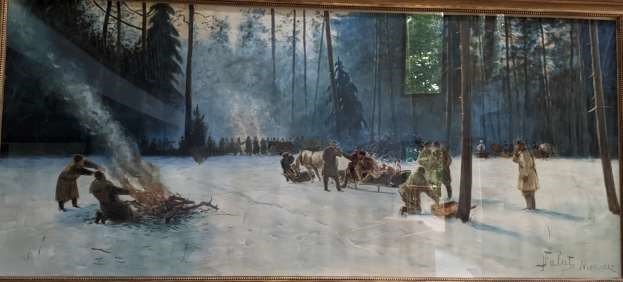
This work was given by Małgorzata and Kazimierz Baraniecki to Teresa and Walenty Gołąb as a wedding present on 27 December 1947.
It is now in the possession of their daughter Ela Brueckner.
Nr 35 — Fałat Julian (1853–1929) – “Setting Out for the Hunt in Nieświeżu (Wyjazd na polowanie w Nieświeżu)”
Technique:
Tempera on paper (mounted on canvas)
Dimensions: 50 × 117 cm (panoramic format)
Exact date of purchase: Saturday, 29 September 1945 (purchased in a package with the oil by Józef Brandt, “A Cossack… (Kozak…)”)
Seller: Mieczysław Horski
Structure of the final post-war cash-and-barter payment:
9,200 zł – laid out in pure post-war cash.
5,400 zł – currency supplement in the form of 18 paper dollars (at the rate of 300 zł per dollar).
Half a litre of pure spirit – introduced directly as a hard financial equivalent (bringing the cash up to an even sum of 15,000 zł).
A package of 12 works given from the house as Horski’s property – valued jointly and receipted by the parties at a total value of 20,000 zł (including 5 works by Mother for 4,000 zł, 3 works of Grandpa Franio’s with Gierymski’s original palette for 7,000 zł, and 4 old sets).
15,000 zł – a declared promissory note of debt which Kazimierz remained owing to the dealer (Total value of the Fałat-Brandt package: 50,000 zł).
Source of family funds: To finalise this gigantic transaction and obtain cash, Kazimierz Baraniecki spent all his last financial reserves and sold to his father, Grandpa Franio, the last family gold ducats.
Kazimierz Baraniecki’s note:
Julian Fałat “The Hunt (Polowanie)”. A large work measuring 50×117 cm, also painted in tempera, acquired from Mr Horski on Saturday 29 September 1945. Father writes of it thus: I gave for it 9,200 zł in cash and 18 dollars, which corresponded to the sum of 5,400 zł. In addition I gave half a litre of spirit, i.e. 15,000 zł in total. In addition I gave 2 works by Zofia Stryjeńska. One entitled “A Highlander (Góral)”, and the other “A Highland Woman (Góralka)”, as well as the work received from Mr Sosnowski by Jaxa-Małachowski entitled “View of the Sea (Widok na morze)”, Gierymski’s “Idyll on the Lake (Sielanka na jeziorze)”, oil, on a palette. These works were valued at a total of 7,000 zł. In addition I gave 3 works by Tadeusz Kaleta. One “A Sleigh Ride (Jazda na saniach)” and “A Mounted Soldier (Konny żołnierz)” and “Wawel”. Valued together at
1,000 zł. Apart from that, works bought 3 months before to be given away (?): Wierusz-Kowalski: “A Sleigh Ride (Jazda saniami)”. In addition: Wyczółkowski – Wawel – a crayon drawing,
Ruszczyc – Ploughing (Orka), but unsigned, and Orłowski – Kościuszko at Maciejowice (Kościuszko pod Maciejowicami) – his youthful drawing. And further: Andriolli – “A Quarrel at Table (Awantura przy stole)”. This was a pledge for money borrowed by Horski. These three works I returned for the borrowed 8,000 zł, and Orłowski was counted to me at 1,000 zł. In addition Rozwadowski – Four-in-Hand (Czwórka koni) for 3,000 zł. Thus, all these 12 works were counted at 20,000 zł. In addition I owe 15,000 zł. The transaction also includes: Brandt Józef – A Cossack Awaiting the Return of the Commanders (Kozak oczekujący na powrót panów dowódców) with 3 horses and 3 dogs, oil, on board 37×57 cm. Thus, for both these works I paid 35,000 zł and I owe him 15,000 zł. I spent my last money on this and sold to Dad /i.e. Grandpa Franio/ the last ducats. In this transaction there were 5 works by my Mother. 2 works by Zofia Stryjeńska /a painter living in the years 1891–1976/ and three by Tadeusz Kaleta /a Kraków painter of the first half of the 20th century/ for 4,000 zł, and in addition there were three works belonging to Grandpa Franio: Rozwadowski, Gierymski and Jaxa-Małachowski, calculated together at 7,000 zł. Converted into dollars I paid 177 dollars, i.e. 935 zł.
Nr 36 — Fałat Julian (1853–1929) – “The Hunt in Nieświeżu (Polowanie w Nieświeżu)”
Technique: Watercolour on paper
Dimensions: Smaller format
Wartime status: A permanent element of the pre-war and occupation inventory. Commemorative history:
This card definitively orders and closes the history of the first, chronologically oldest Fałat in the house (item no. 9).
In the years 1941–1942 it fell victim to the ruthless practices of Mieczysław Horski, who repeatedly took it away surreptitiously from Dynów and pawned it as a liquid security instrument in his other Kraków transactions.
Only at the end of 1943, on the eve of finalising the great Collective
Account for 50,000 zł, after a complete and final debt settlement with the dealer, did this charming, intimate Fałat happily return to the family’s hands and hang again in the Dynów salon.
Nr 37 — Fałat Julian (1853–1929) – “Landscape from Polesia (Krajobraz z Polesia)” / Camp with a Roasting Roe Deer (Obozowisko z pieczoną sarną)
Technique: Tempera on paper
Dimensions: 91 × 190 cm (powerful panoramic format)
Date of purchase: 1946 (post-war)
Seller: Mieczysław Horski Description of the work and historical-artistic context:
An outstanding, monumental panoramic work from the artist’s cult borderlands cycle.
The work depicts the depth of the wild Polesian spruce forest with majestic, dense woods in the background.
In the foreground, in a forest clearing, a hunter’s shelter built primitively from conifer branches was captured, before which a campfire burns. The main narrative point of the canvas is a wooden spit broken over the fire, on which the carcass of a freshly hunted roe deer is roasting.
This motif is the fruit of Fałat’s Polesian hunting expeditions of the 1880s and 1890s, during which, as the official painter of imperial and Radziwiłł hunts, he studied hunting customs.
Description of the work: “Landscape from Polesia (Krajobraz z Polesia)” is one of the most beautiful landscape compositions by Julian Fałat in Kazimierz Baraniecki’s collection. In the foreground is a forest shelter, before which a hunted roe deer roasts on a spit.
In the background stretch the characteristic, extensive Polesian spruce forests.
The work masterfully combines pure landscape with a hunting motif, yet the main hero of the composition remains nature. Fałat, with extraordinary subtlety, rendered the light penetrating between the trees and the specific atmosphere of a calm forest morning. Kazimierz Baraniecki considered this work one of the most beautiful and most atmospheric compositions in his holdings.
History of the work: The work was purchased from Mieczysław Horski in 1946. It came from the same legendary group of great works from which the other three monumental Fałats in the collection derived.
According to information passed down in the family, all these four works had previously belonged to Captain Michniewicz.
On the reverse of one of these canvases was the seal of the Dresden Museum and other numerical markings, which may attest to an extremely interesting earlier history of the whole group.
Editorial comment: Among all the Fałats in the collection, this very work possesses the most lyrical, calm character. It is an excellent artistic complement to the dynamic and monumental hunting scenes. The question of the provenance seals requires further research.
State of research: Photograph: preserved. Manuscripts and date of purchase: confirmed. Seller: Mieczysław Horski. Further history: not established.
Sources: Kazimierz Baraniecki’s manuscripts, Baraniecki Family Archive.
Nr 38 — Fałat Julian (1853–1929) – “Landscape from Bystra (Pejzaż z Bystrej)” / “Landscape from Bystra (Krajobraz z Bystrej)”
Technique: Tempera on paper Date of purchase: December 1941
Seller: Mieczysław Horski
Price and settlement structure: 520 zł in pure cash and as a supplement: two wooden frames taken from works by Gustave Lin purchased in Italy in 1938 (valued and counted in this transaction at 50 zł) Cash price: 520 zł
Additional payment component: two handsome frames for works by Gustave Lin, estimated at 50 zł
Total transaction value: about 570 zł
Description of the work: The work depicted a landscape from Bystra — a locality where the artist spent the last decades of his life and created many of his mature works. The technique was defined in the list as tempera. No photograph or detailed description of the composition has survived. It is not known whether a winter view of the locality, a forest, buildings, a stream or a mountain landscape was depicted.
History of the work: Kazimierz Baraniecki bought the work from Mieczysław Horski in December 1941. He paid 520 zł in cash for it, and to the settlement he also added two frames originating from works by Gustave Lin held in the collection, valued together at 50 zł. The total value of the transaction was therefore, according to his notes, about 570 zł. In the transaction register the work figures as a certain purchase from December 1941.
Kazimierz Baraniecki’s note: “Julian Fałat. ‘Landscape from Bystra (Krajobraz z Bystrej)’. Bought in December 1941 from Mieczysław Horski for 520 zł, adding to that 2 frames for works by Lin, estimated at 50 zł.”
Editorial comment: The frames from Lin’s works constituted in this transaction a real, valued component of the commercial payment. They must therefore absolutely be taken into account when calculating the total, real cost of acquiring this work.
State of research: Author, title, technique, month and year of purchase, seller and form of payment: confirmed. Dimensions and photograph: unknown.
Sources: Kazimierz Baraniecki’s manuscripts, Transaction register, List of the collection, Baraniecki Family Archive.
Nr 39 — Fałat Julian (1853–1929) – “Sketch from a Restaurant (Szkic z restauracji)” / Figures from the World of Culture at a Tankard
Technique: Drawing / sketch in pen or crayon Full iconographic description of the scene:
A unique, humorous and anecdotally characterful drawing of great historical significance.
The sketch captures an intimate, social meeting of the most outstanding representatives of Polish culture at the turn of the 19th and 20th centuries, sitting in a restaurant at large beer tankards. Kazimierz Baraniecki precisely identified the figures captured, listing in the note the silhouettes of: the outstanding painter Leon Wyczółkowski, the Nobel laureate Henryk Sienkiewicz, the author himself, Julian Fałat, a figure recorded as Markowicz, and several other artists from their closest Young Poland circle. Description of the work: An anecdotal work depicting a group of outstanding persons from the world of Polish artistic and literary life at the turn of the 19th and 20th centuries, sitting in a restaurant at a beer tankard.
Kazimierz Baraniecki, on the basis of detailed physiognomic features, recognised among the figures captured: Leon Wyczółkowski, Henryk Sienkiewicz, the author himself, Julian Fałat, a person recorded in the note as Markowicz, and several other, as yet unidentified figures.
The source description from the manuscript reads: “A sketch of a restaurant depicting a couple of figures from the artistic world. Wyczółkowski, Sienkiewicz, Fałat himself, Markowicz and a few others at a tankard.”
History of the work: No information has yet been found about the circumstances of purchase, price or the seller’s name. The work was, however, clearly listed in the old list as a separate, independent work by Julian Fałat, independent of the landscapes. Editorial comment: The identifications of the outstanding figures (Sienkiewicz, Wyczółkowski) come directly from the family interpretative note and have not yet been verified against comparative material. In particular the surname “Markowicz” requires a fresh, critical reading from the original manuscript.
State of research: Author, subject and list of recognised figures: recorded in the source. Technique, dimensions and date of acquisition: not established. Photograph: not found.
Sources: Kazimierz Baraniecki’s notes, List of the collection, Baraniecki Family Archive.
Nr 40 — STEFAN FILIPKIEWICZ (1879–1944) — Winter Landscape with a View of the Mountains (Pejzaż zimowy z widokiem na góry)
Technique: oil on canvas
Date of acquisition: before the Second World War (in the working list 1933, according to the note probably January 1939) Purchase price: 400 zł
Seller: Mieczysław Filipkiewicz (dealer)
Description of the work: The work depicted an atmospheric winter landscape with a view of a mountain range. The preserved record does not give the exact topographical place, so this depiction should not, without additional iconographic evidence, be identified with the Tatras or with any particular Podhale valley. The technique was defined as oil. In the catalogue list the work appears under the shortened title “Winter Landscape (Pejzaż zimowy)”, with information about a purchase in 1933.
History of the work: Kazimierz Baraniecki bought this work for 400 zł.
The purchase belonged to the group of the last pre-war transactions made with the Kraków art dealer described in the manuscript note as “Mieczysław Filipkiewicz”.
In the same period (probably in January 1939) Baraniecki also bought from him: the large work by Wacław Radwan, “Gdańsk”, for 250 zł, and Wincenty Wodzinowski’s “Motherhood (Macierzyństwo)” for 300 zł. The collector expressly noted that these were the three last works bought from this pre-war source; later his main wartime supplier became Mieczysław Horski.
Kazimierz Baraniecki’s note:
“From the Jew Filipkiewicz, Mieczysław, I bought ‘Winter Landscape with a View of the Mountains (Pejzaż zimowy z widokiem na góry)’ for 400 zł. At the same time I also bought T. Radwan’s ‘Gdańsk’ for 250 zł […] and also
Wincenty Wodzinowski’s ‘Motherhood (Macierzyństwo)’ for 300 zł […]. These were the last 3 works bought from the Jew. Later I traded with Mr Horski.”
(The ethnic designation used in the manuscript is preserved in the scholarly documentation solely as evidence of the language of the time and the personal character of the author’s note). Editorial comment: The sources contain a clear chronological discrepancy concerning the year of acquisition (1933 in the working list versus January 1939 in the contextual description). This requires verification.
It is also not certain whether the dealer Mieczysław Filipkiewicz was in any way related to the painter Stefan Filipkiewicz.
State of research: Author, subject, technique, price and seller: confirmed. Year of purchase: ambiguous (1933/1939). Photograph: not found.
Sources: Kazimierz Baraniecki’s manuscripts, List of the collection, Register of pre-war transactions, Baraniecki Family Archive.