
Marcin Baraniecki
—Do you watch television before noon?
—It happens.
—And don’t you feel guilty then, for wasting your time?
—Not in the least!
My friend looked at me with disapproval.
—And what do you watch? Are you learning something? — he asked with some impatience.
—What do I watch? Sometimes old westerns, sometimes old boxing matches, like Clay, Liston, Patterson, Rocky Marciano, for instance…
—And you don’t mind wasting the time? — he persisted.
—Not a bit! I always dreamed of having time for it, and now I finally have it! At last I can get up at three in the morning, have a coffee, listen to the pre-dawn silence, watch a Gołota or Tyson fight, and know that when I feel like sleeping a little later, I can go back to bed and sleep. I can even take a nap after lunch! As long as I like!
—That sleeping — after the morning coffee, you mean?
—It doesn’t bother me somehow. It’s left over from my days driving a truck.
—How so?
—You know, when I was driving, it would happen that I was tired as a dog and sleepy beyond bearing, and then at a truck stop I would get myself a “bucket” of coffee. That coffee wasn’t really coffee at all, just something like burnt engine oil, but it could be drunk. So I drank it and fell into a kind of restless, excited delirium, in which at a certain moment I didn’t know where I was… It’s a horrible feeling, and believe me — I wouldn’t wish it on an enemy. You drive, you drive, the highway sings to you, night, and suddenly… panicked thoughts: Where am I? Where am I?! What country? What highway? What? Where? As if for a fraction of a second I had lost consciousness and suddenly woken up.
Fortunately, it passed quickly, because some road sign, board or signpost would appear and I would return to some sort of sobriety. Such moments were terrible. Especially when I was driving at night.
So I would stop somewhere and try to rest. That was when I learned to rest in a particular way. I called it “the Marcin method”, but in fact it is as old as the world, and if I had been a little better informed, I would have known.
In any case, “my” method consisted in trying to relax completely. I didn’t lie down. I stayed sitting behind the wheel the whole time. Sometimes I didn’t even switch the truck off. I sat with my head resting on the headrest and slowly, systematically relaxed my whole body. From my feet to my head. Legs, belly, shoulders… One by one. Everything. The face was the most important thing. I noticed then that very often my face was tense — even while I slept — and that was tiring. So I tried to “let go” of that tense mug, to relax it until it sagged, and even to let my lower jaw drop and allow my mouth to open.
—And what did that do for you? Did you fall asleep?
—It was hard to call it sleep, but I sank into complete non-being — as if I had died. It lasted ten minutes at most, but afterwards I was as fresh as if I had slept the night.
—You’re joking, surely? Some fakir’s tricks? Yoga?
—Maybe, maybe not. After a while, though, I noticed that you can’t use it too often, and that such ten-minute sessions certainly can’t replace real sleep.
—What are you saying, Marcin? Wouldn’t it have been better to stop somewhere for the night and sleep eight hours, as God commanded?
And to that I no longer answered anything, because my friend was not a trucker but a teacher, and it was hard to expect him to put himself in my shoes about what I was talking about.
Whatever one may say, a driver’s job is hard, physical work. You can explain and tell yourself a lot about papers, documents, etc., etc., wanting to introduce into it some element of “mental” work, and therefore “better” work, but those are just “sham activities”, because in essence it is hard, very demanding physical work, which can wear out the body and sometimes even kill. It can also ruin family life and lead to various addictions, but that is just by the way, ha, ha, ha!
That I would one day be a pensioner never entered my head. I liked my work, I felt good in it, and wherever I could I shouted that they would sooner cart me off to Siberia in a kibitka than I would retire, and also that I would work until I smashed my head into the steering wheel — just like the heroes of American films who get shot in the back of the neck. Then a loooong horn sounds and the film ends, because everything has already been said.
In the end, I always wanted to be a trucker, and going to Canada I knew one hundred per cent that it was only that and nothing else.
And yet it happened. As if independently of me. As if the decision had come from someone else. Firm and severe.
It was October. My favourite month. One night it rained, and by morning everything was wet. I was getting into the truck, I slipped on the step and fell to the ground. As I fell I scraped my shin and my arm on the sharp steps, and on landing I also banged my head on the ground.
I lay there a little dazed, bruised and bloodied, with my trousers torn, but for the moment I didn’t get up, because I didn’t know what was what and I wanted to cool off a bit. So I lay quietly, thinking that at that very moment my trucking adventure had just come full circle. For I remembered that many years earlier I had had an almost identical fall. I had lain in the mud then too, battered and dirty as a pig.
It dawned on me that these two falls bracketed, like a clasp, the thirty-five-year period of my so-called trucking “career”. It was just then — in the mud of southern Ontario — that a thought suddenly struck me: who knows — perhaps my time had come, perhaps it was a sign that the times of struggle, of rushing, of sleepless nights, of closing eyes, of nervous conversations with clients, of sitting in the crush of street traffic, of the asphalt fleeing under the wheels, and of several-day-old squashed cakes at truck stops were passing. Perhaps they were passing just now!
That first fall, in the distant past, had happened to me at the very beginning of my trucking adventure in the far-off northern little town of Pickle Lake — some 550 kilometres north of Thunder Bay. In normal conditions such a little distance should take about eight, maybe nine hours to drive, but as I said — I was young, green, a bit hot-headed, without experience and without any knowledge of the area. It took me a hellish twelve hours, I arrived tired, and it was already six in the evening. Somewhat out of the blue, the gospel of St Matthew about hiring workers to work in the vineyard suddenly came to mind:
“…And he said to them: Go you also into my vineyard, and I will give you what shall be just. And they went their way. And again he went out about the sixth and the ninth hour, and did in like manner…”
Well, it was about six o’clock and the workers were waiting for me. When I saw those poor Indians, tired from long waiting, dirty after a whole day’s work, probably hungry and ready for a rest, my heart tightened and I felt the weight of guilt. Not that it was my fault, of course, but still…
I had a load of kitchen cabinets for a mining settlement. A whole trailer full of cabinets! Manual unloading, indescribable primitiveness, mud up to the knees, slippery plank walkways, houses in less than shell condition, and midges and mosquitoes everywhere, which could squeeze in literally anywhere.
The Indians laid down planks along which they carried those furious cabinets, and I worked in the trailer, shifting the cabinets and handing them to them, and they took them on their backs.
All in all, it wasn’t so bad, because in most cases I had to do it all myself, and here — the height of luxury — I only take down a cabinet, one by one, and hand it over! I also shook off the feeling of guilt, because the Indians weren’t angry, they even chatted a bit, but not much, because to tell the truth nobody was much in the mood for talking.
It was there that, when the work was done and I was staggering on my feet, wanting to get into the cab, I swayed a little on the top step and lost my balance. I fell with my full weight backwards into the soft Ontario mud, which for squelchiness and stickiness probably has no equal in the whole world….
I fell with my full weight, with no braking at all, with no chance of grabbing hold of anything, heavily and a bit stupidly, because backwards. At the very last moment I tried to twist round like a cat, but what chance did I have of being a cat?!
So just as there — in Pickle Lake — so now — I lay on the ground, and it looked as if these two falls opened and closed an enormous stretch of time. A time of work, of earning a living, of various changes, ups and downs…
Throughout that whole long period of time I never worked an ordinary eight-hour day. Always, but always, they were dreadfully long, many-hour days, beginning at pitch-black dawn and ending in still blacker night, when I finally reached home and, frozen stiff as an icicle, could at last get under a hot shower!
God — what a delight that was! Almost beyond description! And although, as I lay down, I knew that in a few hours I would have to drag myself up again and start the frozen truck, those short nights in a warm bed were a reward beyond compare.
Do I now feel guilty for watching television before noon???
None! Zero guilt! Zeeeero!!!
But I must also say that throughout all that time of work I was happy to have it, to be able to drive and support my family. All the time, what fascinated me was not so much the driving itself as the atmosphere of hard work and the fact that I was taking part in something new.
I don’t know whether I can explain it, but I felt as if I were building something from scratch, as if I were rebuilding a country, creating something and serving something. That hard, physical work, in which you were almost always left to yourself and the only instruction was — “just do it so it’s done right” — gave me an enormous amount of satisfaction and even pride.
I remember when I came to my company’s terminal, dropped the trailer, parked my truck and walked through the great docks — I was as if intoxicated by the sight of so many people working hard. Trucks drove up, dockers unloaded the goods that had been brought in and reloaded them into the railway wagons that had been put in place, work boiled like a cauldron… Over the almost kilometre-long docks there hung the spirit of such strenuous, I would say fervent, work that my heart swelled!
But that is not what I wanted to talk about now.
Well, suddenly — while I was lying in the mud — a thought came into my battered head that perhaps the time had come, and that perhaps I ought to start thinking about retirement.
The spirit was still willing, but that fall from the truck showed that the flesh was already weak.
Why not? After all, why not? I have my years, thank God I have something to put in the pot too, so why not, indeed?
And yet, somehow I wasn’t sure. It made me squirm! What, how, what retirement again?! — it churned in my head.
And then certainty came, and from that moment I no longer hesitated, and I even began to await the end with strained longing.
And the last day came, the last load, the last parking of the trailer, and then a few handshakes, a few warmer words, and finally the bobtail drive to the buyer, who was impatiently waiting for my truck.
He bought it, as they say, “sight unseen”, without checking, looking or haggling. For the truck was going to Africa, to Calabar in Nigeria, to be precise. Whom it was to serve there, with whom it was to work — I had no idea, but as I said goodbye my heart tightened, so I climbed up onto the bumper, kissed the cold snout of the bulldog and said /perhaps a little theatrically/: “Thank you, my friend!”
Theatrical perhaps, but it was an undeniable fact that for a good few years that truck had fed me and my family, and I had spent more time with it than with my Wife.
The truck sailed off on its long journey to Calabar, and I went to the bank with the cheque. Then I set off towards home.
I was beginning a new stage of life. From that moment on I was a pensioner.
And I felt good. A little dazed, perhaps, a little tired, perhaps, but good. Thoughts were still buzzing in my head about what it would be like not having to get up before dawn any more, and whether I could stand total idleness, but somehow, strangely, it didn’t worry me.
The word “pensioner” somehow sounds poor. The word “retirement” sounds even poorer. It brings to mind a bent, worn-out man sitting on a bench in the park and feeding the pigeons with a trembling hand. It also brings to mind queues of old people who have time and wait for goods that are to be “thrown into the shops”.
Yes, yes — that is prehistory now, but it sits in me, and it certainly used to sit there. Of course, those rather sad memories and imaginings from years gone by were pushed aside by cheerful advertisements of handsome older people drinking wine from tall glasses on a beautiful yacht… Of course, the grey, drab grannies of old were replaced by elegant, mature ladies in flowing shawls and with beautifully arranged hair, who cuddle up to their ever so handsome partners…
But despite that, the memory of those old, sad figures of pensioners still knocked about somewhere deep in my head, when on that winter’s day in 2017 I was beginning my retirement.
—And what will you do in your retirement?
That question surrounded and besieged me throughout the whole transitional period between work and retirement. In the little word “that” there sounded sarcasm and disbelief in the success of my decision. Immediately after that question there followed a series of others. There was also “good” advice.
—You must occupy yourself with something. Absolutely. Otherwise you’ll die. And quickly. Have you read how long GM workers live after retiring? Two years! Not even that! Everybody knows it!
—You must do something! Perhaps you’ll start some social work, charitable work… Perhaps a food bank, or an old people’s home…
—You say you don’t like working for free — all right — go to Wal Mart, or to Home Depot, or to…
There was no end to it. At first I answered, I explained something, and then I simply understood that it belongs to tradition. People like to give advice, especially when it costs them nothing.
—You’ll probably sit on the sofa with the remote in one hand and a beer in the other, right?
I said nothing.
—Well, let me tell you, that’s a straight road to death. First you’ll get fat, then you’ll stop washing and shaving, you’ll turn into a tramp and die!
That’s more or less how it looked.
A good friend of mine, who had decided to retire a little earlier, went through a regular horror. After many years on the highway, he was finally at home. To his misfortune, he lived with two grown-up daughters. One unmarried, the other divorced. From morning on he was exposed to a hurricane of caring advice and remarks.
—Dad, what are you doing?!!! Don’t you know that eggs will kill you? Leave those preserves alone! Sugar is death for you! No beer! Have you gone mad? Do you want to die???
And so on, without a single break. He told me it got to the point where he was afraid to come down to breakfast in the morning. So he escaped to restaurants, to his friends, until at last he found himself a woman who moved in with him. For the daughters it was a bitter awakening. They moved out. “At last” — as my friend said. And yet it could have been different…
People asked me these questions about my retirement future above all because everyone who knew my attachment to work, my frequent exclamations and declarations that I would work at least until my very death, and perhaps even a few years after it, simply did not believe that I would decide to “hang the truck keys on a nail”. They did not believe it and would not take it in.
All of that fell silent the moment it was understood that my decision was final and, to use the old official jargon — “there is no appeal against it”!
So I was returning home as a freshly baked pensioner. It was — as I said — a winter’s day in 2017.
Trucks overtook me with roaring engines. Sometimes I heard a sound like a diving Lancaster, and then I knew that it was a slowing truck that had switched on its engine brake. Sometimes I saw a cloud of snow blown off the trailer roof by the rush of air. I knew then how hard it had been for the driver to push that snow off from the top of the trailer! I looked at the company names written on the trucks and trailers passing me, at the makes of the vehicles, the tyres, the shiny fuel tanks, the lights, and so on and so on.
All of it had been familiar and dear to me for so many years. At one moment my heart tightened gently, because I knew that my trucking life would never return, and that from that moment on I would look at the highway from a car, and not from the height of a truck cab.
But that tightening lasted only the briefest moment, because immediately afterwards I thought that now I no longer had to rush anywhere, and tomorrow I could sleep as long as I wanted.
Another thing was that thoughts swirled in my head about what would happen next and what it would look like, but I kept telling myself that whatever happened, above all I had time. I had time to make a plan. Yes — I calmed myself — first I’ll make a list of what and how, and then we’ll see.
List or no list, almost at once, in various telephone calls and conversations with friends, one subject began to come through, which pleasantly excited, electrified and even addicted all the younger and older pensioners. It was Travel!
I write this word with a capital letter, because, as I noticed, for our pensioner community travel had grown into the role of a fetish or an idol, and almost every conversation looked more or less like this:
—Now you’ll start travelling!
Or:
—Retirement? Great? So where are you going?
Or:
—You know, we’ve just come back from the Maldives! And where are you going?
Sometimes I said nowhere, that at last I wanted to sit in my garden, look at my spruces, which I had planted thirty-odd years ago, take a glass of whisky with ice without fear that I would have to go out, or that I would have a hangover, because the next day I would be able to sleep as long as my soul desired!
Sometimes, though, I listened with interest to stories of distant travels, of sailing round Tierra del Fuego, of adventurous expeditions into the heart of Asia, of yearly trips to Poland and… Europe — as if Poland were not part of it…
One would like to say, in the words of Louis Stevenson, that I listened to those yarns “about hanging, and walking the plank, and storms at sea, and the Dry Tortugas, and wild deeds and places on the Spanish Main”.
Naturally I’m joking, because my friends didn’t push anyone into the sea, let alone hang anyone, but their stories were interesting and tempting. Travel — the dream of all those who at last had time, were curious about the world, and could afford it.
But despite all these urgings and encouragements, I really wanted to stay at home. For so many years I had missed it. And even if I did come home for the night, it was always in the black of night, for a few hours. The icy dawn drove me out onto the road again. I was in a better position than those who had chosen “life on the highway” and came home only on holidays, but I didn’t get to live at home much, oh no, I didn’t!
And so I didn’t want to travel. I dreamed of lazy days, with late breakfasts in a warm kitchen and a slow, shuffling little walk from window to window.
I would walk about the house — I dreamed — and from time to time stop quietly, almost with dignity, and I would hurry for nothing. Here I would stop, there I would sit down, here I would put down my little coffee, and there a little glass of Armagnac. Perhaps I would even lie down for a moment on the soft sofa, or cast an eye over some old, favourite book — just like Treasure Island, With Fire and Sword, or say The Mysterious Island…
I had the feeling that I could always go, and that put me off going all the more. The feeling that something can be done at any moment more often than not means that you don’t do it.
The second subject that, alongside travel, kept coming up in conversations with my pensioner friends was the return to Poland. And it was no rarity. People spoke as if hypothetically, but with details that seemed to indicate that the matter had been thought through thoroughly.
—You know, Marcin — we’re thinking about whether to go back to Poland. Not altogether, but like half a year here, half a year there. We’d get a million and a half for our house, in Poland we’d buy for… etc., etc.
I listened to this with half an ear, but I didn’t hide my disapproval. Unfortunately, a few times I said something. Very quickly I was silenced.
—What do you know about it?! We’re going back, we buy, and we live like kings! We’ll come to our daughter for the winter, and then back to Poland! From Poland we’ll take trips to Bali, to Kenya, or wherever we want! And bara bim bara bum! By the way, did I tell you how much they’re offering us for our house???
And to that I had no answer at all, although — as it turned out later — there were cases of returns from those returns, and one of them was even crowned with kissing Canadian soil at Pearson Airport in Toronto.
The couple who did it had gone to Poland a year earlier, after thirty-five years in Canada. They had no children, and so in fact nothing kept them in Ontario. They came from Mazovia, but they had dreamed of a “lovely little house in the Podhale”. A super-comfortable highlander cottage, with this and that, and even a fancy sauna and, of course, a garden fish smoker, a little wine cellar, and so on. In a word, the height of luxury.
And everything would have been fine, except that among their new neighbours they were at once considered strangers, and it turned out that “their own people didn’t accept them!” They were in Poland, in the beautiful Podhale, they had a little house and a bit of money left, but they were not from the Podhale! They were from Canada, from Mazovia, but they were certainly not from the Podhale! And that was the main /though there were others/ problem. Almost from the beginning they were surrounded by a strange atmosphere of hostility. At least, that’s what they said.
They tried to get closer to the neighbours, but it came to tears, to some failed little get-together “over coffee”, to a dead cat thrown onto the porch, and to a supposedly accidental wrecking of the car… There were other incidents too. It’s hard to work out what happened and how, but they went through it. Fortunately, they sold the “lovely little house” and returned to Ontario. There were some losses, but they didn’t hide their joy at being back.
They said:
—What happened to us is not all that important, because such a mistake can be avoided. What matters rather is that those who decide to return must be aware that here in Canada there are certain imponderabilia that speak very strongly in favour of this country.
—And what are these “imponderabilia”? — I asked.
—In Poland — they answered — there are wonderfully stocked shops, wonderful landscapes, well-kept towns and villages, monuments, and whatever you want. A beautiful country! And yet — in this Canada of ours, perhaps even a more modest one — there reigns relaxation, gentleness in relations between people, calm and stability and… a smile!
Those are the “imponderabilia” — they said — and that is what is missing in the Old Country!
So the subject of returns hovered over our pensioner community, and I felt it clearly during my first pensioner conversations with friends.
I was delighted that we could meet, for instance, on a Tuesday, at one in the afternoon, for lunch! Tuesday! An ordinary working day, when everyone is rushing, hurrying, thinking about this and that, while we sit quite calmly, sipping our wine and enjoying a pleasant conversation. On a Tuesday! In the middle of the day!
I was in seventh heaven!
I remembered the years when I couldn’t take a single day off, because I was on the road all the time, the children were at school, the house wasn’t paid off, the car loans were strangling me, and the Visa bill caused states of anxiety!
I remembered it well, and all the more did I savour my brand-new, beloved little pension! If only I could, every morning I would kiss its dear little face!
Fairly soon after retiring I realised that in this new world of mine there was one more little topic — and a little topic which, as time went by, turned out to be becoming ever livelier and more topical.
Health.
Knee operations, heart attacks, mini-strokes, back pains, chronic bronchitis, old-age asthma, prostates, problems with peeing, sex, teeth, hearing, memory, arthritis, etc., etc. Sometimes, fortunately very rarely, a cancer snarled somewhere, but on the whole people held up pretty well.
All of this kept coming up here and there in conversations, sometimes half in jest, sometimes anxiously, but always with the hope that somehow it would be all right and that it wasn’t evening yet.
They played golf, ran in the parks, trained in gyms, planned trips, exotic cruises on catamarans and yachts, and did lots of things that only a few decades ago had been the attribute of youth.
There was also something else — but fortunately marginal — that disturbed this idyllic picture a little.
You see, in a world of unlimited free time and a certain financial comfort, here and there long-hidden and suppressed habits, customs, and even quite dangerous addictions began to appear.
Long-restrained urges and inclinations blossomed in favourable conditions like mould that appears on bread left in damp warmth.
Alcoholism is a cruel little devil, but one that seems to have grown up with us, as if domestic, familiar, one of our own. Drugs are another matter. And those happened here and there.
Nobody spoke about it outright, but “a word to the wise is enough”, and from half-words, jokes and even behaviour one could learn that something somewhere was not going the way it should. Some began to think they were in their early twenties and threw themselves into a whirl of amusements and dangerous games with beautiful Cuban women, for whom they sacrificed their wives, with whom they had lived for several decades.
Divorce, a sports car, wild holidays and even wilder sex, and then in a few cases, a fairly quick stroke, a heart attack, or even a funeral.
In 1968 — at a military camp in Lublin — they kept us on such a short leash that in fact we had no time to smoke a whole cigarette. All the time we were devilishly busy, and the platoon commanders squeezed the last drops of sweat out of us. It was then that I heard from the lips of our company commander those significant, very wise words:
—A young soldier must not have too much free time, because then he starts to think, and there is nothing worse than a thinking soldier!
The same saying can be applied to any situation in which there is plenty of time, because then thinking begins, pondering what to do and how to amuse oneself further. The consequences are not long in coming.
Nevertheless, the whole gigantic wave of baby-boomers that entered retirement age held up, and still holds up, splendidly, and in very many cases seventy-year-olds look twenty, thirty years younger. That is an enormous difference compared with the times of our grandparents, who “always looked old”.
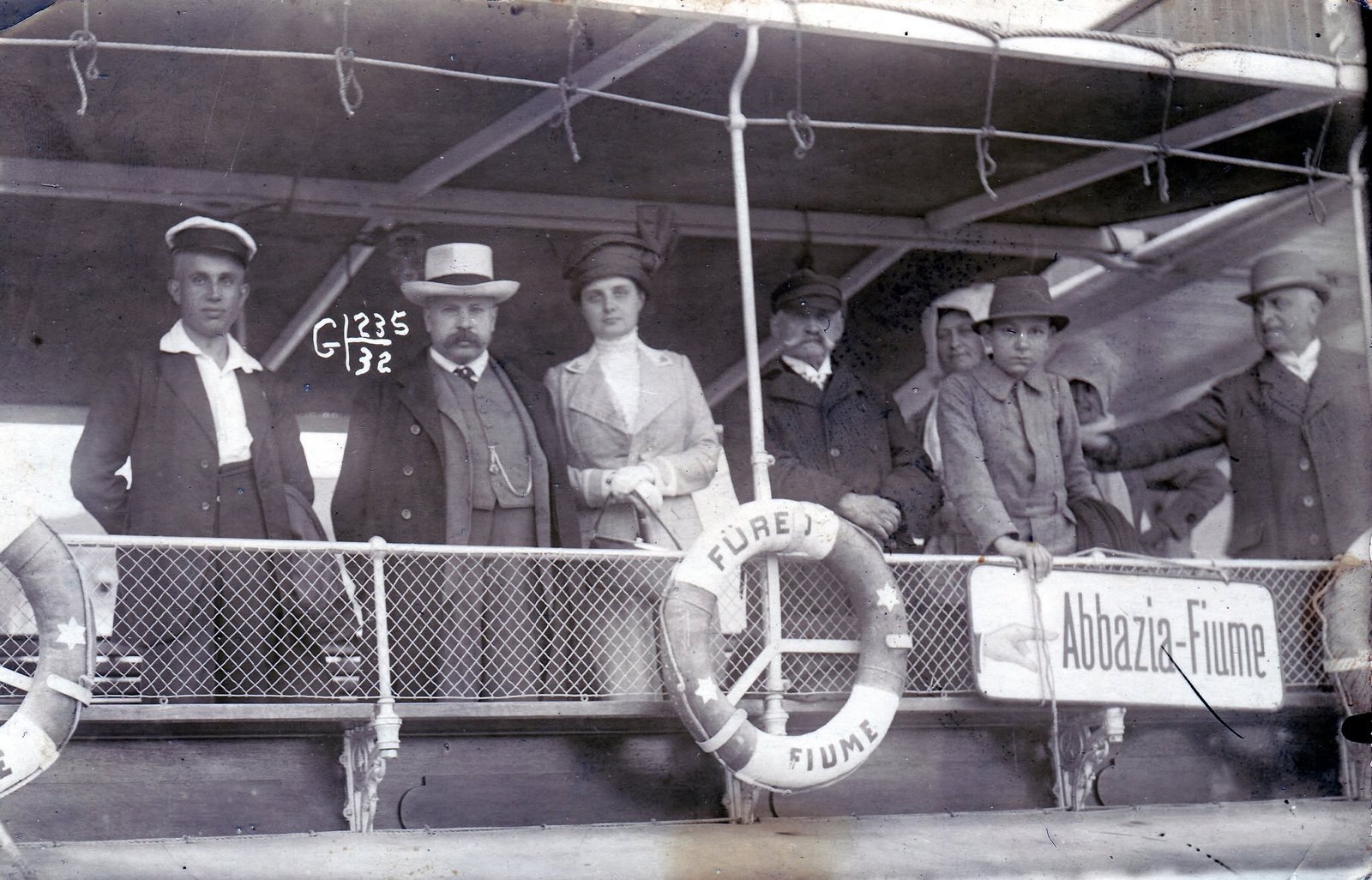
The photograph I am including was taken in 1913, during a holiday ferry trip from Abbazia /today’s Opatija in Croatia/ to Venice. My grandparents — Franciszek and Wanda Baraniecki. Grandpa is 39 and Grandma is 26. How differently today’s thirty-year-olds look! Not to mention us — the baby-boomers!
Above all the pleasures and delights of retirement age stood one most important one! More important even than the celebrated travelling, golf, catamarans and moose hunting!
It was grandchildren!
Little chubby ones, in whom we see the next prolongation of our own life. We look for resemblances, we exclaim that they are the very spitting image of our progeny — blood of our blood, bone of our bone, and sinew of our sinew!
When I was still working and whole days passed in the pursuit of money, and visits home were rare and short, all of that looked a little bit differently.
Already during my first pensioner meetings I realised what an enormous role grandchildren play at this stage of life. Of course I knew it before, but perhaps “not quite”…
In the last years of my work it happened more and more often that some trucker would take a telephone out of his pocket and say:
—Wait, let me show you my little grandson! Do you know how clever he is?!
And then would begin the showing of photographs of some chubby little thing, sometimes crying, sometimes laughing, and most often in the arms of an overjoyed grandpa.
With time, when a friend said he would show me something, I knew in advance that I would see photographs of his granddaughter or grandson! I also knew by then that a little bow on a bald head meant a girl, and a blue little jacket meant a boy, and that looking at the photographs would include stories about the little one’s virtues.
—He doesn’t cry at all! And he eats!!! If you only knew how he eats!!! You can’t tear him away from the breast! It must be after grandpa — he would add with a meaningful wink.
Photographs of grandchildren stood in places of honour in the trucks, sometimes even replacing photographs of wedding wives.
One of my friends explained it to me with rough tenderness:
—I’ve already looked my fill at my old woman, and I’ll look some more, but this Kevin of mine is so sweet!!! He rides with me! My helper!
It must also be said that not everyone was granted that, but that’s how it is, and every life is different… I’m not saying better or worse — just different.
So that was more or less the picture of the retirement years that my acquaintances, colleagues and friends presented to me. I was already one of them, because it was understood that I had stopped driving once and for all, and that there was no point in telling me that I “must” do this or that, because I would “die”!
Still in the first few weeks I had a few offers to go out on the road — mostly from colleagues who wanted to take a few days off but didn’t want to park the truck — but I refused.
After a short time things smoothed out and quieted down, and the memory of the working years slowly faded and paled. Of course, all through the first year — at the sight of a truck — my heart beat a little faster, but that was probably rather because it was filled with joy at the decision I had taken.
However, there appeared matters that, rather unexpectedly, filled the coming months to overflowing.
Before I tell about the matters that rather unexpectedly filled the first year of my retirement, I must mention two mini-problems that kept coming up among these — what can I say — ageing people.
—Your man has retired?! How will you stand him now???
—Now he’ll be pestering you twenty-four hours a day!!!
—He’s retired? He’ll be sticking his nose into everything, I suppose! And all the time just eating and sex! How will you stand it???
Questions and exclamations of this kind appeared here and there, in conversations, at meetings and on every possible occasion.
A man in the house! What will you do? Your whole life turned upside down!
And the “men” sat quietly, because what could they possibly say? It was women’s chatter, women’s questions, and the very essence of femininity, because, as everyone knows, “a woman understands a woman, darling!”
Aleksander Woysym-Antoniewicz, a fine writer of song lyrics, had a rather particular opinion about it. We drank vodka in the Wygodny bar on the corner of Hibner and Rutkowski streets. Aleksander, much older than me, had known vodka for years. In the end it got the better of him in the early seventies, but then — in 1969–1971 — we met fairly regularly.
He said:
—And do you know, sonny, what infuriates me most?
—Probably that they don’t serve pigs’ trotters in aspic today — I answered a little naively.
—Yeees, that too, but most of all what infuriates me is women’s solidarity! Damned women’s solidarity, which we men have never been, and are not, able to understand, let alone put into practice! And in the fight against this women’s solidarity we haven’t a chance!
So spoke Aleksander Antoniewicz — an artist, a connoisseur of life and people. I must admit I learned a great deal from him. He passed away many years ago and lies quietly in the Bródno cemetery, but I remember him sometimes, our drinking bouts together and our long talks into the small hours. And towards morning we would go to the Główny station, because in the buffet there you could get tomato soup with noodles and beer. Aleksander said it “puts you back on your feet”.
So together with these worries about how it would be with a man in the house, there appeared the subject of living space, or as they say here, “space”.
—Out of the question! He must give you “space”! And lots of it! Let him sit in the garage, or else he’ll be meddling with the cooking all the time!
I must emphasise that my Wife bore all this advice, these remarks and questions bravely.
—We have a basement… — she explained.
In fact it had never occurred to me before that I could be a burden to my wedded Wife, but everything I heard at various meetings gave me something to think about, and in the first days of my retirement I crept quietly along the walls… None of the fears and warnings came true for us, and to this day I absolutely never meddle “with the cooking”.
Truckers are terribly talkative. More than once or twice I saw chance meetings of two drivers and couldn’t wonder enough at how much they had to say to each other. Another thing is that to a large extent I was like that myself, and probably still am.
Two truckers pass each other in a truck stop car park. They say “hi”, “how ye doin’?” or something of the sort, and that innocent contact almost always turns into a little chat, and that in turn into a longer conversation, which sometimes lasts a good hour! Or longer!
Conversations by the trucks, while putting on tarpaulins, while waiting to be loaded, and above all the “over coffee” conversations are an inseparable attribute of the profession. It is about them that the well-known “trucking” bard Dave Dudley sings, that they talk about loads, women, and how fast their trucks can go.
Well, at some point in my more attentive looking around the pensioner world, it struck me that older people are also incredibly talkative. Just like truckers, or maybe even more so.
With truckers you can explain it by the fact that for long hours they are alone with themselves, and that when at last they meet a kindred soul they cannot tear themselves away from it and must talk it all out.
With pensioners, or older people in general, their talkativeness may come, just as with truckers, from a calm desire to talk things out with someone who is “from the same shelf”. Perhaps it also comes from the calm and relaxation finally achieved! We have time, we can talk! We have lots of time!
This talk is mostly about the past. How could it be otherwise? It’s nice to reminisce, to talk about what one has lived through, what one has done, and where one has been. That is the essence of meetings in the park, over tea, or at a barbecue. Another thing is that sometimes this talkativeness can wear you out completely.
On my walks I meet all sorts of people more or less my own age. Almost all of them make contact incredibly easily and start a conversation. They rarely ask about anything. They like to talk!
And I noticed how much they need someone to listen to them. And God forbid you interrupt, because they are afraid they will forget what they wanted to say. And one more thing — they almost always want to say everything. About work, family, politics, and the years they have lived through.
Seeing this, during such meetings I try to listen, which, to be honest, doesn’t come easily to me, but thanks to it I learn a great deal. Among them there are pearls worth writing about. A countless number of worlds, memories, experiences and impressions.
During these conversations I learn about the Vietnam War, the hippie madness of the sixties, Canadian working conditions in the early seventies, and so many other things. All of it seen from a Canadian-American perspective, and therefore so different from ours — the Polish one — in those years.
It’s worth talking to a pensioner!
The first weeks of my retirement passed as smooth as butter. Naturally we went on holiday, which in reality was a holiday from permanent holidays, we met friends for various lunches and non-lunches at the craziest times, like on a Monday at 11 in the morning, ha, ha, ha, to savour the possibility of meeting at such hours, and slowly, very slowly, I got round to various outstanding matters.
All of this lasted until suddenly — as they say, “Deus ex Machina” — news of the serious illness of my Wife’s mother struck us.
Such news, in the case of a person approaching ninety, should not be a surprise, but in reality it always is, and everything that follows it touches the whole family. Mama had had a stroke, she was alone, and the fact that she was found and taken to hospital was a hundred-per-cent miracle, because if it hadn’t been for the neighbour who, quite unexpectedly, was knocking at the gate and called for help, Mama would have died there on the kitchen floor, unconscious and unaided.
It was already the end of March. I happened to be settling down to a delicious browsing of old documents, I had made myself comfortable in the armchair and was reaching for a little glass of Bénédictine, when a telephone call from Poland knocked me not only off balance but out of my whole year’s plan.
That’s how it is.
Many of us still had living mothers — mostly mothers — because the fathers had already departed for their “eternal rest” — and these ladies were reaching such venerable ages that one kept hearing about hospitals, serious complications and deaths.
Among us there were lucky ones whom Providence allowed to go and be together with the dying person, but there were also cases when everything happened at lightning speed and there was no dreaming of getting there in time. Naturally, many then went to the funerals, but let’s be honest, that was no longer it! Far from it!
Of course, that was an opportunity to meet the family, sometimes even an unknown one, some cousins or would-be nephews, but on the whole it didn’t make much sense. At least, that’s what I was told, and that’s probably how it was in many cases.
The wake, perhaps a drop of vodka, some conversations, veiled little reproaches, old grievances, some reminders of this or that, that after all you left and you weren’t here while we were “fighting” here, and so on and so forth.
With us it was different, because Mama was alive. She was seriously ill, but she was alive.
Dramatic news of the illness or agony of a mother or father electrified the whole baby-boomer community. Seemingly the normal course of things, but in many cases these sudden, alarming tidings were for us a collision with truly ultimate matters. They were a genuinely unavoidable, yet how painful, reminder of our own fragility and temporariness.
A telephone call, the trembling voice of a sister, a brother, or someone else, and a short message:
—Your mother is in hospital. It’s probably the end, because she no longer speaks or eats. If you can come, come as soon as possible!
And then a nervous conversation with one’s spouse, looking for a plane ticket — for the earliest possible date — and packing black clothes as well — just “in case!” — and the journey.
And then the return home, tear-interrupted accounts of the last moments, looking through some small keepsakes left by the deceased, and the report of the funeral.
Sometimes it was different, because after the initial alarm came a long illness, uncertainty, nappies, sleepless nights, no contact with the sick woman, who was slowly fading away, lying in a bed set up wide in the dining room.
Then, for the ageing — say seventy-year-old — daughter, a real test of endurance began, during which emotions and feelings balanced on a sharp edge and left their mark on the relations between the departing one and the exhausted carer. Or carer.
And these realities touched the circle of our friends more and more often, the vast majority of them already pensioners. They shook us and showed us that all our travels, catamarans, sports cars and delightful meetings are worth little in the end, and that perhaps it is worth thinking about what our end will look like.
Nevertheless, many defended themselves against such thoughts and threw themselves all the more into the whirl of pleasures, because “why should we deny ourselves anything!” and in general… Let’s drink and dance while we still can and don’t have to wear nappies!
Although such a saying may shock and outrage, it must be said that there was something even more tragic than the death of an old mother or father. It was the death of a spouse. And that too struck our community like a cruel bolt from the blue.
The death of parents was, as it were, expected. Old age, sometimes heavy with suffering, found its natural and expected end in departure. It was the ordinary course of things, which, although painful and wounding to the heart, nevertheless brought a certain relief, because there is nothing worse than the sight of a beloved Person who is suffering.
The loss of a spouse, on the other hand, was a knock-out from which some were never to recover.
Forty-odd years together, a shared emigration, children, grandchildren, sometimes even great-grandchildren, and an unimaginable load of emotion cemented them so strongly that tearing one from the other crippled for ever. And yet that happened, because the approaching old age was slowly beginning its mowing and was already touching our group with the very tip of its scythe. For now very gently, only now and then, but always painfully!
Such tragedies were also a cause for reflection. For everyone.
Whatever one may say, people grow gentler in old age. Exceptions include the “grumpy, old man” invented by the media, who sits in a rocking chair on the porch, waves his stick and yells at everyone in sight. Although it must be admitted that sometimes there was one like that too. Exceptions, but confirming the rule.
Old age smoothed out characters. Of course, there were little topics that inflamed people to white heat, especially among Polish friends, but my Canadian colleagues almost never talked about so-called politics. They talked about grandchildren, about hockey, about some adventures from their days on the highway, but about politics and religion rather not.
The Poles, on the other hand, loved those subjects. Politics was and is a problem, but most decided that conversations of this kind were too dangerous and stressful, so they began to avoid them.
—I’ve already had one heart attack. What the hell do I need a second one for? — said my friend.
So people went back to travel, to golf, and to plans for the next ten years.
For ten, because no one made them for longer.
Such were my observations and musings during the first months of my sweet little retirement. I enjoyed it, and I still enjoy it, like a little boy who has learned that the test has been cancelled.
When I look back, I see the time of my work so clearly and distinctly, as if those 45 years were a single week that has only just passed. I see my first and last day of work, the various turns of fate, the various jobs, changes, expectations, successes and failures, and — I must say this with a clear heart — I have a sense of duty fulfilled.
And so, to my friend’s question whether I now feel pangs of conscience when I watch television before noon, I answer loudly and clearly NO!
With delight I sink into my reclining armchair, and with even greater delight I watch the Patterson–Johansson fight of 1959. My Wife is preparing a tasty lunch in the kitchen, and I am getting excited over the dramatic third round of the fight, in which the huge Swede knocked the champion down seven times. I shout out some comments, and my wife looks in and calls:
—Marcin, do you have to watch those old things of yours so loudly?
And I, although I hear Her perfectly well, smile and answer perversely in the words of Sienkiewicz’s Putrament:
—Raise thy voice a little, for time has spoiled my ears, and deaf is my old age!