
Marcin Baraniecki
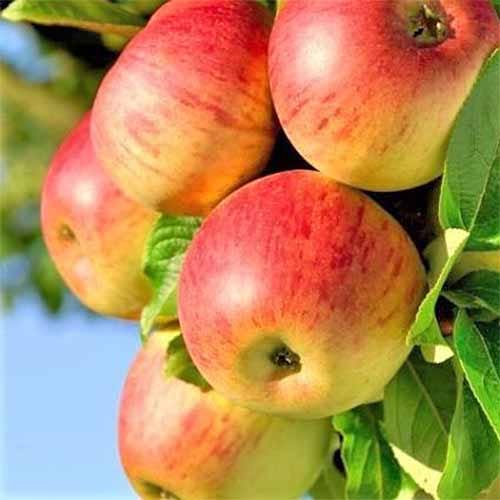
Filip Konecki was convinced that the Cox’s Orange Pippin was the best fruit in the world. Especially the “orange” one.
In the orchard of his family home grew two old trees of this exceptionally tasty variety. They were a hundred years old, or perhaps more, but it looked as though age not only did not limit the number of fruit they bore, but that each year there seemed to be even more of them.
Towards the end of September, when the time for the harvest came, ladders were set up, and the yellow-red apples, pleasant to the touch, with their slightly rough skin, were gently picked and laid in wicker baskets. From there they went down to the cellar, where, on wide shelves covered with straw mats, they were laid out stalk upwards and so that they did not touch one another.
The trees were called “Karzełek” and “Starowinka”. Nobody in the family knew where those names had come from. Even grandad always used to repeat that in his childhood, that is, eighty years before, those names had already been in use.
Every year, too, once the apples had been laid out in the cellar, similar conversations took place among the people of the house.
It went like this:
— Just look at that! This year “Starowinka” gave more than two hundred apples, and last year only about a hundred and twenty!
— What are you talking about? Why, we gathered that many from “Karzełek”!
— Nothing of the sort! Not from “Karzełek”, but precisely from “Starowinka”! I know for certain!
Conversations like these, and similar ones, took place every year. It never occurred to anyone to count the apples while they were being picked and, to check the truth of these estimates, to keep the harvests from “Karzełek” and “Starowinka” separate. Besides, it may well have occurred to someone, but nobody ever intended to put such checks into practice, because in that way the tradition of the conversations, and of persuading one another of the abundance of the harvest, would have fallen away.
And tradition in the Konecki house occupied a very special place. As if nobody spoke about it, but any change in the prevailing customs was unthinkable. Besides, it was not only customs that were at stake here.
It was a place where everything breathed age and permanence.
The preparation of food, the laying in of stores for the winter, the yearly slaughtering of the pig, the shredding of the cabbage, the pickling of the cucumbers, and all the other household rituals were unchanging, old, and covered with the patina of time.
The cabbage was shredded on the age-old shredding bench, on which one sat astride and, with great effort, shredded head after head. That shredding bench remembered, if not Napoleonic times, then certainly the years of the Spring of Nations! The huge barrel, in which the shredded cabbage, under the weight of a great stone, pickled together with carrot and salt, was likewise archaic, blackened, and as if fastened to the spot where it stood. Nobody ever moved it from there, to anywhere at all. Besides, it was hard even to imagine, because the gigantic barrel was much wider than the door to the pantry. It seemed that it had stood there even before the walls were built or the door made!
It was the same with everything. With the making of sausages, the preserves for the winter, the baking of bread, or the washing and mangling, and even the ironing, because the iron, too, was antediluvian. Heaven forbid an electric one! It was a shapeless lump of an iron “with a slug”, which was heated on the stove and slipped into the “belly” of the iron antique.
It was primitiveness beyond description, and perhaps even “sinful”, but probably not, because “holy” pictures hung on the walls, and behind them were tucked dried Easter palms.
Both apple trees were therefore an inseparable part of that reality. So too was the yearly celebration of the harvest, and the conversations about its size.
All of that was part of the house and of its tradition.
So Filip Konecki was convinced that in all God’s world there was no better fruit than the orange Cox’s from the family orchard. In the course of his life he had eaten many different fruits. He had even tried some exotic ones, unknown and strange in taste, but none of them could stand comparison with the Cox’s! Especially the ones from “Karzełek”!
And that, too, was yet another oddity of the house. For it had become accepted that the apples from “Karzełek” were better than those from “Starowinka”! Grandma bristled at this distinction and scolded those who told “such impossible things”, because “Starowinka” was her beloved.
When it happened that someone dared to put the fruit of “Karzełek” above those from “Starowinka”, grandma waved her hand and said:
— Oh, leave me in peace with your “Karzełek”! “Starowinka” — that is the dear apple tree! The best!
The female part of the household stood, in accordance with feminine solidarity, on grandma’s side, and the male part praised “Karzełek”.
And so it always was. Generations passed, and the division into the “Karzełek people” and the “Starowinka people” endured.
He remembered all of it so well that even after fifty years he heard the words of those conversations, saw the old implements, the rooms, remembered the mood and the emotions, and above all felt the taste of his beloved apples. And then he always said to himself in his thoughts:
— And yet, there is nothing like the ones from “Karzełek”!
Filip left that house just outside Warsaw with his mother and his two younger brothers just after the war.
The house itself had survived the wartime cataclysm, but it was badly damaged. The first German bombs, which in September 1939 fell on the grounds of the house, broke the roof timbers, so that the building looked like a man with a broken spine. Besides, that was not all, because all the windows had been torn out of their frames, the walls were cracked, and the garden was pitted with craters from the explosions. Then, in 1944, during the Uprising, new damage was added, so that the survivors of the wartime conflagration really did not know what to tackle first. And the house was full of people.
Filip’s grandparents were still alive, and there were also two uncles who, in the summer of 1945, had miraculously returned from German captivity, as well as two families of relatives who during the Uprising had lost their flats in the city centre, and also complete strangers, poor wretches who had fled from burning Warsaw just as they stood. Altogether, every pair of hands was needed for the work.
In this state of affairs, the departure of Mrs Magda Konecka with her three underage sons was lamented by everyone, but there was no help for it, because quite unexpectedly news had come from her husband and father, who urgently begged the family to come to him, to Germany.
The husband of Mrs Magda Konecka — the mother of Filip and his two younger brothers — Captain Jan Konecki — had followed the whole wartime trail with General Anders’s army, but towards the end of the war he was taken prisoner and ended up in the prisoner-of-war camp for Polish officers at Murnau in Bavaria, from where American soldiers from General Allen’s 12th Armored Division liberated him in April 1945.
After his liberation he remained in the West, and from there he sent that desperate plea for the family to come.
For his part, he did not want to return to Poland. He could not stand the Communists, he had already been through his share of things in Siberia, and he did not want to risk bringing up three boys in the Soviet system.
The departure was kept secret. At the beginning of 1946, the free crossing of the border was already greatly restricted, but Mr Konecki had sent instructions on how and by which route to travel, and had additionally assured them that a guide he had arranged would help them cross the “green border”.
While the farewell of Mrs Magda and her three boys was tearfully lamented by all the people of the house, it was understood that there was no other way, because a wife and children must be with their father, and there was no sense in tearing one’s clothes in grief.
The patriarch of the family, old Mr Szczęsny Konecki, blessed them with a scapular, grandma thrust a basket of bread and hard-boiled eggs into their hands as well, and off they went.
At the last moment, twelve-year-old Filip slipped a few apples into his pocket — the ones from “Karzełek”, because by a miraculous dispensation of fate that very apple tree had survived! “Starowinka” had been felled for fuel during the war by some sacrilegious hand.
From that time, that is, from 1946, he had not been back in Poland.
Not because he did not want to, but simply because he had been terribly busy all the time. First with school, then with work, with the business, with unceasing business trips, and then with his family, his children, and their start in life. And somehow there was never any time.
Besides, he felt no such need. The news from there concerned mainly family events. First the death of grandad, then of grandma, the weddings of cousins, and the births of various nephews, whom he neither knew nor could even connect with one another.
Letters brought information that the old family house was in a deplorable state. One of the cousins living there wrote about it, rather timidly, but clearly asking for help with the repairs. He did not ask for details, he simply sent her money then. His William even opened a special account for the cousin at the PeKaO bank, into which he put some sums, but in the end that was all, because the cousin did not write about how the money had been spent.
He hoped that the repairs had been finished, and that the house still served the family. He was tempted to ask in a letter about “Karzełek”, but he quickly talked himself out of it, because in the end what did an old apple tree mean beside the conditions of life there! He read about them in the newspapers and listened on the radio, and although he did not understand everything, it was clear anyway that in Poland things were hard beyond measure.
So he was in no hurry to visit this new Poland.
On top of everything else, his ageing father — an officer and a war veteran — tirelessly repeated that the Communists were unpredictable and incalculable.
— Do not forget, Filip — he said in a trembling voice — that for them you are a fugitive. You, as well as your brothers! Thank God you escaped from that paradise, but remember that the Bolsheviks do not let such things go unpunished. I know them only too well!
How much truth there was in that he did not know, but to be safe he did not go. Besides, the character of his firm’s work, the pace, the need to meet current deadlines, and everything connected with the running of a sizeable transport company meant that any departure, whether for remembrance or for pleasure, was unthinkable.
What is there to say about a trip to Europe! Taking two days off seemed harder than a flight to the Moon. For as the years went by, the business grew, people and equipment increased, some customers left, others came, and the work went on without a break, flowing like a river, like Niagara Falls, which never stops.
After some time, thoughts of a holiday, of some trip, or even of a few days off faded, lost their sharpness and their charm. Somehow he could not see himself without work. And however much, as the years went by, he no longer had to work so hard, he still came to the office, checked the correspondence, received callers, and dealt with telephone calls.
Besides, he felt good at work. It had become his second home. Especially after the death of his wife, who had left him after only eight years of marriage.
And yet, although more than fifty years had passed since those distant, Polish times, he still remembered the taste of his beloved apples all the time! Especially those from “Karzełek”! That memory tickled him and drew him like a magnet.
And at last the moment came when he began to think a little more seriously about this journey “into the past”.
It did not come at once. He hesitated, pondered, weighed it up. He was not old. He was only sixty-six, but he felt that his mind, his way of seeing the world, of understanding people, especially young people, was different from what it had been. He felt old. Perhaps not so much in body as in spirit. He was tired, and it happened more and more often that he forgot. He caught himself losing not only names, surnames, or dates, but whole periods of his life.
His eldest son William had taken over the business, was managing splendidly, and Filip had to admit that the firm functioned even better than under his rule.
Such an admission did not come easily to him, because all the time he thought that he had to be in the firm, that “the master’s eye fattens the horse”, and similar nonsense, but he also saw that this new, computer world was no longer for him, that it was beyond him and was positively pushing him into retirement.
And although work had been his second home all the time, he felt that he must, and that he ought to, step aside. He knew that William would not tell him so openly, but he realised that he was in the way, that with his remarks and advice he wearied, and even irritated, his son, and that, all in all, it was no longer his firm.
More and more often he caught himself returning in his thoughts to the past — to the very earliest times, from childhood. Again he smelled the scent of freshly baked bread and heard the scraping of the long wooden peel being slid into the great oven, from which baked loaves were drawn out. The delicious sounds of butter being churned in the churn rang in his head so clearly that sometimes he even rose from his armchair to check whether someone in his kitchen really was baking bread.
But the kitchen in his house was cold and empty. It gleamed with steel, tiles, marble, and splendid brass pans, which hung new, unused, and shining, exactly as they had been brought from the shop. They were ornaments, not living vessels that are part of a kitchen and of kitchen work. Nobody fried anything on them, stewed nothing, or heated anything up, because, first, there was nobody to do it, and second, nobody even thought of it.
They say that a house without a woman falls into decay, but in Filip’s case his house did not so much fall into decay as grow cold.
From the moment of his wife’s death, everything changed, and what had once been pleasant, warm, and tasty — like the orange Cox’s — now became cold and pale like a shoot that had grown without sun. Just like the one that had been pulled out from under the roof when the gutters at his house were being replaced.
The wild vine twining around the house had somehow pushed its way under the eaves and, without sun, had run riot in the nooks of the wall and the roof covering. The uncannily pale shoots resembled a long tapeworm, vegetating without light somewhere in the damp darkness.
The sight of that plant, deprived of any colour at all, then suggested to him an association with his own widowed existence. For that was how it was. While he still went to work, he had the impression that things were not so bad, but the moment he decided on retirement, everything wavered.
Perhaps it would have been different if he had had a woman beside him, but he did not even allow such a thought to come to him. He could not imagine living with some other woman, sleeping with her in one bed, kissing her when leaving the house, and eating, for example, breakfast with her. He could not imagine that, because the very thought of it seemed to him a betrayal of his late wife.
Certainly, such a way of thinking was nonsensical, and many of his nearest and dearest advised him to marry again, but he would not hear of it.
And not that there were no willing candidates. Straight after Emmy’s death, a few women circled around him, making no secret of their interest in him, but as time went by, faced with his ostentatious coldness, they left.
There was, admittedly, one who for a long time would not give up, but after a few months she, too, left. That was a Polish woman — Jadzia. She brought carefully packed good food, offered to cook at his house, invited him on trips to the lake, but he almost always refused, so after a while the matter fell through.
And it must be said that, apart from him, everyone else was sorry, because Jadzia was a woman like a doe, and besides a splendid cook, and she could have been a pleasant friend. She was “in the early afternoon of her days”, that is, about sixty, and a few years earlier she had buried her husband.
But Filip did not let himself be tempted.
So he sat alone. The worst of it was that faltering memory, but in the end what did it matter? There were moments in his life that he himself wanted to forget.
He certainly would not have made any fuss about it, but unfortunately one day an unpleasant incident occurred. You see, during a telephone conversation with his son he forgot his name. Without thinking about the consequences of what he was doing, he asked him:
— Forgive me, son, but could you remind me what your name is?
That question had stormy consequences, because that very same day the whole family turned up, and even his daughter Aga, who lived in Vancouver, telephoned with the nervous question whether she ought to come.
At first, the family descent delighted Filip, but immediately afterwards he realised what it was about. Questions such as how he was feeling, whether he ought to have himself examined, to live with someone, perhaps at William’s house, were a clear signal that the family was worried, was beginning to decide for him, and was trying to help. And to help according to a scenario laid down in advance.
And he needed no help at all! He saw that clearly, lucidly, and soberly.
And so what if he had forgotten his son’s name?! So what?! It happens! He is getting on in years! He forgot, and that is that!
For the time being he sat quietly and listened to various voices, advice, solicitous questions, and remarks uttered “in passing”, but slowly anger began to grow in him.
Luckily, he controlled himself, forced himself to smile and nod, but when at last they had all gone — he breathed again!
At last it became quiet and peaceful. He did not have to listen to all of that, to feel the solicitous care surrounding him and the gentle weaving around him of a net of orders, instructions, and all kinds of “good advice”.
Luckily, he managed to convince them that they could leave him alone without any pangs of conscience, and that nobody had to live with him!
— I have a telephone, I can manage — he assured them, still on the threshold. — I am fit as a fiddle, and you really need not worry about me!
He sat through all the “Daddy, we are with you, you can count on us, you are always welcome with us, and so on, and so forth”, but truly he had had enough of it. As soon as they had gone, he poured himself a double, or perhaps even a triple, whisky and sat down in his armchair.
It was just then that the thought of the journey to Poland returned.
He knew that sitting at home any longer boded no good. The caring telephone calls from the children, the seemingly chance visits, the constant questions about how he was feeling, the timid urgings to move in with them, and the like, annoyed him and disturbed his peace. He did not want all of that.
— What are they after — he thought, chewing over his irritation — is this how a child’s love is supposed to show itself? And if so, then he does not want such solicitude!
Out of the blue he remembered how, after Emmy’s death, their middle daughter Sonia had begun to shower him with ultra-radical advice on how he ought to eat, what to do, what not to eat, not to drink, and how to exercise, so that his belly would go down, because “just look at you”, and so on, and so forth.
It even went so far that she began to check the contents of his fridge and throw out whatever, in her opinion, was “unhealthy”!
— Now that Mum is gone — she exclaimed energetically, and even a little rudely — I have to look after you, and you will see how I shall keep an eye on you!
In such a state of affairs, the journey to Poland seemed to him a splendid solution. It could be not only an escape from the advice and solicitude of his children, but also a return to that old world which made his heart tremble and reminded him of his childhood days.
Deep in his soul he was a little afraid that this forgetfulness of his, which caused such worry, would one day engulf that dear world of memories too, but for the time being he pushed such fears away from himself. He was aware that most probably things would not get better, but he did not want to think about it.
A few days after the family gathering, he confided to William his plan to visit Poland. Naturally, a “volcanic eruption” followed at once. This time it was even sharper. It began with heated attempts to talk him out of the journey, then urging that, if he absolutely insisted on going, then he must go with someone, then again a whole avalanche of advice and warnings came down, until at last everyone grew tired, someone began to make supper, the granddaughters ran about, splashing one another with water from the hose, and something like peace came. The evening was brought to a close by William, who said:
— Dad, you decide for yourself, and we hope you know what you are doing. You are not ill, but you know yourself that on such a journey it is pleasanter and safer to be with someone. Think about it. Perhaps someone could be a good companion for you.
Filip admitted to himself that this was not foolish advice, and that it was worth thinking over, but after a whole sleepless night of tossing and turning in bed, he decided after all that he would go alone. True, the familiar Mrs Jadzia kept recurring in those thoughts, encouragingly, and once even very temptingly, but in spite of everything he held to it that he would go alone. This journey was to be his, and his alone!
It was July 1997. Exactly fifty-one years had passed since he, together with his mother and his two younger brothers, had crossed the German border. Their father, who was waiting for them, had paid a guide then, who, walking along the southern border of the Soviet occupation zone, had led them through to Bavaria, where the Americans were in charge.
It was a risky road, but the post-war confusion, the crowds on the roads, and the unclearly marked areas of control meant that in many regions nobody knew who was actually in authority. In that sea of people and of troops on the move, they finally managed to reach Munich, where their father was waiting.
That he remembered perfectly. Almost every hour. His weeping mother, his younger brothers constantly asking about everything, the omnipresent ruins and the wrecks of all kinds of equipment cluttering the sides of the bombed roads.
When they left — or rather fled — the family home, it was a clear July night. First, in indescribable crush, they travelled all night by train to ruined Wrocław, then in a hired lorry almost to the border itself, and further still in some battered old car, which, after two days of torment, finally brought them to their destination.
He remembered that journey as if through a fog. The discomfort, the hard benches, the poorly dressed people, and the omnipresent traces of the war that had only just ended were a distant memory, as if from another world and another reality.
He also remembered how, just before leaving the house, in spite of express orders not to take large luggage, his mother had loaded a great trunk, which could not even be moved and which — to her great lamentations — had to be left behind after all.
His present preparations for the journey reminded him of those last moments in the family home, and of the unfortunate trunk into which his mother had packed some clothes and even pots — all with the thought that on the journey they “might come in useful”.
That trivial, insignificant memory of the trunk again brought back the image of the old house, in which — as he remembered — all the travelling things cluttered up the so-called “little attic”, leading to the main attic.
Great trunks, suitcases, travelling bags, antediluvian hat boxes, assorted cases, vanity cases, and all the travelling “equipment” lay there, dusty and musty. In the trunks were kept old quilts, bedspreads, moth-eaten kilims, plaids, sleigh coats, furs, skins, and a whole mass of things of unknown purpose, which were neither used nor needed. In spite of that, nothing was thrown away, because that, too, was a tradition that had been kept for years.
The insides of those trunks were lined with old newspapers. Supposedly to protect them from the moths, of which there were, in any case, a great plenty.
As a ten-year-old boy, he used to steal in there with his younger brothers.
Looking at those old newspapers stuck to the inside walls of the trunks was immensely interesting to them. They showed people in clothes no longer seen. Gentlemen in top hats, ladies with tournures and splendid hats with ostrich feathers, small children dressed in strange little jackets, and a whole world, long past, which, from the perspective of years, seemed almost comical.
In days long past, when various Koneckis, in various years, still went away on some holiday, those old-fashioned contraptions were used, but in later years, when there were no longer any servants or porters, nobody had either the strength or the need to fetch them down, dust them off, and lug them to the carriage or the train. Besides, people travelled less and less, until at last, with the outbreak of war, everything came to a stop.
Now, as he packed his suitcase, Filip remembered that departure of theirs, the trunk left behind, and the journey to the border.
It seemed to him that fifty years had passed like the blink of an eye. Germany, England, Canada, school, work, the business, the wedding, the children, their weddings, the grandchildren, and everything between those milestones was already history, blurring and sometimes breaking off altogether, as happens with an old fabric whose fibres part at a touch and leave a hole.
Distant events he remembered in detail, but the last ten or fifteen years were full of blank spots. He could not recall the most obvious things. For example, how many grandchildren he had, when they were born, and of what sex they were.
He remembered the name of the dog that had been his companion sixty years before, but he did not remember his granddaughter’s name.
He tried not to think about it. He told himself that this is how it sometimes is, that there is no point in straining and tormenting oneself. Besides, that was not important, because for the time being he kept in his memory all the time what he really did not want to lose — the memories of his earliest years.
So in the summer of 1997, seen off by his children and grandchildren, furnished with a million pieces of advice and warnings, hugged and kissed, he boarded the train to New York, where after a few days he went aboard the liner Queen Elizabeth and sailed for Europe.
That was exactly what he wanted. Not that he was afraid of aeroplanes, but he had never flown before, and he did not want to try now.
The moment he stepped aboard the ship, a strange thought suddenly seized him.
For no reason at all, and quite unexpectedly, there rose before his eyes that distant moment when, just before leaving the family home, he had grabbed a few apples in the kitchen and hidden them in his pocket. For some reason he could not fathom, that distant, exceedingly trivial moment suddenly seemed to him enormously important! He stood rooted to the spot.
What?! How?! Why now?!? — it churned in his head — where did that come from?!? After all, it was an utterly insignificant event from half a century ago! Not even an event! Simply a trifle, an unimportant crumb of the past!!!
But that unimportant crumb grew in his head in a strange way, and suddenly he was seized by an extraordinarily clear conviction that precisely this scrap of memory was immensely precious, and was the beginning of something new!
He stood motionless, wanting to shake off that bizarre thought, but it evidently lasted a little too long, because the officer receiving the passengers came up to him with the polite question whether he could help him with anything.
A little later, once he had settled into his cabin and freshened up as best he could, he went out on deck. The bizarre thought had vanished as suddenly as it had appeared, and Filip was not sure what had really happened, and why for a few minutes he had been so absorbed by it.
They were just casting off. The sight of the receding Statue of Liberty involuntarily stirred a strange feeling of melancholy in him. He had never sailed in here, had never lived through that first sight of the longed-for “promised land”, but he imagined what the crowds of immigrants felt, who, after a long ocean voyage, saw for the first time that splendid Monument of the Free World.
Looking at the distant shore, the city, and the slender Statue, he fell into thought. And again, for some reason he could not fathom, he saw in his mind’s eye those few apples which, more than half a century before, in the last moment before departure, he had snatched from the kitchen of the family home.
He remembered that he had taken them from the large basket in which apples were kept for what were called dried apples. For there was a custom that in late autumn sliced apples were laid on the stove, where they dried out, and in wintertime they were a sweet treat for the children.
He and his brothers kept helping themselves to those drying titbits. Grandma would then slice fresh apples and lay them on the stove again, invariably telling them not to take any for the time being and to wait until the apples had dried. Naturally they never obeyed, and after just two days they were stealing them piece by piece.
Afterwards they had pangs of conscience, but not very great ones, because they told themselves that sooner or later all the apples would be eaten anyway. Whether they were more or less dried made no great difference, after all.
Looking at New York receding into the distance, he again had the feeling that this old memory was, for some reason he could not fathom, enormously important to him.
To calm himself down a little and grow quiet, he went for a walk through the beautiful interiors of the ship.
He stopped in the Golden Lion Bar. It was almost empty. At one of the tables sat a solitary woman, and at the bar two older men were chatting cheerfully about something. He ordered a scotch, and just as he was raising the little glass to his lips, it seemed to him that he was falling prey to an illusion.
He could not believe his eyes. At first he thought it was some vision connected with his earlier thoughts, but after a short time he realised that it was no apparition at all, only that at the table sat Mrs Jadzia, whom he knew — the very same woman who, after the death of his Emmy, had come to him with good baking and invitations for outings together.
She sat, looked out at the sea, and sipped something from a tall glass!
— No, no, no! — he thought, agitated and almost furious — there is no such coincidence! It cannot be! Here, on a liner sailing to Europe, in the same bar and at the same time?!?
He was absolutely convinced that it was his family’s doing, and most likely William’s, who had organised such “care” for him! He was sure it was him! Probably talked into it by his sisters! A conspiracy behind his back! What an idea!
He flew into a rage. He could have left, but he decided to stay and settle the matter at one stroke.
He went up to the seated Jadzia, and was just, just about to say something unpleasant, that “he did not wish it, that he would not allow it, and that he did not agree to any interference in his affairs”, when suddenly he noticed that Jadzia was no less surprised, and truly, sincerely astonished. The expression on her face left no shadow of a doubt that this unexpected meeting was a complete surprise to her.
He cooled down a little, but anger was still shaking him, and he even began to say something, when Jadzia smiled so sweetly and joyfully that in a single moment the unfortunate words stuck in his throat and he felt ashamed and embarrassed. And Jadzia rose from the table, held out her hand, and exclaimed:
— Filip??? Filip Konecki?!? What a meeting! Can it be possible? And where are you sailing to? Oh, oh, what am I asking?! After all, we are all sailing in the same direction, ha, ha, ha! Please, please! And who are you travelling with, if I may ask?
And so it began. Then they went to the restaurant for dinner, and after that there was a long walk at sunset and a calm, uncommitted conversation.
Jadzia was sailing to her daughter, in London, with whom she intended to spend the holidays. Her daughter was freshly divorced; there had been troubles, a lot of stress, and a fear of depression, because her husband had left her literally a few months after the wedding. “He ran off and covered his tracks.” So she was travelling to the despairing girl, to comfort her a little and simply to be with her.
Filip, for his part, told in a few words about his retirement, which had begun, and about his decision to visit his Polish family haunts.
About his stormy talks with his family, and still more about his “minor” troubles with his memory, he did not say a single word.
As the conversation went on, it turned out that they had much in common. When, some time before, she had tried to make friends with him, there had been no mood for such conversations. Filip had treated her then almost icily. Now, as they walked along the deck, heard the sound of the waves, and smelled the ocean, they felt that it was different, and that the old coldness had given way to polite warmth and understanding.
As he learned, Jadzia came from near Warsaw. Her parents had a sizeable fruit farm there, near Zaborów. She had left Poland back in 1956, on the wave of the October thaw. She was twenty then. In Canada she first lived with an aunt in Montreal, and then, after her marriage, in southern Ontario, in Kitchener. Her husband had died a few years before.
It was already well past midnight when they went to their cabins.
The next day they met at breakfast.
Jadzia ate little. Besides coffee, she took an apple for herself and slowly cut it up on her plate. And it was just then that something unexpected happened, because at that sight Filip froze. With wide-open eyes he looked at the fruit being cut.
Suddenly, in the space of a fraction of a second, he felt a terrifying clarity of thought. It seemed to him that in a single instant, in the course of a brief flash, he had seen the whole life of the woman sitting beside him! He had the impression that he saw her thoughts, all her troubles, cares, and joys. Immediately afterwards, everything vanished.
When he opened his eyes, he saw Jadzia’s frightened face. She was holding him by the hand. People began to gather around them; someone was asking about something, someone was calling out, and a moment later the doctor who had arrived was taking his blood pressure, listening to his heart, and shining a tiny torch into his eyes, checking the reaction of his pupils.
Everything passed, but the incident gave them much to think about, above all Filip, to whom it at last came home, what the children had said, that travelling alone could really be risky.
About the strange vision or delirium, he did not mention a single word to Jadzia, but when the next day they went out on deck together, he looked at her differently.
And that did not pass unnoticed.
— You mentioned that before the war your family lived in Warsaw… — Jadzia began.
It might have seemed that this question was meant to steer clear of any talk about the previous day’s breakfast incident.
And he liked that. He liked that very much! No “how are you feeling”, or “what could it have been”, or that “he ought to get himself examined”, and so on, and so forth. What she was asking about was simply a return to the interrupted conversation. He looked at her gratefully.
— Yes, my parents and grandparents lived in Mokotów — he said. — Then, before the war, that was “faraway” Mokotów, and now — well — I shall see. That is exactly why I am going. I shall see how it has changed, whether it is still as it used to be, whether the great stove in which the bread was baked is still standing…
— Exactly — Jadzia cut in — we too had such a great kitchen, whitewashed with lime, and there was a great oven too!
— I know — Filip said suddenly — it is the one you fell off when you were climbing up to catch Kac…
Jadzia froze and fell silent. After a longer moment she asked cautiously:
— And you, how do you know that??? How do you know that our cat was called Kac, and that as a little girl I really did fall off that kitchen stove? How do you — for the love of God — know that? Who are you?
And it could be seen that she was trembling, agitated, and even a little frightened. And Filip, as though he did not see it, and without looking at her, went on.
— Yes, it was a great stove. It had a steep hood like that. And behind it there was quite a gap. You used to hide there as children. And during the occupation your grandma hid little Dawidek Szulman there… Do you remember?
Jadzia sat as if turned to stone. Filip, too, said nothing more, and both of them were silent. Jadzia looked out at the ocean. The blood had drained from her face, and in the light of the pale sun shining through the bursting spray of sea water she looked almost ghostly.
At that moment a young steward came up to them to ask whether they needed anything. He was carrying a tray with drinks. He bent down with a polite smile.
Under the influence of this question, the atmosphere returned to some sort of normality. Jadzia ordered a juice, and Filip a scotch, but even so — after the steward had gone — they went on sitting in silence, and neither of them tried to break it.
Filip was not sure what had happened. He did not understand Jadzia’s silence, but wanting to respect it, he did not speak either. He was afraid he had somehow offended her. Admittedly, he had said only what had come quite naturally, but at the same time he had an undefined feeling that not everything was as it should be.
He felt that he must, that the situation that had arisen had somehow to be eased, so when they got their drinks, he spoke up with a somewhat forced cheerfulness:
— They say that scotch should only be drunk after midday, and my excuse for that is that somewhere in the world it is always afternoon, so it is enough to imagine that one happens to be there…
It was an old joke, but Jadzia smiled palely, looked more closely, and said:
— And now, Filip, tell me the truth about yourself! How do you know about my family home, about the details, and finally about Dawidek, and what does all this mean anyway, who are you and what do you want? For God’s sake — who are you???
But Filip, as though he had not sensed her tension, and making light of the question a little, answered:
— What do you mean, who am I? You know very well — an ordinary pensioner! I told you I am going to Poland to see my family’s old haunts. Nothing more! I want nothing! And besides, what could I possibly want? What is the matter with you? What is happening? Why are you asking?
That was how a long conversation began, which stretched on to lunch, then to dinner, and long into the night.
The conversation turned around the past, old events, the fortunes of emigration, and at last came to those wretched incidents of forgetting, to the unexpected returns of insignificant memories, and finally to the strange reading of events from years ago.
— I understand none of this — Filip explained — all of it goes beyond any diagnosis. Besides, it is fresh and new, because this business with the apples only started coming back to me recently. Truly, I cannot explain it.
— Believe me, Jadzia — he said fervently — I have no idea at all what this is about. Perhaps I am suffering from some illness that is developing inside me and brings on moments of enormous clarity of mind, during which I see the past, events, and even other people’s thoughts!
— My God! Filip! That is terrible — Jadzia whispered — and on the other hand wonderful! Are you saying you can read everyone’s thoughts?
Filip smiled.
— I have no idea whether everyone’s. It has only been going on for a few days, but every so often I “see” other people’s past. Sometimes very clearly, sometimes less so. Now, as we talk, I have the impression that I have known you for many years, almost from birth, and I see your life almost in detail.
Jadzia blushed like a peony and at the same time covered her mouth with her hand.
— Say nothing! Please, say nothing… she cried out so loudly that the guests sitting nearby turned their heads with curiosity.
— Please — she said quickly, already more quietly — I do not want this! I do not want it! Stop, and best of all, let us leave it as it once was. Better that we do not meet!
— But Jadzia — Filip even stammered with emotion — we are not “meeting” at all! You will do as you wish, but I assure you that nothing is changing. For now we are sailing together to Southampton, then we are going to London, and then we shall see. Now we are simply talking. That is all. And we are spending a pleasant time…
Just then the orchestra began to play “Blue Spanish Eyes”. Filip rose and gently took her by the arm.
— Will you dance, Jadzia?
They were in no hurry. Everything unfolded slowly, lazily, and as if in a dream. At one moment he held her closer and felt that she answered in kind.
There are moments that dislike haste and unfold to their own rhythm and at their own pace…
They ordered breakfast to the cabin, because it was already late and they did not want to hurry with dressing. Afterwards they went out onto the balcony and watched flying fish leaping high and dolphins swimming at dizzying speed. At a certain moment Jadzia turned to him and, looking into his eyes, asked:
— All right, Filip, but do your visions say anything about the future? What do you think — will my daughter still be happy? I would so much like it!
Filip smiled.
— That I do not know,” he said, “but I think I shall be able to tell you once I see her.” “You know what, I have an idea — I know you are to go on holiday to France together, is that right?
Jadzia sat bolt upright.
— And how do you know that?!?
— Calm down, Jadzia — you told me yourself yesterday!” he replied with a gentle smile. “Listen, if you agree, let us go together. Perhaps I shall be able to help you? What do you think of that?
— Well, and Poland?
— Well, we shall go to Poland afterwards. I waited fifty years, so I can wait another month. What do you think?
— What do you mean, ‘we shall go’? Together?
— Yes, because surely you will let yourself be talked into visiting the Old Country, will you not?
And Jadzia said nothing, only smiled and held out both her hands to him.
That same evening Filip was again a little absent, though not as he had been two days earlier at breakfast. He spoke quite lucidly, but Jadzia noticed that from time to time his eyes became unseeing and as if covered with mist.
Something like people who are “absorbed”, of whom Dostoevsky writes in “The Brothers Karamazov”:
“If one were to nudge a man in absorption, he would start, and look about as if wakened from a dream, uncomprehending. He would soon come to himself, it is true, but if you were to ask him what he was thinking about, he would be unable to recall anything, and he would certainly conceal that deep impression which he had felt during the time of ‘absorption’. Those impressions are very dear to him, he surely gathers them, without realising it, not knowing why or for what purpose.”
In a sense that was just how it was with Filip, with this difference, however, that he did not conceal his visions, but quite the contrary — as soon as he had “come to himself” he began to speak. As if he wanted to tell quickly what he had “seen”, for fear of forgetting it. Rather like those who, on waking, cling to their dreams and at once say what they dreamt.
His behaviour was different from a few days earlier. It might have seemed that in receiving his visions he had “grown up”, that he no longer marvelled at them and was learning to receive them.
He felt that, thanks to Jadzia, a calm and balance had come over him such as he had not known since the death of Emma. He was angry with himself for having so long resisted any contact with women! But who knows — perhaps it was for the best! Perhaps he had been waiting precisely for her?
He was growing calmer and more penetrating in his analysis of what was happening.
He realised that his moments of penetrating into the interior of others and his deep understanding of their feelings, and even their thoughts, were nothing new in him.
Yes, it was true that he had never before had so powerful an impression as the one he had felt at the moment of stepping aboard the liner, but at the same time he recalled that in earlier days too he had had moments of such illumination. He had treated them then as quite ordinary, ascribing them to the ordinary course of things.
He remembered, for example, childhood outings with his parents to the centre of Warsaw, the tram ride, and then the walk along Nowy Świat and Krakowskie Przedmieście. One such outing in particular had stayed in his memory.
It was just before the outbreak of war.
Looking at the monument to Copernicus standing by the Staszic Palace, he noticed that the Great Astronomer had his gaze fixed on some indefinite distance. Just as he did when, in moments of reverie, he gazed into space.
Then too, gazing at the Scholar’s face, he felt — surely for the first time in his life — a strange clarity. He looked at his father, who in his walking-out uniform as an officer of the gendarmerie stood beside his mother and his younger sons.
And precisely at that moment, it seemed to him that he saw his deportation to Siberia, his wartime trail and his long captivity. He cried out then and even wanted to say something to his parents, but his mother nudged him lightly, telling him to behave and walk faster, because they still had a good way to go to Castle Square.
That was the first time. He thought about it for quite a long time.
What happened next he did not remember, but he probably told no one about it, and his father was taken to Siberia a few months later.
Many years later, already in Canada, when he was in his prime and the firm was going like a storm, he too had from time to time moments of extraordinary penetration, and once he even made use of it when signing some contract.
He saw nothing extraordinary in it, however. He ascribed his skill in conducting negotiations solely to his professional knowledge of the matter. He was surprised, it is true, at how it came about that he knew exactly which way the client’s thoughts were going, but he could not explain it. As a result, the signed contract turned out to be exceptionally advantageous for the firm. And even then he ascribed no extraordinariness to it.
All these memories, or rather fragments of memories, were now coming together into one whole.
Their ship was approaching Southampton and a captain’s ball had been planned for the last evening.
They felt good together and, although it had been only a few days, it seemed to them that they had already lived ages together and knew each other better than many a long-married couple.
But precisely on that last evening something happened that put their awakening love to a severe test.
Just before the ball, as Jadzia was finishing her make-up and, waiting for Filip, had poured herself a glass of wine, she suddenly heard a rather loud noise behind the door. When, in alarm and fear, she opened it, she saw Filip lying in the corridor, who with wide-open eyes and terror in them was trying to say something. The alarmed medical staff carried him to the surgery. After a while Filip was more himself again, but the doctor, who remembered him from the recent incident at breakfast, firmly advised him to stay in bed and, naturally, to give up the ball.
Despite that, Filip insisted and, after a short rest, declared in a firm voice that they would go just as planned, and that there was nothing more to say!
This time, however, it did not go as easily as a few days earlier, and the doctor asked him to sign a document stating that Filip was doing this at his own request and on his own responsibility.
— Was it a stroke, doctor? Jadzia asked.
— Without thorough examinations, one cannot say for certain, dear madam. Your husband has a tendency to faint — that is certain — but there can be very many causes of such a condition. I firmly recommend thorough examinations. Tomorrow we shall be ashore. I think you should go to hospital at once and consult a doctor.
Jadzia swallowed this “husband” quite smoothly, thanked him and promised to do what she could. She could not, however, deny herself a small pleasure, and said:
— You know, doctor, my husband is so stubborn… And as she did so she made a worried, “wifely” face.
The ball was a great success, but Filip drank nothing and ate almost nothing. At one moment, and it was already past midnight, he excused himself to Jadzia and went to the lavatory.
— I shall be back in a moment, darling — he said.
But long minutes passed, and then a whole quarter of an hour and longer, and Filip Konecki did not return.
Worried, Jadzia called a waiter, but he came back with nothing. Filip was nowhere to be found. The alarmed staff announced over the loudspeakers a message about the search for an elderly man, but for another, nightmarish hour no one could come upon the missing man.
Jadzia ran along the decks, calling and weeping.
Unfortunately, one of the stewards rashly threw out a foolish suggestion that the man sought might simply have fallen overboard. It caused a sensation, questions began as to whether Filip had been drinking and what state he was in, but Jadzia had had enough of it. She assured them that he had been perfectly sober, and that she did not wish for any further remarks. The doctor who arrived confirmed the earlier fainting fit.
The night passed in anxiety, uncertainty and tears.
Unexpectedly for everyone, early the next morning Filip appeared on the main deck. He showed the tiredness of the night, but he looked fairly lucid. Naturally he caused a general sensation and many questions, but all that lasted quite briefly, because Filip declared that he felt tired and would like to lie down. At once he also asked the stewards to take him to his cabin.
And that was all he said. Jadzia helped him undress, but at once discreetly left, because Filip closed his eyes and it looked as if he were falling asleep or simply had no desire for any conversation.
That day the ship was coming into port. Everywhere one felt pleasant excitement and bustle, and passengers gathered at the rails watching the great ship being brought alongside the quay.
Filip appeared on deck literally at the last moment. Jadzia waited for him full of fear, anxiety, regret and reproaches, but he came up to her as if nothing had happened, kissed her on the cheek and said:
— I almost overslept! Why did you not wake me?
— But I knocked more than once,” she said, confused and surprised, “you did not open…
— Well I never! I must have been sleeping really soundly!
Jadzia looked at him with a pained smile.
— Filip! Filip! For goodness’ sake — what happened to you? We all searched for you all night! There were announcements, so many people looked for you everywhere! Where were you? What happened to you? Are you well? You fainted earlier, and then… Where were you all night? Holy Mother! Speak to me!
She paused the torrent of questions for a moment and looked at him with fright and tenderness.
— And what was supposed to have happened,” Filip’s voice was full of sincere amazement, “I was in my cabin the whole time!
— All night? What are you saying??? We were at the ball! Then you went out, left me alone and disappeared! And then — in the morning — you turned up from goodness knows where…
— I went out from the ball, you say?! Jadzia, Jadzia, what are you talking about? What ball?
And at that moment Jadzia stopped asking, only took him by the arm, leaned her head against his shoulder and said gently:
— Soon we shall meet my daughter. She is sure to be waiting for us with the car! We shall go to her place, eat something, rest, and then go for the examinations, all right? You must be well for our holiday!
— Look, look! And what holiday is that?
But Jadzia did not answer that question either, only pressed herself to him still more closely.
And yet, contrary to every fear spoken and unspoken, at the moment of meeting Marta — Jadzia’s daughter — Filip was already perfectly normal, cheerful and talkative. He packed the luggage into the car and within an hour they were at Marta’s, at her house. The little house was small, but cosy and, what mattered, it had a microscopic garden full of greenery.
At first Marta was a little surprised by the unexpected guest, but she soon realised that for her mother he was someone more than just an acquaintance. She winked at her approvingly, at which Jadzia blushed a little, and at once a lively conversation began, and already at the moment of arriving at the house Marta was on almost friendly terms with Filip. He looked at her attentively, listened to what she said, sometimes asked about something, sometimes put in a word, and tried to make this first meeting develop calmly and without constraint. And then there was supper.
It was quite clear from the girl that she had been through stress. She tossed her hair nervously, put on a brave face, and tried to treat lightly the departure of the man she had recently married and lost.
Despite these efforts, both her mother and Filip saw her hidden sadness. It hurt. Jadzia saw the pretence clearly. After all, can a child deceive its mother?! But Marta covered everything with rapid talk, jokes and a somewhat artificial insouciance.
At one moment, as they were preparing supper in the kitchen, Jadzia asked her, with a little fear in her voice, whether she would mind Filip going with them on the planned holiday to France. Her voice trembled and one could hear in it fear of her daughter’s reaction, but with relief and pleasant surprise she heard that Marta did not mind at all. The girl even looked pleased.
— I am so glad you found him, Mum! With a man it is always safer,” she said quickly, “of course we shall go together. I am only a little worried that I shall spoil your honeymoon, ha, ha, ha!
— Instead of my own, I shall go on yours! she added mournfully, and at once burst into heartfelt tears.
The atmosphere became almost unbearable, and Jadzia began to regret that she had at all, without agreeing it with her daughter, suggested these joint holidays to Filip. She began to reproach herself.
— What possessed me?” she tormented herself inwardly. “What an idea? I must have lost my mind!
At supper, then, she sat distressed and grief-stricken. Marta too had quietened a little, and after the first animation silence reigned.
Then Jadzia went to wash up, and Filip slowly peeled an apple on his plate.
— You know, Marta,” he began in a low voice, “I was here in England as a very young boy. My memories are painful, but after all, who said that memories of youth must always be pleasant?” “After arriving from Germany, we waited here for permission to leave for Canada, and my parents placed me for that time in a Jesuit school. It was hard for me, and I could think of nothing except that we might leave here. Best of all back to Poland. Home.
— Now that I am here, all the same I would like to see the places I remember from those years…
Silence fell again.
He cut the apple into quarters, but did not eat it. Marta drank tea, holding the cup in both hands. From the kitchen came the quiet clink of dishes, and somewhere in the distance a dog could be heard barking.
Filip leaned towards Marta, took the cup from her hands and put it on the table. He took her gently by both hands and, looking into her eyes, said very quietly:
— Very soon you will meet Rafał, and you will be happy with him… Truly happy! Very soon…
Marta looked at him with astonished eyes. All the time, unthinkingly, she let this stranger hold her hands, but she felt that somehow it was good for her, that Filip’s quiet voice calmed her and somehow soothed her. Slowly an inexplicable certainty came over her that what she heard was true. A truth that would be fulfilled without any doubt.
— Rafał? she whispered. — When will that be? she asked.
— Soon… Near the cathedral…
And at that moment Jadzia came into the room. Seeing Filip and Marta sitting almost head to head, she stopped for a moment and drew back, but just then Filip moved away from Marta, knocking the little plate with the cut apple, which fell to the floor with a crash.
Filip made an indeterminate movement, began to apologise, Jadzia quickly came over to help him pick up the broken pieces, and after a few minutes everything was back to normal. The magic of the moment, however, vanished as quickly as it had appeared.
And then Filip excused himself to both ladies and went to lie down, because, as he jokingly said, the first day ashore had been exhausting for him, and he, an “old sea dog” who had spent all of seven days at sea, needed time to acclimatise.
At once the next day, at breakfast, they saw on television a dramatic report of the terrifying flood that had struck the south of Poland. It was called the flood of the century, of the millennium, and was even compared to the biblical Flood.
— Well, I do not know, Filip,” Jadzia said, drinking coffee, “how it will be now with this journey of ours to Poland. Such a tragedy! What will those poor people do there?
— It seems to me that one does not exclude the other,” he answered, looking at the television screen. “The flood, as they say, is in the south. We are to go to Warsaw… Besides, not now in any case. First we shall go to France, and then we shall see, all right?
Marta said nothing, only from time to time glanced at Filip with a certain awe and as if in expectation. Like a small child to whom its father has promised a present on condition that it is good. The child looks at him with joyful hope, but with a certain anxiety as to whether its behaviour will indeed be judged “good” and whether it will receive the present.
They did not return to the previous evening’s conversation by a single word. One had the impression that both of them did not even remember it, but that was as far from the truth as possible, because Marta thought all night about the words she had heard, and especially about the fact that the Rafał met by some cathedral was to bring her happiness.
In this state of affairs, after a few weeks of pleasant rest and sightseeing in London and the surrounding area, the time came to leave for France.
Just before it, however, a tragic event occurred which, like a bolt from the blue, shook not only all London, England or even Europe, but almost the whole world.
For at the end of August, in a macabre car accident in Paris, the universally loved and admired beautiful Diana — Princess of Wales and former wife of the heir to the British throne — was killed!
Faced with this macabre news everything froze, and people walked about with horror and tears in their eyes. Everything drowned in mourning and pain.
Marta, who like many other women and girls identified with Diana in unfulfilled love, an unhappy marriage and a life lived in tension, dissolved in tears. Not only she! The whole country joined in grief for the beautiful woman who embodied all unhappy loves, loneliness and searches for happiness. The whole country wept for its Princess!
Jadzia pressed for a quick departure, because she was convinced that all three of them needed at least a temporary escape from this sadness, and that the holiday would heal their spirits.
Filip had already seen all the places he remembered from his youth. At some he stopped a little longer, but then he waved his hand, as if brushing away bad thoughts. He was then as if absent, and answered in half-words. His reactions, moreover, changed quite dramatically during the day. At one moment he was animated beyond measure, and at once afterwards he closed himself in silence.
Marta looked at him with anxiety, but Jadzia calmed her, assuring her that Filip was just like that, and that was that.
To no medical examinations, let alone a stay in hospital, could he of course be persuaded. He did not even want to mention the incidents that had happened to him during the sea voyage, he played them down and gave the impression that he did not believe in them at all! He considered that nothing had happened, and that Jadzia was exaggerating everything.
— I am perfectly well,” he answered her timid remarks that before the holiday in France he ought to go and be examined. “It is true that I have these strange moments of mine, which you fear so much, but on the other hand, who knows, perhaps thanks to them I shall be able to help someone… Perhaps Marta? After all, you asked me to, do you remember?
Yes, she remembered, but now, more than before, she saw that her requests had been irrational, born only of emotion and a desperate wish to help her unhappy child.
— After all, how could he help?” she asked herself, nervous and even irritated. “He may indeed have some strange gift of reading thoughts, or seeing other people’s past, but surely he cannot bend the future to anyone’s needs!
But contrary to what she thought, she believed desperately that Filip really could do a great deal. And that was natural. In moments of oppression and distress a person seeks help everywhere, even where he knows that help is unreal.
They left a week after the death of Princess Diana, of whom there was constant writing, talking and remembering in endless reports, films and interviews.
In France, as in the United Kingdom, the tragedy of Diana still occupied the front pages of all newspapers and periodicals, yet after the first days of shock Paris was already returning to life, the boulevards were full of people, the cafés and restaurants invited one to wonderfully fragrant coffee and a small glass of pastis, tourists mingled with Parisians, and the whole city was wrapped in the gentle, “sweet” September sun, which caressed squares, gardens, parks and streets.
They stayed on Saint-Severin in the Latin Quarter, from where everywhere was close, all around were good restaurants, and the atmosphere breathed a Parisian quality that cannot be defined, but which everyone who comes here feels at once.
A few days after their arrival they went to Notre Dame Cathedral, and there, climbing the narrow stairs to the roof of the tower, Marta met Rafał.
Filip and Jadzia stayed in the main nave, because the climb up the steep stairs frightened them a little, but Marta decided to go up the tower and see Paris.
And then, as she was already going out onto the roof itself with the other tourists, the young man walking behind her asked about something. Marta turned round and, looking him in the eyes, asked simply:
— Rafał?
And then a strange thing happened. The young man smiled and answered:
— Yes, it is I…
They stood by the balustrade. They looked at Paris, showed each other particular places, and as they stood and admired the splendid city they felt that a feeling was awakening between them which, slowly but inexorably, strove towards something beautiful and awaited. Something for which they had longed from the moment of birth! They had the impression that they had known each other forever, that they knew everything about each other, that they felt the same, thought the same and dreamt of the same things.
They stood beside each other and looked at Paris. Somewhere below the city throbbed, one could see people, streets and splendid houses, but all that seemed to them as nothing beside the love being born in them.
They scarcely talked at all. They stood beside each other, and that was enough for them. They wanted to stand like that and look at Paris for ever. They wanted to be close to each other.
After half an hour Jadzia began to worry and decided to go up and see what was happening. Why Marta was not coming back.
They came down the three of them. Jadzia was radiant, and the faces of the two young people said everything, and even more! Filip looked with a smile and asked nothing.
Within a few days came the farewell. The couple, head over heels in love, went to Toulouse, where Rafał worked on some architectural project. They wanted to be together, together and only together.
Just before leaving, as Rafał was finishing packing the car, Marta came up to Filip and, embracing him, said with tears in her eyes:
— Thank you! You have given me my life back!
Then she began to say goodbye to her mother, but after a moment she came up to Filip again and asked very quietly and a little childishly:
— Tell me, Filip — are you an angel from heaven? Please tell me! I really shall not tell anyone…
And Filip stroked her hair and answered:
— Yes, my child, a most real angel! But do not tell anyone about it! Not even your mother!
And he winked at her roguishly.
After the young people had left, Jadzia and Filip immersed themselves in quiet sightseeing around Paris, and then, after a few days, they left by train for Germany, for Bavaria. Filip wanted to call in at Murnau am Staffelsee and see the prisoners’ camp in which his father had been held captive. That was understandable and natural, because the journey was to be a return to the past, but at the same time one could not help noticing that Filip was in no hurry and was doing what he could to delay it.
At first Jadzia wondered a little, but all the same she held back from questions. She trusted that everything had its reason. After having witnessed the incredible change in her daughter’s life, she believed him without reservation.
In this slowing of the road to the Homeland, Jadzia felt Filip’s fear. Fear of returning to what had passed. She knew it. She knew that some old emigrants, who for whole ages had not visited the Old Country, feared this. They feared that such a return would shatter their memory of their native parts and destroy the picture which through the years they had tended and cherished. For that picture was theirs and theirs alone, and by no means did they want to lose it.
Jadzia felt that this was just how it was with Filip.
While Filip kept assuring her that he felt splendid and firmly denied that he was ill, Jadzia knew well that it was the opposite. Besides, it was visible to the naked eye.
She said nothing, tried to surround him with care and did things for him where she could, but she saw that things were not going in a good direction.
To make matters worse, it looked as if the illness was quickening and taking hold of Filip ever more severely. Above all he was “absent” ever more often. He would then close his eyes and give the impression that he was dozing, or sunk in thought. Then, when he came to himself, he would begin to say something, ask about something and return to the same subjects, but Jadzia felt that he was pretending and making a bit of an effort, wanting to assure her that he was lucid and taking part in the conversation.
On the day before leaving for Munich they decided to say goodbye to Paris and “let their hair down” a little, but as there was still plenty of time before evening, for the time being they went for “a little something”.
They went into Cafe Buci on rue Dauphine and ordered onion soup. It was about noon, and the bar was filling with people coming for lunch.
That soup was Jadzia’s idea. It must be said, a rather unfortunate one. For she remembered that she had eaten it here once, many years ago, with her late husband. She had imprudently wanted to repeat it now, and had even mentioned it to Filip, but almost at once she regretted it, because she realised she was doing something indelicate, unnecessary and downright stupid. At once she asked the waiter, wanting to change the order, but Filip gently stopped her.
— Jadzia, darling — I shall very gladly try this soup. You have pleasant memories connected with it, and I understand that perfectly, but I assure you that for me our future matters, not the past.
Jadzia smiled apologetically, but inwardly she scourged herself without mercy.
— Whatever came into my head!?” she thought, trying not to show it. “Why did I say that?!
And although everything indicated that Filip really attached no importance to it, after a little while he looked at her and, out of the blue, said gently:
— You drank white Arbois with this soup, but it was not very cold…
Jadzia paled and froze with her spoon in her hand.
— Filip, Filip — please!” she whispered. “I beg you!
And Filip, as if not hearing it, added:
— And afterwards you kissed on the Pont Neuf…
Silence fell. They ate the onion soup with croutons, not looking at each other. Jadzia had her eyes cast down, but after a short pause Filip roused himself from his momentary “absence” and said quickly:
— Jadzia, darling — it is good that you have pleasant memories! Forgive me for reminding you of them, but you know yourself how it is with me now — some ailment is playing tricks with my mind and emotions… Truly — I am very sorry!
And he laid his hand on hers.
Jadzia calmed down slowly, but for the umpteenth time she felt a shiver of fear, or perhaps of anger, that this man sitting opposite her knew her thoughts, her past and, who knows, perhaps even her most secret secrets, which she herself wanted to forget. It came into her head that life with such a man might be a nightmare, and that all efforts to help him might prove for her deadly, mortally dangerous, and above all quite unnecessary!
— What did I need it for?” she wrestled inwardly. “What for? What do I need him for? Do I need a man at all? What for? And if I do, should I not rather look for one who will look after me, and not I after him?
And she tormented herself as if on the rack.
Suddenly the thought came into her head to get up, go out and run away from this man who could read her thoughts. To run home, to Canada, shut herself in her room and not come out, not come out, not come out! She felt she was balancing on the edge of panic.
— How can one live with someone before whom one cannot take refuge in the world of one’s own thoughts?! she trembled inwardly.
Again she was terrified that he heard this thought and felt her fear, because she understood that everything she thought was as visible to him as a shop window.
And not knowing what to do, she burst into tears.
And Filip pushed his plate aside and, as if reading her thoughts, said with a fervour unusual in him:
— Do not be afraid, Jadzia! I implore you — do not be afraid of me! We are together, and I know it will stay that way! Nothing threatens you from me! I assure you! And I shall tell you one more thing — you will have no trouble with me at all.
— If I were to lose my mind completely, go mad or die — one telephone call is enough, and my son William will come and arrange everything. He has my instructions, my will and power of attorney for such a case. You know his number, but please, just to be certain, take this letter. All the information is in it. I wrote it yesterday.
And from the inside pocket of his jacket he took out an envelope.
Jadzia trembled as if with fever. She did not wipe her eyes, but she felt that in some miraculous way the danger was passing and a strangely blissful calm was coming over her.
— What has happened to me?” she wondered, surprised. “After all, this is a splendid man, who is good to me and dear… he helped Marta, he is with me and understands me without words!” “What has happened to me? He has taken care of everything! And I wanted to leave him???
She wanted to say something, perhaps to apologise, somehow to explain herself, but suddenly she noticed that Filip was already “far away”.
He was still smiling gently, but Jadzia noticed that he was no longer looking at her, but at the huge fruit dish, covered with a glass dome, standing on the bar counter.
Filip looked at them for a while, and at a certain moment he got up, went to the bar and chose an apple from among them.
— Is this a Cox’s? he asked.
— Unfortunately not, dear sir,” the barman answered politely, “this is a Gala! Royal Gala. Very tasty. Please, help yourself!
Filip brought it to the table and laid it gently on the little plate.
— Please, please,” he murmured, “a royal gala…
And saying this, he stroked it with his fingers. Suddenly, without raising his eyes, he began to speak.
It sounded like a return to a story once interrupted. He spoke lucidly, but Jadzia already knew that this was precisely another moment.
And Filip spoke as follows:
— On Sundays we always had tomato soup at home. Come hell or high water, tomato soup with dumplings had to be on the table. Grandmother brought in a huge tureen and slowly served everyone. That was how it was until the Uprising. After its defeat and the burning of the city, a few boys lived with us — insurgents from Śródmieście. They were not much older than me, but they considered themselves real soldiers, the kind who had already smelt gunpowder.
— Another thing was that the poor things were dreadful. Emaciated, hungry and homeless. Grandma took them in, hid them in the attic and tried to wait out the madness of the invaders, who tormented Warsaw the whole time.
— Our Mokotów was not as destroyed as other districts, and many insurgents sought shelter here.
— Somehow then — in October 1944, Grandma broke her hip, so she could no longer bring the Sunday tureen of tomato soup to the table. My mother began to take over from her in that.
— As a matter of course, Grandma’s rule slackened, and Mum made a few changes, among which was that Grandma’s tomato soup gave way to broth! Mum insisted that “at their house”, the Sunday soup had been broth. That “at their house” meant her parents’ home.
— It has to be said that in the time of wartime poverty all these silly stories about soups were almost sinful, but that was how it was, and come hell or high water, from the end of the Uprising our Sunday dinner began with broth.
— My father was already in Murnau by then, and sometimes sent postcards with news, but it was all dry and expressionless, because the Germans censored every word. — Over every postcard Grandma shed bitter tears and at once began preparing a food parcel and sending it to the officers’ camp. Luckily that was allowed. She sent them constantly, anyway.
— My poor Janek, she would say, the poor soul went hungry in Siberia, then in the war, and now in captivity! God be merciful and bring him back home, to his family!
Filip stopped speaking, only stroked the apple and stared at the onion soup, already cold.
— Tomorrow we shall go there, he finished, to Murnau!
The onion soup was already cold and no longer fit to eat.
There is not the slightest doubt that Jadzia was an attractive woman. Perhaps not so much pretty as — if such a word may be used — handsome. She had an excellent figure and knew very well how to show it off, but that was not the most important thing. Incomparably more important was her immensely pleasant way of being. She had a charm in her that worked on everyone. Not only on men.
That was precisely why, when after the death of Emma, Filip’s wife, the question of his remarriage came up on the Konecki family agenda, all the children came out in favour of Jadzia.
Nothing came of it then, because Filip was stubborn, cold, even icy, but William, Aga and Sonia urged their father insistently to keep up good relations with Jadzia. Simply to avoid loneliness. Filip, however, stuck to his guns.
Jadzia still came for a short while, brought some tasty food and baking, and once even managed to invite him to the lake, but on the whole the matter fell through.
The meeting on the transatlantic liner Queen Elizabeth took place a few years later, and both were already somewhat different people.
Jadzia’s husband had died a few years before Filip’s Emma. He died fairly young, of his heart, but that is the way it is with men, that they leave sooner. Evidently they live too intensely and have more “on the clock” than their partners. Despite such prognoses and statistics, Jadzia had counted on growing old together, but as it turned out, fate decreed otherwise.
The handsome widow did not have to wait too long for interest in her, as well as “incidentally” in the large house in Kitchener, but luckily she managed to chase away the unwanted suitors and keep her independence.
With Filip it was a little different, and from the first meeting he struck her as interesting. Even when he was silent. He knew how to listen, he was calm and — which was not without significance either — he had an elegance of the old style about him.
Even when she realised that her visits were not expected, she did not feel rejected. She understood him, because she had been through a similar situation and knew that after losing a spouse a person needs time and quiet.
The meeting on the ship was no less a surprise to her than to Filip, but she could in no way have supposed that things would develop as they did. In the six weeks that had passed since then, she had asked herself many times whether at her age such youthful falling in love was still possible. She herself was shocked by it and pleasantly confused. She felt in love like a young girl and could not believe it was happening.
Then came London, the trip with Marta to Paris, meeting Rafał, and so on, and although all that time she still felt dazed by the unexpected love, unlike the way such falling in love is lived through in youth, she did not lose a sober judgement of the situation.
For all of it was difficult, new and extraordinary. The hardest thing was that she could in no way foresee what it was leading to. On the one hand Filip fascinated her and she was simply in love with him, and on the other she was afraid of him and could not decide whether, and to what degree, she could trust him.
They say that love is blind, but it must be noted that not when it comes at the age of sixty-odd, for then one sees even more sharply and clearly than in youth.
The letter Filip had handed her, with his decisions concerning his illness, lay unopened. She did not want to think about it. She had taken it only so as not to cause greater tension there, in the restaurant.
They were sitting at breakfast. The previous evening they really had “gone wild”, for after a long walk along the boulevards Rochechouart and Clichy and around the Place Pigalle, they had reached the Moulin Rouge, where they spent a delightful evening.
Her earlier fears and tears during lunch at the Cafe Buci had faded into oblivion, and they had a wonderful time. And they had something to celebrate! They celebrated the love of Marta and Rafał, said farewell to Paris, and above all rejoiced in their own love, in being together, in being in love and drinking good wine.
Then they went out into the Paris night and walked again through streets full of the city’s bustle. Grateful girls on the Place Pigalle bantered with potential clients, the smell of roast chestnuts mingled with the smell of tobacco, and their heads were buzzing and they felt so happy that at one point Jadzia cried out:
— You know, Filip, let us stay here for ever! We shall live near the Place du Tertre, drink wine and eat baguettes and walk about Paris…
— And what about the journey to Poland? Filip asked. Have you forgotten already?
— Oh, indeed! I had almost forgotten! Very well, first we shall go to Poland, and then back here, to Paris!
— And perhaps first we shall go to Murnau, then to Warsaw, and only then come back here, eh? Will you agree to that?
— Of course I agree, she burst out laughing, today I agree to everything, because today we are in Paris and drinking wine!
But the next day, over morning coffee, the hidden fear returned. She began again to be afraid that Filip was dragging her after him into some unknown, dreadful abyss. And it happened because Filip, just as on a few other occasions, suddenly began to say something quite detached and as if unconnected with reality.
— In the dining room of our house in Mokotów, he began in his calm voice, there hung a portrait of my father in the uniform of a gendarmerie officer…
He broke off for a moment and looked at the roofs of the neighbouring houses reddening in the September sun and the little flock of pigeons flying over them.
Jadzia listened, but even then she felt a slight shiver of fear. It was like that every time. Filip recalled the most distant times of his childhood. A strange thing, he never recalled, nor spoke of, his family home in Ontario, of Emma, the children and grandchildren. He never mentioned his work, the firm, fishing trips, or any business events. He never spoke of Canada. He always returned to those distant pictures from his young years, to his grandparents’ house, and then his parents’, and to his childhood experiences.
It was the same now. She comforted herself that this was not one of his “flights”, but a perfectly sober preparation of her for the visit to Murnau, yet his gaze fixed on space said otherwise.
— That picture, Filip went on, was exceptionally dear to my mother. She did not look at old photographs, she did not recall their years together, but many times a day she glanced at that portrait. Before our departure, our flight, she stood before it for a long while. I think she prayed to it for help and protection during that perilous journey on which she was setting out with three children.
During the wartime separation, the uncertainty, the tears and the lack of news of her husband, that portrait replaced everything for her.
— My mother, as you may know, he went on, died not long after arriving in Canada, but I remember well that at the moment of death she was looking at that portrait. Father stood by the bed, but she was looking at the picture hanging there.
— Father never spoke of the war. Neither of Siberia, nor of the fighting trail with Anders, nor of captivity. After Mother’s death he closed himself off completely, and he put that portrait into Mother’s coffin. As if he wanted to go with her, or at least to sweeten her loneliness.
Jadzia tried to listen calmly, but she felt a cold shiver of unease on her back. She shuddered.
— Tomorrow we shall see the place where they imprisoned Father… Tomorrow, as early as tomorrow, Filip ended.
The train left in the evening, and after six hours of comfortable travel they were already in Munich, and the next morning a taxi took them to Murnau am Staffelsee, to the museum of the former prisoner-of-war camp for Polish officers.
It was then, too, that while they were looking round and had come to the great parade ground and stopped for a moment, something unimaginable suddenly happened.
Jadzia froze like Lot’s wife. She could not believe her eyes!
From the side of the buildings surrounding the parade ground some man was approaching. Jadzia stood beside Filip holding his hand.
— Filip! Do you see him??? Is it possible???
But Filip did not answer.
Jadzia had the impression that she was dreaming. The approaching man was her late husband! She was sure of it! He walked with an even, unhurried step, like someone in no hurry. There were still several dozen metres between them.
Jadzia watched attentively. The impression was so strong that at one point it seemed to her that she would faint. She squeezed Filip’s hand hard, but immediately afterwards thought in a panic that her husband might notice it.
The strange phenomenon lasted a short while. When the approaching man was already very close and the features of his face could be made out, Jadzia at once saw her mistake. The illusion was so strong that she could almost not believe it. The resemblance in movements and silhouette was striking!
But it was only a resemblance!
In the end, the dead do not rise from the grave to walk about the parade ground in a former prisoner-of-war camp in Murnau; they just lie quietly and peacefully where they were buried! She felt quite faint. Filip held her up with a strong arm.
— God, what is happening to me? she thought, calming herself slowly.
But she was not allowed to come to herself, for Filip bent over her and said in a low voice:
— It is not him…
That was already too much! She tore her hand from under his arm and began to walk with a quick step towards the gate. At times she half ran, her hair came undone, and with that quick, nervous step she began to attract the attention of the few tourists. Someone even came up and asked something, but she did not care, only quickened her pace, wanting to get away from that place, to escape from that man, from apparitions, mysteries, mind reading and foretelling the future!
Suddenly she longed passionately for her home, for the quiet of a well-organised everyday, for visits from her granddaughters, for peace and monotony.
She stopped.
— What is happening to me, she thought feverishly. It is only a resemblance! That happens!
She shuddered again.
— How did Filip know that I saw it like that, and that this fellow resembled my Jarek???
And immediately afterwards:
— What am I saying? What am I babbling? After all, I know that he reads minds! God, how frightened I was!
Filip caught up with her a second later.
— Jadzia, Jadzia, what has happened to you? You cannot react like that! Calm down! It is only someone very similar. That is all! And you need not worry about me! We have already talked about that!
— How can I not worry??? she burst into tears. How can I not worry? Indeed I must, but all of this is too difficult for me, too heavy, somehow… abnormal! Who ever heard of knowing someone’s thoughts? Do you not understand that? I have had enough! Do you understand? I want to go back to Canada, home! I beg you!
— Dearest Jadzia! We can go at once, but we did say that we would go to Poland, to see the old haunts, Warsaw… And then we would return to Paris… That is what you wanted, is it not?
And he held her close, while she kept trembling and from time to time sobbing, just as happens after a long cry.
They were already standing outside the gate of the camp-museum. Jadzia was calming down slowly. She took a handkerchief from her handbag and pressed it to her face. Immediately afterwards she began to tidy her hair, but still said nothing.
Filip waited until she had finished, and then said:
— You know what? Let us go and have something to drink. It will do us good! After all, we are in Bavaria! We shall go for a good lunch, sausages, beer, potato salad… What do you think?
It was said warmly and kindly, but Jadzia was silent. She was slowly coming to herself, but she could not rid herself of the thought of returning. On the one hand she began to wonder at herself, because after all, until now she had been a woman firmly standing on the ground, but now she felt that what had happened in her life over the last few weeks had made her somehow helpless and weak.
— Perhaps it is my being in love that is making such a madwoman of me? she thought. I must pull myself together, or end it all! One or the other!
But she knew very well that she did not want to end it!
She knew very well that that tempting return home promised nothing good.
It is true that it would be a return to peace, routine, lonely walks and, at best, play with her granddaughters, but after some time it would become sad, and perhaps even empty, because in no way could she again experience such falling in love. That she knew for certain.
She knew very well that this quite unexpected, wonderful breath of youth, of a feeling and a state of being in love long forgotten, was a splendid gift which on no account must she squander!
Suddenly she felt a wave of heat, and sweat began to run down her neck.
— Damn it, she thought with a mocking smile, on top of all this, my cursed menopause! How am I to get myself in order?
As if at the touch of a magic wand everything changed, the difficult thoughts flowed away, and suddenly the most important thing was that her bra had begun to chafe her from the “heat of the blood”, that she felt unwashed, and how was she to sit in that restaurant?!
For she had decided that whatever she might resolve, for the time being it was worth having something to drink and trying those German sausages.
They went to the Griesbräu restaurant on the Obermarkt, where at a large table they were served tall glasses of ice-cold beer, cheese and sliced cold meats.
Jadzia drank almost all of it and breathed deeply.
— Filip, Filip, she began cheerfully, what are you doing to me, boy?!
And the “boy” took her hand and said:
— It is you who are doing something to me, girl!
So they ate and drank, and things went well with them, but they knew they could not sit there any longer, so after a night spent in the hotel they hired a comfortable car and through Regensburg and Pilsen drove in the direction of Prague, Wrocław and at last the longed-for Warsaw.
The splendid motorway fled beneath the wheels of the car, they passed charming little towns and villages, stopped for short breaks and rejoiced that they were travelling and were together.
Jadzia thought about the events of the past day, about the strange phenomenon in Murnau, about the inner turmoil, the panic, the indecision, and as time and the road passed she came to the conclusion that, being with Filip, she must learn to keep her distance from what she sees and hears.
In the end, what was most important to her, namely comforting her daughter, had succeeded beyond all expectation. As for herself, she decided that after the whole journey and the return to Canada she would see what happened next. For the time being she would decide nothing.
And yet, contrary to those calming thoughts, deep in her heart a fear slumbered.
The near future was to show how very justified it was.
It is not easy to return. Especially after half a century. That is why Filip drove ever more slowly and made ever longer stops.
Jadzia had not been in Poland either since her departure, that is, for more than forty years, but unlike Filip she had kept up contacts with her family in the old country all the time. At first, not very frequent, but in recent years lively and warm.
Her younger sister Bożena had stayed on the family farm, and according to what she wrote and what she said during long telephone conversations with Jadzia, the orchards inherited from their parents were flourishing in the literal and figurative sense of the word, business was going well, and the family lived in plenty and comfort.
There had been, after their parents’ death, various questions of inheritance and paying off, but both sisters had happily fought their way through those obstacles of life and remained on good terms. Luckily so, for in many homes problems with dividing the estate left by dead parents had led to mortal quarrels, the break-up of families, the severing of relations and every evil, at the root of which there always lay money, money and yet again money!
Filip, on the other hand, apart from a distant cousin on his mother’s side, no longer had any family in the old country. His parents, brothers, children and grandchildren were together with him, in Canada, and his grandparents had been dead for many years.
From time to time he had news from that cousin living in Poland. Not often, but fairly regularly. The cousin wrote that the family house in Mokotów had survived various ups and downs of post-war Poland and still served the family. As it turned out, that family was only his father’s elder sister, Aunt Paulina, who, blind and almost a hundred years old, was living out her days in the family seat. Some young person was said to look after her, about whom the cousin wrote nothing more definite.
Filip had telephoned him before leaving Canada, but the conversation was difficult, for the cousin was already an old man, heard poorly, kept saying “hello, hello” and gave the impression of not understanding everything. In any case, that was the last news of Aunt Paulina and of the house in general.
Driving towards the Czech border, he thought with some unease about what he would find there, whether he would recognise the house, the furniture, the pictures and the surroundings. Slowly a terrible curiosity took hold of him as to what he would see there, how it would be when he entered the house, and whether the great oleograph depicting the beheading of John the Baptist still hung by the entrance.
That picture occupied a special place in his earliest memories. Perhaps because it hung in the hall and one saw it at every entrance into the house.
The whole picture was dark, only the figure of the Saint being led to execution was bright, lit by a beam from heaven. He remembered the splendid, menacing figures of the guards, the crowd of curious people and the waiting executioner.
That picture worked on the imagination and he dreamed of it countless times. Even after leaving Poland, when for almost a year he was at a Jesuit school near London, it happened that the picture returned to him in dreams and reminded him of the family home for which he longed. And he longed because in that cold England, among unknown people, he felt bad and sad. Father assured them that waiting for the departure to Canada would not last long, but even so they waited a whole year.
In Canada it was different already, but even then there were moments when the great, dark oleograph from the hall of the family home stood before his eyes.
Many pictures, drawings and sketches hung in the house, but “The Beheading of John the Baptist” was somehow special.
Filip said nothing to Jadzia, but in his mind he tried to foresee what that meeting with the past, with Poland, Warsaw and the family house in Mokotów would look like. It seemed, however, that in this case his gift of seeing the future somehow did not work.
For the time being he was like a small child waiting for a present and unable to wait for it.
Despite that impatience and excitement he tried to keep calm and on no account to show Jadzia how tense, curious and expectant he was.
At the German-Czech border they were warned that the road to Poland was enormously difficult, because the July flood had destroyed many crossings, undermined the roads and damaged some petrol stations.
— We strongly advise against it, the customs officers said, but if you must go, then try. Remember, though, that there will be many diversions and delays!
They had not expected that. Two full months had passed since the flood, and they thought the roads had already been repaired, but as it turned out, they were still fighting on and trying to keep up with the repairs before winter.
Working people and machines in motion were visible everywhere, but above all, wherever they drove there were plenty of ruined things and still here and there standing water.
At the first station they therefore took fuel, filled three large plastic containers besides, bought food and set off.
They asked everywhere about road conditions, and after various deliberations they decided to take the route via Hradec Králové, Olomouc and Ostrava, which was supposed to be passable already and fairly quick.
Even so, the road was tiring, and Jadzia began to regret that they had not gone by train. She had her reasons also in this, that whatever one said, Filip was a sick man, and she was afraid of what would happen if during the drive he again fell into his “absence”. She dreaded it, so she entertained him with conversation, looked for various music stations on the radio and every so often called out that she wanted a wee, that she must have a coffee, or that she simply wanted to stretch her legs. All of it to occupy and distract him.
That was a little irritating and tiring, so Filip proposed a change at the wheel. He had asked for that before, too, but Jadzia would on no account agree, for as she said, she did not know the car, the road, the country, and he was not to bother her, because she was not travelling with a man in order to work as a driver as well! Now, too, she refused.
So they drove on, but just before Ostrava an accident happened which nevertheless forced Jadzia to change her mind.
They wanted to eat lunch, so they stopped at a lorry stop, where there was a petrol station, a restaurant and a small shop.
And at that stop Filip got lost among the great lorries standing there. Jadzia had just left the table to go to the lavatory, and in the meantime Filip went out to the car park to get some air. He went out and vanished. Jadzia, on returning to the restaurant, fell into a panic. She began to shout and call for help, but fairly quickly one of the drivers brought Filip back. He had found him wandering between the trailers and containers.
Jadzia threw herself round his neck, the assembled drivers greeted it with applause, and Jadzia in her excitement kissed the one who had brought Filip back, too! All in all, everything ended “bloodlessly”, but Filip remained dazed and uncertain. Jadzia settled him on the back seat of the car, covered him with a blanket, sat herself behind the wheel and set off towards the Polish border. Now she knew for certain that she must drive, and there was no appeal from that.
Filip slept, or pretended to sleep, but he sat up when they crossed the border.
At the moment when the WOP officer was handing them their passports back, Filip leaned out and asked in a voice not his own:
— Is this Poland already? Are we in Poland?
— Yes, sir, you are in Poland, the officer saluted with a smile, I wish you a pleasant stay.
And to those words Filip answered nothing, only tears flowed from his eyes.
Jadzia did not see them, because she was sitting behind the wheel, and Filip leaned back and sank into deep thought.
Despite the still visible traces of the terrible flood, the road they took towards Warsaw was fairly quiet.
Jadzia tried not to drive too fast. Besides, she was not so much tired as rather dejected, for Filip sat listless, hardly spoke at all and from time to time closed his eyes as if dozing.
Since the moment of getting lost among the lorries in the car park near Ostrava, he had been quiet and grave. The sudden animation at the border, which had brought tears and momentary joy, gave way to thoughtful gazing through the window. Jadzia tried various subjects, but the only one at which Filip livened up a little was the subject of the family house.
Seeing that, Jadzia tried to ask him about details from long ago, about the family and the first years after leaving Poland, and although she already knew some of them from earlier conversations, she asked because she felt that Filip liked to talk about it.
Even so, she had the impression that he answered her rather out of politeness, and that his thoughts were far away.
She racked her brains over how it had happened. After all, only two days earlier, when they were driving through Bohemia, Filip had been in quite good form. Suddenly, from the moment of that brief getting lost in the car park, he had become a tired old man who had neither the strength nor the inclination for any action.
But in thinking so she was mistaken, for Filip, despite appearances, was himself all the time, only he was simply not in the mood for conversation. He realised that by his behaviour he might hurt Jadzia, and tried to be polite, but in fact he wanted nothing but quiet, which would allow him to think through the plan that was being born in his heart and head.
And it concerned Jadzia. Already in Paris, already then, he felt that his love for this “newly rediscovered” woman was rising in him and filling his heart. But that feeling was not a sudden falling in love. It was a building that grew slowly, solidly and surely.
That moment when, on the parade ground in the museum at Murnau, Jadzia left him and began to run towards the gate pierced him like the blade of a knife. Precisely then, when he saw her fleeing from him, he felt how much he loved her and how terrible it would be if he lost her.
He ran after her then, calmed her, held her in his arms, but at the same time, deep in his heart, he swore to himself that never, ever would he allow her to flee from him like that!
Then, when in the car park near Ostrava she threw herself round his neck, rejoicing at his being found, he felt still more clearly that he was hers, and she his. For ever!
For the time being he needed peace, because he had to think through what was next.
For the time being they had agreed that first they would go to the house of Bożena, Jadzia’s sister, and only then, perhaps the next day, visit Warsaw and the house in Mokotów. Filip agreed to everything.
— Promise me one thing, Jadzia said, laying her hand caressingly on his shoulder, when we are in Warsaw, you will go and get yourself examined, will you? Besides, Bożena’s son is a doctor and works in a hospital, so he will certainly be able to help us! Do you promise?
— But Jadzia, my dear, I am perfectly well, believe me! Do not worry about me… If you wish, I shall go for those examinations, but I assure you that my “illness” cannot be cured by doctors. I know that for certain.
She looked at him, but only for a moment, because they were already approaching Zaborów, the traffic on the road was growing heavier, and driving, she had to pay more attention.
— I know for certain, Filip went on, that from the medical point of view this is not any illness at all. I told you that it sits deep in my psyche. No, do not be afraid, I assure you once more that I am in my right mind, and that what happens to me is connected with that old, small incident from the time when I was leaving the family home with my mother and brothers… I told you about it, do you remember, darling?
Yes, she remembered that he had told her in some detail about some apples taken then from a basket standing on the kitchen table.
— Of course I remember, she said vivaciously, but for heaven’s sake, all of that was more than fifty years ago! You were barely a teenager then! What does it mean at all, and what connection can it have with how you feel now?!?
She tried to choose her words and not speak of illness, so as not to irritate him and create tension, but she was losing patience.
— I do not know, I do not know, he repeated quietly, but that moment, for some unknown reason, became enormously important to me. As if in that small incident, in those few favourite apples, the whole world of my childhood, which I did not want to lose, was contained.
Jadzia fell silent, for they were already driving up to Bożena’s splendid house.
They had gone a little out of their way, but all in all it was not far, and from Łódź, where they had spent the night, it took them only two hours.
Bożena received them with open arms, her husband was one great hospitality, and there was no end to questions, exclamations and laughter.
Filip woke from his silence, drank a small glass of Scotch and slowly came to himself. And Bożena turned out to be an excellent hostess, and in a flash the table was laden with starters, little herrings, little mushrooms, cold meats, finally a splendid steak tartare, and then trout, veal in béchamel sauce and at the end a beautiful apple pie.
Seeing that dessert, Jadzia looked anxiously at Filip, but he set about eating calmly, and the dinner passed calmly, cheerfully and without sensation.
Bożena’s husband talked a great deal about business, investment opportunities in Poland, holiday plans and travels. He brimmed with energy and satisfaction.
— There is nothing like capitalism, he enthused, here it is America now! Even better than America!
Jadzia and Filip listened with some interest, but apparently not such as was expected, and after a while the temperature of the conversation fell.
In the evening a few friends came, again there was splendid food and even better spirits, and again there was talk of money, business, travel plans and so on. The guests were filled with satisfaction at being rich, enterprising, dashing and bold.
They spoke of it in a rather strange way, which on the one hand was meant to testify to modesty, and on the other to emphasise wealth.
It went more or less like this:
— You know, one of them said rather loudly, I bought my daughter a pony for her name day… Let her ride it. With a saddle… By the way, I also bought her an old BMW like that. Almost three years old… After all, she is not going to walk on foot, ha, ha, ha!
The others did not take it up, because each wanted to talk about his own achievements.
About midnight Filip and Jadzia said goodbye, explaining that they were tired after the journey, and went to their bedroom, and the next day after breakfast they set off for Warsaw.
Filip tried to be cheerful, but the tension and expectation were visible in him.
They drove through Ołtarzew and Piastów, until at last they reached the southern outskirts of Warsaw, where they stopped to catch their breath for a moment and work out how to find the old family house of the Koneckis.
Filip trembled with impatience.
Finding the family house took them longer than they had thought, for they wandered about a little and for a while even doubted whether they were on the right street.
Filip did not recognise it. Everything looked different. Even the surface of the street, once cobbled, was now asphalt, smooth, with comfortable pavements. The house itself was almost invisible, for overgrown with luxuriant shrubs and sprawling trees, it hid deep in the garden. The fence and gate were entwined with wild vine and some bushes so thickly that one could not even make out the path leading to the house.
The houses in the neighbourhood were newer, better kept, had beautiful metal fences and wide drives on which stood handsome cars. In their company the Konecki property struck one by its neglect. It looked as if it lacked a master who would bring it to order.
Filip remembered that by the gate there was a bell, which one rang by pulling a brass handle. To his joyful surprise it still hung over the gate.
The handle was fairly shiny, but the rod that joined the handle to the bell was covered with verdigris. He pulled carefully, and when he heard the lovely, metallic sound he leaned heavily on Jadzia’s arm and pressed his hand to his breast, as if to calm his heavily beating heart. It seemed to him that those two sounds, the bell and the heart, complemented each other and turned him into a young boy who in times long past had also pulled that same handle for fun. Grandma would then call from the porch not to play with the bell, because her “ears were swelling”, and he and his brothers would run off to the garden and invent another game for themselves.
They rang a few times, but nobody came out. Filip hit upon the idea of asking the neighbours, but at the moment when they were about to leave they heard footsteps, and a low voice asked:
— Who is there?
Despite her years, Aunt Paulina held herself straight as a soldier on guard. She was not quite blind, as Filip’s cousin had written, only enormously short-sighted. Every thing she wanted to see she had to bring right up to her eyes. She frowned as she did so, squinted her barely seeing eyes, moved the object being looked at a few times, and only then recognised it. It was the same with Filip. She took his face in both hands and drew it to her squinting eyes.
Filip bent towards her, and so they remained. Jadzia stood aside.
— Filip, Filip… Janek’s son, is that not so? Yes, yes, I know… Janek went away to Canada! The poor soul suffered during the war… So you say you have come, have you?
She let go of his face and leaned on her cane.
— And who has come with you? she squinted her eyes again and turned her head towards Jadzia.
— That is Jadzia, auntie… We came together…
— Look, look — I thought your wife was called Emma! Something has got muddled in this old head of mine! And I used to remember! Oh, I remembered everything! What can you do? Old age, my dear Filip, old age! Do you know that I am already almost a hundred years old? Well, not quite, I still have two years to go, but I feel as if I were a hundred already — she smiled again, screwing up her eyes, which this time could have meant that she was joking.
— But what are we standing here for? Come in, come in — we shall have some tea… Anulka will make it presently.
— Anulka?
— Yes, she is my adopted granddaughter. She helps me in the house, because I can do very little myself now.
Nobody knew where they came from, but suddenly two enormous cats appeared and began rubbing themselves against her legs.
— Ah, who is this — she said tenderly — just as one speaks to little children — is it not Beria and Jeżow by any chance?
Filip smiled.
— So your cats, auntie, are called after those Stalinist criminals? What an idea?
— You had better believe it! I have more of them, as it happens. There is Felek — that is after Dzerzhinsky, there is Sierow, Mierkułow, Pasow… I call Mierkułow Miercio…
And so, chatting away and tapping with her stick, she led them into the house, and in the hall Filip almost cried out. On the wall beside the coat rack there still hung the dusty, dark oleograph showing the beheading of John the Baptist. Speckled with flies, with rotten patches of damp, but still the same!
— Good heavens! Auntie! — that is the same picture! Has nothing changed here?!
— Oh, it has changed, it has! We had lodgers here, even some great official lived here, but thank God they did not throw us out. There is nothing to talk about now. I am left alone. Only with Anulka.
Filip walked through the rooms, looking, comparing with what he had kept in his memory, but little reminded him of what he remembered from childhood. The destruction was terrible. Everywhere there was a smell of cats. You could see that various alterations had been made, rooms partitioned and new windows knocked through. In the kitchen there was no longer the great stove in which bread had been baked, and in the pantry he noticed only the trace of the huge barrel in which cabbage had once been pickled. Apart from that oleograph hanging in the hall, everything was different. Auntie had a few pieces of furniture and trinkets, but those Filip did not remember.
With a beating heart he opened the wide doors to the garden. It was the end of September and everywhere was colourful, autumnal and warm. The weather was balmy. Here, in far-off Mokotów, distant voices of the city could be heard, it is true, but the trees growing in the garden muffled them still more.
The garden itself was very overgrown. Of any beds, if one could speak of them at all, only a barely visible shape remained. Gooseberries, raspberries and currants formed an impenetrable thicket around the edges.
Filip stood in the doorway and looked. Jadzia was right beside him. He took her by the hand and together they went down a few stone steps. In the distance a tree was growing. They saw it. Filip pointed it out to Jadzia and said simply:
— That is “Karzełek”!
Jadzia said nothing, only pressed herself close to him. They went up to the tree. Its age was plain to see, but on its twisted branches they still saw a few apples. They turned yellow and red in the full September sun. They were not large, but they shone like jewels.
Then Filip picked two and handed one to Jadzia.
— Jadzia, my dearest — he said, holding a Cox’s in his hand — will you become my wife?
And Jadzia took his apple, bit into it and said:
— Of course I will!
Straight after that she held out her own for him to bite.
And that was their wedding. Their wedding rings were orange Cox’s apples from “Karzełek” — from the family garden! And they ate them with relish!
— There is nothing better than a Cox’s from “Karzełek” — said Filip.
— What a pity we cannot take it to Canada — answered Jadzia.
And then something happened that she had never expected or planned.
— We need not take it with us, my dear wife — let us stay here with it! Let us stay here!
— What do you mean, “let us stay”? And what about Canada, our houses, our children, our grandchildren…
But she did not finish. For a little moment she looked at him with astonished eyes, but straight after that she threw her arms around his neck and said:
— Very well! Let us stay!
The few months that passed after their wedding were filled with so many events that they themselves wondered how it was possible, what was happening, and whether they really were the same people who in July had met on the Atlantic, then had been in Paris and in Germany, and in the middle of September had reached Warsaw.
They wondered, because the whirl of work that swept them away set before them so many new challenges that they no longer had time to think about the past, only, “like a storm”, pressed forward!
— There is not much to say about it — Filip cried out — there is nothing like work! That retirement was drinking the health and energy out of me!
He was a different man!
And there really was a great deal of work, because they set about a thorough renovation of the family house. In the meantime they had to extend their visas, submit applications for Polish citizenship and at last clear up the formal matters concerning ownership of the house.
The renovations were run by Bożena’s husband — Sławek, who was incredibly efficient, knew where, what and how, and above all knew how to talk to people. The matter was important, because for all its correctness, Filip’s Polish, marred by his accent, sometimes caused difficulties in conversations with contractors.
A new, reviving spirit entered Auntie Paulina too. Filip sat with her in her room, asked, listened and reminisced, and she repeated:
— Thank God you are here, and that you remembered our house! It will be easier for me to die…
But the old lady was not at all ready to die. Quite the contrary. Filip’s presence, conversations with him about the past, digging up in her memory various family connections and stories, seemed to stimulate her and perhaps even to make her younger.
For the time of the noisier work Bożena offered them all a stay of a few weeks in her splendid house, but by Christmas they were able to return to Mokotów and celebrate Christmas Eve in the new rooms. There was still a long way to go before the end, but the large dining room was already almost finished.
Jadzia and Anulka “went wild” in the new kitchen, and from that wildness there came not only the twelve Christmas Eve dishes, but a whole mass of extra desserts, crowned by baked Cox’s apples with cherry jam!
Eating them, Filip looked at Jadzia and both of them, at the same moment, winked at each other knowingly. About their wedding in the garden, by “Karzełek”, they told nobody. It was theirs and theirs alone.
All the work ended in the early spring of 1998. There remained small, everyday trifles which, as everyone knows, never end in a house.
It was April. Everything was in blossom, the sun warmed more and more strongly, and a better time could hardly be imagined. Auntie Paulina dozed in her armchair, her cats lolled on the terrace and wandered about the garden, Anulka bustled about the kitchen, and it was a time of peace.
It was then too that Sławek visited them, Bożena’s invaluable husband, without whom the renovations that had been carried out would have lasted incomparably longer, if they could have been finished at all. Sławek was a born organiser and businessman, and into the fruit farm that Bożena had brought with her he introduced a scale and efficiency such as had never been there before. Bożena’s and Jadzia’s parents could not praise their son-in-law enough!
Then their parents died, Jadzia had long been in Canada, and Bożena and Sławek managed on their own and with enthusiasm, bringing their orchards and the profits flowing from them to a level never seen before. They enjoyed well-deserved respect among other fruit growers, who made use of their advice.
While Bożena had completed her horticultural studies at the Warsaw School of Agriculture, Sławek had no education at all. He said that all his education had ended with the sixth class, because it was just then that he had been thrown out of school with a wolf’s ticket. He told how he had shouted some stupid things about Stalin, someone had heard it, and it had ended in expulsion. That was the year 1950 and Sławek was twelve years old. He regretted those irresponsible pranks afterwards, because his father had been summoned several times to the UB on account of them, but fortunately they survived. Only Sławek went to work on a state farm, where he got a sound thrashing.
Now he dropped in on the Filips on a working visit, because there were still finishing matters to attend to, he proposed replacing the gutters and something else besides; enough to say that they sat down on the terrace, unhurriedly, to consider what they ought to do.
Jadzia brought Scotch and water, and coffee for Sławek, because he was driving.
Sławek was full of energy and began to develop his subject, but at a certain moment Filip stopped him with a movement of his hand.
— You know, all that is in order, but I have another matter, in which I am counting very much on your help.
— I am all ears, dear brother-in-law! Speak plainly! I am at your service!
That was just Sławek’s style! A little coarse, a little warm-hearted, and above all — as he often repeated — Warsaw, because Sławek prided himself above everything on being a Varsovian.
— You see — Filip began cautiously — I have an old apple tree here in the garden. Very dear to me. It bears excellent fruit… Have you tried them, perhaps… It is a variety rare today — it is called Cox’s Orange Pippin.
— Nowadays Szampion does duty as a Cox’s with us — Sławek interrupted him. — A Cox’s is an old variety. Hard to store. That is why they bred Szampion.
— Szampion?
— That is what we call it here. It ought to be champion. Your way, ha, ha, ha! And do you have Cox’s apples there in Canada? Certainly not!
— What I mean, Sławek, is that I should like to graft some apple tree with my Cox’s. Could that be done?
— And which little tree is that? Show me!
Sławek looked “Karzełek” over, felt it, smelled it, stroked it, even licked it, and at last pronounced:
— It cannot be done now, because the shoots, or scions as they are called, have to be cut in the autumn, kept through the winter and grafted in the spring. It is too late now to cut them.
— And would you not like to try?
— How am I to try it for you, brother-in-law? I am no miracle-worker, but if you insist I can do it. Nothing will come of it, but do not worry about that, because then we shall do it as it should be done, we shall cut in the autumn and in a year’s time we shall graft. Either way, do not count on little apples sooner than in some two or three years! And that at the earliest! Even with my care and expertise, ha, ha!
— So what? Will you do it? — Filip smiled pleadingly.
— Of course! What would one not do for a brother-in-law?! But I tell you, nothing will come of it…
— I shall risk it!
In the evening after he had gone, Filip took Jadzia into the garden, led her to “Karzełek”, and together the two of them embraced the old tree. Holding hands, they encircled the apple tree. Filip touched the trunk with his forehead. Jadzia followed his example. So they remained for a moment. When they were returning to the house, Jadzia pressed herself close to him and asked quietly:
— What do you think, Filip — shall we have our apple children?
And Filip answered with deep conviction:
— Certainly!
Two weeks later they already knew that the grafting had succeeded. Sławek could not believe his eyes!
Throughout her whole life Jadzia had been a woman firmly planted on the ground. It is true that she sometimes let herself be carried away by emotions, fears and even superstitions, but those were only moments of ordinary human weakness. And although she was a believing person, it was hard for her to believe in strange, supernatural events that were called miracles.
And yet the sight of the splendidly developing grafted little apple tree left her speechless, and she folded her hands as if in prayer.
What was stranger still was that neither Sławek nor Bożena could get over their amazement either, and even they could not explain this phenomenon.
And yet Sławek was a practical fruit grower, the like of whom you would search for with a candle! And yet Bożena was an educated fruit grower, and that for generations!
That pair were not some chance gardeners who cultivate a domestic allotment. They were specialists, whose orchards numbered more than fifty thousand apple trees alone, who in the season employed several dozen workers and were known not only in Poland, but in many international fruit-growing organisations.
And even they, and perhaps above all they, looked at this miracle, or perhaps freak of nature, with wide-open eyes and could not explain it.
— In all my whole life — Sławek stammered — I have never seen anything like it!
— Strange, very strange — Bożena agreed — it seems that this is a case on which one could do, if not a habilitation, then certainly a doctorate!
The only person who somehow strangely did not share the general amazement was Filip. He looked at the beautifully blossoming shoots with certainty and calm. Just as if he had expected nothing else and had expected precisely this.
Jadzia looked at him and asked:
— What shall we call him? Since he is the son of “Karzełek”, perhaps “Karzełek Młodszy”, what do you think?
— Splendid! Karzełek Młodszy sounds positively royal!
Auntie Paulina sat in her armchair and listened to the delights and cries of amazement. In spite of her efforts she could not see it whole, but she nodded her head and said thoughtfully:
— New life is being reborn, a new family, a new home. I remember “Starowinka”, her sad end during the last war, and how afterwards our “Karzełek” tried to give us more apples, but it seems to me that the old fellow is tired now and it is time for him to rest… A new generation is coming!
And Sławek, who all the time could not calm down and was examining the little apple tree in detail, said:
— If it goes on like this and this — as you call him — “Karzełek Młodszy” goes on developing at the same rate, then who knows — perhaps next year you will live to see the first apple!
In the evening of that day, when the two of them with Jadzia were sitting in the kitchen putting the bills in order, Filip suddenly looked with a strange gaze and said:
— Your Marta is coming…
Jadzia waved her hands with joy.
— What are you saying? How do you know? When? With Rafał?!
She showered him with questions, but Filip came to himself and answered:
— Yes, with Rafał.
But he said nothing more about it, and after a moment he changed the subject completely, because he began asking about some bills, receipts and contracts.
Jadzia knew that pestering him for further explanations was pointless, but the familiar unease gripped her heart. It had not been there for a long time.
Throughout the whole time of the renovations at home there had not been a single return to the former state, to brooding, to “gazing”, to speaking of the future and all that which in some sense took him away from her.
Because that really was how it was. The tone in which he had spoken of her daughter’s arrival reminded her of that time when she first heard of his “prophetic” powers. And that tone created an invisible boundary between them. That was how she felt it. She had the impression that he was a stranger, and perhaps even menacing. She did not want that, and she was afraid.
She laid her hand on his shoulder, because with that warm gesture she tried to erase the barrier that had arisen. She did not want him to be so different and so absent.
She was almost certain that the return of his “illness”, or rather his “miraculous powers”, had something to do with the developing little apple tree, and suddenly — she herself did not know where it came from — she felt a dislike for it, or rather jealousy! Jealousy that this violently growing graft was taking her husband from her.
She smiled bitterly. The apple tree was to be her rival?! What an idea?! What a sick idea!
And although she laughed inwardly at these crazy thoughts of hers, she felt that this tiny seed of jealousy had settled somewhere deep in her heart and was ready to grow.
That really frightened her.
At night she had nightmarish dreams. She dreamed that with some superhuman force she was destroying old “Karzełek” and trampling “Karzełek Młodszy”, and then she went up to Filip, who was standing nearby, but he drifted away somewhere into the distance, and she was left alone in some terrifying, cold desert.
It was a terrible dream. She started up and sat on the bed, but at the same moment Filip, woken up, put his warm arm around her and pressed her to himself. She clung to him like a traveller dying of thirst to a spring of refreshing water.
The next day she telephoned Marta.
— Mummy! But that was meant to be a surprise — Marta cried out in astonishment — how do you know we are coming?!
And Jadzia answered only:
— Filip told me…
And Marta understood.
Indeed, a few days later they were welcoming Marta and Rafał at Okęcie. Rafał had a small studio flat behind Żelazna Brama. His contract in Toulouse had come to an end and the time had come to return.
There was no end to the joy, laughter and merry cries. Filip insisted on going for dinner to the house in Mokotów.
Marta bubbled over with joy and fresh news. She had already settled and closed most of her London affairs, and the two of them had decided that for the time being they would live in Poland.
There was much to discuss and plan, because the young people mentioned something about a wedding and perhaps even a reception, but meanwhile they went off to their own place, and the Filips were left alone. Auntie was already asleep, Anulka was finishing the kitchen tidying, and they went out onto the terrace.
At the sight of “Karzełek Młodszy” Jadzia almost cried out. The little tree was bigger than the day before! Much bigger! One could say that it was growing before their eyes!
Jadzia looked at it with mounting anger. Filip stood to one side. Suddenly he covered her eyes with his hand and said:
— Calm yourself, Jadzia! Calm yourself!
But that warning came a little too late, because at the same time they heard a crack and saw that a sizeable branch had broken off old “Karzełek” and hung limply along the trunk.
Filip took his hand from Jadzia’s eyes and both of them looked in horror at this silent protest of the old tree, which for its “child” demanded love, not anger.
And Jadzia wept a long, tearful weeping.
A whole year had passed since the day “Karzełek” lost its branch. In that time Marta and Rafał had welcomed a chubby little son, Sebastianek, and Jadzia had spent a few weeks in Canada, where she had gone to settle various matters connected with the house, her pension and taxes.
Filip had not wanted to go. First, he could not make up his mind about the aeroplane, and second — and this was decidedly more important — he did not want to leave Auntie Paulina, who, on the eve of her hundredth birthday, was feeling weaker and weaker. Invaluable Anulka was with her day and night, but Filip’s presence was needed by the old lady as air is needed, and she demanded his company several times a day.
It was autumn 1999. Jadzia’s stay in Canada had been hard for them both. After her return they could not get enough of each other, and they even made promises that they would never part like that again, but they laughed merrily as they did so, because such promises suit first love better than people past sixty.
So they were together, Warsaw smiled on them with September sunshine, Mokotów basked in the warmth of the departing summer, and everywhere one felt peace and harmony. After the holidays the children had returned to school, people to work, and everything was returning to normal.
It was just at that time that something unheard of happened in the house in Mokotów!
One day Auntie Paulina fell ill and Anulka came running to Filip with a desperate plea that he should come at once, because “the lady is dying”.
Indeed, Auntie was very changed and a marble paleness had already touched her hands. Filip went up to her. He looked at her sharpened features and half-closed eyelids. He touched her forehead and hands, and then he got up and went out into the garden.
Anulka looked at him with wide-open, questioning eyes, but Filip did not see it.
After a time he returned with a beautiful orange-red Cox’s, which he cut open and, gently scraping it with a teaspoon, began to put into Auntie’s mouth. Already at the first moment the sick woman’s lips moved gently, like those of someone tasting a flavour. Then it went a little more easily, but it ended with two teaspoonfuls, because it was plain that Auntie was already very tired.
Filip stayed with her all night. Tired Anulka went to bed. Jadzia tried to take his place, but he told her that he was not sleepy, and that he would stay.
It was then — and it was already towards morning — that Auntie Paulina opened her eyes, looked at Filip sitting beside her and said in a quiet voice:
— Give me some more…
He scraped the Cox’s again and put it to her mouth. This time she managed to swallow a little more, and straight after that she fell into a deep sleep. And during that sleep, a delicate flush appeared on her cheeks, and her hands lying on the quilt lost their paleness.
The improvement came quickly. Already on the second day Jadzia made a purée from a few apples, which, after it had cooled, Filip gave to Auntie, and she ate it with relish and even once said:
— It is good… Life is coming back to me…
And life really was coming back, and with a force that amazed everyone. Rafał came with Marta and tiny Sebastianek, Bożena came with Sławek, and they could not believe their eyes! Auntie was already sitting in her armchair. She was still weak, but her face was rosy, her eyes merry, and she even spoke quietly.
What was most important was that she saw better and better. Before, almost blind, now she looked about her curiously and whispered joyfully:
— I can see you, I can see you!
The second change was less pleasant, because Auntie’s hair began to fall out. She did not have very much of it, but what she had fell out in long strands, so that she became more and more bald. Jadzia put a little scarf on her head, but the old lady pushed it down onto her shoulders. There was a certain impatience in that movement, and Jadzia did not try to put it right.
Towards the end of October, a month, that is, after Filip first gave her a little of the apple, Auntie rose from her armchair. Her head was covered with a down of new hair.
In December she already had short but strong blond hair, which Jadzia could arrange into quite a pretty hairstyle. Auntie was a different person. It looked as if several dozen years had fallen away from her.
To welcome in the year 2000 she even asked for a little wine.
Every day after dinner she ate a small plateful of Cox’s purée. She asked Jadzia to buy some new — as she put it — more fashionable dresses.
— These old ones make me look terribly old! — she laughed merrily.
There was no question that she looked and felt like a young person. In the summer she was already sitting on the garden terrace, a glass of wine in her hand, laughing with a pearly laugh.
— Do not call me “auntie” — she said — because it makes me feel enormously old, ha, ha, ha! Call me “Paulina”!
And indeed she looked much younger, not only than Filip and Jadzia, but even than Anulka, who was about forty.
Everything was turned upside down when Auntie, or rather Paulina, proposed a trip to the seaside together.
— I have not been on holiday for ages and ages! Let us go, let us go! We shall go to Zoppot! We shall stay at the Grand Hotel! I was there in 1928! The casino, the balls, the evenings on the pier! Let us go without fail! Filip — book the train tickets! Anulka — you are coming with us, are you not?
— I cannot go, madam, because who will stay with the cats?
— Do not call me “madam”, Anulka! Call me by my name! And as for the cats, you are right! I had quite forgotten about them!
— Beria is very old already, madam — Anulka said, paying no attention to what Paulina had said — and Jeżow has to be watched terribly closely, because he is a dreadful robber! Only yesterday he throttled a little bird…
But Paulina seemed not to hear it, because her enthusiasm and joy ran ahead of her and made her, like a young girl, flit in a carefree way from subject to subject, laughing and joking.
She filled the whole house with laughter and singing. She asked Marta to buy a gramophone and records, because she wanted to listen to music. When she heard that there were no longer any gramophones and large records, only a quite different system, she agreed readily, saying:
— It is all the same to me! Bring anything, as long as I have music and songs here and it is merry!
Jadzia looked at this unheard-of, quite miraculous transformation with enormous amazement, and kept asking Filip what had happened, what would happen, and where such a transformation came from, but Filip looked neither surprised nor taken aback.
— Let us rejoice together with her, my love… While it lasts…
— So what — shall we go to the seaside? — she asked.
— No, Jadzia, it is better that she stays at home, because it is already coming to an end…
She died in September. Death came to her gently and quietly as she sat at afternoon tea on the garden terrace. She happened to be telling, in a lively voice, about some ball at which she had danced with a “very handsome officer”, whose name had “somehow slipped her mind”. Suddenly she fell silent and bowed her head.
The sun gilded her pretty hair, which fell down and covered her as if with a veil.
Jadzia and Filip sat without a word, and Anulka began to cry.
As if at a command, cats began to gather from all sides. Old Beria, wild Jeżow, and also Felek, Mierkułow, Pasow and the others settled at her feet, miaowing sorrowfully.
And it seemed that both “Karzełek”s — the Elder and the Younger — also felt the general sorrow, bowed their branches and rustled sadly.
Auntie Paulina’s funeral took place at St Catherine’s cemetery in Służew. Besides the Filips, Anulka, Sławek and Bożena, and Marta with Rafał and Sebastianek, and a few neighbours, the church was practically empty.
They were returning from the grave. The path leading to the exit was strewn with fallen leaves, which made the melancholy of the rite still more piercing. Autumn always brings a certain note of longing, but in cemeteries that mood grows stronger still.
They held each other by the arm. At a certain moment Filip turned round, looked towards the grave, and straight after that looked questioningly at Jadzia.
— Where are we? — he said suddenly.
Jadzia froze.
All the way home Filip sat in silence. When they arrived, he got out fairly confidently, but in the doorway he swayed slightly.
— I must rest a little — he said.
He went out onto the terrace and down a few steps into the garden. Jadzia walked at his side. They came up to “Karzełek”, and then Filip leaned one hand on its trunk, and with the other drew his wife close to himself, and said, as if continuing a story already begun:
— You know, Jadzia — of all the fruits in the whole world, the best is the Cox’s Orange Pippin! I tell you — there is nothing better! In my family home there were two such apple trees. We called them “Karzełek” and “Starowinka”. Then only one was left…
Suddenly he broke off.
Jadzia wept quietly.
And Filip sank to his knees and so remained.
Little Sebastianek tore himself away from his mother, who was standing on the terrace, ran up to them, but, seeing Filip kneeling, stopped with his mouth open and after a moment burst into loud weeping.
THE END