
Marcin Baraniecki
Chapter I
In the little town people said that Szymon Kalter had killed his father. It was an old rumour, which everyone had heard, knew and repeated. In its time, just after it broke out, there was no end to the accusations. Even the curate — without pointing at anyone — said that such a murder was a terrible sin, almost beyond forgiveness, and perhaps even a sin against the Holy Spirit, for which, as is known, there is no mercy either in this world or in the next.
It is hard to say whether he had any right to talk so sharply, but perhaps he did, for Szymon was a convert and a parishioner like everyone else. Whatever one may say — it sounded a little too menacing.
Parish priest Noga therefore scolded him for such rather wilful opinions, but in the end the seed once sown kept sprouting here and there and bearing poisonous fruit. So people began to keep away from Szymon Kalter.
Then, in the early autumn of 1945, when the matter was still fresh and hot, the militia tried an investigation, which however was quite quickly closed for lack of evidence. Another thing was that the young people’s government had then far more important matters than occupying itself with an alleged murder about which nobody knew anything for certain.
Szymon himself was nevertheless kept a few days under arrest, and even given a few smacks in the face, but that too came to nothing, for Kalter kept repeating stubbornly all the time that his father had been very ill and had died in his sleep.
Where then did such a suspicion come from, where did the militia come from, where did the general outrage come from?
It looked as though the rumour had broken out in the market square, on market day, when at the stalls with farm equipment Stasiek Chyła was telling how the night before, walking past the Kalter house, he had heard something like snoring and a call for help. Someone was calling in a weak voice, there were also curses to be heard and the noise of breaking glass.
No more was needed, for when on the third day the news broke of the death of old Israel Kalter, everyone began to recall something, remembered something, had seen and heard something, as if they had suddenly begun to feel the truth of the rumour, which remained a rumour all the same. For nobody knew anything definite to confirm it.
The militia officer — keeping order on market day — heard what was being said and decided to call on the Kalters, but before he did so a few days passed, for first there was the funeral, and then a raid by some unknown robbers on the local pharmacy and the pursuit of the fleeing men that went with it. These events knocked people out of their normal rhythm and pushed the matter of the alleged murder into the background.
Who those unknown pharmacy robbers were, nobody really knew. Some said the UPA, others that they were ordinary bandits, and still others pointed to some military formations, about which nobody was sure whose side they were on. In any case they knew what they wanted, took medicines and dressings, and ransacked the premises into the bargain.
True, the war had ended a few months earlier, but here in the Subcarpathian country there was no peace, for in the villages, hamlets and even lonely farmsteads the old wartime anger lurked, and armed men roamed the forests, whom the war had weaned from ordinary work and the routine of everyday life. A little further south, the fighting with the Ukrainian nationalists was still going on “in full swing”!
Whatever one may say, there was no peace, and in this state of things the militia officer from the market square visited Kalter rather out of ordinary curiosity than to start some complicated investigation, for he had neither the time nor the inclination for it.
For form’s sake, however, he took Szymon Kalter to the station, where he was kept for a few days. All of it so that he might “remember something”, which the aforementioned “smacks in the face” were supposed to help him do. But Szymon Kalter denied all accusations and categorically maintained that his aged father had been ill and had died a natural death.
Even so, that criminal rumour and everything connected with it did not come out of nowhere. As they say, “there is no smoke without fire”. In other words, all was not as it should be with the Kalters.
The Kalters had lived in the little town from time immemorial. As, indeed, had many other Jewish families who over the centuries had grown into the reality of the Subcarpathian country. The family was rich and obliging, but had at the same time a certain strange trait that set it apart from the local Jewish community.
All its members, namely, had no Semitic features at all. They were tall, well-built, blue-eyed, with straight, fair hair. And this appearance gave the impression that there was some distance between them and the rest of the congregation. Or perhaps it only seemed so?
Who knows — perhaps it was precisely because of this “Aryan appearance” that a few of them survived the nightmare of the occupation. Perhaps that is why…
The other local Jews perished in the camps, in mass shootings and in all manner of repressions. We know how it was!
In the end, in post-war times, there were no Jews left in the little town. Except for the Kalters. Father and son. They still lived in their pre-war house.
Years passed and the matter of the alleged murder seemed to be drying up. That is how it is in these small communities. First heated emotions, everyone ready for at least a lynching, but some time later the cool Subcarpathian wind blows over the hot heads and life returns to normal. Or maybe not…
So it was, for example, in a small village that lay not far from the little town, where festering hatreds had led to mutual mass murders of Poles and Ukrainians.
The memory of that drama endured, but nobody spoke of it. As if they tried to forget, but from time to time the bad memories returned, and when drink had slightly clouded someone’s reason on some occasion, the old demons returned.
So it was too in the case of Szymon Kalter. As if the rumour of patricide had been forgotten, but something was still remembered. As if everything was fine, but behind his back voices were lowered and people said:
“That Yid! He murdered his own father!”
In 1945 there were no pre-war Jews left. The young generation often did not even know that there had ever been any Jews in the little town at all.
True, the remains of the synagogue still stood and people still said “in the Jewish cemetery”, but everything there was in ruins. The old cemetery gravestones had been used by the Einsatzgruppen of Obersturmbannführer Heinrich Stein to repair the road.
This collective amnesia was rather strange, for before the war Jews had made up almost half the population of the little town, but what could be done — that was how it was.
Nobody pondered much over that forgetfulness. Indeed, their disappearance in 1939 could be compared to blowing out a brightly burning candle. As if those four hundred years of living together had never happened at all! It was as astonishing as it was terrifying. Four hundred years of life together had passed almost unnoticed!
The Germans fell upon the little town in September ’39, made a round-up, shot those they caught, and then, to the dull, ominous beating of a drum, announced that all Jews still alive were, on pain of death, to present themselves in the market square.
Those gathered were formed into a column and marched out to the sound of warning shots from machine guns.
They were never seen again. The whole column was supposedly handed over to the Soviet authorities approaching from the east, who in extenso took them away “to the back of Russia”, where the great majority of them perished.
In the little town, however, two Jewish families survived, and one of them was the Kalters. Apart from them, Ryfka Mendel survived with her tiny grandson Izaak, but they — in 1949 — left for the newly created state of Israel.
The Kalters stayed, but not because they did not look like Jews. Not because of that.
They survived hidden in the nooks of the house, and specifically in some secret cellar, which — as rumour had it — only they knew about. The Kalters were butchers, and their sprawling, shapeless house, full of extensions, lean-tos, sheds and God knows what kind of shelters, hid so many passages, rooms and little chambers that it was hard to find one’s way about in that labyrinth.
So they survived. Father and son. They never denied their nationality — although, given their appearance, they could have.
Religiously they were not Jews, for Szymon had converted back in the twenties, and it must be said that since then he had been a fairly conscientious, practising Catholic. His old father, on the other hand, was wholly without religion and sometimes gave expression to it. He was, as they say, religiously indifferent.
“What should I bother God with?” he used to say. “For now we do not disturb each other, and when the time comes for us to meet one day, we shall not quarrel either!”
After his father’s death and that foolish spell in the militia station, Szymon Kalter felt the ill will surrounding him, and perhaps even heard the gossiping whispers, but did not react. The belligerent curate, who had brandished “sins against the Holy Spirit”, somehow calmed down. Perhaps under the stern eye of parish priest Noga, or perhaps simply submitting to the biblical command not to judge, lest he himself be judged.
That quotation was quite often cited by the parish priest, who, knowing human faults inside out, knew how easily such judging comes.
At Sunday sermons he thundered from the pulpit:
“Judge not, that you may not be judged. For with what judgment you judge, you shall be judged: and with what measure you mete, it shall be measured to you again!”
And that last “it shall be measured to you again” echoed from the church walls, trembled in the presbytery, the naves and the church porch, and probably reached people’s hearts, for more than one bowed his head and beat his breast on the sly.
Faith in those days was simple and sincere, but tailored to the measure of human experiences, and there had been no shortage of those. Nobody peered into anyone’s conscience, but everyone knew what, who and when, so they kept silent.
In the end it was a small community, where everyone knew “how everyone stood”. It was also known how it had been in wartime, who had fought and who had fled, who had sat in a camp and who had been taken deep into the Reich and worked for a Bauer.
Many young lads from these parts had been taken in the first Tarnów transport to the terrible Auschwitz. Only a few returned, and even they were utterly wasted away. One of them — Staszek S. — returned so changed that he was almost not quite in his right mind. But he returned! Most did not return.
There were also those who had gone “to the forest” and then fought in the mountains, and those who later joined the ranks of the young government imposed by the Soviets and began to work for it. Sometimes in its administrative organs, and sometimes… in its security organs.
And although nobody “looked into anyone’s pots”, still — as they say, “you build the dam to fit the pond” — it happened that at some bigger drinking bout, some devilish, loathsome lizard crawled out of a man, which knows not what and knows not how, but pants for murder.
I speak of all this at length and perhaps in too much detail, but understanding the realities of place and time is enormously important when judging what happened.
And what happened was that in the death of old Israel Kalter, something abnormal was suspected all the time. And it had little to do with the gossip spread at the market by Stasiek Chyła. The point was that, to put it simply, the Kalters were different, and that difference had its own history.
As I mentioned, they were butchers. That trade passed with them from father to son. Butchers and slaughtermen. They slaughtered animals, made sausages, hams, pork necks and brawn, and for a few generations they had been shohets respected by the congregation, authorised for special slaughter and the production of good kosher food.
And suddenly, at some point — still in the days of Szymon’s father’s youth — they stopped being that. What, how, why — nobody knew.
Both Israel and his son Szymon still “slaughtered”, but no longer for the Jewish congregation, only for the gentiles.
That was it — as if they were Jews, but at bottom they were not. And it made no great difference that Szymon’s grandfather, his great-grandfather and his great-great-grandfather had slaughtered animals in the manner commanded by the Law of Moses and supplied the whole congregation.
What the reasons for this change were — nobody knew. To top it all, in 1921 Szymon abandoned the faith of his fathers, received the Sacrament of Baptism in the Catholic church, and for the Jewish community ceased to be a Jew.
That was already a bit too much!
The whole congregation, with the tzaddik at its head, was dumbfounded, for the Kalters were not “some little Jews or other”, but a long-settled family performing a much-needed function and universally respected.
The old, renowned tzaddik Cwi Elimelech nearly clutched his head, wondering what had come over that respected Jew and what would come of it now.
Nothing came of it, though, for Szymon Kalter stood by his decision and never explained it, and his father Israel was never one for talk and brushed aside any questions with silence. He would scratch his sparse beard, look at the questioner with his faded eyes, and give the impression of being enormously astonished at something.
It was suspected — and probably not without reason — that the parish priest, that is, Prelate Noga, had been drawn into this Kalter secret, but nothing came of those suspicions, for no human power could have extracted anything from the universally beloved priest.
From that time, that is, from Szymon Kalter’s conversion to the bosom of the Roman Church, almost 25 years had passed, but nobody forgot about it, and the Jewish congregation, right up to the war, kept quietly counting on the apostate returning to the bosom of Judaism.
For the Poles, on the other hand, Szymon Kalter was not a Catholic “of full blood” either, and even twenty-five years later people still spoke of him — with a delicate note of contempt — as “a convert”.
What also mattered was that, in judging his national belonging, his faith or lack of it, in people’s eyes, did not in sum matter much. For both sides alike the Kalters were and remained Jews. Full stop.
But there was something else besides all this. And although it may sound false, or even hypocritical, that something carried the strongest weight.
The Kalters were rich!
And not with some new wealth worked out in the sweat of one’s brow in a single generation. Nothing of the sort. The Kalters were rich — one might say — for ever.
Whether their wealth came from butchery is hard to say. People like to reckon up others, so the Kalters were reckoned up too, more than once or twice, but those reckonings did not add up, for it looked as though the Kalters could not have grown rich on their butchery.
Their wealth, but not only that, meant that both sides of the little town’s community — Polish as well as Jewish — at bottom respected the Kalters.
It must be said that in many cases there was a good deal of genuine gratitude in it, for the Kalters always helped those in need and did not keep their prosperity only for themselves.
People burnt out of house and home, flood victims, families afflicted by illness or death, or anyone in need, could always count on the Kalters. And they — although resistant to sponging — were always ready to help.
And they helped!
They made no distinctions between Poles and Jews and were there for everyone who by some turn of fate found themselves in dramatic need.
Chapter II
The war overturned this whole settled order. In 1945 there were no Jews left, nationalist emotions awoke, and above all everything was new and began to creak in the iron grip of the people’s government. That grip strengthened at a dizzying pace and a few years later was already choking everything like a terrible python squeezing the last life out of its victim.
Szymon Kalter still went to the cattle market as before, where animals destined for slaughter were driven in. It was part of his work. He chose, bought, took them home, killed, dressed and prepared tasty products. Probably the tastiest in the neighbourhood. He had no shop, but everyone knew that Szymon Kalter sold hot black pudding, excellently smoked little sausages, brawn and other delicious things, and that one need not be shy about the hour, only simply come. Szymon was almost always at home, and received customers in the yard, where on a cleanly scrubbed table he presented his goods. The table was wooden, on trestles, with many cuts made by the blows of butchers’ cleavers and knives. Faded from repeated washing and scrubbing.
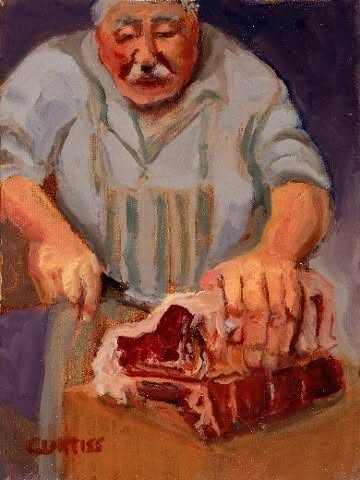
Kalter wore a white apron, his sleeves rolled high, and serving his goods he never let go of the great butcher’s cleaver in his hand, with which from time to time he neatly cut off the piece requested.
This picturesque scene and the routine of the cattle markets was brutally broken by the act of April 1950, which in hard, official language forbade any trade in farm animals, private slaughter, trade in meat, and so on.
Bolshevism was taking over ever wider areas of life, pushing its way into homes, caring nothing for privacy, but rather doing everything so that there would be less and less of it, or perhaps none at all.
People crouched to the ground like hares to the balk, nobody traded, nobody bought. Life froze, for failure to observe the new law was threatened with severe penalties, and the raging Security Office could sharpen those penalties at will. And it never failed to do so.
The word “meat” was pronounced in a lowered voice.
At that time there were, at bottom, two butchers in the little town, for besides Szymon there was also Mariańcio, who however did not run his own business, but only from time to time hired himself out to dress piglets and calves at farmers’ houses.
Mariańcio — back in the twenties — had practised in Paris, in a charcuterie not far from Notre-Dame cathedral, and knew his work. Even the rather fine work. He always talked a lot about his French stay. Kalter did not consider him competition and liked him, and even hired him for help from time to time.
With the harsh act of 1950 all these practices ceased.
At the cattle market now raged Władyko — a great hulk of a man — newly appointed manager, to whom the new function had gone strongly to his perpetually drunken head, and who with a great stick in his hand watched over the order of the work. He tramped through the omnipresent mud, trod in cow dung, tapped his stick on the carts and shouted. He never spoke, he always yelled. At people as well as at animals.
With a “beret” pulled down over his very eyes, dressed in a “quilted jacket”, turned-down “rubber boots” and with a drool-covered cigarette end in his mouth, he resembled a camp kapo more than an official of the administration.
A sadist he was too, than whom it would be hard to find a worse! The animals brought in he treated simply terribly. Another thing was that not only he, for the hearts of others were somehow also unfeeling towards animal pain and suffering.
It was quite certain that wild Władyko was the very devil incarnate, for as rumour had it, to top it all, besides his inborn cruelty, he wallowed in disgusting incest. Everyone knew that he lived with his two daughters, with whom he had sexual mix-ups, and worst of all — he did not even deny it very much. It even happened that in public he made plain allusions as to how things were with them at home…
The daughters — girls of sharp tongue — also in turned-down “rubber boots” and quilted jackets, sometimes helped their father at the cattle market, brandishing sticks no worse than he did.
These disgusting practices, of which they were suspected, vividly recalled the biblical story of Lot and his daughters, which in the Old Testament is written in these words:
And when he dwelt in a cave with his two daughters, the elder said unto the younger: “Our father is old, and there is no man left on the earth, to come in unto us after the manner of the whole earth. Come, let us make him drunk with wine, and let us lie with him, that we may preserve seed of our father.” And they made their father drink wine that night: and the elder went in and lay with her father: but he perceived not, neither when his daughter lay down, nor when she rose up.
And the next day the elder said to the younger: “Behold I lay last night with my father, let us make him drink wine also this night, and thou shalt lie with him, that we may save seed of our father.” And they made their father drink wine that night also, and the younger daughter went in and lay with her father: and neither then did he perceive when she lay down, nor when she rose up. So the two daughters of Lot were with child by their father.
With Władyko’s daughters it was, it seems, not so bad, for as yet neither of them, apparently, walked about “with child by her father”, but they drank with him, caroused, and on the whole did not deny that “Dad”, when he drinks, is “a bull, no use talking about it!”.
They could also be dangerous. So at least it was said.
So then, the animals driven to the cattle market were now bought up by the state. No private deals!
One day the terrifying news broke that the authorities would check whether everyone was observing the ban and whether someone, somewhere, was not secretly “slaughtering”. Unexpected searches were expected, and many eyes turned towards Kalter’s house. He, however — sensing the danger — buried himself in his shed and repaired an old chaff-cutter. He did not sell meat, what he had of sausages he hid in his secret lean-tos and… froze.
There was silence, for now nobody really knew what would happen.
Nobody risked anything, but it happened sometimes that in the early dawn, here and there, some flitting figure could be seen, someone threw something over a fence, some whispers were heard and a quiet patter of feet. It looked, then, as though there were those who, despite the threat of prison, had not lost their appetite for a good little sausage. Besides, what is there to say — one had to live somehow…
But the little town had many snooping eyes.
Władyko’s daughters, for instance, who at night drank somewhere, or returned home with their father, or simply dallied with someone, were only waiting for an opportunity to denounce some “crimes” to the authorities… And not only they, for as I have said, there were among these simple people “scores of wrongs” which sometimes only waited to be “crossed out”, but sometimes cried out for blood.
Nobody had anything against Kalter — except perhaps that old matter of the alleged patricide, although even that, after five years, no longer looked as sharp as it had in September ’45 — but in the times that had come nobody could feel safe, and certainly not a butcher!
And indeed, it happened!
On 1 May 1950, when the procession was forming in the market square and those with portraits of the leaders wandered this way and that, for it was not yet known who walked behind whom, Szymon, standing aside, said in a low voice:
“And whose Russian soldier are they carrying? Are there no Poles left?”
He said this about the portrait of Marshal Rokossovsky, hung about with medals.
To his great misfortune Weronka heard it — one of Władyko’s daughters from the cattle market — and at once snapped:
“And what business is it of yours, you Yid, you bloody shit, what Poles do? We’ve not got at your arse nearly enough yet! You devil incarnate, you haven’t yet paid for that father’s blood of yours!”
And she said it in anger, her eyes glinting like a she-wolf ready to bite and tear. Her kerchief had slipped from her hair, her usually red cheeks seemed to spurt blood, and in that fury she seemed even uglier than when she drove pigs at the cattle market.
What had bitten her — none of those listening knew. Perhaps she had not yet sobered up from the day before, or perhaps Kalter had displeased her about something at the cattle market, it is hard to say; suffice it that she was furious as a wasp and only looking for a quarrel.
Szymon Kalter looked at her, said nothing, only spat at her feet and walked away.
The shriek of the enraged girl chased after him:
“And what are you spitting at my feet for, you Yid p…! Such people should be taken to the militia! He doesn’t like our leaders! Look at him, people! Surely he ‘slaughters’ at night too — a saboteur, that’s what he is!”
And after these words, fear fell upon many, for although people knew Weronka and her sister Józka, nobody had expected such bitches of them, and that the job at the cattle market had so turned their heads that they would want to ruin a decent man.
And one must know that such a public naming of someone as a “saboteur” was almost the same as handcuffs on the wrists. After all, it was the year 1950, the authorities had by now more or less consolidated and had no brakes at all. Choking terror hung over the Country.
And so, the very next day, two militiamen came to Szymon Kalter’s house, and under the station a black Citroën from the county town was seen.
But before that happened, Kalter, sensing the gravity of the situation, did not go home, but turned aside to the local pharmacy.
Its owner was Mr Franciszek Frey, who for the moment had no idea that in about eight months he would no longer be any kind of owner, for in January 1951 the people’s government would take his long-standing workplace from him and send him into forced retirement.
Szymon Kalter was quite a frequent guest here, for for his smoking he needed various pharmacy specifics, above all saltpetre, and also special herbal mixtures, in the preparation of which the pharmacist was an unsurpassed specialist and a true heir to the knowledge of his father the pharmacist, his grandfather the pharmacist, and a few earlier pharmacist ancestors.
At the back of his pharmacy he kept a huge garden, in which, besides fruit trees and a dozen beehives, there was a multitude of all manner of herbs used in the production of medicines.
Of course, no Pharmacopoeia, Austrian or Polish, ever admitted such prepared medicines for sale, but Mr Franciszek Frey did it — one might say — a little “for private use”, for many local peasants did not even want to hear of “state” medicines, only demanded “what Mr Pharmacist always made and always helped”.
There was badger ointment, various mixtures with honey, combinations of herbal teas, something for sweats, something for a regular period, cough drops, various salves, and so on. All “the pharmacist’s own”, not some “state” stuff!
For Kalter there was always saltpetre prepared, and besides that a whole set of herbs such as savory, thyme, mustard, borage, comfrey, for those were the things he needed. There were also dried and suitably prepared fruits of cherries, quinces, cornelian cherries and many others. And it was almost hard to believe that all of it — literally all of it — came from the pharmacy garden and apiary! And yet it was so.
In the relations between the “pharmacy” and the Kalters there was, however, something else besides, namely that the Kalters had from time immemorial used the pharmacy ice house and had their own allotted, spacious place there.
And the pharmacist Frey’s ice house was an archaic but extraordinarily useful building.
A pharmacy, or a butcher’s establishment, simply could not do without it.
Those were different times and nobody anywhere had any refrigerators. And truth to tell, nobody needed them all that much.
After all, in peasant farmsteads and cottages there were cold cellars and deep wells, into which, if need be, sour milk was lowered, or cabbage juice, a pat of freshly churned butter, or even that can of beer. Despite their usefulness, however, even the coldest cellars and wells were in no way comparable to that Frey ice house, which, although old and in fact “antediluvian”, was absolutely unique and irreplaceable.
Its beginnings were lost in the mists of history and it seemed to have existed for ever, or at any rate as long as the Frey pharmacy itself, that is, since the second half of the eighteenth century.
Sunk into the ground, the huge, turf-covered half-cellar looked like a grass-grown hillock. To the heavy doors one went down a few steps. After opening them, down a few more steps one descended into a great room with shelves running along the walls, on which, on straw mats, lay blocks of ice hewn in winter on the river and brought by cart, or, when there was good snow, by sledge.
Such mighty blocks kept in the dark half-cellar through the whole summer, and food frozen on them kept there for months. They kept until the next winter, and probably could have kept for ever, but once a year the ice house was thoroughly cleaned, the old ice thrown out and fresh ice laid in.
It was laid on the shelves and beneath them, and also on a special grating hung beneath the ceiling. Its mass, together with the eternal darkness, meant that the food kept there froze solid. A freshly hunted hare placed there, say, in January, kept its freshness until late November, and certainly, frozen solid, could have stayed there longer.
The town ice-cream man — Mr Polanko — also used the ice house. He kept there his ice, used for making ice cream, which on hot summer days was no small attraction for the town’s children.
The Kalters had from time immemorial had their own shelf allotted in that dark, frosty “cave” for their meats. They kept on it fresh “quarters”, “halves” and all kinds of semi-finished products, which at the right time, quite fresh, were worked up by them and sold.
Szymon was therefore a frequent guest there, had his own key and did not have to announce himself. His house stood close by, so it was a step away.
Others too used the ice house from time to time, but the Kalters were “from time immemorial” and their agreement for using it had lasted from time immemorial.
Such conditions, their “immemorial” standing and mutual understanding, created a certain intimacy that marks close friends of the house.
And yet, despite this long standing, it was not the intimacy of a bridge table or of conversations together in the drawing room. And not because the pharmacist, or the Freys in general, in any way set themselves above the Kalters. Those were simply the customs, and everyone knew how the little town’s community functioned, or, to put it rather unpleasantly — where everyone had his place.
Any disturbance of this order usually met with immediate disapproval.
For example, the local farmers — or, more broadly, the peasants — did not like being addressed as “sir”. It even happened that they did not react, pretending it was not meant for them.
After 1945 the new system turned this settled order upside down, and the great majority felt terrible in it. Of course, there were also those for whom the new rules of the game and the “throwing off of the shackles” suited them perfectly, but it happened that the community brought them back to order. Not always, but it happened.
And again I must give an example, for I want to be well understood. It happened that this or that fellow would barge into the pharmacy on market day and, cracking the whip he held in his hand against the floor, “demand and require” immediate service.
“I demand and require! Now there are peasant governments! There are no masters! The doctor gave me a prescription! I need medicines right now!”
Often such cases met with disapproval from others.
“Look at Wojcieszek putting on airs! They haven’t even sold their piglet yet, and already drunk and throwing themselves at the pharmacist!”
Such cases — however isolated — did happen.
In these wholly new conditions, some kind of metamorphosis took place in many people, unleashing base behaviour, perhaps a desire for social advancement, or sometimes a settling of scores for past wrongs. Real and imagined.
Perhaps that was what played its part in the case of the furious Władyko and his daughters. Others tried to adapt, but even so it was not too easy, for the new “master”, that is, the “socialist state”, was not at all gentler than the old “masters”, but quite the opposite, for above all it was boundless and inexorable. The office was impersonal, the laws ruthlessly enforced, and above all the new state was insatiable.
After the May Day incident with Władyko’s Weronka, Szymon Kalter did not go home. He left the crowd, for he realised that his remark had been a colossal stupidity and indiscretion. He fumed at himself for having said anything at all in that crowd! And to whom?! To Weronka??!! He could not forgive himself for it, but what was done was done — the “dangerous bull” that had arisen, or rather the situation, had somehow to be taken by the horns.
In this state of things he decided to go to the pharmacy and see the pharmacist, for he knew well that nobody could help him better than Franciszek Frey.
So he went, but he came at a bad time, for as it turned out, the pharmacist himself had unexpected troubles, and as it turned out the next day, the black Citroën that had appeared by the militia station on 2 May had nothing to do with Szymon’s trivial, though potentially dangerous, incident with Weronka.
As it turned out, representatives of the Security Office had come about the old matter of that long-ago raid on the pharmacy, which in 1945 had coincided with the death of old Israel Kalter, his funeral, Szymon’s few days under arrest, and above all with the rumour that the son had killed his father!
The day before, Mr Franciszek Frey had received a militia summons. Naturally he went, for he could not but go, but after a few questions he was told to go home and wait.
Chapter III
So he waited.
There was much to think about, for as is known, the times were terrible, people had gone quiet, watching what they did, what they said, and even how they looked at others.
In this state of things, and as if just on cue, Prelate Noga appeared in the pharmacy — friend and confidant, and above all a good Man, who had been in the parish for over fifty years and through all those years, two wars included, there was nobody who would have said one bad word about him.
And the pharmacist’s face brightened like that of a prisoner whose doors to freedom have been opened.
“Welcome, dear Prelate! There could be no better guest! How glad I am! Surely the merciful God himself has sent you!”
The parish priest, a little surprised by this extraordinarily cordial greeting, smiled kindly.
“I am glad too, dear Mr Franciszek. I am glad too. But what is this, your face looks somehow clouded… Probably because today is Labour Day, and the pharmacy may not be opened, eh? Ha, ha, ha…”
“Oh, come now, dear Prelate — what sort of holiday is that… I have a worry, and indeed I need advice today. Do sit down, dear Prelate…”
And the pharmacist was already seating the reverend gentleman in the armchair, while Mrs Wanda — the pharmacist’s wife — brought from the cool hallway a small carafe of liqueur that was called “Franiowa”.
Mr Franciszek prepared it every autumn — as indeed he did many others. They were all good, for cherry liqueur with honey, cornelian cherry liqueur and quince liqueur were all there, but none was so loved as “Franiowa”. It was a drink of a most peculiar taste, whose recipe was as old and “moss-grown” as its oldest bottles, kept with tenderness and respect in the deep pharmacy cellar.
It had been made by Mr Franciszek’s father, but then it was called something else. Later that name was forgotten, and later still people took to calling it “Franiowa”. Another thing was that the pharmacist himself did not like strong drink and usually limited himself to a mug of beer with his dinner. Mrs Wanda served it to him with the second course, cool, straight from the ice house. The liqueurs were for guests, and for the most awaited guests — “Franiowa” itself.
So they sat down, and Mr Franciszek told his trouble in a few words.
“It is that business of five years ago — you remember, Father — when the Ukrainians robbed my pharmacy. They are calling me in about it again. I rack my brains over what they want, for they have already examined and asked… I told them everything, but evidently they need something more. So many have already testified, and all said it was the UPA men, but all the time they keep digging that it may have been the NSZ or others… I am worried — I tell you, dear Father — very worried…”
“Yes, I remember well. Just then old Kalter died and there was a bit of fuss about his funeral… I remember, I remember! How could I forget?”
And just at that moment Mrs Wanda appeared in the doorway and said that Szymon Kalter had come on urgent business.
Truth to tell, the moment was not the happiest, but as they say, “a guest in the house, God in the house”, so Mr Franciszek rose from the armchair and with a broad gesture signalled him to come in.
“Ah, Kalter, welcome, come in, come in — please, please…”
But Kalter did not sit down, for truth to tell nobody expected him to, but in a few words he set out his sudden trouble and asked for help. And he did so in the hope that the pharmacist would help through the husband of his granddaughter Dusia.
That husband was Jacek Woźniak — once, before the war, a good-for-nothing and idler, and now… head of the department for economic crimes of the county Public Security Office.
He came from the little town and everyone knew him, but during the war he had vanished from sight, roamed the forests, fought somewhere — suffice it that he was active, and so actively that people began to talk about him.
Mr Franciszek’s granddaughters — still as small children — had played with him and roamed the little town. Ordinary children’s games. The boy was unruly, but at bottom liked everywhere. Even then one of them — Dusia — looked at her playmate with curiosity. But they were still children! Little children.
After the liberation, when Dusia and Jacek were already in their twenties and their hormones were raging at high speed, an accident happened, as a result of which a happy marriage took place.
And it was not about a pregnancy! No, no! Not with a Frey girl!
It was the year 1946. Four years later Jacek was already a lieutenant. Things went quickly then. Faster than usual, but such were the needs of the new administration and nobody looked at papers. What mattered was commitment!
All were needed with “open minds, hot hearts and clean hands”!!!
“The best for the ‘security’!”
So at least it was said all the time.
That the Freys, and Mr Pharmacist in particular, allowed such a marriage was beyond people’s heads.
So Szymon Kalter, fearing a sudden arrest, tried to secure himself, counting on the pharmacist’s protection with Captain Jacek Woźniak. And he did not miscalculate, for Franciszek Frey said without a second’s hesitation:
“Why, of course, dear Kalter — of course! I shall telephone Dusia this very day, so that she warns Jacek.”
And he could do it, for there was a telephone in the pharmacy. A great, black, ebonite crank telephone, from which one could get a connection to the county town. Naturally through the post office exchange. In the little town there were at that time fifteen numbers.
Kalter left, bowing in the old-fashioned way, with a broad gesture, and after he had gone the two gentlemen sat for a while in silence.
Prelate Noga broke it, stirring as if with impatience, and said:
“What is this, Mr Franciszek? You want to intercede for Kalter, and in your own case you ask me for advice? Why, the best advice is Jacek!”
“By no means, Father Prelate, by no means! I have an old agreement with that boy that I shall never involve him in any family matters. With what face could I break it now?”
“Well, if that is so, there is nothing even to talk about. One must wait. I think, however, that from this cloud there may come a very small rain, or perhaps none at all…”
“God grant it! Golden words, dear Father!”
“And do you know — the old priest changed the subject — that there is something lordly about this Kalter, don’t you think?”
Mr Franciszek touched the liqueur glass with his moustache and smiled:
“Who knows — ‘his mother must have gazed at some nobleman’ — he quoted Sienkiewicz’s Mr Sielicki.”
And the prelate fell into the same tone and answered with Zagłoba’s words:
“Oh, more likely some nobleman gazed at his mother!”
They laughed merrily, for after a moment of tension there usually comes a desire for relaxation.
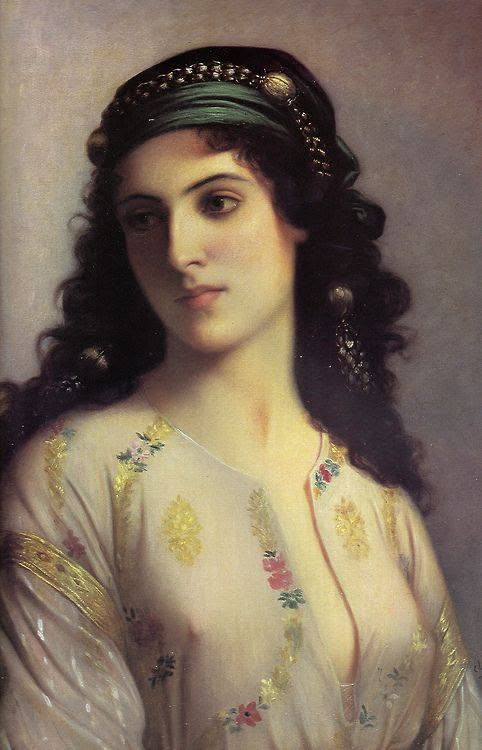
“Yeees — Mr Franciszek went on — old Israel did not have that — I would say — pride which I see in Szymon, and yet, whatever one may say, he was a Jew universally respected… He did quarrel with the rabbi, it is true, but it must be said that he had his reasons… He changed a great deal too after his wife’s death. Do you remember her, Father? She was a beautiful Jewess! Her name was Chana. She knew well of her beauty and it fairly carried her away. The old Jewesses looked on it with distaste, but the men — they followed her like — begging the Father Prelate’s pardon — dogs after a bitch.”
“Oh, do stop it, dear Mr Franciszek. Do stop it. You ask whether I remember? How could I not? I remember perfectly. I had just come to this parish. Which year was it — 1900? Perhaps even a little earlier… Indeed, the woman was like a doe, but you are right — she was perhaps a little too pretty, for the rabbi wrinkled his nose and looked at her a little askance. I remember, I remember…”
“And it began with that story about Schultz — do you remember, Father Prelate — that tenant of Wyręby Ruskie?”
“Naturally, naturally… There was something to it… And that Schultz, Mr Franciszek, who was he? Did you know him? I never saw him in our church. It seems he was a Lutheran or a Calvinist, am I right?”
“I knew the Schultzes from when I was studying in Vienna. It was a good family, but that one from Wyręby was certainly not one of them. He called himself a Courland baron, but that was probably not true. Mr Rodłuski gave him Wyręby on lease, for he himself was taking a cure for gout somewhere on the Riviera and rarely came back to these parts. Where he dug him up I do not know, but something comes back to me, that Schultz came to these parts from deep in Russia, where he held some estate on lease from the Koziełł-Poklewskis in Siberia. Probably his lease there had ended, he returned to the Country, and Rodłuski took him on at Wyręby then.”
It was also said that in earlier times he must have been a military man, for at Wyręby he introduced discipline like in a line regiment, and rode a horse like nobody in the neighbourhood.
Well then, Chana Kalter, at that time a young married woman, used to go to the manor there, for she sewed some little things for Mrs Schultz. Israel was furious, for he wanted to keep his young wife for himself, and she did nothing but run off to those Wyręby.
And then Szymon was born, and beautiful Chana supposedly died in childbirth. That was what people said then.
“Yes, yes — the Father Prelate sipped a little of the liqueur — even then not everything was clear. I was a young curate, but I remember that somehow nobody knew anything about her funeral. I spoke then with Rabbi Szmul and I remember him saying that the congregation did not bury her.”
“Just look, dear Mr Pharmacist — two deaths, of two spouses, and both somehow so mysterious. And on top of that, separated from each other by almost half a century.”
“That is true. Old Israel was a widower for probably fifty years. It is curious that he never took another woman. Why, with his money he would have had competitors galore. And besides, even without that, any woman would have married him. The Jew was, after all, well-built, handsome, and a butcher such as it would be hard to find better! Another thing is that after that slaughter in ’39 he terribly wilted and grew decrepit.”
“Who knows? Sometimes celibacy is the best solution… I know something about that — the old prelate laughed.”
“Well, yeees… — Mr Frey fell thoughtful for a moment. And what was it really with those rumours when he died? That rascal Chyła trumpeted round the town that he had heard some row at the Kalters’ then… How could that have been possible? After all, Szymon was the old man’s only guardian. Why would he have killed him?!”
To this, however, Parish Priest Noga answered nothing, only rose slowly from the armchair and began to take his leave.
Outside the windows the procession was going on in full swing, the band blared march tunes, and from the platform the local and county officials greeted the passers-by in a friendly way. It was a new holiday, passed by the Sejm a few days earlier, but preparations for it had been going on for a few weeks.
Labour Day!
Those who before the war had worked somewhere in big cities remembered it and recalled it, but most peasants did not know this workers’ tradition. They came to look, for after all it was an attraction. Perhaps not quite such as, for example, the Corpus Christi procession, but still a break from the everyday round.
Chapter IV
And besides — or perhaps above all — after the procession and the speeches, mainly about the Six-Year Plan, there was the “artistic part and activities in subgroups”, that is, a dance and not inconsiderable drinking, which dragged on until late at night.
Not far from the fire station a floor of planks had been built, there was also a buffet, the band played songs by Mirska, Ciżyński and Fogg, but not too many, for polkas led the way, and what was usually played at weddings. That was liked and danced to. The planks of the floor creaked, the drum thudded, and the accordionist surpassed himself. Men in white church shirts wet with sweat, girls in summer dresses, and dancing in full swing.
As the evening went on, when the couples, breathless from dancing, had dispersed here and there /especially “there”/, the music slowed, and then slowly, slowly the end of the day came, and only here and there could giggles still be heard, laughter, and sometimes songs, of which one above all stood out from the others. “Highlander, do you not regret?!”
Sung solo or in parts, it vibrated in the silence of the evening and carried far, above the little town, the river and the surrounding hills. It reached too the ears of Szymon Kalter, who was trying to sleep.
The incident with Weronka, the visit to the pharmacy and the drunken singing had thrown him off balance and would not let him sleep, so he went outside, so as not to wake his wife, and lit a cigarette in front of the house.
His thoughts circled round past events, but chiefly concerned the recently announced ban on the meat trade. After all, it struck at his earnings, his livelihood and, at bottom, his whole future.
Another thing — he thought — it had been worse, incomparably worse! He remembered well the occupation and the terrible September of 1939, when he and his wife and father had hidden in the secret cellar and had not succumbed to the psychosis of obedience to the Germans.
Everyone had heard and seen the round-up. The echoes of the bursts of machine-gun fire had not yet died away, the bodies of those shot had not yet grown cold, and yet — at the sound of the great drum and the shout of the town crier, who read out the order requiring them to come forward, the Jews came out and stood in the market square!
Kalter smoked his cigarette and once more racked his brains over how it had been possible???
How had it been possible that they went to the slaughter without a word of protest, of complaint, frightened like cornered rabbits? After all, they had heard the shots…
But at once he remembered his own fear of today! And fear of whom? Of a dirty, stupid girl who had called him a saboteur? Of a possible arrest, which might have brought some problems, but surely not death! What comparison was there at all? And yet he had been frightened, and to such a degree that he had gone to Frey to ask him for help.
And a blush of shame flooded his face, but luckily nobody saw it, for he sat alone and night was all around.
They had gathered then, on that warm September day in 1939, and everyone wept — the women, the children, and what men were left… and he sat in his cellar…
Like a rat — it flashed through his mind.
Like a hero — it flashed through his mind again.
Like a wise, prudent man!
And that last thought was probably closest to his conscience.
He heard the furious barking of the sheepdogs, the shouts of the SS men, rifle shots, and trembled. His wife clung to him like a child to its father and did not tremble, but from time to time a kind of sob passed through her body, shaking her. Like a child that chokes after long weeping, as if recalling a wrong it has suffered.
His father sat right beside him and stared tensely at the wall. The little cellar had no windows, and a small candle cast flickering shadows.
The violent tramping of heavy military boots could be heard, sometimes receding, sometimes right there. It was obvious that the SS men were looking for those in hiding.
The terror of the moment was paralysing. And it was then that a terrible thing happened.
Suddenly, at one of the next approaches of the noise of boots and the yelping of the maddened dogs, his father stirred and moved violently towards Szymon. His eyes were as if crazed with fear, and saliva dripped from his mouth, running down his beard onto his shirt.
“Go to them, go… save us, say that you are a German… after all, you are… when they come, defend us… they won’t touch a German…”
And he said it quickly, in a breathless whisper full of tense pleading.
The Germans were above them, rummaging through the house, smashing the furniture, but after a moment a sharply shouted order came from the market square, the SS men dashed out, and all that could be heard was the slamming of doors, knocked off their hinges with a kick and hanging on a single hinge.
The Kalters came out of hiding only in the morning.
The little town was as if stunned, but by noon something stirred, and a few boys ran to the river to see what had become of the Jews.
Szymon Kalter was silent. Of what he had heard from his father in the moment of his worst weakness he did not mention a single word. One does not usually ever return to such things, but in the case of the Kalters the matter returned.
Now, in the warmth of the May night, he recalled that terrible time of torment, tension, and above all fear.
And yet he need not have been afraid. His appearance — as I mentioned — was Aryan, and nobody — without checking his circumcision — would have said that the man standing before him was a Jew. And yet he was afraid. He was a Catholic, he spoke Polish without an accent, and yet he was afraid.
From that accursed occupation he remembered fear.
There was also something else that returned to him like a nightmare. A terrible sense of guilt, which kindled in his heart flames of despair and regret.
When the column of Jews led by the SS men had left the little town and nobody knew where they had gone, whether to death or to eternal slavery, Szymon Kalter came out of his hiding place with his wife and father.
He came out, looked at the empty market square, and joy flooded his heart that he was alive!
He felt no sorrow or despair! He felt great joy that in the inscrutable judgements of God he had been saved. His family and he. And only that mattered.
That moment of joy he remembered very clearly. It tormented him and scourged him through all the following years. Eleven years had passed, and he still remembered it as if it had happened yesterday.
How could he?! How could he?! After all, so many people of his own blood had gone to their destruction, and he rejoiced that he was alive??? So many relatives, so many good, innocent people, whom he had known since childhood, played with, then traded with, sold meat to, had gone to their death, and he rejoiced that he was alive???
What devilish selfishness had taken root in his heart???
And in the depths of his conscience he saw for himself no excuse and no relief. None! He even had moments when he regretted that he had not come out of that damned cellar of his and gone with the others…
In such moments the memory of his father’s behaviour, his animal fear and his babbling pleas for rescue was downright disgusting.
And those senseless, incomprehensible words about his own son being a German… What did he mean by them? How terribly had his filthy fear for his life addled his mind?!
Szymon sat, smoked another cigarette, and the old memories shook him like an electric shock.
After those September events of ’39, his father wilted, and through the following years, until his death, he was at bottom a walking corpse. He seldom spoke, he did not go out to people. He would only sit in the garden behind the house and sit for hours gazing into the distance. He did nothing. He simply sat. But Szymon felt that his father was struggling with himself, that he wanted to say something, to talk, to cast something off. He knew him better than anyone else, after all. They had been together all their lives. They worked together, traded together. After all, he had taught him the craft and initiated him into the various secrets of butchery and sausage-making.
He waited patiently, for there is nothing worse than forcing someone to open up.
Such were the thoughts and quiet memories of Szymon Kalter on the warm night of 1–2 May 1950, and the next day — as I said earlier — two militiamen stood in the doorway of his house, who began to ask about a public statement insulting the leaders of the socialist state.
Both had straps under their chins, which meant they were on duty and added gravity. One of them had an automatic slung over his shoulder, and the other a map case, from which he took a notebook. He wrote nothing in it, however, only tapped with his pencil.
The one tapping was Corporal Kazik Pełzak, a local lad whom Szymon had known since birth.
“Well, how will it be, citizen? Do you admit that you insulted the leaders of the state, and that you do not observe the ban on private slaughter and are a saboteur?”
“Nothing of the sort happened. I insulted nobody and I observe everything. Kazik — don’t you know me?”
“There is no ‘Kazik’ here, citizen! Answer the questions!”
“Why, I am telling you…”
“What are you telling us?”
“Well, that I insulted nobody.”
“And are you a saboteur?”
“Nooo…”
And at that moment Corporal Pełzak did not know what to do next or what to ask. For a moment he could not make any decision, so he put away his pencil and notebook and declared:
“You will come to the station. There we shall talk.”
And that “we shall talk” already sounded very official, perhaps even threatening.
So Szymon took his cap and went, with the two militiamen with straps under their chins behind him.
But as soon as they arrived at the station, everything changed in the twinkling of an eye. For it turned out that among the three officers from the county Security Office who had come in the morning about the old raid on the pharmacy was Captain Jacek Woźniak, the husband of Dusia née Frey, granddaughter of the pharmacist Franciszek Frey.
When he saw the patrol coming in with Szymon Kalter, he approached and, without even looking at the militiamen, shook his hand. Corporal Kazik Pełzak he brushed aside without ceremony and went out with Szymon into the street.
“They’re pestering you, eh?” he began calmly. “Don’t be afraid of anything — nothing will happen to you, but you must be careful. They told me you said something. Be careful. It is not as it was before the war — now we must be vigilant, for there are enemies everywhere, damn it, just waiting to snatch our government from us…”
“Thank you, Jacek…”
“Come, come, it’s all fine, no need to talk about it. I came here because they want to ask about that raid on the pharmacy, so I wanted to be there.”
“But that was five years ago…”
“What does that matter? We must investigate everything. That rabble from the forest must have been in on it… Well, never mind — Szymon — go home and sit quietly. I shall come in the evening and we shall drink and talk.”
“So you are staying until tomorrow?”
“Maybe…”
Szymon breathed deeply. With relief.
If only they would leave the pharmacist alone — he thought. How lucky that Jacek is here! How lucky!
And in the pharmacy, the questions about the raid were the same as before. Two officers who had come with Jacek asked them. Jacek sat and wrote something.
Mr Pharmacist Frey answered calmly.
Immediately after the three officers had entered, he was astonished at Jacek’s presence, but asked nothing, only invited the arrivals into the dining room. The situation was a little cool, but luckily Mrs Wanda suggested a small refreshment, and “if the gentlemen officers would like to warm themselves a little with a good liqueur”, she would bring it at once.
The Security Office men scratched their heads, settled themselves at the table, and Jacek said, why not, but after the questions.
So the questions were the same as five years earlier, when, right after the raid, Mr Franciszek Frey and all the household had been interrogated.
Meanwhile Mrs Wanda brought a “modest refreshment” and a large carafe of a dry liqueur, which on account of its great strength was not usually served. Mrs Wanda used it only as a medicine and sometimes drank it for some stomach upset in a tiny little glass.
This time the glasses were large.
The old prelate’s words proved true, when he had foreseen “from a great cloud a small rain”, for nothing changed after this interrogation. The Security Office men scribbled a few pages, told him to sign, and then drank the vodka, ate a tasty dinner and set about leaving.
It looked as though the matter of the raid on the pharmacy in 1945 was closed once and for all.
Even so, when the terrible guests had wiped their mouths and after a few hours of questions had finally left, Mr Franciszek Frey was not reassured. Above all he was horribly tired from the tension, from watching what he said and not making some mistake, for the Security Office men used the old method of asking about the same thing several times.
But besides that there was something still more worrying. During a loose conversation, after the proper interrogation, when the officers had reached for their glasses and Mrs Wanda’s excellent little herrings, a question was dropped as if in passing, which gave much food for thought and caused Mr Franciszek’s growing fear.
“So here, in the citizen’s house, was the Gestapo office?” asked one of the questioners, out of the blue.
And it sounded like a continuation of the conversation, although there had been no talk of that time of the occupation. After all, they had asked only about ’45 and about that raid.
“What are they after?” ran through Mr Franciszek’s mind. “What are they after? What has the Gestapo office to do with the robbery of the pharmacy by the UPA?”
And suddenly, for a brief moment, a terrible premonition seized him that this whole conversation had nothing at all to do with the history of the raid, but with something entirely different.
Perhaps the answers to all questions, suspicions and fears were to be sought in the wartime events…
Chapter V
After the massacre of the Jews in September 1939 and after the column of those still living had been led out of the little town, the Germans seemingly left, but that was only a small moment of respite. A month later, in November, they appeared again, only no longer in the form of the ghostly Einsatzgruppen, but of the Wehrmacht, which occupied the conquered territories. At once they began to organise the German administration.
It was clear that the invaders were settling in for a long time. The little town and the whole county were incorporated into the Kraków district of the General Government. An occupation police and judicial network arose.
It was then that the Gestapo came to Franciszek Frey’s pharmacy and occupied the whole first floor of the tenement house in which, on the ground floor, were the pharmacy and the pharmacist’s flat.
The head of the post — Obersturmführer Hans Oehlers — was official, but polite, one might even say gallant. There was also Kriminalassistent Schielke and a few others, who very quickly organised the office.
Mr Franciszek had nothing to say about it, for the Germans neither asked nor requested. They were simply the authorities!
But the pharmacist walked about “offended”, for he could not get his head around what was happening. Educated at the University of Vienna, he spoke German as he spoke Polish, but in the first days of the Gestapo men’s presence in his house he not only did not open his mouth, but did not even answer greetings. Deep in his heart he was a Polish nationalist who could not accept living under one roof with enemies who had attacked his country.
Within a few short months this was to change dramatically! And that change weighed upon the lives of many people.
Above all, the shooting, deportation and, in short, total destruction of the Jewish population of the little town did not fit in people’s heads. Nobody could even imagine how it would be without the Jews. The life of the little town was so bound up with them that it formed an inseparable whole. After all, it was almost half of all the inhabitants.
After September 1939, of that huge community only two incomplete families survived.
To top it all, in December of that year one of them, that is, Ryfka Mendel with her grandson Izaak, was taken away in an unknown direction. Everyone thought Ryfka had perished, but as it turned out much later, both she and little Izaak had survived. How and where was not known, but at the beginning of 1950 a letter came to the little town, written already from Israel. Ryfka thanked everyone who had helped her in those terrible days and swore eternal gratitude.
At bottom, people did not really know what that gratitude was about, for nobody could remember how it had been with Ryfka and whether anyone had helped her at all then.
That she survived the September massacre and the leading out of the remaining Jews she owed, it seems, only to herself. She simply took her little grandson, climbed onto the bread oven, covered herself with rags and sat like a mouse under a broom. She did not run out with the others.
It was all so sudden then! The headlights of the cars blinded the frightened Jews, and the unceasing bursts from the machine guns and the barking of the sheepdogs tore at those gathered in the market square with such terror that it seemed to everyone that hell had opened its jaws and swallowed any hope!
And besides, the day before, shootings had been heard and everyone was screaming their hearts out in despair…
So they ran out into the market square, for they were afraid with a fear that robs one of reason. The parents of little Izaak also ran out, but when they were already in the doorway, in the panic and scuffle, Ryfka tore the little one from her daughter and shouted that she would take him and hide him. There was screaming, haste, madness, darkness, and just then the rain poured down, as if even the sky had begun to weep over that Jewish misery…
Ryfka survived, and the Kalters survived too, but in December she was unexpectedly caught near the house, seized and taken away, while the Kalters stayed.
What Ryfka Mendel meant, writing of her undying gratitude for the help shown, was hard to fathom. The letter was written to old Kokunicha, who lived wall to wall with Ryfka, a Polish woman, a good neighbour, but a woman of a venomous tongue and an unbridled mouth.
That Ryfka had written to her of all people surprised nobody, for there was no family left, and the two women had known each other since “time immemorial”.
“That Ryfka Mendlowa, who lives next to Kokunicha” — people said.
In such a description there could be deep psychological characterisation, there could be a description of place, the topography of the little town, and goodness knows what else, but certainly there was no dislike in it, or God forbid hostility.
Ryfka and Kokunicha — like everyone else — were members of a community, almost a family, in which nobody noticed nationality or origin.
They certainly liked each other with an ordinary small-town liking, helped each other, and sitting in the evenings on the doorsteps gossiped sedately, but whether in moments of terror Kokunicha would have risked it and helped a Jewess — nobody knew that.
What then was that thank-you meant to signify — nobody knew. Perhaps sarcasm, perhaps a reproach, or perhaps sincere, deep gratitude for saving her life…
After Ryfka and her grandson Izaak had been taken away, a strange time set in, and although life went on its course, terror hung over the little town, and especially over the Kalters. For everyone knew that they were Jews, and a single word, dropped deliberately or not, could bring upon them Ryfka’s fate.
And as sometimes happens in life, something enormously important was decided by something very unimportant, almost an accident.
Obersturmführer Hans Oehlers, you see, was not particularly happy with the post entrusted to him as head of the Gestapo in a tiny Galician little town. Even the broad powers covering almost half the county gave him no satisfaction, for he felt in himself the strength and destiny for higher things, but he put a good face on the situation and decided to use his position as best he could. And he could do much, or even very much! I have said too little! On his own territory Hans Oehlers could in principle do everything! At least that was his deep, inner conviction. And like many “omnipotent” men, he could afford a pleasant, smiling face, “lordly” gestures and behaviour.
One of the first visits he made while touring “his domain” was to Mr Eustachy Dornicki — owner of the local estate of Dorniewo, which comprised a few farms and a group of manufacturing works, including a brickyard, a mill, a brewery and a candle and stearin factory.
The daughter of Mr Eustachy — the beautiful Roma Dornicka — had married Karol Frey — son of the pharmacist Franciszek Frey — and had with him that Dusia — later the wife of Jacek Woźniak — head of the department for combating economic crimes of the county Public Security Office.
By some of the local landowners, Roma’s marriage to Karol was considered a mésalliance, for the Dornickis were regarded as “gentry and a half”, but Mr Eustachy himself never thought so, seeing in the Frey house an old love of tradition, patriotism and the respect surrounding it.
Besides, the two gentlemen had known each other almost since childhood, and had even spent some time together during their studies in Vienna, where Mr Eustachy studied agronomy and Mr Franciszek pharmacy.
With that “studying”, it varied, for it seems they caroused not a little, but nobody mentioned it, and the escapades of youth were in time covered by the dust of oblivion.
In later years, living in the same neighbourhood, they visited each other, invited each other on various occasions, and from these visits the marriage of the children hatched.
Well then, the first visit of Obersturmführer Hans Oehlers was to the Dornicki manor, to which he invited himself for dinner.
The atmosphere was cool, but the Gestapo man seemed untroubled by it.
“Shootings??? What shootings? Why, I have nothing to do with that, Herr Dornicki. Nothing at all! I am a police officer and as a policeman I keep order! What is wrong with that? After all — for God’s sake — there must be order!”
Oehlers made an almost offended face, as though anyone could have suspected him of killing Jews.
And at that moment — as if to distract attention from the “vile suspicions” — he exclaimed:
“And what wonderful cold meats are these? What a little ham, brawn, sausage! I have heard, I have heard — you Poles like to eat well! And where do such delicacies come from, if I may ask?”
“We have an excellent sausage-maker here in the little town…”
“Who might that be? Perhaps I shall visit him myself and buy some cold meats.”
There was a moment’s silence, but there was no turning back.
“It is Kalter.”
“Ah, Kalter? I shall remember, I shall remember. The name sounds somehow familiar. Is he not a German?”
“Oh no, no! A good Pole. A good family. Butchers and sausage-makers for a long time.”
“Kalter, eh? A Pole?”
And the Gestapo man narrowed his faded eyes and smiled with half his mouth.
And that incident, although seemingly trivial, saved the Kalters. Another thing is that it might not have saved them, but quite the opposite — sent them to a camp, or simply deprived them of life — but it turned out otherwise. Mainly because Oehlers liked to eat and drink well, but also because the little bird could not escape his grasp. He could always clip its wings, or cut its throat. For the time being, however, he could be allowed to bring choice smoked tenderloins, little pork necks and sides of bacon.
Such was more or less the train of thought of Obersturmführer Hans Oehlers, who on that early December day of 1939 was stuffing himself with good Polish food at the Dornicki manor.
As a consequence, Szymon Kalter endured and could — or rather had to — work. Another thing was that the Germans never raised any charge against him. No small credit for this was also due to Prelate Noga, who ostentatiously greeted Kalter with the words “Praised be Jesus Christ”.
Chapter VI
So it went on until the spring of the following year.
Meanwhile the Germans were intoxicated with victories, and their newspapers carried enthusiastic news of the successes of the invincible German army.
Such weeklies as Das Reich, Die Wehrmacht, Das Schwarze Korps, and also the Polish reptile papers, with the Kurier Krakowski at their head, wallowed in paeans to the Third Reich.
The little town accepted all this without a murmur, for what was there to murmur about, but more and more boys and girls went “to the forest” to organise themselves in resistance against the occupier.
Szymon Kalter worked in the sweat of his brow, supplying people with meat, and the Gestapo men with tasty little sausages. Another thing was that they always paid. And yet they might not have paid. Schielke, Vogel, Steiner would come, and sometimes Oehlers himself. They were correct, said their guten Morgen, chose their sausages, paid and left. Sometimes they joked, and at those jokes Szymon’s heart froze every time.
Their uniforms, leather coats and the sound of high boots brought involuntary terror into Kalter’s yard. Sometimes they also had their purchases brought to the office, and Szymon then walked slowly, as if being led to the guillotine.
His father never showed himself. He sat in the garden, sheltered by a spreading quince bush, and tried to be invisible. Since that September collapse he was a different man, and it looked as though he had withdrawn from everything. Even, and perhaps above all, from his son.
The life of the little town returned to some sort of rhythm.
True, in the neighbourhood there were arrests, and the presence of the invaders stifled one’s breath, but even so, in those first months it seemed that the Germans were still trying to keep up some appearances.
In the early summer of 1940 everything underwent a dramatic change, which turned that seeming calm upside down.
It began with a small incident.
The Gestapo men living above the pharmacy had a maid to help them, who cleaned the office, washed and ironed.
Her name was Stefka, and as people said, “she was a whore like few others”! Not that the Germans had anything to do with her! Nothing of the sort! That would be the last straw! They were officials, in spotless uniforms, even elegant, while Stefka was, after all, an ordinary girl from below Kalnica…
It was the custom for Stefka to collect rainwater for the Germans’ laundry. She carried buckets of water, splashed about on the stairs — just an ordinary clumsy lout, who had no respect for other people’s property. At the same time she felt that she was rubbing shoulders with power, and that in her opinion she was allowed more than others.
The youngest son of Franciszek Frey — Staszek Frey — was a veterinary surgeon and worked in the neighbourhood treating farm animals. He came to his father’s pharmacy for medicines and dressings.
One day he came on horseback for some specifics for a sick sow. He tied his horse in front of the pharmacy and went inside to talk with his father and his elder brother Karol.
Just at that time Stefka was carrying rainwater in buckets, and the tied horse somehow stood in her way.
“Get out of the way!” Stefka screamed — “get out of the way, you damned plague, you wretched beast!”
Staszek heard the woman’s shouting, came out of the pharmacy and called out:
“Stefka — what’s my horse done to you? Go and serve the Krauts instead, and leave the horse alone!”
But Stefka felt her power, and how she did not splash the rainwater into the horse’s face and how she did not bang the empty bucket on the horse! Another thing was that she did not manage to strike, for at the sudden splash the horse jerked as if pricked with a spur and reared up, tearing the lightly tied reins from the tree. The bucket rolled with a crash over the cobbles, and some Gestapo man looked out of the upper windows. And Staszek was carried away completely!
“Stefka, you dolt — you Gestapo whore! If I douse you with water, you’ll be drying yourself till you die!!!”
And it seemed to end there. Staszek calmed the horse, Stefka went off cursing for all the world to hear, and it looked as though the row had been more or less averted, but not entirely.
Staszek was arrested that same day. Whether the incident with Stefka had anything to do with it, it is truly hard to say, but somehow it coincided.
The next day the macabre news broke in the little town of the arrest of a dozen others, and of a sudden search of the Kalter house and the taking away of old Israel, who without mercy was pulled out from under his quince bush and taken away.
It became clear that the “elegant” Germans had “taken off their gloves”.
The newspapers brought news of lightning victories in France, whose capitulation was inevitable.
The Germans felt themselves the invincible masters of Europe.
Those arrested were taken in an unknown direction. Nobody knew anything.
The shaken Szymon Kalter came to the Freys at dawn.
“They’ve taken Father…”
“And they’ve taken our Staszek…”
“Mr Frey — Szymon Kalter lowered his voice — save them, I beg you. I will give a lot of money. Really a lot. Go to Oehlers, please…”
And Szymon’s voice trembled and his hands flew about as if in a fever.
“It is not about money, Kalter. I have large sums too. But will it help? Will it help?”
But he went! He took the “offended” expression from his face, took the money and went. In German — as I mentioned earlier — he spoke fluently.
But the Germans were icy. Obersturmführer Hans Oehlers gave no explanations, except that the Germans must look after their interests and must defend themselves against those who strike at them.
Mr Franciszek could not understand what his son Staszek’s quarrel with the maid had to do with the interests of the Great Reich, and naively proposed a bribe. He had never done that, he was a straightforward, dutiful man, and in other circumstances he would not even have admitted the thought of bribing someone, least of all the hated authorities, but he decided on this desperate step in a moment of terrible fear for his son.
The Gestapo man froze. He sat for a moment looking at the money, and then said dryly:
“Herr Frey — now it is too late. Too late!”
They sat facing each other. In the next room Kriminalassistent Schielke tapped at the typewriter. Outside the window could be heard the hubbub in the market square, the rumble of carts and the barking of dogs.
And the gold brought by Mr Franciszek glittered in the rays of the June sun…
“Herr Frey… Please wait…”
Mr Franciszek turned away from the door. His heart hammered like a hammer.
“You see — your son is already in Tarnów and my hands are too short there, but we have a dozen or so prisoners here, and those I could free, but truly I do not know whether that would interest you…”
Half an hour later the pharmacist went downstairs, aged by many years, but not broken! Not broken!
In the pharmacy room his wife, trembling with terror, waited for him. When she saw him, she did not need to ask anything. They embraced in silence and sat like that all night. It was June 1940.
At that time Staszek Frey was on his way to Konzentrationslager Auschwitz, and from there nobody could tear him out any more. A few days later he became the “property” of SS-Hauptscharführer Gerhard Palitsch and his thirty bandits, who became the first camp functionaries, or as people came to say — kapo.
I realise that I have again digressed far from the subject, but all the events of 1950, the visit of the Security Office officers to Pharmacist Frey, their questions about the raid on the pharmacy and their interest in the Gestapo office in the flat above the pharmacy, had their source in those wartime events.
All of it was neither simple, nor clear, nor unambiguous, for life in times of “oppression, care and affliction” lays bare true humanity with all its weaknesses, littlenesses and greatnesses.
Only when death lurks close by, and terror takes away feeling and reason, does a man become naked and true. True to the point of pain!
It is obvious that in 1950 the events of the beginning of the war were very much alive in people’s consciousness. What did those ten years mean? Everything was fresh, and the smell of blood had not yet vanished from the graves of the murdered Jews, Ukrainians and Poles.
What the war did not change, the people’s government that followed it changed, along with its iron apparatus of so-called security.
In the wild Bieszczady backwoods and in the foothills, things kept happening which nobody supposedly spoke of, but which everyone knew about. Bad things.
After the Security Office officers had left, Mr Franciszek Frey sat as tired as if he had behind him some unspeakably heavy work. He felt that these conversations and half-questions circled round some matter from the past. He racked his brains over what it could be. After all, it could have been about anything, for very often the Security Office acted by groping, just to find a hold somewhere and at the right moment to blackmail or strike.
He felt that this new government pushed its way into every nook of human life and bored on until it had sucked the last drop of blood from its victim and squeezed out its last breath.
Late in the afternoon Kalter came to thank him for arranging the protection of Jacek Woźniak.
“Oh, come, come — Mr Franciszek bristled — how could I not help? Kalter, Kalter — do you not remember how much we went through together? Could I not help when I could? Thank God that Jacek is there…”
“I always thank you…”
Kalter sat down on a chair.
“Shall I give you something? Some vodka, perhaps?”
Kalter answered nothing, but the pharmacist rose from the armchair and brought a carafe.
“Whatever one may say, Mr Frey, you are sent from God. Today you helped me… and before that, how much we owe you… You saved my father for me — he said quietly — and not only him alone… And you were always there where you were needed…”
“Oh, come now, don’t talk like that, Szymon… I helped when I could. Luckily it so happened that I could. Then — in ’40 — it was a hard time, Szymon, harder than measure. You know it yourselves. When they took my Staszek away, I thought everything was finished. But don’t say that your father’s return was only my doing, for it was not so. You gave too…”
“What did I give?! They would not even have talked to me, let alone taken gold from me…”
And at that moment enlightenment came upon the old pharmacist. Yes! That was what those devils from the Security Office were after! That was it! And he almost went dumb with the shock.
Kalter leaned over quickly and took Mr Franciszek by the hand…
“Mr Pharmacist, Mr Franciszek — what is the matter with you? Shall I call someone?”
But Mr Franciszek came to himself, waved his hand and looked more sensibly.
“No, no, it is nothing. Tiredness. I understood what those curs from the Security Office were after. They are looking for gold!”
“Quiet, quiet, Mr Frey, for God’s sake, quiet… One must not talk of that now! Jacek was with me before he left and said that a law is being prepared banning the possession of gold. If they find it on someone, it means the gallows! Jacek said I should tell you, because he did not want those who came with him to suspect anything.”
“So that was what it was about! But for God’s sake — how could they have known that Oehlers took that gold from me?! Who could have known that? Oehlers died in ’45, I know that for certain. Besides, the Germans would never have admitted taking money for freeing prisoners! No, no!”
“Yes, yes — my Staszek was already beyond their reach, but they agreed to free a dozen or so whom they were holding. Oehlers was greedy for that gold… It was then that Israel returned, and also they freed Ryfka Mendlowa, who went off somewhere into the world and only now has written, from Palestine… Old Kokunicha showed me that letter. A worthy Ryfka. A grateful Jewess!”
“Yes, yes — Szymon leaned towards the old pharmacist’s hands — you saved people… you saved my father, Ryfka and so many others… How lucky that Staszek survived Auschwitz and also returned. Late, but late, yet he did return… You ask who could have known? Who knows? Perhaps someone saw? You know how it is with us… It is a small town! Most important is that the gold did not go to waste, but saved people… saved my father…”
And at that moment Szymon Kalter sank to his knees, and so he knelt, his hand all the time holding Mr Frey’s arm.
On the table stood the untouched carafe of liqueur, and there was silence, only from afar could be heard the barking of dogs and the rumble of carts, and through the open windows came the humming of cockchafers.
“Kalter, Kalter…” — Frey began quietly, but said nothing more, for his voice seemed to stick in his throat.
At that moment Mrs Wanda came into the room, but seeing them, she withdrew and quietly closed the door behind her.
Kalter rose from his knees, sat for a moment on the chair and drank a small sip from the glass. Mr Franciszek sat lost in thought.
Chapter VII
May passed, and June wrapped the world in splendid summer weather. Again, as every year, the riverside fields whitened and gilded with daisies, which bloom around St Margaret’s Day, from whom they took their name.
Everywhere could be heard the hum and bustle, for all that lived in the forest and in the field was bringing up its young and rejoicing in family life. A holy time. Nobody hunted, nobody set snares, and throughout nature gentleness reigned.
In the little town life went on its usual course, but one could feel some undercurrent of tension, perhaps echoes of the wartime conspiracy, perhaps uncertainty about what the future would bring.
All the time, and especially on market days or holidays, one saw young people dressed in the wartime fashion — in breeches, long boots and jackets. They stood in groups, smoked cigarettes cupping them in their hands, and talked in low voices. As if they wanted to hold on to that past time — the time of struggle, glory and fame, when everything was simple and good, for the enemy was one and everyone wanted the same thing — the Country and Freedom.
In Warsaw, Silesia, Pomerania or in the so-called West, that is, the Recovered Territories, work on reconstruction was in full swing, people thrilled to the ethos of hard work, the building of a new system and a new life. Here — in the Subcarpathian country — the greatest destruction was the destruction in human hearts, and that was not rebuilt so easily.
Of course, the war had rolled through this idyllic, mountainous, warm country more gently than elsewhere and had left no smoking ruins, but wounding human consciousness it had done something more… Those wounds would take decades to heal.
Here and there the embers of villages and farmsteads still smouldered, but that still did not hurt as much as the wounds in hearts, feelings and minds.
In June 1950 the last deportations were taking place under the infamous Operation Vistula, which had dragged on for three years and dripped with the tears of the deported. People howled with despair, for they had to leave their native parts, their farms and everything in which they had grown up.
No good were requests, applications, petitions and the submission of declarations of loyalty. No good were protections, appeals to past merits, eternal loyalty, or mortal illness. Nothing mattered!
The authorities were without mercy.
The first and most important task was to root out and burn with a red-hot iron the so-called Banderites, which in the authorities’ understanding meant liquidating the bands.
And there were still quite a few of them. The authorities called them “Banderites”, without wondering whether they were remnants of the Ukrainian Insurgent Army, or sub-units of undetermined character and provenance — formed from the remnants of former Black Hundreds /if there were any at all/ and hiding Hitlerite criminals from SS-Galizien.
Nobody knew who was who. All that was known was that as long as one held a Parabellum in one’s fist, and a few grenades in the barn, then if need be one had something with which to defend one’s house and livestock.
So the time was strange and uncertain, but one had to work and push one’s barrow of life on, however heavy.
After that dreadful Security Office visit in May, Mr Franciszek Frey could not come to himself. More and more often he lay down, or dozed in his armchair. The pharmacy was run by Karol — the eldest son — helped by his beautiful wife — Roma née Dornicki.
Mr Franciszek sat in the garden looking at the San, the rolling hills and the forests covering them. Spring had passed and summer was already in full swing. The heat stood motionless, windless, almost unbearable.
At such a time, towards evening, there came to the old pharmacist his friend, and now already his kinsman — the former owner of the Dorniewo landed estate — Mr Eustachy Dornicki — Karol’s father-in-law.
A pleasant guest, a summer evening, and many memories of long-past, distant, youthful years.
They sat under a spreading walnut tree, and Mr Franciszek began to fill his pipe, when suddenly from the house Mrs Wanda approached.
“Forgive me, gentlemen…”
Mr Dornicki rose gallantly from his seat.
“I humbly kiss the hands of the gracious lady” — Mr Eustachy bowed low.
“Good evening to you, good evening… and I really am sorry, but Kalter has come and insists on seeing Franio.”
“Well then, ask him in, Wandzia, ask him in… You don’t mind, Eustachy?” — the pharmacist turned to his friend.
Kalter approached, carrying a large bag with him, and Mr Frey thought he wanted to go with meat to the ice house, but Kalter came up to the two gentlemen, made a movement as if to bow, and suddenly sank heavily onto the bench. His face was pale and abundant sweat stood on his brow.
“What is the matter with you, Kalter? What is wrong with you???”
“Nothing, nothing — I am ill and ailing, but I must ask you for a talk… I must!”
“Perhaps tomorrow, then? You see, I have a guest…”
Kalter looked at Mr Dornicki, but after a moment’s hesitation replied:
“No, no, it is even better this way… Who knows? Perhaps it is even better.”
“What is the matter with you, Kalter???”
“You see, I am very ill, and it seems to me that I shall probably die, so I want to settle my affairs, so as to go to God with a clean heart. You see, I cut myself with a cleaver at work, the meat was not good, and now I am ailing. My arm has been festering for a week and is turning black…”
“With a cleaver? At work? Why, show me! If need be, to hospital! It is even worth cutting off the arm to preserve life… Show me! How was it at work? Szymon — why, you are a butcher!”
“I was dressing a filthy boar. First I slaughtered it, and then, while dressing it, my cleaver slipped and hit me in the arm.”
“What are you talking about? What boar? Were you not afraid? Why, there is a ban, after all.”
“There is no ban on this boar, and there never was… Mr Franciszek… I… I killed Władyko and dressed him in the yard, only I was in a hurry and my cleaver slipped…”
Horror and dread showed on the faces of both gentlemen.
“What are you saying, Kalter??? What are you saying? Do you know what you are saying?!!! Szymon!!!”
But Kalter sat calmly, only feverish flushes appeared on his face.
“He killed my father! He was a devil! It was the one who lived at the Zakole and got his own daughters with child, only they lost it somewhere… It was a little devil straight from hell. He wanted money from my father, but when Father did not give it to him, he killed him…”
“How do you know that??? How?” — Mr Franciszek clutched his head, and Mr Eustachy sat as if turned to stone.
“Stasiek Chyła told me. He told me everything. He saw it all — then… Władyko knew that he knew, so he forced him to silence. He threatened to kill him if he said anything, so Stasiek first spread it about that I had killed my father, but recently he got angry with Władyko, because he beat him with a stick at the cattle market…”
Kalter ran out of breath and sat for a while saying nothing. The warm evening lay with the last rays of the setting sun. The three men sat motionless, frozen in horror!
“He got angry with him — Kalter went on after a moment — because it was like this: Stasiek brought his little cow — her name was Siwuszka — and Władyko, as was his way, beat her with a stick wherever he could, so Stasiek began to shout for him to stop, but Władyko kept beating her. So Stasiek yelled that Władyko was a Ukrainian mug with a black palate. That made his blood boil, he jumped and beat Staszek with the stick so that he lay in bed for a week. And then — gentlemen understand — out of his anger at him, he came to me and told me how it had been with my father, and how Władyko had struck him and killed him, and also that Władyko had shouted about gold and money, but the old man had also called him Ukrainian mugs, and that he had no money of any kind…”
“God, God… And where were you then, Szymon? Where???”
“I was in the field. My work took me a while, and then I met Józka Purcz and we talked a little. When I returned, Father lay dead. Something must have startled Władyko, for nothing had been touched, only the lamp smashed and the pantry ransacked…”
Silence fell, and all sat as if paralysed.
“Show me that arm” — Mr Franciszek was the first to come to himself.
Kalter obediently took off his jacket, and at once it was clear that it was bad, indeed very bad. The arm, in fact, was turning black, and the wound was rotting.
“That has been badly dressed… I shall wash it for you at once and give you a good ointment. And you will have to go to hospital at once… I shall telephone… Perhaps they will send an ambulance, or someone will drive you… Come with me…”
“I shall have the horses harnessed at once and Pietrek will drive over” — Mr Eustachy spoke up.
But Kalter sat. It was clear that this confession had brought him some relief, but he still sat as he had sat. His jacket had slipped from his shoulders and fallen onto the grass. He spoke a little more quietly, as if that terrible confession had drained him of strength and weakened him still further.
“No, no — it is already too late. I feel it is too late. And I shall not go to any hospital either… Let me finish, gentlemen… Mr Franciszek, I have brought money. Let him use it somehow, Mr Franciszek — for something good… you know… as it was then with Oehlers… And if not, let him give it to the prelate — he is a good man, he will know who is in need, and support him there…”
And he touched the bag he had brought with him.
“Szymon, Szymon — and what did you do with that wretch — where is the body?”
“As I said — I dressed it like a boar. Into pieces… With a cleaver… but somehow it slipped…”
It was clear that he was growing weaker.
“So where did you put it… I mean, those pieces?”
“In the ice house.”
“In my ice house??!!”
“Yes. I covered them with a mat and there was ice on top…”
“Szymon!!!”
“No harm done, Mr Franciszek, no harm done — they are not there now. Mariańcio buried them. I told him it was spoiled meat. It is buried now — only I had to wait a few days, a good time, for you know how it is with us — everyone watches everyone. Mariańcio took them out at night and buried them.”
“Kalter — do you know that for such a thing one can now end up on the gallows” — Mr Dornicki spoke at last.
“One can, one cannot… It is all the same to me now. I killed a devil. A filthy devil who murdered an old, unhappy man… My father… Even… even if he was not my father” — he added more quietly.
“You know???” — Mr Eustachy leaned towards him and laid his hand on his shoulder.
“Yes. I know that I am Schultz’s son…” And he sighed deeply, like a man who has cast a great weight from his heart.
From that summer evening a few months passed. Szymon Kalter died just after All Saints’ Day.
It was the custom that around St Martin’s Day the Dornickis organised a small party. Mr Eustachy used to say that it was in memory of Poland’s rebirth, but Mrs Dornicka connected it with the memory of her husband’s father, the late Marcin Dornicki, who on that very day — on his name day — had returned from Siberian exile.
How it was there is hard to say; suffice it that Prelate Noga, Mr Pharmacist Frey and the local doctor Zaremba usually came to that meeting, though this time the doctor was missing.
The three gentlemen were already sitting after supper. The prelate had naturally been admitted to the secret.
“Kalter, Kalter — who would have thought?! — Mr Eustachy began — and just imagine, he was suspected of murdering his father, and look at that!”
“They say that rascal Chyła has joined the Security Office…”
“That is who they need there. Certainly!”
“And how was it with that Schultz from Wyręby? Do you think he really was Szymon’s father?” — Mr Frey changed the subject.
“I knew Schultz — Mr Dornicki put a Wawel into his pipe with ceremony — Rodłuski let him have Wyręby on lease back in 1890. I remember it well, for he consulted my father then and asked about him. He was a German — probably from somewhere in Courland, or perhaps Livonia. A good organiser. Only a terrible womaniser — as people said then — a very temperamental man… That there was something between him and that beautiful Kalter woman is certain. Israel was furious. They say he said he would kill him. The rabbi tried to calm things down, they also sought help from the parish priest, but all to no avail.”
“Israel threw the rabbi out of the door and cursed him for all the world to hear, at which there was a great uproar, and it ended with the congregation stripping Israel of his honour.”
“Chana Kalter is said to have died in childbirth, but there was no funeral… Perhaps Israel, furious with the whole world, took her away… I do not know that. Whatever one may say, Szymon resembled that Schultz, no use talking about it! Just like his own son!”
“Father Prelate — and what do you think of all this? How will it be with our Szymon there — at God’s Judgement? He had a good heart, after all, he helped people and left great money for the poor. And besides everything, the man had his reasons, and more than one of us would have done the same…”
And the old priest fell thoughtful, and after a moment said this:
“Nobody can judge another, and nobody can speak of another’s sin — only God and he himself. In the depths of his conscience a man talks with God, and only then does God’s Judgement take place.”
“I think, however, that in His immeasurable mercy Almighty God — whose ways are not our ways — will forgive him, will open His arms and receive him into His Kingdom, for Szymon Kalter will not be guilty of his sin.”